
While cleaning out my drawers the other day, I found no fewer than eight different chargers. Ranging from brick-sized laptop adapters to recently purchased thumbnail-sized cubes, they came in every imaginable shape and size. But one peculiar detail caught my attention: while chargers released over the past few years have undeniably gotten smaller, their size reduction seems to have completely stalled at a certain point. Why did some shrink to half their original size, while others refuse to get any smaller, no matter how advanced our technology becomes?
Place identical 20-watt chargers side by side, and another anomaly emerges. The size difference between a model from five years ago and one from today is stark. Yet, among models released within the last two to three years, they all share remarkably similar dimensions, regardless of the brand. If technology keeps progressing, why has their size plateaued? In fact, there is a fundamental reality here that directly refutes the common assumption that “advanced technology shrinks things infinitely.” Inside a charger, there are certain parts that can never be reduced, no matter how far technology advances.
Chargers Are Actually ‘Conversion Factories’
The electricity supplied by a wall outlet and the electricity accepted by a smartphone battery are entirely different animals. Wall sockets deliver 220-volt alternating current (AC), whereas batteries can only accept direct current (DC) between 5 and 20 volts. Converting electricity that alternates direction 60 times per second into a unidirectional current at a drastically lower voltage—that is precisely what happens inside a charger. This is why the proper technical name for this little box is not simply a charger, but a converter or power conversion unit.
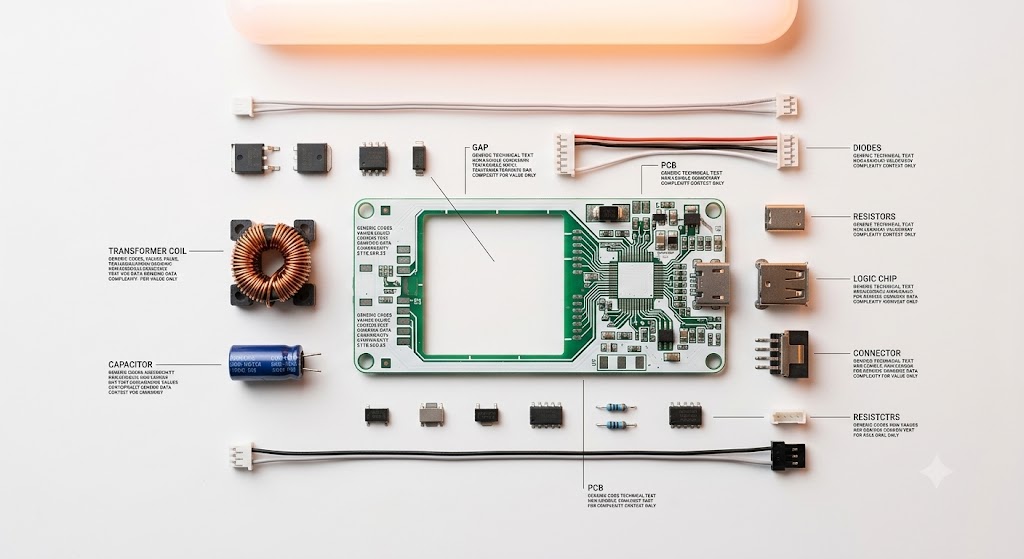
Inside this compact enclosure, four primary components operate in sequence.
First, the rectifier circuit receives the AC power and filters it so that it flows in only one direction. By arranging four diodes in a bridge configuration, it ensures that output flows in a single direction regardless of how current enters. Once it passes this stage, the current moves in the right direction, but its waveform remains rough and undulating.
Next, the capacitor—commonly known as a condenser—smooths out these turbulent waves. By temporarily storing electricity and releasing it steadily, it irons out the bumpy voltage into a nearly flat DC line. When you open up a charger, you often find a cylindrical component inside; it is usually handling this exact task.
Then comes the core component: the transformer, which steps down the magnitude of the voltage itself. It works on the principle of wrapping wire into two separate coils, using the magnetic field generated by current changes in one coil to induce a lower voltage in the other. For this transformation to occur efficiently, however, the direction of the current must alternate at extremely high speeds—tens of thousands to hundreds of thousands of times per second. This is why a switching transistor sits right ahead of it. By rapidly toggling the current on and off, it creates the optimal working conditions for the transformer.
These four components—rectifier circuit, capacitor, transformer, and switching transistor—function as a single cohesive unit. Their collective job is to tame raw, high-voltage AC from the wall into gentle, safe DC that your smartphone can digest.
The Real Reason Chargers Got Smaller
This brings us to why chargers have shrunk so dramatically in recent years. The answer lies in gallium nitride, or GaN—a material widely highlighted in modern advertising. The mechanism connecting GaN to physical size reduction is fascinating.
Traditionally, switching transistors in chargers were made primarily of silicon. Silicon has a bandgap—the energy required to switch between conducting and non-conducting states—of about 1.1 electron volts. In contrast, gallium nitride has a bandgap of 3.4 electron volts, nearly three times larger. To use an analogy: think of a gatekeeper. A silicon gatekeeper hesitates and takes time deciding whether to let electricity pass. A gallium nitride gatekeeper opens and shuts the gate far more rapidly and decisively.
What happens when this switching speed increases? If the switching transistor can turn on and off faster, the transformer can alternate its magnetic field just as rapidly. The more frequently the magnetic field alternates, the smaller the coil needed to transfer the exact same amount of energy. In practice, ramping up switching frequencies from the standard 65 kHz to between 130 and 300 kHz drastically slashes the physical volume of the transformer and its accompanying magnetic components. This fundamental principle is what transformed brick-sized laptop adapters into palm-sized cubes. At equivalent power outputs, GaN achieves approximately 40 percent smaller volume and roughly 30 percent lower heat generation compared to silicon.
Why Can’t They Shrink Away Entirely?
Looking at this progression, one might reasonably expect that future technology could eventually shrink chargers down to the size of a ring. In reality, that will not happen. There is a clear reason why the size of high-performance chargers released over the past two to three years has plateaued: two insurmountable physical barriers prevent further shrinkage, no matter how fast switching speeds become.
The first barrier is thermal dissipation. Cramming 100 or 140 watts of power into a palm-sized, sealed plastic case leaves no room for cooling fans and severely restricts heat dissipation pathways. Pushing components to their absolute physical limits to shave off millimeters might pass initial factory performance tests. Over prolonged everyday use, however, internal capacitors dry out prematurely, and solder joints suffer thermal fatigue. This is why mission-critical enterprise equipment designed to run 24/7 intentionally uses spacious enclosures. Smaller is not unconditionally better.
The second barrier is far less visible, but much more fundamental: safety distance.
Firebreaks Between Buildings, Clearance on Circuit Boards
When designing architectural structures, building codes mandate specific buffer zones or firewalls to prevent flames from jumping between adjacent buildings or individual units. No matter how advanced building materials become or how thin walls can be engineered, this physical separation cannot be eliminated.
The ability to prevent fire does not stem from material performance, but from physical distance itself.
Identical principles govern the interior of a charger. In electrical engineering, these concepts are known as clearance (the shortest distance through air) and creepage (the shortest distance along the surface of an insulation material). International safety standards strictly mandate a minimum physical separation between the primary circuit carrying dangerous high-voltage AC and the secondary circuit connected to user-accessible ports on a smartphone. This distance cannot be shortened, no matter how advanced semiconductors become or how revolutionary new materials are. The ultimate line of defense against stray current—preventing electric shock and fire hazards—is pure, physical distance.
Take apart a charger, and you will notice narrow, elongated gaps on the printed circuit board entirely devoid of components. At first glance, these empty channels might look like unfinished engineering or wasted space. In reality, that empty void is definitive proof of a safe, compliant design. It is not an unoccupied spot waiting to be filled; it is an area that must remain completely empty by design.
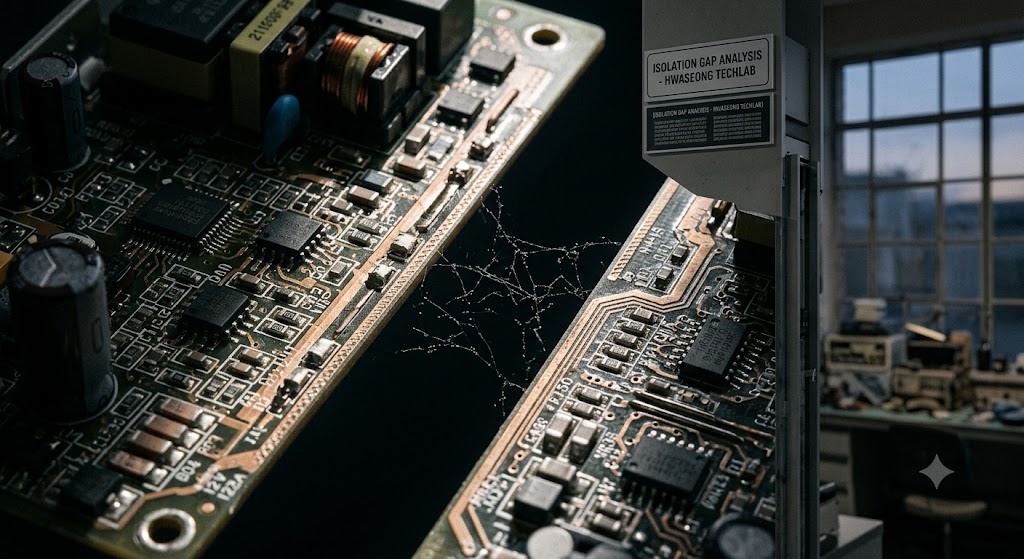
For electronic equipment placed closer to the human body for longer durations, such as medical devices, these distance requirements become even more stringent. While standard communication converters might require a baseline clearance of around 0.7 millimeters, medical equipment in direct contact with patients mandates significantly wider reinforced insulation distances. As operational risk escalates, it is physical distance—not clever circuitry—that must expand.
Furthermore, accelerating switching speeds amplifies electromagnetic interference (EMI). Mitigating this interference requires incorporating choke coils and specialized suppression capacitors, which themselves cannot be scaled down past a certain physical threshold. As the transformer shrinks, these auxiliary filtering components quietly step in to occupy the freed-up board space.
What Truly Shrank Was What We Never Saw
When chargers appear smaller today, it is not because the external shell we see has simply been compressed. Rather, the previously invisible transformers and switching components shrank thanks to material innovation. Meanwhile, the equally invisible safety distances remain fixed by international safety standards, completely unaffected by passing trends.
While consumers perceive that “chargers have gotten smaller,” what really happened is that engineers minimized only the parts that could be reduced, leaving the irreducible safety margins untouched. As those non-negotiable safety distances occupy an increasingly large percentage of the total internal volume, charger dimensions have naturally converged toward an immutable limit.
This lesson extends beyond chargers. We often assume that as technology improves, every limitation will eventually dissolve—that ongoing progress will someday yield unimaginably tiny, weightless, flawless devices. Yet many domains harbor irreducible minimum thresholds that technology cannot—and should not—eliminate. Firebreaks between buildings exist for this reason, as do healthy boundaries between human beings. That empty space is not waste; it is the fundamental prerequisite that keeps everything safe.

The next time you look at a charger—though opening one is certainly not recommended due to shock hazards—keep in mind the silent gaps hidden within its casing. That quiet, unoccupied space is the very reason this small box can operate safely and reliably in the palm of your hand every single day.
References
- Tommox, What is GaN Technology? Explaining the Future of Fast Charging
- TILNOTE, Recommended USB-C Fast Chargers 2026: GaN 65W Comparison
- Belkin Korea, GaN Charging
- OpenWiki, Complete Guide to Choosing GaN Chargers (2026)
- Power Center, Essential Isolation Considerations When Selecting DC/DC Converters
- Anhuang Electric Power Technology, What Are Clearance and Creepage Distances?
- Weidmüller, Clearance and creepage distances
- US Patent 9,049,783, Systems and methods for obtaining large creepage isolation on printed circuit boards
- US Patent 5,010,314, Low-profile planar transformer for use in off-line switching power supplies
- KR100544265B1, AC/DC Converter and Power System Using the Same
- KR100440345B1, Converter for Converting Three-Phase AC to DC
- ROHM TechWeb, AC-DC Basics
- Market Research Future, GaN-Based Power Supply Adapter Market Size, Share, Trends 2032
- PTC, Electrical Clearance and Creepage Analysis Information
- US Patent 12,183,667, Semiconductor package with power electronics carrier having trench spacing adapted for delamination