
On August 20, the Clark County Department of Transportation in Nevada, which oversees Las Vegas, announced its robotaxi fleet allocations. The approved numbers for the next 12 months are 5,000 for Tesla, 1,000 for Uber, and 1,000 for Waymo. A company that had long been forced into a defensive position in the autonomous safety debate has received five times as many permits as its competitor.
At nearly the same time, another number was being quietly updated. Tesla robotaxis, which have been operating in Austin since last August, reported 15 accidents to the NHTSA over four months. When divided by mileage, that is approximately one accident per 57,000 miles. This is one-fourth the rate of the human driver average suggested by Tesla itself—one accident per 229,000 miles. These figures are particularly notable given that the vehicles were operating with safety monitors on board.
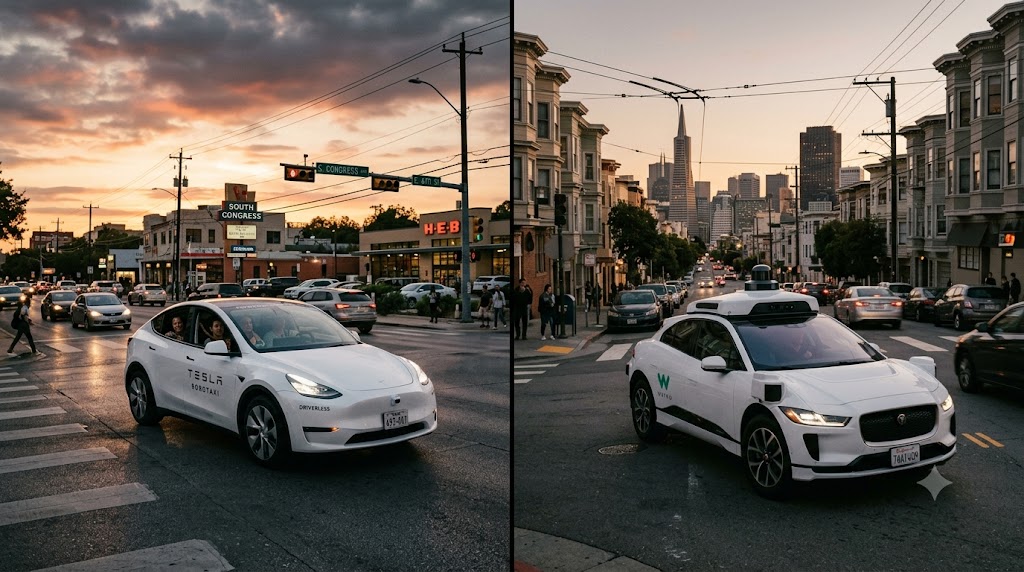
Same company, same month, same question—is this car reliable?—yet the answers are contradictory. Regulators have opened up the floodgates for volume, but road data suggests they are still riskier than humans. To resolve this paradox, we must set aside the familiar debate of LiDAR versus cameras. The divide lies elsewhere.
This isn’t just a story about two Silicon Valley companies. If you live in Austin or Phoenix, you may have already ridden in one, and even if you are in Seoul, the results of this competition will directly impact the autonomous roadmaps and regulatory discussions of domestic automakers within a few years. Whether the Hyundai Motor Group pushes for low-cost, camera/radar-centric autonomy or keeps LiDAR as a default will ultimately depend on which company’s data convinces regulators first. The same applies to how insurance companies assign liability for autonomous accidents. Rather than who wins, how they win will define the road standards for the next decade.
This competition already has a precedent for failure. GM’s Cruise had its license suspended following an accident in San Francisco in 2023 where a pedestrian was dragged, and the company eventually folded its robotaxi business in 2024. The reason for Cruise’s collapse was not just the technology itself, but the fact that the data submitted to regulators after the accident did not match the actual situation. This is why we must carefully scrutinize the accident rates and mileage figures currently being released by Waymo and Tesla. More than the numbers themselves, the transparency with which they are compiled is the condition for preventing the next Cruise.
The Stakes Both Companies Placed
Waymo and Tesla set out to solve the same problem, but their foundations are different. Waymo vehicles are equipped with multiple LiDAR sensors, radars, and over a dozen cameras on their roofs. Before starting service, they map the city’s roads down to the centimeter. Tesla is the opposite; it reads its surroundings using only eight cameras and makes decisions via the same neural network everywhere, without pre-mapping. Elon Musk has long called LiDAR a “crutch,” and last year he reaffirmed the camera-only approach, stating, “Humans don’t drive by shooting lasers out of their eyes.”
This conflict is long-standing. Waymo’s predecessor is Google’s 2009 self-driving project. It was designed from the start to be “perfectly safe on a perfect map,” which meant it took time to reach commercialization. The first paid service didn’t launch until 2020 in Phoenix. Tesla’s Autopilot launched in 2014, but FSD, which claims full autonomy, came much later, based on the premise that “every car sold is training data.” They chose to collect driving data instead of drawing maps. Because their starting points differ, the types of numbers they boast about today are also different.
Both sides have labeled the other. Waymo proponents argued that safety could not be proven with cameras alone, while Tesla supporters countered that the precision-mapping method could never scale. They effectively declared, “This method won’t work,” to one another. Yet, in 2026, both of these declarations began to falter.
The Surveyor and the Scout
This resembles the age-old conflict of two ways to secure unfamiliar territory. One is the surveyor. They measure the terrain precisely before entering a new area, creating a map that records every curve and boundary before they walk it. As long as they have a map, they know exactly what is under their feet. However, they cannot take a single step confidently on unmapped land, and they must re-survey every new area from scratch.
The other is the scout. They enter unfamiliar terrain without a map, making decisions on the spot based only on visible clues. Their strength is that they can be deployed anywhere immediately, but no one knows how often they misjudge new terrain until they actually walk it.
Both approaches face the same question: Is this method scalable across vast lands? Can the surveyor’s mapping speed keep up with the scout’s field judgment, or can the scout’s frequency of error never overcome the surveyor’s precision? This is exactly the question Waymo and Tesla are currently trying to answer in their own ways.
This competitive landscape isn’t limited to just Waymo and Tesla. Amazon’s Zoox is testing custom-designed robotaxis in Las Vegas and San Francisco, and Uber is solidifying its platform strategy of brokering vehicles from multiple companies, receiving 1,000 units in this Nevada approval. However, these two have not yet accumulated as much mileage as Waymo or Tesla. The real-world data for the current safety debate ultimately comes from these two companies.
Two “Impossible” Claims Collapsing
Let’s look at the surveyor’s rebuttal. Waymo’s 5th-generation vehicle cost $100,000 to $125,000 in hardware per unit. This is why it was long criticized for not being able to scale due to the cost of LiDAR. However, the 6th-generation vehicle, Ojai, unveiled this May, reduced the number of cameras from 29 to 13 and cut the number of LiDAR and radar units, bringing hardware costs under $20,000. Even including the production cost of the Zeekr-built chassis, the figure is around $125,000, significantly lower than the previous Jaguar I-PACE-based vehicles.
Map production speed has also changed. Another long-standing criticism of Waymo was that mapping took years per city, but the company finished the transition from test runs to fully driverless operations in two Texas cities in just a few months late last year. This means the “generalized Waymo driver” that has learned once does not need to relearn stop signs or pedestrian concepts in every new city, but only needs to verify unique local intersection structures.
The scout side is faltering from the opposite direction. The first hurdle for the argument that cameras alone can scale was whether they were safe without safety drivers. Tesla began removing safety monitors from customer vehicles in Austin last January, and in July, it launched fully driverless services in Miami without an initial supervised period. It has expanded to six cities across Texas and Florida.
The problem is that safety data is not keeping up with the speed of expansion. Here, we must define “accident.” The NHTSA does not only count collisions where airbags deploy, people are injured, or towing is required. Nearly every collision involving an autonomous system, regardless of the intensity of contact, is reported. Because the threshold is so low, it is highly likely that the 15-case figure includes minor contact. Even so, when converted to a ratio against mileage, the 15 accidents reported in Austin result in one per 57,000 miles. Waymo has disclosed that on a much larger sample—over 127 million miles of fully driverless driving—it has reduced serious injury accidents to less than one-tenth that of human drivers. Placing the two figures side-by-side, the proposition that cameras alone are safer than humans has not yet been proven. Rather, data to the contrary is accumulating.
The nature of the accidents also differs. Recent analyses tracing the causes of accidents show that Waymo was at fault in only 12–15% of all incidents. Most of the others involved being rear-ended by other vehicles while stopped. This means that while the total number of accidents accumulates due to high operation volumes, the system was not the cause. Conversely, while Tesla’s reported numbers are low, the fault rate is higher even under supervised conditions. This suggests that the system still lacks sufficient real-world driving experience.
Why is the fault rate important? Because it determines the direction of insurance and litigation. Being rear-ended while stopped does not significantly impact Waymo’s liability insurance premiums. Conversely, accidents caused by errors in judgment are different. If the company is found at fault every time, premiums pile up, and those costs eventually return as higher fares or slower expansion. Tesla’s low number of reports is a figure to boast about, but it also means the sample size is small. Common criticism among those analyzing this data is that 15 cases in one city over four months is statistically too early to draw conclusions.
Cost savings come with a separate price. The Zeekr, which manufactures Waymo’s 6th-gen chassis, is part of China’s Geely Group, so a 127.5% tariff is applied to the finished vehicle. To avoid this, Waymo brings in empty chassis stripped of Chinese connectivity components and sensors, then installs its own sensors and computers at an Arizona plant. The U.S. Department of Commerce’s connected vehicle regulation, set to take effect in 2027, is another hurdle. They reduced mapping costs, but in exchange, they have placed their supply chain on top of geopolitical risk.
The price of reducing sensors has also not fully emerged. Reducing cameras from 29 to 13 and cutting LiDAR and radar means removing redundant verification paths. Until now, Waymo’s safety record has been built on the premise that “multiple sensors verify the same scene in different ways.” Whether the 6th-gen can maintain the same level of safety with that redundancy thinned out is an answer that will only come after Ojai has run a few million more miles in several cities. The cost-cutting figures are verified, but whether those savings will maintain the same safety record remains to be seen.
Where the Numbers Don’t Point
Looking at this, it seems the match has tilted, but the most important crack lies in a place neither company has faced head-on yet.
Let’s look at Waymo’s growth curve again. The company announced a milestone of 500,000 rides per week this March. Since then, the number of service cities has increased from 10 to 15, but the number of weekly rides has remained stagnant for four months. The weekly rides per vehicle have decreased from 167 last May to 125 recently.
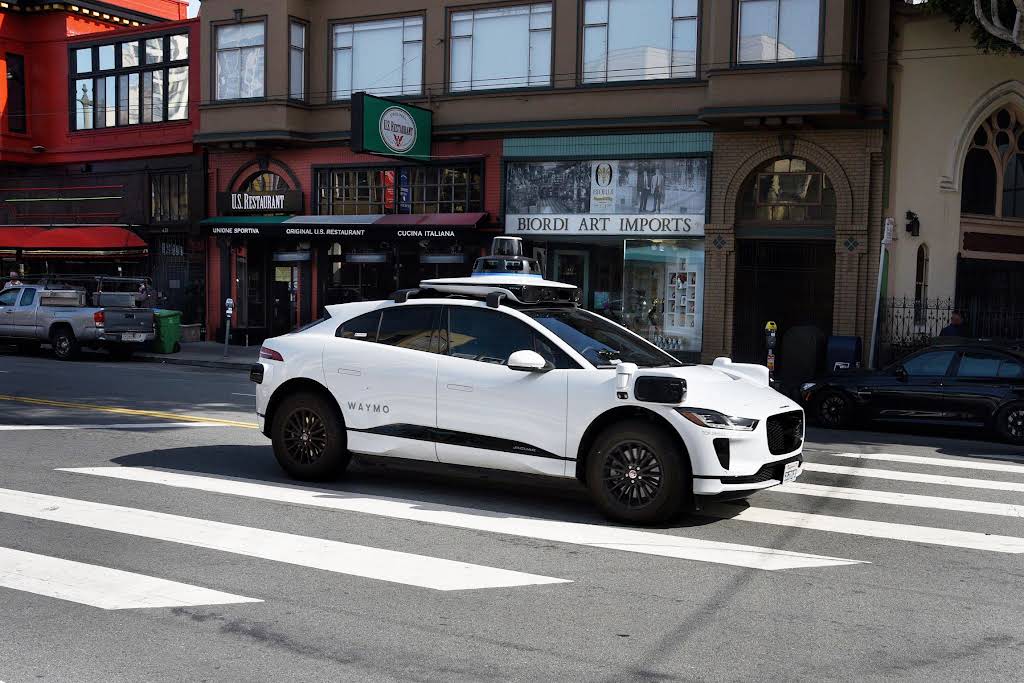
On the evening of July 4th in San Francisco, Waymo vehicles with depleted batteries stopped in the middle of congested roads. Even tow trucks couldn’t get through the blocked streets. This means the speed of increasing cities and the speed of actually carrying people in those cities are different curves.
The crack on the Tesla side is in a different direction. Last summer, Elon Musk said half of the U.S. population would be able to use robotaxis by the end of the year, but the recent goal has been lowered to about 12 states by the end of 2026. The expansion plan for 5 cities scheduled for the first half of this year has also been delayed. There are only about 50 vehicles actually running in Austin, falling short of Waymo’s 250+ in the same city. The 5,000-unit permit received in Nevada is an upper limit, not an actual deployment approval. The speed at which that limit is filled depends on the completion of the yet-to-be-released FSD v15.
The way they lowered the target is also worth noting. Changing from “half the population” to “about 12 states” is not just a numerical adjustment, but a change in the standard itself. Half the population refers to actual availability, but 12 states is just the number of regions where regulatory approval has been granted, without disclosing how many vehicles are actually running there and how often. The gap between the 50 in Austin and the 5,000 in Nevada is the proof. Permits are potential; the number of vehicles on the road is the reality of this moment. Tesla’s announcements often mix these two layers.
In summary: the surveyor’s maps are being drawn faster than expected, but the speed of actually carrying people on those maps cannot keep up with the expansion speed. The scout is keeping the promise that it can go anywhere without a map, but it has not yet proven that its on-the-spot judgments are better than human ones. Both have broken one “impossible” barrier while remaining stuck at another.
Why do they conflict in this way? Because the objects the two companies optimized for from the start are different. Waymo spent over a decade proving that its cars don’t cause accidents in a given city. As a result, its safety data is solid, but its business sense for turning that safety into profitable routes is being learned relatively late. Tesla is a company that has optimized for releasing as many cars in as many cities as possible as quickly as possible for over a decade. It is strong in volume and speed, but it is just now learning how to handle the accident data generated by that speed. The cracks in both companies are not technological limits, but holes punched on the opposite side of what they chose to excel at first.
These cracks are reflected in the stock price. A significant portion of Tesla’s stock price is already seen as reflecting the future value of the robotaxi business. This means the potential for that valuation to shake grows every time an expansion target is lowered. On the other hand, Waymo is just one of Alphabet’s many business units and is not yet required to provide independent profitability metrics. This difference also divides the companies’ attitudes. Tesla is in a position where it must manage market expectations by setting bold goals, while Waymo is in a position where it can set low, quiet goals and speak only through data. This is why the same number is read with different levels of caution depending on where it comes from.
Next Time You Call a Robotaxi
The 5,000 and 1,000 units approved in Las Vegas are not the results of the match, but rather the stakes each has placed on different bets. Regulators have given Tesla a wider playground, but they haven’t exempted them from the homework of proving safety on it. Waymo has planted flags in more cities, but it isn’t even sure yet if those cities are actually profitable routes.
What else is needed for these stakes to turn into a real victory? For Tesla, it’s a sample size. It is difficult to draw conclusions from 15 cases in one city over four months. Data needs to be accumulated over a year across all six cities, at a scale of millions of miles, for a comparison with the human average to be statistically meaningful. For Waymo, it is profitability per route. Safety data has been accumulated with a large sample, but to prove that this safety can be a business that runs on its own without advertising, ride density per city—not the number of cities—must increase again. Both are homework assignments that need more time.
If you happen to open an app and call a robotaxi next time, you might remember that beyond the arrival time and the fare on the screen, this question is at stake: Is that car following a pre-drawn map, or is it making a decision in this very moment on a street it has never seen before? And whichever it is, the data to verify that the judgment is truly better than a human’s has not yet been completed.
References
- TokenPost, 'All 170 trackers driverless, Tesla Austin robotaxi', 2026-08-20
- TradingKey, 'Nevada approves 5,000 robotaxi permits as Musk forecasts Tesla's insane growth', 2026-08-25
- Forbes (Brad Templeton), 'Studying Fault In Robotaxi Crashes; Tesla's Not Getting Hit Enough', 2026-08-05
- Electrek, 'You can now ride a Chinese EV in the US as Waymo opens Zeekr Ojai to all', 2026-08-20
- The Next Web, 'Waymo opens cheaper Ojai robotaxi built by China's Geely', 2026-05-28
- Business Model Analyst, 'Waymo Went From 10 Cities to 15. Its Weekly Ride Count Didn't Move', 2026-08
- Digital Today, 'Tesla robotaxi expansion hits a brake… the real bottleneck hidden behind inconvenience is safety', 2026-05-13
- AI Matters, 'Tesla robotaxi, driverless operations in Miami', 2026-07-07
- Electrek, 'Waymo shuts down can't scale argument with quick test to fully autonomous in Texas', 2025-12-04
- AI Times, 'Waymo adds 4 cities, Tesla in a speed race… US robotaxi competition expands', 2026-07-09
- TechCrunch, 'Waymo's skyrocketing ridership in one chart', 2026-03-27
- Waymo, 'Delivering more for our riders in a year of incredible growth', Waymo Blog, 2025-12-10
- Yahoo Tech, Tesla vs Waymo NHTSA crash rate comparison, 2026
- VaaSBlock, 'Waymo is expanding. Tesla is still just making promises', 2026-07-22
- Contrary Research, 'Deep Dive: Tesla, Waymo, and the Great Sensor Debate', 2025-07-08