
A few days ago, while watching the news, I noticed a strange juxtaposition.
Right next to an article reporting that President Trump had ordered a drastic reduction in ROK-US joint military exercises, another headline appeared claiming he was displeased that South Korea wouldn’t assist the U.S. in the Strait of Hormuz.
The very same person, in the very same week, was showing two completely contradictory faces toward South Korea. One was a gift, and the other was a bill.
Wondering why these two scenes played out simultaneously, I looked a bit deeper. In searching for the answer, I realized that what is unfolding around the Korean Peninsula right now is a far more structural story than it appears.
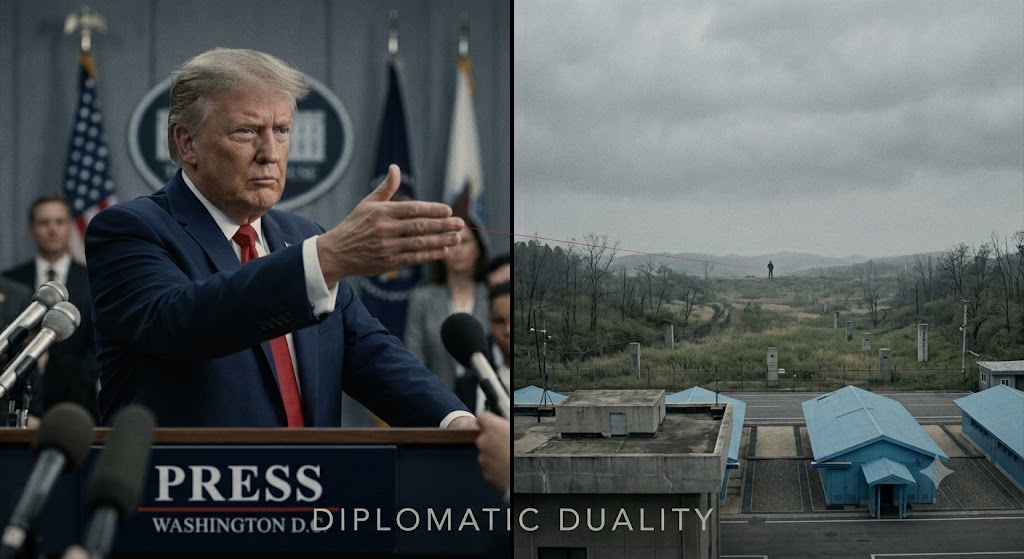
Why Demand Exercise Reductions While Angrily Demanding Help in Hormuz?
On August 17, President Trump posted a message on his social media account.
He stated that he had a very good relationship with Kim Jong Un, and expressed discontent over continuing to participate in the long-scheduled joint military exercises between South Korea and the United States.
He added that since it was too late to cancel them entirely, he had instructed the Secretary of Defense to significantly scale down the exercises.
North Korea had been fiercely protesting the drills, calling them a rehearsal for an invasion, but now the U.S. president himself had stepped forward first to scale them back.
Yet just two days later, the same president spoke in an entirely different tone.
He explicitly stated he was “displeased” that South Korea had refused a request for assistance—specifically, the deployment of naval warships—in the Strait of Hormuz, a waterway through which 60% of South Korea’s crude oil imports pass.
Showing goodwill toward South Korea one day, and acting as if collecting a debt two days later. Viewed separately, these two moments might look like mere whims, but when placed side by side, a different picture emerges.
It is the sight of someone pulling two different levers simultaneously to achieve a single objective.
This underlying objective is what makes things intriguing.
Did President Trump genuinely have a sudden change of heart for the sake of peace on the Korean Peninsula?
Or is a problem that originated somewhere else entirely being resolved by borrowing the stage of the Korean Peninsula?
The Moment My Neighborhood Becomes a Bargaining Chip
There is a clear reason why this question does not feel distant or irrelevant to everyday life.
A reduction in joint exercises is not merely a single line of diplomatic news; for people who receive reserve military training notices each year and experience road closures during that period, it means a tangible change in their daily lives.
The issue of the Strait of Hormuz is no different.
A significant portion of the oil consumed in South Korea passes through that narrow strait. If something happens there, gas prices jump at the pump, heating bills surge, and grocery store price tags shift to reflect rising logistics costs.
This is not just an issue for Washington; it directly affects our household budgets.
More fundamentally, South Korea is a participant in this game, not merely an observer.
A nation where U.S. forces are stationed, citizens live near training ranges, nuclear submarines make port calls, and trade and security are packaged together into single negotiations. When the U.S. and North Korea sit across from each other, a significant portion of the cards placed on that table involve events happening directly on South Korean soil.
Yet, when it comes to the room where decisions are made about how those cards will be played, South Korea is not always invited.
This connects directly to why President Lee Jae-myung described himself as a “pacemaker.”
It means facilitating and assisting Trump’s role as a peacemaker and mediator of peace.
In a marathon, a pacemaker is a runner who sets a predetermined tempo to help the favorite win.
It is a role built on the premise that while you participate in the race, the medal belongs to someone else.
The moment the president used this term, he effectively defined South Korea’s standing.
A Lead Actor with No Exit Sets Up a New Stage
Let’s switch lenses for a moment.
If we re-examine what is happening not in the language of diplomacy and security, but through the language of theater and staging, something different comes into view.
President Trump is currently trapped on a stage with no visible exit: the stage of the Iran war.
Triggered by airstrikes conducted alongside Israel in late February, this war has dragged on for more than half a year, defying initial assurances that it would conclude within weeks.
In its wake, the Strait of Hormuz—through which one-fifth of global oil shipments flow—was blockaded, sending domestic U.S. gasoline prices soaring.
Poll after poll shows around 60 percent of respondents saying the war is not worth the cost, and President Trump’s approval rating has plummeted to 33 percent—the lowest since his return to office.
With the November midterm elections looming, this stage has turned into one that delivers nothing but scathing reviews for its lead actor.
In a play, what does a lead actor do when there is no way to earn applause on their current stage?
They move to a different stage.
A stage that makes the audience focus elsewhere—a stage that can showcase an entirely different finale from before.
North Korea is precisely that kind of stage for Trump.
While in Iran he remains commander-in-chief of an endless war, in North Korea he can act as a dealmaker managing a nuclear crisis through summit diplomacy.
Indeed, on August 19, President Trump brought up a specific figure in front of reporters that he had rarely mentioned before: that North Korea possesses 57 nuclear weapons.
This is being interpreted as a signal that the negotiation focus may shift toward a nuclear freeze or arms control, rather than the original goal of complete denuclearization.
There is another reason why the theatrical metaphor is so fitting.
In stage direction, what matters most is not the actor’s sincerity, but the sequence of scenes presented to the audience.
If a successful scene featuring a mood of reconciliation with North Korea follows a failed war in Iran, the scene that sticks in the memory of the audience—the voters—is likely to be the latter.
A reunion with Kim Jong Un may not be an end in itself, but rather a spectacular Act II designed to overshadow the failed Act I of Iran.
What a Single Approval Rating Number Tells Us
Let’s put this into more tangible terms.
An approval rating of 33 percent sounds like an abstract statistic.
Put differently, it means that only one in three American adults believes the president is doing a good job right now.
Imagine three diners sitting at a restaurant table where two of them complain about the food every single month—that gives a sense of just how desperate a signal this number is for a politician.
The Hormuz blockade is no different.
Rather than saying one-fifth of global oil shipments are blocked, imagining that one out of every five bottles of oil sold daily worldwide fails to be delivered brings home the severity.
The ripple effects show up on price tags at U.S. gas pumps, those price tags register in voters’ choices, and those choices determine the outcome of the November midterms.
The chain reaction of one number translating into another—this is the exact spot where the Trump administration currently stands.
Laying out the duration of the war along a timeline reveals the same narrative.
The war, which began with late February airstrikes, initially kicked off alongside assurances that it would conclude within weeks.
But five months later in July, the approval rating had dropped to 37 percent, and only a third of respondents supported the war.
By August, it sank further to 33 percent.
Rather than vaguely stating that “approval ratings gradually fell,” aligning the timeline with specific figures reveals that this decline is not a random fluctuation, but a steady outcome accumulated as the war dragged on.
The survey finding that 8 out of 10 respondents believe “this war will continue for a long time” suggests this downward trajectory is likely to persist without a rebound.
This Is Not Just Trump’s Story
Yet taking a step further, this does not end simply as a matter of tactics for a single man named Donald Trump.
It reveals itself as the latest edition of a much older pattern.
And that pattern already existed in fully formed fashion within Trump’s own past record.
In June 2018, President Trump held the historic first-ever US-North Korea summit with Chairman Kim Jong Un in Singapore.
The person who actually made that meeting possible was Chung Eui-yong, then National Security Advisor of the Blue House, who directly delivered Chairman Kim’s message to the United States.
It was a structure where South Korea built the bridge, and the U.S. and North Korea shook hands on top of it.
The following February, the two leaders sat down together again in Hanoi, but this time the outcome was different.
Chairman Kim did not agree to the complete dismantling of nuclear facilities, and President Trump walked out of the venue.
It was a total collapse—the so-called “no deal.”
Then-President Moon Jae-in attempted to patch things up by hurriedly arranging a trilateral meeting at Panmunjom, but could not break the underlying deadlock.
Looking back at the role South Korea played in this episode is revealing.
While indispensable as a mediator when making the summit happen, South Korea was also left to clean up the pieces once the talks broke down.
After the main protagonists exited the stage, tidying up the aftermath was always left to South Korea.
Seven years later, the Kim Jong Un that President Trump seeks to meet once again is not the same person as before.
Independent military experts estimate North Korea has already developed around 60 nuclear warheads and secured fissile material sufficient to produce up to 90.
Some even assess that this figure might be an underestimate.
Its backing from Russia and China has also grown far more robust in the interim.
Even if they return to the negotiating table, North Korea is no longer a counterpart Trump can simply walk away from as easily as he did in Hanoi.
Yet the fundamental structure of the stage—where the U.S. and North Korea play the leads while South Korea handles both facilitation and cleanup—shows signs of repeating itself verbatim.
Crafting diplomatic achievements on a relatively manageable external stage to manage domestic public opinion when backed into a political corner at home is a strategy repeated since the Cold War.
And the stages chosen for this purpose have typically been countries where the interests of major powers overlap, yet lack the power to set the rules of negotiation themselves.
The Korean Peninsula has served as such a stage multiple times ever since the signing of the Armistice Agreement.
End-of-war declarations are brought back up during U.S.-China diplomatic standoffs, North Korea policy resets with every change of administration, and inter-Korean relations thaw only to freeze again—a cycle repeating for decades.
What makes current developments novel is not that the method has changed, but the very fact that this repetition is playing out once again without exception.
What we have taken for granted—the premise that Korean Peninsula issues are equal negotiations solved jointly by North and South Korea alongside neighboring powers—is shown once more to be merely rearranged according to the needs of whichever power sets the size and agenda of the table.
The response of the Lee Jae-myung administration operates on a clear recognition of this structural reality.
In his National Liberation Day address on August 15, President Lee departed from the conventional demand for upfront complete denuclearization, proposing instead a multilateral dialogue involving the two Koreas, the U.S., and China to first achieve an end-of-war declaration and a halt to North Korea’s nuclear advancements, using this as a springboard toward a phased peace regime and complete denuclearization.
He deferred the principle of prior denuclearization and reordered the sequence.
Discussions inside and outside the government even suggest pushing for a peace treaty within Trump’s term by 2027.
This is because the peace treaty is viewed as the key to unlocking the prolonged stalemate surrounding the wartime operational control (OPCON) transfer.
The problem is that for this initiative to work, it requires the consent of the actual signatories of the Armistice Agreement: the United States and China.
It is no coincidence that Chinese Foreign Minister Wang Yi’s visit to South Korea occurred at this precise juncture.
It was Wang’s first standalone visit to South Korea in five years, and the timing overlapped precisely with moves to resume US-North Korea dialogue.
National Security Advisor Wi Sung-lac directly explained President Lee’s Liberation Day proposal—a phased approach beginning with halting North Korea’s nuclear advancements rather than demanding immediate complete denuclearization—and requested China’s cooperation.
While Wang responded that China’s policy toward the Korean Peninsula maintains continuity and stability and promised to continue playing a constructive role, he reiterated via Xinhua News that the fundamental solution to peninsula tensions lies in the U.S. abandoning its hostile policy toward North Korea.
In a single visit, he simultaneously delivered words of cooperation and asserted that the root cause of the problem lies with the United States.
At the same time, South Korea finds itself squeezed between U.S. pressure for Hormuz troop deployment and North Korean criticism of its security policies, such as the introduction of nuclear-powered submarines.
Indeed, immediately following Trump’s remarks on scaling down joint exercises, reports emerged that the Blue House moved to defuse tensions by mentioning the possibility of military contributions in the Strait of Hormuz.
This reflects circumstances where the South Korean government sensed a signal that Trump was seeking something in return for exercise reductions and preemptively weighed its options.
Kim Yo-jong, Vice Department Director of the Workers’ Party of Korea, targeted this South Korean stance directly, criticizing it as “two-faced words and deeds that differ inside and out.” While praising relations between the U.S. and North Korean leaders, she lashed out sharply at South Korea aligning its steps with Washington.
In short, South Korea is now in a position where it must simultaneously prove something to the U.S., North Korea, and China, each in a completely different way.
Bills Keep Arriving Even in a Mood of Reconciliation
There is a critical point to address here.
It is easy to mistake President Trump’s conciliatory gestures toward North Korea as a sign that pressure on South Korea is easing.
But what is actually happening is closer to the exact opposite.
The card offering exercise reductions and the card demanding Hormuz troop deployment come from the very same hand—two sides of the same negotiation coin.
Logically speaking, this makes complete sense.
For President Trump to project a conciliatory stance toward North Korea, ally South Korea must shoulder U.S. burdens in other arenas to complete the picture.
The request for military contributions in Hormuz arriving at the same time as exercise reductions is more accurately read as a single itemized bill rather than an accidental coincidence.
From the perspective of a U.S. administration trapped in Iran with no exit strategy, securing allied participation in defending oil transit lanes is one of the few tangible achievements it can showcase at home.
How the South Korean government handles this bill is likely to become a substantial litmus test over the coming months.
If refused, President Trump’s expressions of displeasure will recur; if accepted, South Korea bears the burden of directly stepping into a military conflict with Iran.
Whichever path it chooses, South Korea is already locked into a dynamic where every option carries a steep price tag.
What the Submarine Docked in Busan Does Not Tell Us
Here, there is one scene that speaks even louder precisely because it remained out of frame.
When a U.S. nuclear submarine made a port call in Busan, the White House Indo-Pacific Coordinator announced it directly on site.
Yet there was no clear answer as to whether this move violated existing inter-Korean agreements.
The Ministry of National Defense simply stated it was not a violation. A few hours later, North Korea launched two short-range ballistic missiles off its east coast.
What is missing from this scene?
It is none other than South Korea’s ‘decision-making authority.’
Which port the submarine would enter, how that signal would be interpreted, and what fallout North Korea’s reaction would trigger—while a South Korean port stood at the epicenter of this entire chain reaction, the person who announced its inception was not a South Korean official, but a White House official.
The very absence of what should have been there—that void itself most accurately reflects the position South Korea occupies today.
The narrative surrounding nuclear-powered submarines is hardly new.
South Korea’s acquisition of nuclear-powered submarines has long been discussed under separate agreements in which the U.S. approved the concept and agreed to jointly explore fuel procurement methods.
However, North Korea has pushed back against this plan, characterizing it as a step paving the way for South Korea to become a de facto nuclear-armed state.
In other words, regarding the very same submarine agreement, the U.S. interprets it as strengthening security cooperation, while North Korea views it as an attempt at latent nuclear proliferation.
A single South Korean defense policy exists concurrently within two diametrically opposed narratives, and South Korea caught in between without fully belonging to either was mirrored in the Busan port call scene.
A Pacemaker Cannot Set the Finish Line
Let’s return to the opening question.
The real reason President Trump suddenly reached out to Kim Jong Un: the answer is likely not singular.
The quagmire of the Iran war, plummeting approval ratings, the upcoming midterms, and perhaps an enduring desire for a diplomatic legacy—it is most likely a multi-layered picture.
What is clear, however, is that South Korea’s place in this picture resembles stage props rather than the lead protagonist.
The Lee Jae-myung administration calling itself a pacemaker might be a humble self-assessment, or a realistic strategic choice.
From proposing multilateral dialogue and setting a peace treaty timetable to coordinating with China during Wang Yi’s visit, it is true that South Korea is striving to write its own script.
But a pacemaker holds no authority to designate the finish line.
The finish line is already drawn by someone else; the pacemaker merely runs ahead to pace the race up to that point.
That leaves us with this question:
Is South Korea truly running this race together, or is it merely pacing the tempo to someone else’s finish line?
Let’s return to the scene that prompted this piece: the same president extending a gift and a bill to South Korea in the very same week.
Looking back now, that contradiction was not really a contradiction at all.
It was simply the heads and tails that naturally emerge within a single negotiation.
Yet realizing this fact does not alter South Korea’s vulnerable position.
Facing both the front and back of the negotiation table—that is where South Korea stands today. Depending on how it responds, the next scene we witness on the news may determine whether South Korea takes an equal seat at the table, or is relegated backstage once again as a supporting extra.
References
-
Financial News, “Trump Mentions ‘57 North Korean Nukes’… ‘Will Meet Kim Jong Un Again This Year’” (2026.08.19)
-
Financial News, “Blocked in Iran, Trump Seeks Breakthrough via North Korea… Will a Stronger Kim Jong Un Engage in Dialogue?” (2026.08.18)
-
Weekly Kyunghyang, “‘North Korea Possesses 57 Nukes’ Trump: ‘Displeased with South Korea Refusing Hormuz Support’” (2026.08.20)
-
Kyunghyang Shinmun, “Both North Korea and US Express Dissatisfaction with South Korea… Shaky ‘Pacemaker’” (2026.08.20)
-
Daum News, “Trump Reaches Out to North Korea, Wang Yi Heads to Seoul… Is the Korean Peninsula Dialogue Clock Ticking Faster?” (2026.08.17)
-
MBC News, “Trump Clinging to Kim Jong Un… Why Go This Far?” (2026.08.20)
-
Kyunghyang Shinmun, “President Lee Proposes Multilateral Dialogue for End-of-War Declaration… Starting with ‘Halt on Nuclear Advancements’ Instead of ‘Prior Denuclearization’” (2026.08.16)
-
Kyunghyang Shinmun, “‘Let’s Begin Discussions Among Parties for an End of War’… President Lee Jae-myung Makes First Proposal for ‘Multilateral Consultations’” (2026.08.16)
-
Busan HAPS, “President Lee Jae-myung’s Liberation Day Proposal on North Korea, Korean War End-of-War, and Peace Regime 2026” (2026.08)
-
Newspim, “Trump’s Approval Rating Drops Again to 33%… ‘Lowest Ever’ Across 1st and 2nd Terms” (2026.08.18)
-
Huffington Post Korea, “Trump’s Approval Rating Hits ‘Historic Low’ at 33%, ‘Red Light’ for November Midterms” (2026.08.18)
-
Money Today, “Midterms D-78… Trapped in ‘Iran War Quagmire’, Trump’s Approval Rating Hits Term Low of 33%” (2026.08.18)
-
VOA Korea, “President Lee Jae-myung: ‘President Trump Mentioned It’s Time to Pay Attention to North Korea Issues’” (2026.06.19)
-
Herald Economy, “Trump Now Interested in North Korea’s Kim Jong Un?… Close Aide Analyzes ‘Signals He Is Ready’” (2026.06.24)
-
OhmyNews, “If Asked About the Lee Jae-myung Administration’s Stance on North Korea, Answer Like This” (2025.12.01)
-
Financial News, “Trump Pursues November Meeting with Kim Jong Un… September Meeting with Xi Jinping Serves as Prelude” (2026.08.19)
-
Huffington Post Korea, “Trump Pushes for ‘US-North Korea Summit’ This Autumn: North Korea’s Kim Jong Un Likely Remembers 2019 Hanoi ‘No Deal’” (2026.08.18)
-
Seoul Shinmun, “Meeting Wang Yi, Lee Asks: ‘China, Cooperate for Peace on the Korean Peninsula’” (2026.08.21)
-
Asia Today, “Wang Yi: ‘Will Continue Constructive Role for Peace and Stability on the Korean Peninsula’” (2026.08.20)
-
Digital Times, “‘Blue House Mentions Hormuz “Military Contribution”… Moving to Defuse Pressure Amid Trump’s Drill Cut Demands’” (2026.08.18)