
Who will arrange my funeral when I die, and who will close the accounts on my phone?
The reason aging and death have become a matter for the state is simple.
Families, who once handled care, end-of-life decisions, funerals, and post-mortem arrangements in one continuous line, are no longer capable of shouldering these burdens. Among the 7,171 unclaimed deaths in 2025, three-quarters had surviving relatives.
A report issued in August by the National Assembly Research Service revisits this shift through 53 of its own previous reports. The data points in the same direction.
According to the 2025 Statistics on Causes of Death released on September 22, there were 362,968 deaths that year, with 54.7% of the deceased being 80 or older. More people are dying, and they are dying at an older age.
Aging and Death Were Once Managed Entirely by the Family
The report characterizes the aging and death of the past as private matters handled by individuals and their families. To break it down, the family did quite a lot: they provided care when someone was sick, sat with doctors to decide on life-sustaining treatment when death was near, held the funeral as the chief mourner, and cleaned up personal belongings and settled bank accounts and debts afterward.
The key here is that these four tasks were not separate; they were linked.
Because the same people handled them as a single process, when the family unit shrinks, it isn’t just one area that goes empty—all four parts become vacant simultaneously. The report identifies the causes as changes in family structure, the rise of single-person households, and the weakening of caregiving functions. A household without a daughter to provide care usually lacks a chief mourner to hold a funeral or children to clear out belongings.
The timing also overlaps. By the end of 2024, Korea entered a super-aged society with the population aged 65 and over exceeding 20%. The report predicts that a “society of many deaths” (tasa-sahoe), where the number of deaths surges as the baby boomer generation reaches their 80s starting in the late 2030s, will fully arrive after the 2040s. The term “society of many deaths,” first used in Japan, refers to a society where the elderly population increases, leading to a sharp rise in deaths.
The Evidence: 7,171 Unclaimed Deaths Show Aging and Death Moving Outside the Family
The clearest evidence is death without anyone to conduct a funeral.
The number of unclaimed deaths nearly doubled in four years, from 3,603 in 2021 to 7,171 in 2025. As of 2025, 60.1% were aged 65 or older, up from 51.2% in 2021.
What is noteworthy is the scope of “unclaimed deaths.” It is not just about those with no relatives at all.
According to data reported by Money Today from a lawmaker’s office, 74.9% (5,370 people) of those who died as “unclaimed” in 2025 actually had relatives who refused or avoided claiming the body. Only 18.7% had no relatives, and 6.5% could not be identified. This means that in three out of four cases, the state takes on the funeral not because there is no family, but because the family refuses to take responsibility.
Deaths in solitude are also increasing.
According to Ministry of Health and Welfare surveys, deaths in loneliness rose from 3,661 in 2023 to 3,924 in 2024, reaching 7.7 per 100,000 people. This is not just an issue for the elderly; men in their 60s account for 27.8%, and men in their 50s for 26.2%, making up more than half combined.
The report also admits to its own gaps in this area. Reviewing five years of data, it notes a relative lack of research on preventable deaths, and only one study on suicide, which focused on youth aging out of care. Research on public response systems after a lonely death was also insufficient. It is rare for a parliamentary think tank to openly write, “We didn’t look into this enough,” so I wanted to highlight this point.
53 Reports Bundled Aging and Death into Four Questions
This report is not a new investigation but a “qualitative meta-analysis” of reports issued by the National Assembly Research Service between 2021 and 2025.
It covers 18 reports on aging and 35 on death. Since the agency’s inception, there have been 109 reports on aging and death in total, with nearly half (about 49%) concentrated in the last five years.
Personally, the most interesting aspect was the publication pattern.
Reports on aging were released steadily each year, but reports on death were clustered around events like disasters, major accidents, or high-profile lonely deaths. This suggests that death has long been treated as an “incident” rather than a “structure.” However, in the last five years, the annual number of death-related reports has more than doubled. The report interprets this as death becoming a permanent policy challenge due to the overlap of COVID-19, various national tragedies, and the issue of lonely deaths.
The report organized these 53 scattered documents into four questions, a framework that declares aging and death as a single continuum.
Four questions on aging and death from the National Assembly Research Service report
| Question | Primary Themes |
|---|---|
| How will we age? | Health, care, nursing, medical, aging in place |
| How will we face death? | Refusal of life-sustaining treatment, hospice/palliative care, physician-assisted death |
| How will we prevent death? | Lonely death, unclaimed death, suicide, intimate partner violence, social disasters, workplace fatalities |
| How will we settle affairs? | Funerals, personal effects, inheritance, digital legacy, organ donation, support for the bereaved |
The First Question: Why Can’t We Care for the Super-Aged Alone?
The core of the first question is that the demand for care has become long-term and complex.
In the 2022 Long-term Care Survey cited by the report, long-term care recipients suffer from an average of 3.5 chronic diseases and take an average of 8.3 medications per day. It is overwhelming for a single family member to handle everything from hospital visits to meals. Starting in 2030, the baby boomer generation will enter the “late-old age” phase of 75 and older.
Therefore, reports in this area are scattered across all aspects of life, including nursing costs, home visits, meal support for senior centers, reverse mortgages, and discussions on raising the retirement age to 65. The common direction is “aging in place.” The goal is to receive medical care and support within the community rather than moving to nursing facilities, which requires integrating healthcare with meals, mobility, income, and social relationships.
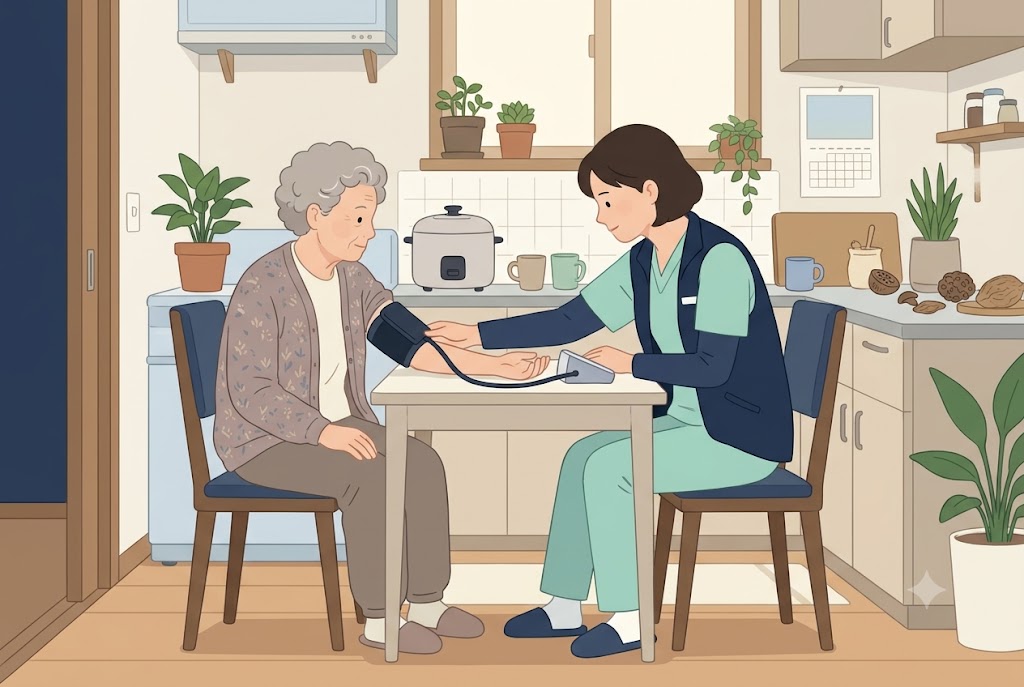
The Second Question: Who Decides on Life-Sustaining Treatment and Home Death?
The gap identified by the report in the second question is clear.
While a significant number of long-term care recipients want to pass away at home, the majority still die in hospitals. The causes cited are the burden of care on the family, practical difficulties during the dying process, and the lack of a support system for home deaths. The wish to die at home ultimately depends on the family’s physical strength and time.
The proposals are concrete: expanding home hospice services, end-of-life care leave for families, establishing end-of-life care fees, and distributing end-of-life management manuals. The report references home death support systems in the UK and Japan.
There is a similar contradiction in the Act on Decisions on Life-Sustaining Treatment. While the law emphasizes the patient’s self-determination, it narrowly recognizes the decision-makers as those in the immediate process of dying, and in practice, the family’s role is significant. The report suggests expanding the scope, strengthening the effectiveness of Advance Directives, and refining the list of designated surrogates. A bill for physician-assisted death, which goes a step further, has also been proposed. Korea allows the withdrawal of life-sustaining treatment for the terminally ill but does not recognize physician-assisted suicide. The report notes that social consensus is still limited but acknowledges the significance of the fact that legislative discussions have begun.
What Happens After: Who Clears Up the Funerals and Digital Legacy?
The fourth question begins with money.
According to the report, a typical three-day funeral costs 15 to 20 million won, whereas a “no-altar” funeral costs around 3 million won. Cremation costs also vary by location. Local residents pay around 100,000 won, but residents in areas without cremation facilities often pay over 1 million won in non-resident fees.
Proposals include expanding cremation facilities, introducing advance funeral directives, and institutionalizing public funeral procedures. This includes procedures that allow non-relatives to hold funerals. Considering the statistics on unclaimed deaths mentioned earlier, it is clear why these procedures are necessary.
The list of things left behind has also changed. While inheritance used to focus on real estate and deposits, digital assets such as online accounts, social media records, electronic documents, cryptocurrency, and digital copyrights are growing rapidly. Settling these involves a complex tangle of inheritance law, tax law, personal information protection, copyright, and platform regulation. The fact that children often cannot close a parent’s account because they do not know the password is already beyond what a family can solve alone.
What Happens When the State Takes Over Aging and Death?
It is not a neat solution just because the state takes over.
The report clearly warns of this. Expanding the public nature of medical and care services threatens fiscal sustainability, and emphasizing the protection of life clashes with the right to self-determination. Strengthening public safety requires restricting some freedoms, and ensuring fair inheritance affects property rights. In all four pairs, choosing one side means the other side loses.
Therefore, the prescription offered by the report is “connection.”
Since senior welfare, medical care, and funeral policies are fragmented by department and law, the goal is to create an integrated legislative framework that connects the entire life cycle, step-by-step, based on social consensus. The government’s move to expand the Presidential Committee on Aging Society and Population Policy into a Population Strategy Committee is cited as an example of this trend.
Looking at the list of future research topics, one can guess what news is to come: “dementia money” (assets managed for dementia patients), adult guardianship and trusts, AI-based early detection of lonely death risk groups, clearing out personal belongings and digital legacies of the unclaimed deceased, digital wills, and physician-assisted death. These are topics that, while unfamiliar now, are highly likely to appear on the agenda of National Assembly standing committees in a few years.
Ultimately, the phrase “it has become the state’s business” is less about the state replacing the family, and more about the fact that we live in an era where the law must decide who can step into the place left by the family. The question of whether a non-blood-related friend can hold my funeral is an issue that, in Korea today, requires the law to clear the path first.
References
- National Assembly Library National Strategy Portal — NARS Legislation & Policy No. 184 List
- Republic of Korea Policy Briefing, 2025 Statistics on Causes of Death Ministry Briefing
- MTN, Last year's deaths 360,000 'highest since COVID'... teen suicides and elderly deaths up, 2026.9.22.
- Financial News, Unclaimed deaths doubled in 4 years... 8 out of 10 are over 60
- Newsis, 'Lonely death' deaths reached 3,924 last year... 8 out of 10 are men, 2025.11.27.