
A friend recently returned from a trip to Osaka and brought back a convenience store bag. Inside was a cup of ramen, and to my surprise, the lid had the word “Samgyetang” (ginseng chicken soup) clearly printed in Korean. It was novel enough to see a Korean-labeled cup noodle in a Japanese convenience store, but what followed was even stranger. I was told that since it isn’t sold in Korea, some people have actually traveled to Japan just to get their hands on it. I couldn’t quite grasp why someone would hop on a plane for a cup of ramen, but after looking into it, I realized this item has been stirring up Korean online communities for months.
What’s the hype about these Samgyetang cup noodles?
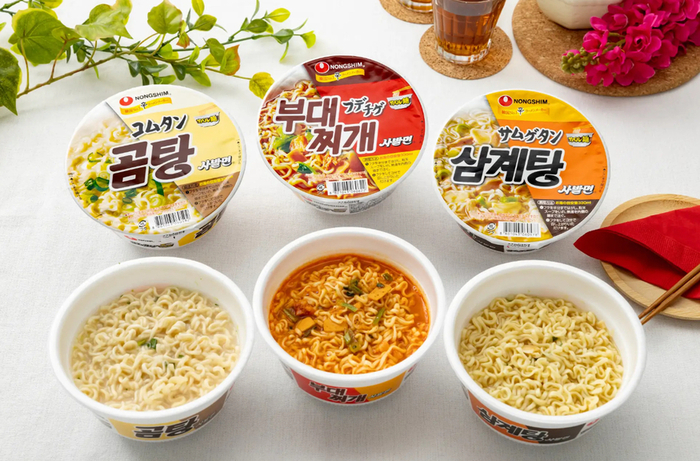
They are a product created by Nongshim Japan. Specifically, the company’s local Japanese subsidiary launched them in early June across all 7-Eleven stores and major supermarkets in Japan, featuring the flavor of chicken broth and ginseng in a cup noodle format. It was released alongside Budae-jjigae and Gomtang (beef bone soup) flavors, but the Samgyetang version stood out and went viral. The local Japanese retail price is between 188 and 192.24 yen, which translates to roughly 1,600 KRW.
Here is the key point: This product has never been officially released in Korea. The only way to buy it domestically is through limited-quantity events occasionally held on Coupang or Nongshim Mall, and even then, the stock sells out within minutes, forcing people to wait for the next event. During periods when there is no supply, the current retail structure sees them being traded on second-hand platforms like Karrot Market at three to five times the original price. It is quite rare for a single cup of ramen to trigger such a shortage.
*## Why Japan, and why a non-spicy flavor?
This is the part I found unexpected. Historically, K-food that ventured overseas primarily competed with spicy flavors. Shin Ramyun established its global presence, and Buldak Ramen swept YouTube, both by leveraging their “spicy” identity. However, the Samgyetang cup noodle went the opposite direction. It completely removed the spice, opting for a ginseng-infused chicken broth—an unfamiliar combination for ramen—to compete.
Digging into news reports reveals this wasn’t accidental. An interview with the researchers from Nongshim’s Soup Development Team 3 and Noodle Development Team reveals that they created over 30 prototypes over 18 months, specifically targeting the palates of Japanese consumers who are sensitive to spice. Japan is known as the home of cup noodles, where consumer standards are notoriously high, so entering the market without the “spicy” weapon was a calculated risk. Ultimately, it worked because the chicken broth base resonated well with Japanese preferences.
There is something else worth noting here. Nongshim has repeatedly stated, “There are no plans for a domestic release in Korea,” and related reports describe the product as a way to “test the popularity and global potential of Korean-style stamina food like Samgyetang in the Japanese market.” In other words, it wasn’t designed for Korean consumers from the start; it was meant to be validated and tested abroad first. With existing options like Ottogi’s Samgyetang or various instant Samgyetang products already in Korea, there might not have been a strong incentive to disrupt the domestic market with their own ramen brand—though this is just speculation, as Nongshim has never officially confirmed this reasoning.
Why is it only released in trickles instead of an official launch?
Interestingly, the reaction in Korea was much hotter than expected. Reports state that when Coupang opened pre-orders for a 6-pack of Samgyetang noodles for 6,980 KRW on the 6th, it sold out in a day, and when Nongshim Mall released 1,000 sets (including 6 Samgyetang, 6 Yukgaejang, and 4 fried chicken legs for 24,200 KRW) on the 12th, they vanished in 10 minutes. People even engaged in “open-runs,” setting notifications and logging in at the exact second of release—an extreme level of demand for a mere cup of ramen.
What’s interesting is what happens next. You would think they would move to a full-scale launch after confirming domestic interest, but Nongshim continues to repeat limited sales. Personally, this looks similar to the pattern of overseas-exclusive Starbucks merchandise or Japanese-exclusive Pocari Sweat editions becoming a topic of conversation in Korea. It’s as if the scarcity itself is a marketing asset. Once it hits regular distribution channels, it becomes just another common cup noodle on a convenience store shelf, but by keeping it as a sporadic limited event, they can generate fresh “open-runs” and buzz every time. If an official launch is the path to maximizing revenue, this current method is the path to maximizing attention—which one is more profitable for Nongshim is hard for me to judge.
Why is a 1,500 KRW item selling for a 5x premium?
I crunched the numbers myself. The local Japanese price is 188–192.24 yen. Given that the KRW/JPY exchange rate fell to the 860 KRW per 100 yen range by the end of August (a period of significant yen weakness), the cost is around 1,600 KRW per unit. Since the domestic limited sale price was around 1,163 KRW for pre-orders and 1,497 KRW for subsequent releases, it’s not exactly cheaper to bring it in from Japan. In fact, in KRW terms, it’s slightly lower.
However, back when there was no domestic official release, it was trading on second-hand platforms for 7,000–8,000 KRW each—about five times the original price. After the two domestic limited releases, the premium dropped to around 4,000–5,000 KRW, but it still maintains three to four times the original price. This premium doesn’t come from costs, tariffs, or distribution fees. No matter how generously you estimate currency exchange or logistics, there’s no reason for a cup of ramen to be marked up 5x. The scarcity—the idea that “if I don’t buy it now, who knows when the next chance will be”—has essentially become the price itself.
What is the goal of the ‘Taste of Korea’ series, which includes the Gomtang and Budae-jjigae noodles?
It’s also worth noting that Samgyetang wasn’t released alone; Gomtang and Budae-jjigae were launched simultaneously. As I felt in my previous analysis of the Japanese labor market, corporate strategies targeting the Japanese market often have different surface and underlying calculations. All three are familiar soup-based dishes for Koreans, but the common thread is that none of them are spicy. This differs from previous export strategies that relied on the heat of Yukgaejang or Shin Ramyun. Perhaps since the spicy line is already established in Japan, this is an attempt to test the mild-flavored Korean line. The consensus in related articles is that the Gomtang and Budae-jjigae versions didn’t generate as much buzz as the Samgyetang, likely because the latter carries a stronger cultural context of being a “stamina food,” which makes for better social media content.
Does it actually taste like real Samgyetang?
I haven’t tried it myself, so I’m cautious about making a definitive judgment. However, reviews following the domestic limited releases consistently say, “It smells like Samgyetang from the start,” “The noodles are slightly thicker than existing cup noodles,” and “It’s better to eat it with rice in the soup.” Since everyone compares it to the Yukgaejang cup noodle, the difference in noodle thickness seems to be a noticeable point, and it seems the ginseng scent is a love-it-or-hate-it feature. YouTuber tasting videos generally lean toward positive reviews, but since these are mostly from people who managed to get them quickly during the limited sales, it’s hard to generalize.
When is the next ‘open-run’?
Given that the two limited sales ended in an instant, it seems highly likely that Nongshim will continue this pattern for the time being. Their stance that there are no plans for an official release remains unchanged. Personally, I’m not sure if this is a sustainable long-term strategy. Making buzz through scarcity only works so many times; if it repeats, consumers might start feeling fatigued. On the other hand, seeing it sell out successfully every time, there seems to be no immediate incentive for Nongshim to switch to full-scale distribution. We will have to wait and see when the next restock notification pops up and if it sells out in minutes again. This type of distribution distortion caused by open-runs isn’t unique to ramen; it connects to the inventory and supply control issues I discussed in my article on the logistics competition between Naver and Coupang.
References
- https://v.daum.net/v/QSr7EZZvC3
- https://v.daum.net/v/20260820104128894
- https://www.wikitree.co.kr/articles/1142707
- https://www.radioseoul1650.com/archives/144167
- https://www.theguru.co.kr/news/article.html?no=102531
- https://namu.wiki/w/%EB%86%8D%EC%8B%AC%20%EC%9C%A1%EA%B0%9C%EC%9E%A5
- https://namu.wiki/w/%EC%8B%A0%EB%9D%BC%EB%A9%B4
- https://ko.tradingeconomics.com/japan/currency
- https://kr.investing.com/currencies/jpy-krw
- https://www.reviewtimes.co.kr/news/articleView.html?idxno=12399