
Overseas buyers are pressuring suppliers, stating, “If you don’t meet RE100, we will stop sourcing your parts.” Yet, in the domestic electricity market, there is a severe shortage of renewable energy available for purchase.
If companies rely solely on the Carbon-Free Energy (CFE) initiative pushed by the government, they risk being permanently ousted from the global supply chain. How can we navigate this precarious reality?
While South Korea ranks fourth in the world by the number of participating companies, the actual domestic renewable energy implementation rate remains stuck at just 9%. We examine this contradictory reality, the clash between nuclear and renewable energy in the era of AI-driven power surges, and a concrete practical playbook for our export manufacturers.
1. The Essence and Core Rules of RE100: Why ‘Additionality’ Matters
RE100 (Renewable Energy 100%) is a private, voluntary global campaign launched in 2014 by The Climate Group, a multinational non-profit, and the CDP (Carbon Disclosure Project)[cite: 1].
Many mistakenly view RE100 as a simple environmental movement or a government regulation, but its essence is a bottom-up market restructuring movement that leverages the immense buying power of global conglomerates to change the supply structure of the global energy market[cite: 1].

The 3 Core Principles of RE100
- Target Deadline: 100% of electricity must be sourced from renewable energy (wind, solar, hydro, geothermal, biomass, etc.) by 2050 at the latest[cite: 1]. Intermediate milestones of 60% by 2030 and 90% by 2040 are recommended[cite: 1].
- Strict Disclosure Obligation: Companies must transparently report their electricity consumption and procurement methods annually via the CDP[cite: 1].
- Principle of Additionality: According to the new technical criteria applied since 2024, only renewable energy produced by power plants that have been in commercial operation for less than 15 years is recognized[cite: 1]. This blocks the use of power from existing, aging plants or simple certificate purchases, requiring proof that “the company’s purchasing action directly led to the construction of new clean power plants on Earth.”
2. The Blade of the Global Supply Chain: “No Renewable Energy, No Contract”
While RE100 used to be just a marketing phrase in sustainability reports, it has now become the most brutal non-tariff trade barrier on the export front.
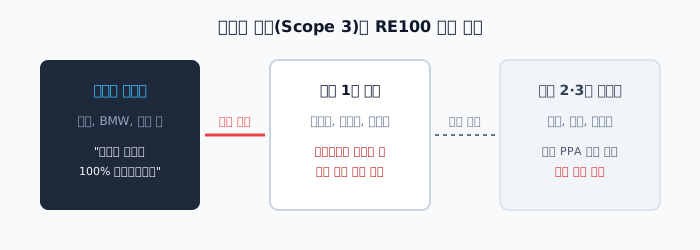
The Ultimatum from Apple and Global Automakers
After achieving 100% renewable energy transition for its headquarters and directly operated facilities, Apple has launched a ‘Supplier Clean Energy Program’ across its entire supply chain. It has declared that by 2030, all electricity used by suppliers manufacturing Apple products must be 100% carbon neutral. Major domestic parts suppliers like Samsung Electronics and SK Hynix face direct hits—such as being dropped as vendors—if they fail to meet these standards.
European automakers are even more direct. BMW, Volkswagen, and others are officially demanding RE100 implementation plans from their domestic battery and chassis parts suppliers. There have already been reports of domestic suppliers losing massive European contracts because they could not provide RE100 commitment letters in time.
The Critical Difference Between Taiwan’s TSMC and Korea’s Semiconductor Industry: Integration with National Infrastructure
Taiwan’s TSMC, the world’s leading foundry, has moved its RE100 target date forward by 10 years, from 2050 to 2040.
As the Taiwanese government developed large-scale offshore wind farms, it built a national-level, large-scale Power Purchase Agreement (PPA) pipeline to deliver that electricity directly to semiconductor industrial parks. This clearly demonstrates that for energy-intensive industries like semiconductors, achieving RE100 is impossible through individual corporate spending alone; it requires national-level expansion of transmission/distribution grids and land-use policies to move as one team.
3. The Ugly Truth of Korea’s 9% RE100 Implementation: Three Structural Barriers
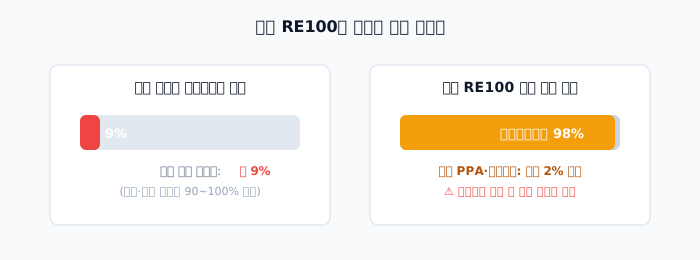
Although South Korea ranks fourth in the number of companies participating in RE100, the actual renewable energy implementation rate at domestic sites remains at a meager 9%.
| Company | Total Company Implementation Rate (%) | Domestic Site Implementation Rate (%) | Overseas Site Implementation Rate (%) |
|---|---|---|---|
| Samsung Electronics | 31.4% | 24.8% (DS Semiconductor) | 93.4% (DX Finished Goods) |
| SK Hynix | 30.0% | 30.0% | 100.0% (All overseas sites) |
| LG Energy Solution | 56.0% | Undisclosed (Low) | Near 100% in US/EU subsidiaries |
| LG Innotek | 61.0% | Undisclosed (Low) | High proportion in Vietnam, etc. |
※ Source: Each company’s latest sustainability report and disclosure materials
3 Structural Barriers
- Absolute Supply Shortage: South Korea’s share of renewable energy generation is among the lowest in the OECD. Due to mountainous terrain and complex local government separation distance regulations, the expansion of new facilities is severely delayed.
- High Procurement Premiums: Due to the supply shortage, the unit cost of domestic renewable energy is significantly higher than that of existing fossil fuel generation.
- Monopolistic Power Market and Excessive Incidental Costs: In a structure where KEPCO monopolizes the power grid and retail distribution, grid usage fees and levies imposed on direct PPAs are so high that trading remains inactive.
4. Pros and Cons of 4 Procurement Methods: The ‘Green Premium’ Time Bomb (98%)
There are 4 procurement methods currently allowed under the domestic K-RE100 system, but actual procurement is overwhelmingly skewed toward ‘Green Premiums,’ which are little more than paper receipts.
| Implementation Method | Method and Features | Additionality (Contribution to capacity expansion) | Greenwashing Risk | Domestic Procurement Share |
|---|---|---|---|---|
| Self-Generation | Installing solar panels on factory roofs, etc. | Very High | None | Less than 1% |
| PPA | Long-term (10-20 years) direct electricity trading with renewable energy producers | High | Very Low | Around 1% |
| REC Purchase | Buying renewable energy certificates from generators | Medium-Low | Medium | Approx. 1% |
| Green Premium | Paying a surcharge on KEPCO bills and receiving a certificate | None | Very High | Approx. 98% |
The KFTC Complaint Against POSCO/SK Group and Greenwashing Risks
Green premiums, which account for 98% of domestic RE100 procurement, do not lead to the construction of new power plants and are therefore not recognized as greenhouse gas reduction achievements on the international stage.
In 2024-2025, the incident where climate groups formally filed a complaint with the Korea Fair Trade Commission (KFTC), calling the Green Premium promotion by POSCO and SK Group “greenwashing that deceives consumers,” clearly shows that expedient procurement has now become a critical legal and financial risk.
5. AI Data Center Power Surge and Big Tech’s Return to Nuclear
In the mid-2020s, the explosive expansion of generative AI completely shook the prerequisites of RE100.
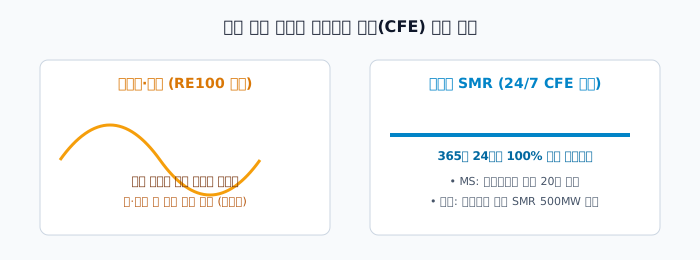
- Demand for 24/7 Firm Power: According to the IEA, data center electricity consumption will surpass 1,000 TWh (the size of Japan’s total electricity consumption) by 2026. Solar and wind power, which fluctuate with the weather, cannot support AI data centers that cannot stop for even a single second.
- Big Tech’s Nuclear PPA Rush: Google signed a 500MW contract for next-generation SMRs (Small Modular Reactors), and Microsoft decided to restart Three Mile Island Unit 1 under a 20-year contract. Amazon and Meta have also successfully closed large-scale nuclear-based PPAs.
6. RE100 vs. CFE: Comparing Key Issues That Will Determine Corporate Survival
Amidst this shift in the power paradigm, the South Korean government is pushing the Carbon-Free Energy (CFE) Initiative, which includes nuclear power, as an alternative[cite: 1].
| Comparison Item | RE100 (Renewable Energy 100%) | CFE (Carbon Free Energy) |
|---|---|---|
| Promoter | UK Climate Group, CDP (Global NGO) | UN Energy Compact, Korea CF Alliance, various governments |
| Recognized Sources | Renewable energy only (Solar, Wind, etc.) | All carbon-free sources (Nuclear, Hydrogen, CCUS, etc.) |
| Time Matching | Annual total offset recognized | Hourly (24/7) real-time matching |
| Nuclear Recognition | Absolutely not allowed (completely excluded)[cite: 1] | Officially recognized as a core baseload source |
| Global Standing | Essential requirement for Apple, BMW, and other global buyers | Expanding around Google and other AI Big Tech/grid operators |
| Korean Corporate Reality | Extremely difficult due to lack of domestic renewables | Easier to implement, but risk that buyers won’t accept it |
The Buyer’s Leverage: “Relying Only on the Government Will Cut Off Your Supply Lines”
No matter how much the government promotes CFE, as long as global customers who pay for parts explicitly state, “We only recognize RE100,” suppliers have no choice but to follow RE100. Settling for CFE alone is suicidal; companies must prepare under the assumption of a multi-standard system where both criteria coexist.
7. Action Plan for Korean Exporters and Policy Authorities
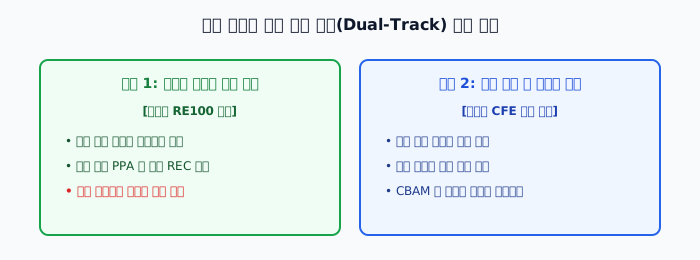
[4 Things Corporate Staff Must Execute Immediately]
- Dual-Track Allocation Strategy: Dedicate on-site rooftop solar and direct PPA power to supply lines for buyers demanding RE100, while flexibly utilizing CFE-based power for domestic needs and greenhouse gas emission credit responses.
- Phased Phase-out of Green Premiums: Reduce the proportion of Green Premiums and gradually increase actual REC purchases or small-scale PPAs.
- Promote Aggregated PPAs for SME Suppliers: If individual company contracts are difficult, SMEs in the same industrial complex can bundle their demand to sign group long-term PPAs with large power producers.
- Proactive Communication with Global Buyers: Share domestic power grid conditions and step-by-step transition roadmaps in advance to defend against sudden contract cancellations.
[4 Things the Government and Power Authorities Must Resolve Immediately]
- Reduce PPA Grid Usage Fees and Incidental Costs: Temporarily reduce high grid usage fees to lower the barriers to entry for PPA.
- Standardize Local Government Separation Distance Regulations: Unify disparate regulations to resolve bottlenecks in solar and wind power permitting.
- Legislate Green Premium Revenue for Facility Investment: Redesign the system so that premium payments are invested directly into funds for new power plant construction.
- Link CFE to International Trade Certification: Collaborate with the EU’s Carbon Border Adjustment Mechanism (CBAM) and international organizations to lead the mutual recognition of CFE achievements.
8. FAQ
Q1. Are Green Premium purchases not recognized as reductions for the Emissions Trading Scheme?
Correct, they are not recognized. Green Premiums are only for issuing usage confirmation certificates and are not counted as greenhouse gas reduction achievements under the Ministry of Environment’s Emissions Trading Scheme.
Q2. Why is nuclear energy excluded from RE100 even though it is eco-friendly and carbon-free?
RE100 organizing bodies maintain the principle of not recognizing nuclear power as “renewable” energy due to reasons such as radioactive waste disposal, safety risks, and impact on marine ecosystems.
Q3. Do domestic SMEs with a low proportion of exports need to prepare as well?
Even if you do not export directly, you cannot avoid this if you are part of a large corporate supply chain. As global conglomerates force Scope 3 (overall supply chain emissions) reductions on primary and secondary suppliers, the demand for RE100 results is also intensifying for domestic SMEs.
Recommended Reading
- 40% of AI Data Center Power is Used for Cooling, Not Calculation: The Economics of CXL and Heat Generation[cite: 1]
- Everything About Next-Gen SMRs and the Nuclear Renaissance Led by Big Tech[cite: 1]
- From Patagonia to Samsung Electronics, the Great Global Adventure of Carbon Neutrality[cite: 1]
- Microgrids via RE100 and VPP[cite: 1]
References
- RE100 Overview - Korea Energy Agency K-RE100
- Transition to Renewable Energy: Global RE100 Status and Insights - UN Global Compact
- RE100 Status and Renewable Energy Procurement Trend Analysis - Korea Energy Agency
- International RE100 Trends and Short-term Outlook - Korea Energy Economics Institute
- Starting with SME Supply Chain Management Law Compliance - ZDNet Korea
- RE100, Did Samsung and Apple Start It Too? Meaning, Status, Participation Method - Haezoom
- RE100 Raid from Europe... Korean Parts Suppliers Cornered by Green Protectionism - Korea Economic Daily
- TSMC is Getting Further Ahead of Samsung - Hankook Ilbo
- TSMC Factory Next to Solar and Wind Power... Taiwan Semiconductor's RE100 Confidence - Hankyoreh
- SK Hynix Sustainability Report 2024 - KRX KIND
- RE100 Response Status and Tasks for Manufacturing Exporters - Korea Energy Agency
- POSCO/SK Green Premium Greenwashing KFTC Complaint Incident - Hankyoreh
- Research Report on PPA System Improvement Directions - Solutions for Our Climate
- RE100 Response Status and Tasks for Manufacturing Exporters - Korea International Trade Association (KITA)
- Electricity 2024: Executive Summary - IEA
- Google, Kairos Power ink 500-MW advanced nuclear reactor deal - Utility Dive
- Amazon, Google, Meta and Microsoft go nuclear - Trellis