

On the morning of November 18, 2025, the air in Mountain View, San Francisco, was no different than usual, but the world’s internet servers were screaming from an invisible overload.
This was the ‘Day 1’ when Google abruptly unveiled its next-generation artificial intelligence model, ‘Gemini 3,’ and integrated it into the heart of Google Search.
Imagine waking up this morning, habitually turning on your smartphone, and typing this into the search bar:
_“Recommend a nearby camping site for a family of four this weekend, with a swimming pool and available for booking now.”
Recall just two years ago, in 2023.
Your thumbs would have been quite busy. You’d scroll past ‘power link’ ads dominating the top search results, click on about ten blog posts, and repeatedly hit the back button.
We’ve all likely experienced the frustration of finally finding a great campsite website, clicking the reservation button, only to see a “Fully Booked” pop-up.
This was the era of the familiar ‘Ten Blue Links’.
But today, Google with Gemini 3 is different. The moment you hit search, instead of a list of links, a single, complete sentence appears on your screen:
“A Campsite in Gapyeong and B Glamping in Pocheon meet your criteria and are currently available for booking.
A Campsite is more suitable for children due to its heated pool.
Shall we book the 4-person site at A Campsite now for 150,000 KRW?”
The links are gone. There’s no need to visit websites anymore.
Google has read, digested, and judged the web to simply ‘serve’ you the ‘result’.
Behind this overwhelming convenience lies a chilling question:
“If I don’t click, how will that campsite owner, and the blogger who posted the information, survive?”
We stand at a major turning point in internet history, transitioning from an era of ‘Information Retrieval’ to an era of ‘Action Delegation’.
In this article, we will explore why Google chose the self-sacrificing ‘Zero Click’ strategy and how it connects to the US-China tech rivalry, ultimately leading to the conquest of the real world populated by robots.
1. The End of Search and the Birth of the ‘Zero-Click’ Empire
From Librarian to Tutor
The web, as envisioned by Tim Berners-Lee, the father of the internet, was a spiderweb of interconnected documents linked by hyperlinks. For the past 25 years, Google has been the diligent ‘Librarian’ of this vast library.
“Related books are on the second shelf of the third bookcase.” Google’s mission was to ‘Refer’ users to the most accurate website as quickly as possible.
But in 2025, Google resigned. Instead, it decided to become an ‘omniscient personal tutor’.
This tutor has already read and memorized every book in the library.
When a student asks a question, the tutor doesn’t just find a book; they summarize its content and provide the ‘answer’.
If the teacher gives all the answers, why would any student bother to pull out dusty books from the corners of the library (websites)?
Cutting Off the Oxygen Supply to the Content Ecosystem: Zero-Click

According to the second half of 2025 reports from data analytics firms, over 60% of Google searches end in ‘Zero Click’. Users ask questions within Google, get answers within Google, and even complete purchases within Google. From Google’s perspective, it has completed its ‘Walled Garden,’ confining users within its own platform.
However, this is disastrous for website operators and content creators, as traffic directly translates to advertising revenue and sales. If Google pre-emptively provides answers, users won’t visit, eliminating the incentive to create content. This is known as the ‘Publisher’s Dilemma’.
If you don’t provide information to Google? You are completely excluded from search results and disappear. If you provide information to Google? The AI learns your information, provides direct answers to users, and no one visits your site.
Innovator’s Dilemma: Why Did Google Destroy Its Own Business?
This was an enormous gamble for Google’s executives. Over 70% of Google’s revenue still comes from search advertising. Users need to click through links for advertising opportunities to arise; if AI provides instant answers, ad exposure opportunities vanish. In business terms, this is a classic case of ‘Cannibalization’.
So why did Google choose this path? Because ‘barbarians’ like OpenAI and Perplexity were at the gates. As competitors attacked with the weapon of “clean, ad-free answers,”
Google made the choice to slaughter its own goose that laid the golden eggs (the existing search ad model).
And from within that slaughtered goose, it birthed a new monster – ‘Hybrid Monetization’ – a model that subtly weaves in ‘actual transaction fees’ and ‘shopping graphs’ into AI answers, rather than simple ad clicks.
3. Agentic Web: Machines That Act on Your Behalf Online
Gemini 3: A Brain Made of Silicon
The Gemini 3 unveiled in November 2025 is not just another Large Language Model (LLM). Demis Hassabis of Google DeepMind defines it as “intelligence capable of reasoning and planning.” While previous AIs were like “parrots probabilistically predicting the next word,” Gemini 3 is closer to a researcher who designs steps to solve complex problems.
Mathematical Reasoning: It achieved a remarkable score of 23.4% on the MathArena Apex benchmark, outperforming other models. Long-horizon planning: In tests like ‘Vending-Bench 2,’ the AI demonstrated the ability to remember hundreds of steps in a task process and self-correct when errors occurred, successfully completing the objective.
From “Search For Me” to “Do It For Me”
This capability revolutionizes the paradigm of the web. This is the beginning of the ‘Agentic Web’.
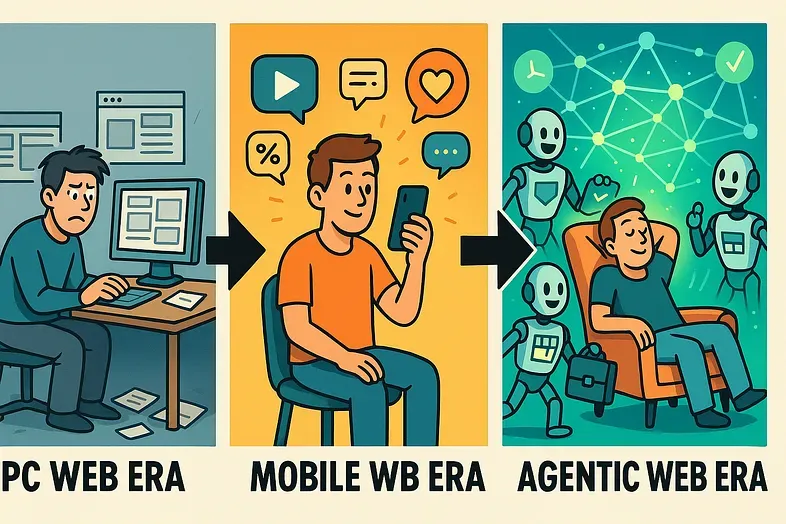
Past: “Find me a flight to Tokyo” → Click Skyscanner link → User compares prices and pays. Gemini 3: “Check my schedule, plan my business trip to Tokyo next month, and book the cheapest flight and my preferred hotel. Pay with the corporate card.” → AI checks schedule, compares flights, searches hotels, fills out booking forms, and completes payment.
Google is no longer a ‘Window’ displaying information; it has become an ‘Agent’ that manipulates the complex machinery of the internet on your behalf.
In this process, websites are forced to offer their data in a format (API) that Google AI can easily read,
and they face the threat of becoming subcontractors paid commissions by Google AI for driving purchases.
3. The Court’s Shield and Sword, and the ‘China Card’ (Geopolitics)
In September 2025, a ruling in a US federal antitrust lawsuit against Google captured global tech industry attention. The court declared Google a ‘monopolistic enterprise.’ However, the worst-case scenarios many anticipated, such as ‘forced divestiture of Chrome’ or ‘spinning off Android,’ did not materialize. Why?
The ‘Invisible Hand’ That Saved Google
Beyond legal judgment, ‘National Security’ arguments were at play. The US Department of Justice (DOJ) wanted to rein in Google, but national security strategists in the Pentagon and the White House had a different perspective.
China is challenging for AI supremacy with Alibaba, Tencent, and Huawei. Particularly with China’s AI model DeepSeek fiercely competing, dismantling America’s ’national champion AI company,’ Google, was seen as strategic suicide.
Google relentlessly exploited this point during the trial.
“If you break us up, the vacuum won’t be filled by American startups, but by China’s Baidu and TikTok.”
Ultimately, Google’s massive AI infrastructure (TPU centers) and data were recognized as a ‘Strategic Asset’ for the United States, allowing the company to avoid the worst-case scenario of being broken up.
The Paradox of the Data Sharing Order: A Poisoned Chalice
Instead, the court ordered ‘Mandatory Data Sharing’ from Google.

This means Google’s click data and query logs, accumulated exclusively over more than a decade, would be accessible to competitors.
On the surface, this seems beneficial for competitors. However, it could be a ‘poisoned chalice’.
Raw Materials vs. Factory: Google possesses the world’s largest factory (TPU clusters and Gemini models) capable of converting data into ‘knowledge.’ Even if competitors receive the raw materials (data), the gap won’t close without the factory to process it. Absolution: Google gains justification to pursue more aggressive strategies by claiming, “We have legally disclosed the data, so we are no longer a monopoly.” In essence, the regulation, rather than restricting Google, has lifted the shackles that bound it.
4. AI Breaks Through the Screen and Conquers the Physical World
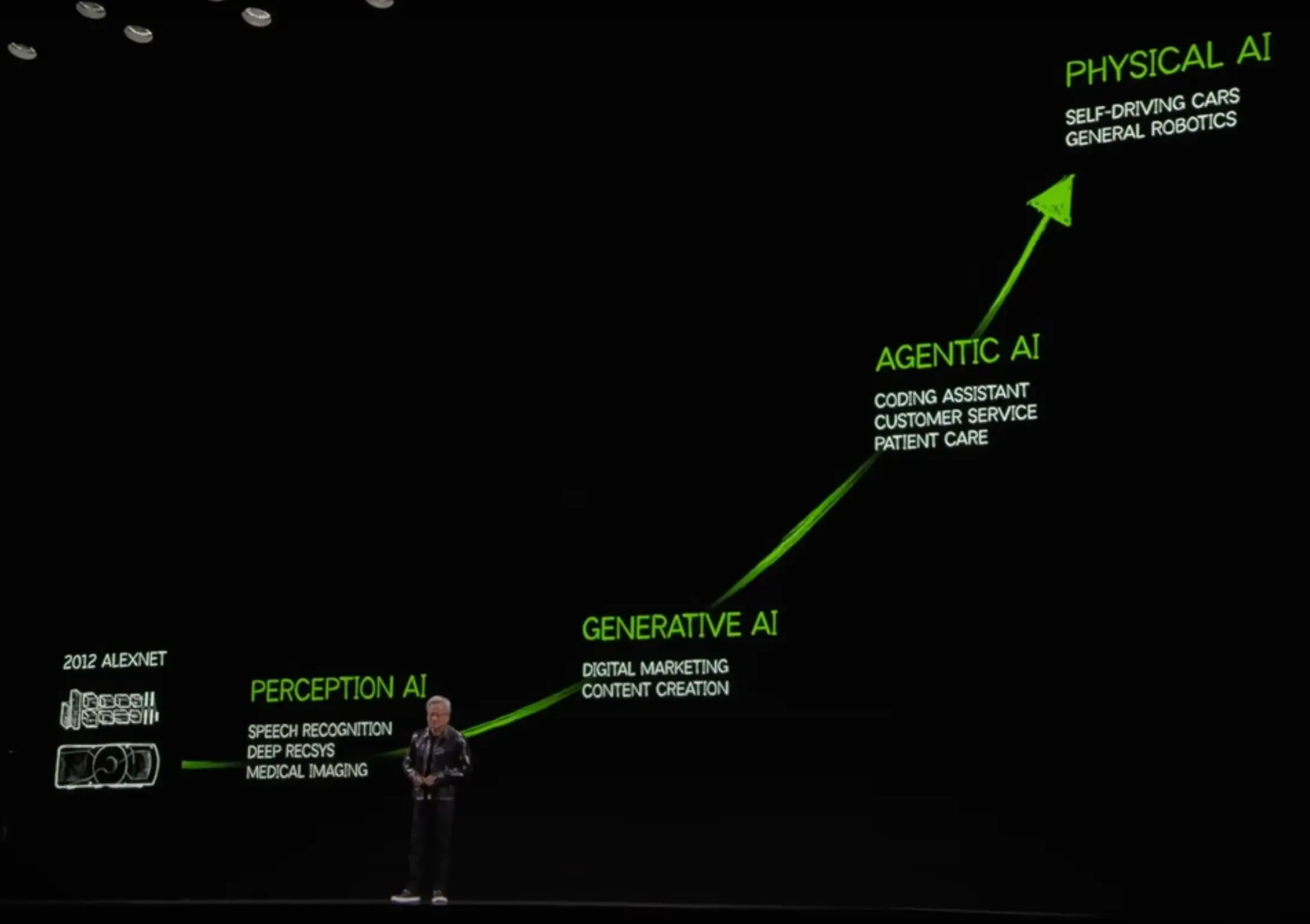
Google’s ambition doesn’t stop at the computer screen. The “third wave of AI: Physical AI,” prophesied by NVIDIA’s Jensen Huang, is Google’s true destination.
Project Astra: Becoming the Eyes of Robots
Project Astra, unveiled at Google I/O, serves as Gemini 3’s eyes and ears. Through smart glasses or smartphone cameras, AI sees, hears, and remembers the world in real-time. If you ask, “Where did I put my glasses?”, a traditional search engine would have provided tips on “how to find glasses.” But Astra is different. It remembers the video feed from your smart glasses and responds:
“30 minutes ago, I saw you place your glasses next to the fruit bowl on the kitchen counter.”
Combined with Google’s global map data (Google Maps), this creates perfect ‘Spatial Intelligence’ that works both indoors and outdoors.
VLA Models: From Text to Action
Through VLA (Vision-Language-Action) models like RT-2 (Robotic Transformer 2), Google is translating text and video data from the internet into robotic movements. Countless “bicycle repair videos” and “cooking videos” uploaded to YouTube are now not only content for humans but also training materials for robots.
When given a command like “Clean up the spilled milk on the floor,” the AI understands that ‘milk’ is a liquid and calculates the physics required for the act of ‘cleaning’—what kind of pressure to apply with a mop—before issuing commands to a robotic arm.
Google, the king of search, is structurally destined to become the entity controlling the brains of robots. Whoever dominates the Web will also dominate the Real World.
5. Google Becomes the ‘Earth’s Operating System’
In 2025, Google’s transformation resembles a grand science fiction drama. They have boldly broken free from the old shell of ‘search’ and attached new wings as ‘AI agents.’ The disappearance of the ten blue links certainly leaves a void, and it will be a harsh winter for content creators.
However, in return, we have gained an omniscient partner that can penetrate the intent of our questions, handle complex tasks on our behalf, and even control robots in the physical world.
What have we traded for this convenience?
Google’s future strategy is technologically marvelous. Gemini 3 and Project Astra will explosively increase human productivity. But we must remember: every command we type into the search bar, and now speak to robots, strengthens the neural network of the giant corporation, Google.
Google is no longer just a ‘search engine.’ They have become the ‘Earth’s Operating System (OS)’, ready to answer before we ask and act before we command.
To live as wise citizens in this convenient yet terrifying empire, we must constantly ask:
“Google, are you working for me now, or are you training me?”