
While browsing defense news a few days ago, one particular set of numbers kept bothering me.
In the ‘Top 100 Global Defense Companies’ list published annually by the U.S. military outlet Defense News, Hanwha ranked 16th, while LIG Nex1 sat at 52nd. While the ranking itself is understandable, a specific figure attached to them caught my attention.
Hanwha’s defense revenue accounts for only 20% of its total group revenue. In contrast, virtually all of LIG Nex1’s revenue comes from defense.
In other words, a company that exclusively sells weapons is ranked significantly lower than a conglomerate. It felt strange, so I dug deeper.
Why is Hanwha, with only 20% defense exposure, ranked higher?
The Defense News rankings are based on the total defense revenue from the previous year.
Therefore, it is the ‘absolute amount’ earned from defense, not the ‘proportion’ of defense within the group, that determines the ranking.
As of 2025, Hanwha’s defense revenue reached $10.437 billion, or approximately 14.3 trillion Korean won. This is an increase of over $3.6 billion in a single year. Even if defense accounts for only 20% of the total, that 20% is so massive that it propels the company to the top of the leaderboard.
This is possible because Hanwha is not a defense ‘specialist’ but a comprehensive industrial group that includes defense.
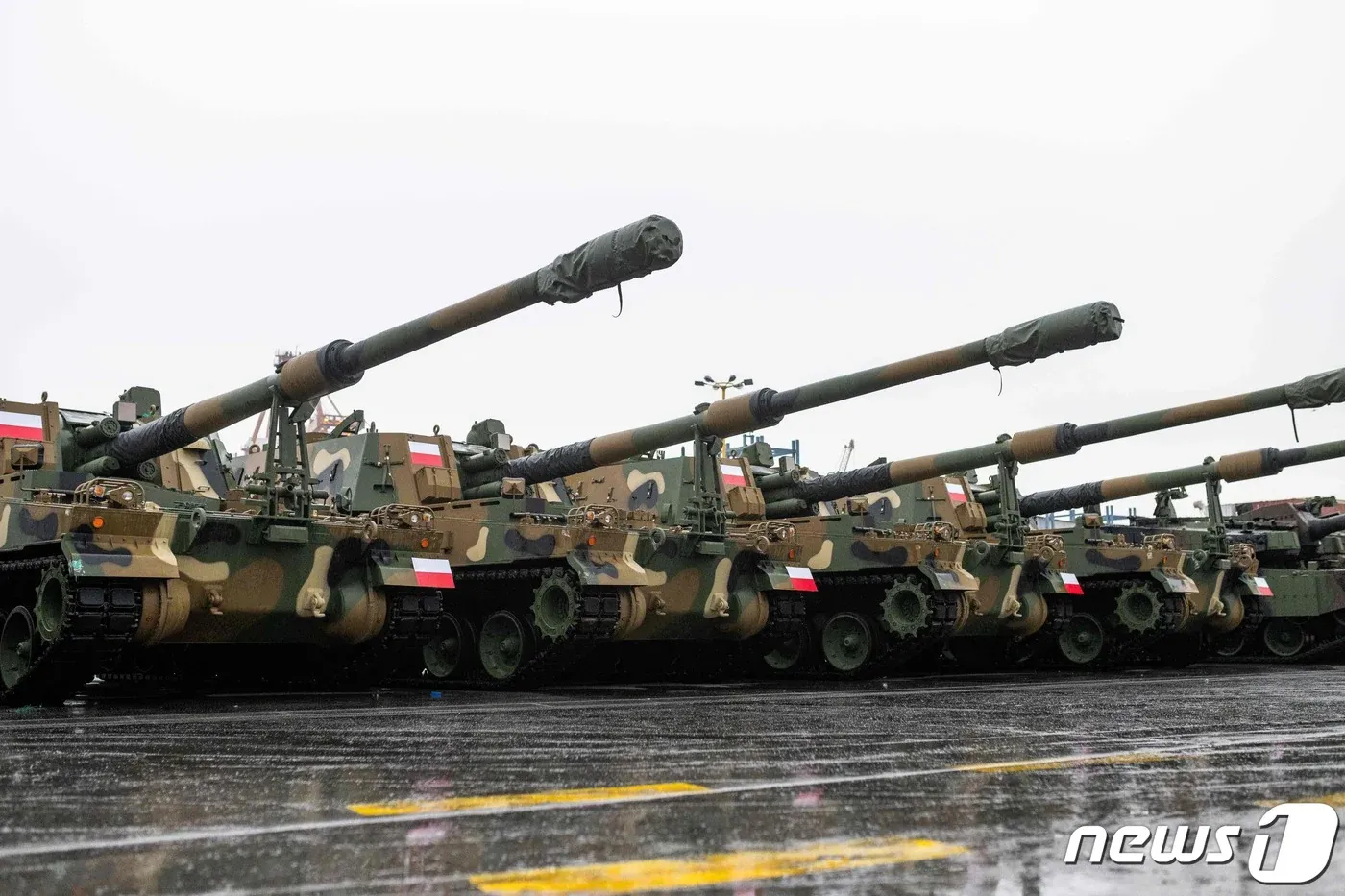
Hanwha Aerospace alone covers a wide range of businesses: aircraft engines, ground weapons like self-propelled howitzers and armored vehicles, shipbuilding (Hanwha Ocean), and space launch vehicles/satellites (Satrec Initiative). In the first quarter of 2026 alone, ground defense sales reached 1.22 trillion won with an export share exceeding 53%, and the aerospace sector’s export share neared 57%. Its ground defense order backlog hit a record high of 39.7 trillion won, 74% of which consists of exports. You can see the company’s blueprint everywhere: supplying K9 self-propelled howitzers and Chunmoo MLRS to Poland, while expanding pipelines to Egypt, Australia, Spain, and Saudi Arabia.
LIG Nex1, on the other hand, has a completely different nature. It is a pure-play defense company that only makes guided weapons, radar, and electronic warfare equipment. Since its revenue share is near 100%, the success or failure of a single weapon system dictates the entire company’s performance. Although its 2025 defense revenue grew by over 28% from the previous year to $3.029 billion (approx. 4.15 trillion won), its ranking only moved up one spot from 53rd to 52nd. Because the gap in absolute scale with Hanwha is so large, the ranking doesn’t fluctuate much, even if the growth rate is high.
It used to be a division of labor: Radar for Hanwha, Missiles for LIG
I discovered an interesting fact here.
While it seems like Hanwha and LIG Nex1 are clashing in many areas now, that wasn’t the case in the past.
When the Korea Missile Defense (KMD) project first began in 2001, the division of labor in the domestic defense industry was clear.
Radar was handled by Hanwha Systems (then Samsung Thales), engagement control systems by LIG Nex1, and launchers by Hanwha Aerospace. Each company handled its own specialty to jointly create a single weapon system.
However, this division of labor has begun to falter in recent years. As the market grew, overlapping territories became frequent.
Currently, Hanwha Systems is partnering with Germany’s Diehl Defence to expand its multi-function radar business, while LIG Nex1 independently develops radar and surveillance/reconnaissance equipment. LIG Nex1’s medium-range surface-to-air missile, Cheongung-II, has been dubbed the ‘K-Patriot’ after it was exported to the UAE and successfully intercepted Iranian ballistic missiles in combat. Its strengths include a price half that of the U.S. Patriot (PAC-3) and ‘cold launch’ technology capable of 360-degree response. The New York Times highlighted this, noting that according to SIPRI statistics, South Korea is now the largest supplier of weapons to NATO members after the U.S. It’s no wonder the division of labor has turned into competition.
LIG Nex1 celebrated its 50th anniversary this year by changing its name to ‘LIG D&A’ (LIG Defense & Aerospace). It also acquired the military quadruped robot company Ghost Robotics for 314.9 billion won, with 40% of the acquisition cost reportedly funded by private equity. This might be evidence that a pure-play defense company has relatively less capacity for business expansion.
So, what is Hanwha Systems, which originally handled radar, doing now? I found that this company is a bit ambiguous among the four. It manages three businesses simultaneously: defense electronics (AESA radar, combat systems), ICT outsourcing, and aerospace (satellites/launchers). While defense accounts for the largest share of revenue, its identity is closer to a ’technology hub.’ It supplies multi-function radars for Cheongung-II to the UAE and Saudi Arabia, while simultaneously launching small SAR satellites and venturing into new businesses like Urban Air Mobility (UAM). Since 2024, the CEO of Hanwha Aerospace has also been serving as the CEO of Hanwha Systems, shifting to a system where one person manages the group’s defense business. This suggests how strategically Hanwha is integrating its defense operations at the group level.
Why did KAI’s ranking drop despite creating the KF-21?
Among the four companies, the most notable is Korea Aerospace Industries (KAI).
It is the symbolic company that developed the Korean fighter jet KF-21, but in this ranking, it actually dropped 12 places from 62nd to 74th. Its 2025 operating profit grew by only 11.8% from the previous year. Compared to the rapid surges of 75.2% for Hanwha Aerospace and 120.3% for Hyundai Rotem, this is noticeably slow.
The reason lies in the development schedule of the KF-21.
After 10 years and 6 months of system development, the KF-21 is just now entering the mass production stage. It was difficult to generate large-scale revenue during the development phase. The situation is expected to change from 2026; KAI has set a goal of 5.73 trillion won in revenue and 10.44 trillion won in new orders for this year. These are 58% and 63% increases respectively, marking the first time in the company’s history that annual revenue will exceed 5 trillion won. Negotiations for the introduction of 48 KF-21s are underway with Indonesia, and there is talk that the first export contract could be signed as early as the first half of this year.
However, KAI has one variable that the other three companies don’t have.
The largest shareholder is the Export-Import Bank of Korea (26.41% stake). Because a state-run bank is the largest shareholder, there is consistent criticism from inside and outside the industry that management decision-making is relatively slow.
In fact, Hanwha has recently been rapidly purchasing KAI shares through Hanwha Aerospace and Hanwha Systems. Its stake grew from 7.22% in May of this year to 12.44% in July and 15.89% in August, and the purpose of its holding changed from ‘simple investment’ to ‘management participation.’ As the stake exceeded 15%, it became subject to the Fair Trade Commission’s business combination review. The FTC has stated that if Hanwha becomes KAI’s largest shareholder or if more than one-third of the executives hold concurrent positions, a separate business combination report will be required. So, the current 15.89% is both a finish line and a boundary.
Why does Hyundai Rotem make both tanks and subways?
Hyundai Rotem occupies a unique position.
It is the only company among the four major domestic defense firms that also operates a railway vehicle business. I wondered how a company that used to make subways and high-speed trains became a powerhouse in tank exports, but looking at the K2 tank’s export performance to Poland, it made sense. In 2025, defense revenue was 3.215 trillion won, a 36% increase from the previous year, and the export share of defense revenue exceeded 70%. Total operating profit jumped more than twofold from 455.6 billion won to 1.005 trillion won, successfully entering the ‘1 Trillion Won Operating Profit Club.’
Just looking at the Polish export volume, the scale is significant. The first contract for 180 units is being delivered smoothly, and production for the second contract of 180 units will continue until 2030. If the third contract for 210 units is also successful, 570 K2 tanks will be deployed in Poland alone. There is talk that Iraq is considering the introduction of 250 units worth about 9 trillion won, and negotiations are also underway with Peru, Romania, and Saudi Arabia. The explanation is that profitability is rising because the method goes beyond simple finished product sales to include local production and technology transfer.
What’s interesting is how the Hyundai Motor Group is responding.
It is reportedly considering moving the defense business unit of Hyundai Wia, another affiliate, which handles firearms and drivetrains, to Hyundai Rotem. The plan is to increase ground weapon package competitiveness by bundling tanks, armored vehicles, and firepower systems together. This is different from Hanwha buying KAI shares from the outside. It is a relatively simple internal reorganization, gathering defense assets already within the group into one place.
Why is the reorganization starting now?
After summarizing this, I was curious. Why are these reorganization moves appearing all at once right now? After looking for more data, I found a common thread in the industry.
The grammar of the defense market itself is shifting from an ’era of selling individual weapon systems’ to an ’era of selling integrated solutions covering land, sea, air, and space as a package.’
Seeing that the defense revenue of a global leader like Lockheed Martin is $72.1 billion—seven times that of Hanwha ($10.4 billion)—the difference in weight class is clear. Since it is difficult for individual companies to close this gap, domestic companies seem to be trying to achieve economies of scale by joining forces.
Hanwha’s expansion does not stop at KAI. There have been reports that it is also eyeing Poongsan, a company specializing in ammunition and copper alloy materials. Poongsan makes almost all ammunition used by the military, from small-caliber rounds to 155mm howitzer shells. If this combination succeeds, Hanwha will become the only comprehensive defense group in Korea covering land (Aerospace), sea (Ocean), aerospace (KAI), and ammunition (Poongsan). Some even predict that if this happens, it will create a ‘Gyeongnam Defense Cluster’ connecting Hanwha Aerospace in Changwon, Hanwha Ocean in Geoje, and KAI in Sacheon.
Of course, there are significant concerns. The KAI labor union and civic groups in Sacheon held a press conference opposing Hanwha’s stake expansion. The issue raised is whether it is right for capabilities to be concentrated in a specific company, given that the aerospace industry is a strategic industry directly linked to national security and technological sovereignty. Conversely, some in academia argue that KAI has not grown as much as other defense companies over the past decade due to government ownership and constraints on CEO decision-making, and that the justification for blocking integration is weak at a time when large-scale investment is essential. It seems difficult to say which side is definitively right.
Where will this reorganization eventually lead?
After summarizing, I realized that the four domestic defense companies are operating on much different logic than I thought.
Hanwha is expanding outward using the capital power of a comprehensive group that includes defense.
LIG Nex1 is a pure-play defense company, so it must bet on the technological prowess of individual weapon systems.
Hyundai Motor Group has chosen to consolidate existing assets inward.
KAI’s future depends on the success or failure of a single project, the KF-21, within the structural constraints of government ownership.
President Yoon Suk-yeol’s goal of making Korea the world’s 4th largest defense power by 2030 can also be read as part of the background for this reorganization.
According to a New York Times article citing SIPRI statistics, South Korea is already the second-largest arms supplier to NATO members after the U.S.
While U.S. companies like Lockheed Martin and Raytheon were operating near maximum production capacity amidst the surge in European air defense demand, Korean companies have been seizing the gap. Viewing the current battle for stakes against that backdrop, it’s closer to the growing pains of an entire industry moving to the next level rather than just the greed of Hanwha.
However, it remains to be seen whether this will be an opportunity to push the entire K-Defense industry to the global top tier or if it will lead to side effects of excessive industrial concentration in a specific company.
FTC reviews, KAI’s labor-management issues, and the government’s official stance are all still ongoing. Personally, I am curious to see if these four companies will remain in their current form five years from now. It seems highly likely they will not.
References
- Money Today, Hanwha Aerospace, backed by record 39.7 trillion won in orders... continues 15-20% growth, 2026.04.30
- Sisa Journal, Hanwha, 16th in global defense... LIG Nex1, Hyundai Rotem, KAI also in 'Top 100', 2026.09
- News Space, [Ranking Lab] 'Hanwha 16th, LIG Nex1 52nd, KAI 74th' K-Defense Big 4, 2026.09
- Sisa Journal e, The stage is set for KF-21 exports... Will KAI's Kim Jong-chul-ho answer with further achievements?, 2026.04.07
- Bloter, [K-Defense Order Analysis] KAI, starting 'KF-21/FA-50' revenue recognition, 2026.02.03
- Opinion News, [War and Defense] ② Korea Aerospace Industries, KF-21 mass production delivery, 2026.04.10
- Data News, Hyundai Rotem, K2 export effect... Defense revenue up 36%, order backlog up 170%, 2026.04.28
- Financial News, Hyundai Rotem, outlines of 3rd contract for Polish K2 tanks, 2026.07.09
- Milli Charge, Iraq, pushing for introduction of 250 K2 tanks, 2026
- Daum News, From 'Goldstar Precision' to 'LIG D&A'... LIG Nex1's unstoppable 50 years, 2026.03.27
- Namu Wiki, LIG Nex1 entry, 2026
- Gyeongnam Ilbo, Hanwha-KAI combination, completion of land/sea/air/space defense ecosystem, 2026.08.10
- 1conomy News, [K-Defense, New Phase ①] To 'Global Top Tier'... Hanwha-KAI solidarity, 2026.09
- New Daily, K-Defense, tectonic shifts coming... Hanwha 'acquires' KAI, Hyundai Motor 'consolidates' Hyundai Rotem, 2026.05.06
- Brunch (NYT Summary), Strengths of Korea's defense industry in the Iran war, 2026.04