
In 1993, a thin white dog appeared in front of the home of Grandma Park Bok-dan on Jindo Island, South Korea. It was the white Jindo (Baekgu) that had been sold to a new owner in Daejeon, 300km away. It was a return journey that took seven months.
This story was featured in textbooks under the title ‘The Returned Baekgu,’ and a statue was even erected on Jindo. It is an event that imprinted the Jindo dog’s homing instinct and fierce loyalty to a single master upon the entire nation. However, for a dog so famous, theories about its origins remained abundant for a long time: that it was left behind by the Mongol army, or that it swam ashore from a shipwreck. When these theories are placed alongside genomic research, the answer is closer than one might think.

How the Jindo Lineage Was Preserved on the Island
The biggest reason the Jindo dog was able to remain a distinct breed is that Jindo is an island. The Myeongnyang Strait, or ‘Uldolmok,’ with its fierce currents, acted as a natural barrier between the mainland and the island, minimizing the opportunities for outside dog breeds to intermingle for a long period.
The isolated island became a kind of natural laboratory.
In terms of appearance, it is a sturdy, medium-sized dog with an inverted triangular head, pricked ears, and a powerfully curled tail. Beyond the familiar yellow (Hwanggu) and white (Baekgu), their coat colors vary, including black (Heukgu), grey (Jaegu), tiger-striped (Hogu), and black-and-tan (Neun-un-baegi).
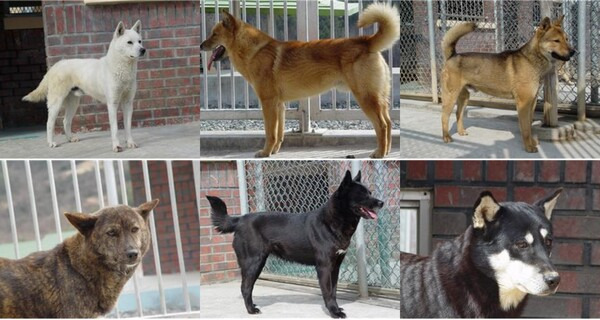
Their temperament is even more famous. They are known for a loyalty that considers their first owner their master for life, making it difficult for them to adapt to new owners; a bravery that protects their territory; a cleanliness that relieves itself only far from its sleeping area; and the homing instinct demonstrated by Baekgu. They are also known for being intelligent but independent, often characterized as stubborn.
Three Theories Regarding the Origin of the Jindo Dog
Before science intervened, the origin of the Jindo dog was passed down through three main narratives.
The most widespread is the ‘Mongolian military dog theory.’ It suggests that the Mongol forces that invaded Goryeo in the 13th century left behind military dogs, which became the ancestors of the Jindo. While it is orally transmitted in connection with the fact that Jindo was the stage for the Sambyeolcho Rebellion, it fails to explain why the dogs were left only on Jindo. The nature of the wars between the Mongols and Goryeo was covered in the first part of our Goryeo and Joseon Overseas Deployment History series.
The second is the ‘Southern Song introduction theory.’ It claims that when a Southern Song trade ship from China was wrecked off the coast of Jindo during the Goryeo Dynasty, the dogs on board settled on the island. While this seems plausible considering Goryeo’s active maritime trade at the time, there is insufficient historical documentation to support it. The extent of Goryeo’s trade with Song merchants is discussed in the Byeoklando section of our History of Trade on the Korean Peninsula.
The third is the ‘indigenous dog theory.’ It argues that they were not introduced from outside but are descendants of dogs that have lived on the Korean Peninsula for thousands of years. The discovery of evidence of dog domestication in Neolithic sites from around 6,000 years ago is cited as evidence.
Why DNA Points Toward an Indigenous Origin
Genomic research leans toward the indigenous dog theory rather than the more dramatic foreign origin stories.
A 2012 genome analysis of the Jindo concluded that it is a pure-blooded indigenous dog that has not mixed with other breeds. The Mongolian military dog theory and the Southern Song theory are based on oral traditions rather than records, and no genetic evidence to support them has been presented to date.
In 2025, more intriguing clues emerged from coat color research. The National Institute of Animal Science under the Rural Development Administration performed a precise genomic analysis of 112 Jindo dogs with different coat colors (32 black-and-tan, 31 black, 12 tiger-striped, 20 white, and 17 yellow). They identified unique variants in the CBD103, MC1R, and ASIP genes that determine coat color. In particular, the CBD103 variant found only in black-and-tan individuals was not observed in foreign breeds, and genotypes resembling ancient West Eurasian wolves were observed in this population. Researchers suggested this implies a possible connection to the ancestors of the Jindo dog.
Comparison of Jindo Origin Theories and Scientific Verification
| Origin Theory | Claims and Basis | Scientific Verification Results |
|---|---|---|
| Mongolian Invasion | Descendants of 13th-century military dogs. Linked to Sambyeolcho oral tradition | No supporting genetic evidence |
| Southern Song Arrival | Introduced via Goryeo-era shipwreck | Lack of records; difficult to consider as a sole origin |
| Indigenous Evolution | Ancient Korean dogs evolved independently on Jindo. Neolithic dog bones, etc. | Most plausible. Confirmed distinct lineage and unique genetic variants |
The Paradox of Jindo Preservation Revealed by the Black-and-Tan
Coat color research also exposed a blind spot in preservation policy. For a long time, the standard for Jindo management centered on yellow and white dogs, while other colors like the black-and-tan were often treated as signs of mixed-breeding.
However, the genome suggests the opposite. The variants found in the black-and-tan were not traces of interbreeding but unique genetic information found only in Jindo dogs, even harboring the potential to connect to distant ancestors. This means that management focused solely on visual standards nearly eroded the genetic diversity inherent in the Jindo. What should be preserved is not a specific appearance, but the breadth of the genes themselves, which span thousands of years.
How the Jindo Dog Became a Natural Monument
Paradoxically, the Jindo dog first received official protection during the Japanese colonial period in 1938, when it was designated as ‘Joseon Treasure, Historic Site, Scenic Spot, and Natural Monument No. 53.’ This served as a shield to protect their lineage from indiscriminate slaughter during the war.
After liberation, the government redesignated the Jindo as Natural Monument No. 53 in 1962, and in 1967, it enacted the ‘Act on the Protection and Promotion of the Korean Jindo Dog,’ a rare law dedicated to a single breed. Only individuals that pass the Jindo-gun screening are recognized as official Jindo dogs, and registered dogs cannot be taken off the island without permission. I, too, was surprised at how strict the management was when I saw the checkpoint while crossing the Jindo Bridge.
In 2005, the Jindo dog was registered with the Federation Cynologique Internationale (FCI) and the UK Kennel Club, making its debut on the world stage.
Fame also brought shadows, such as excessive commercialization and debates over lineage.
The fact that researchers from the Rural Development Administration stated in 2025 that this coat color genome analysis secured the scientific basis needed to set international breed registration standards is in line with the trend of defining the Jindo standard through genetic information rather than appearance.
References
- Wikipedia, The Returned Baekgu
- BreakNews, After the Jindo Baekgu returned from Daejeon
- Encyclopedia of Korean Culture, Jindo Dog of Jindo
- Traditional Culture Portal, Jindo Dog
- Yonhap News, Dogs were raised on the Korean Peninsula 6,000 years ago (2008.03)
- Chosun Biz, Jindo dog, complete genetic analysis... verified as a pure-blooded indigenous dog (2012.04.16)
- National Institute of Animal Science, Press release on identifying Jindo dog coat color genes (2025.06)
- Korea Policy Briefing, Factors determining Jindo dog coat color... revealed by genomic information