
There was a time when a scholar wearing Taesahye and a farmer wearing Jipsin (straw sandals) could cross paths on the road, and their social standing would be established without a single word being exchanged.
The history of Korean footwear follows a path from the gilt-bronze shoes buried in tombs during the Three Kingdoms period, to the Taesahye and Jipsin that signaled social status in the Joseon Dynasty, and finally to the rubber shoes that everyone wore after their introduction in 1922.
Whose feet wore the gilt-bronze shoes buried in the tombs?
About 56 gilt-bronze shoes (including fragments) have been discovered from the Three Kingdoms period, and researchers believe they were funerary footwear. In academic terms, they are called Geumdong-sikri (gilt-bronze decorative shoes).
While they were also found in the tomb of King Muryeong and his queen, the two pairs designated as National Treasures were both recovered from the tombs of local chieftains—specifically the Bongdeok-ri tumulus in Gochang, Jeonbuk, and the Jeongchon tumulus in Naju, Jeonnam.
If you thought gilt-bronze shoes were worn only by kings, you are only half right.
Researchers generally interpret them as tokens of prestige bestowed by the Baekje central government upon regional leaders, meaning a single pair of shoes served as a political gift linking the center to the provinces.
The shoes from Bongdeok-ri were found in a stone-chamber tomb estimated to date from around 450–475 AD. They measure 324–327 mm. Since fragments of the deceased’s bones were found inside the right shoe along with fabric, it is clear they were worn over socks at the time of burial. The shoes were constructed by fixing four metal plates—a sole, two side panels, and a toe cap—with nails, and the soles feature conical spikes about 2 mm in diameter.
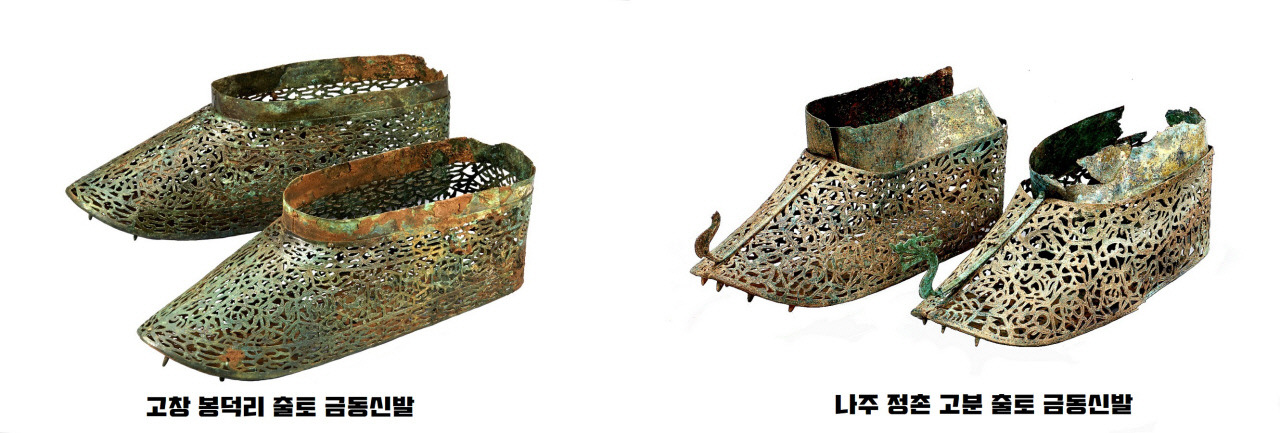
The story of the Jeongchon tumulus is even more intriguing.
Three-dimensional measurements of the two sets of human remains identified there suggest they were both female, aged approximately 45–47. This implies that a regional leader commanding the Yeongsangang River basin in the late 5th century could have been a woman in her 40s. Even ankle bone fragments were found inside the shoes.
What hopes were embedded in the dragon patterns on the gilt-bronze shoes?
the sides of the Bongdeok-ri shoes are divided into hexagonal frames resembling tortoise shells, each containing images of phoenixes, dragons, human-faced birds, and human faces. Counting only the dragons, there are 58 in total (29 on each side). The Jeongchon shoes feature 36 dragon patterns, with an S-shaped dragon ornament on the toe that appears to be ascending to the heavens.
Some interpret these dragons as an expression of the desire to ascend. In the catalog for the Jeongchon tumulus published by the Naju National Research Institute of Cultural Heritage, curator Seong Yun-gil explained the dragon motifs as reflecting the Baekje people’s view of the afterlife, where the deceased hoped to become immortals and ascend to heaven. Since the feet of the deceased lying in the tomb naturally pointed toward the sky, the explanation goes, they placed the leader of the dragon clan in that position.
What caught my eye, however, was the object of the shoe itself.
In the Chinese collection of immortal legends, Liexian Zhuan, there is a story about the Yellow Emperor leaving only his sword and shoes in his tomb after his death; this is interpreted as a sign that his ascension was complete. It suggests that shoes were considered items connected to the path to heaven.
This brilliant technology did not last long.
The Bongdeok-ri shoes share very similar manufacturing techniques and patterns with the gilt-bronze shoes found in the Silla-era Sikrichong tomb. Because the method of creating and joining the side panels is distinctly Baekje, it is suggested that they were either gifts from Baekje to Silla or that Silla purchased luxury goods from Baekje.
However, some analysts argue that metal craft techniques were lost following the Goguryeo invasion in 475 AD and the subsequent relocation of the capital to Ungjin. Later shoes gifted to local powers used a dotted-line technique, and the shoes from King Muryeong’s tomb (c. 523 AD) are considered less sophisticated than those from Bongdeok-ri.
How did Taesahye and Hwa reveal social status in the Joseon Dynasty?
If footwear in the Three Kingdoms period was directed toward the afterlife, Joseon-era shoes were governed by the hierarchies of the living.
Male officials wore Hwa (boots), which were long-necked, when wearing official court attire, while scholars and the Yangban (nobility) wore Taesahye in their daily lives. The Encyclopedia of Korean Culture describes Taesahye as men’s shoes with fabric or leather uppers and white stripes on the toe and heel.
One can gauge the status of Taesahye by looking at the royal family. According to the same encyclopedia, the National Museum of Korea holds a pair of Taesahye said to have been worn by King Gojong, and the Sangbangjeongrye (Records of the Royal Bureau of Clothing) indicates that in the late Joseon period, even the King wore Taesahye rather than Ungpihye (bear skin shoes) or Nokpihye (deer skin shoes) with his daily attire.
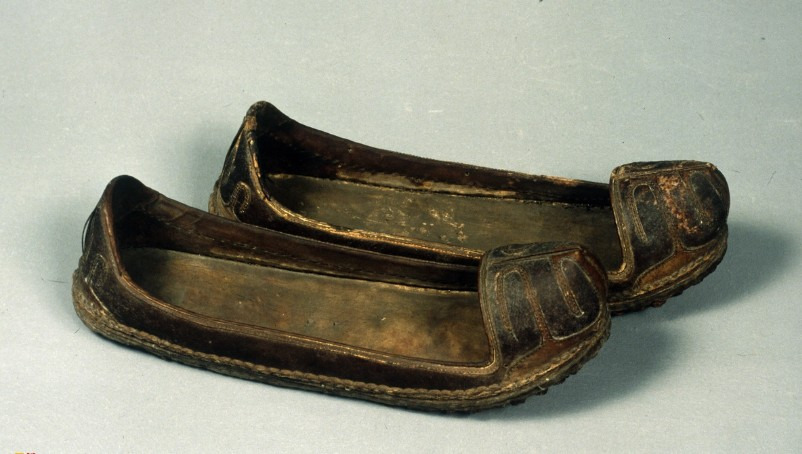
Women wore flowered shoes like Danghye and Unhye. Embroidered on silk or leather, they were immediately recognizable as elegant and ornate. If you are curious about the lives of women in the palace, read Everything About Joseon Court Ladies: A Life Like a Shadow Within Splendor.
Shoes were not the only markers of social class. The story of how even toilets were divided by social standing is summarized in Toilets of the Joseon Dynasty: The Story of Restrooms that Divided Social Classes.
How did Jipsin and Namaksin protect the feet of commoners?
Jipsin (straw sandals) were the most common footwear, woven from rice straw, and were primarily worn by commoners and farmers during the Joseon Dynasty.
The problem was their durability. According to an article introducing the special exhibition ‘Korean Footwear, Feet and Shoes’ at the Daegu National Museum, a single pair would wear out after about four days, so people had to weave new ones every night for the next day.
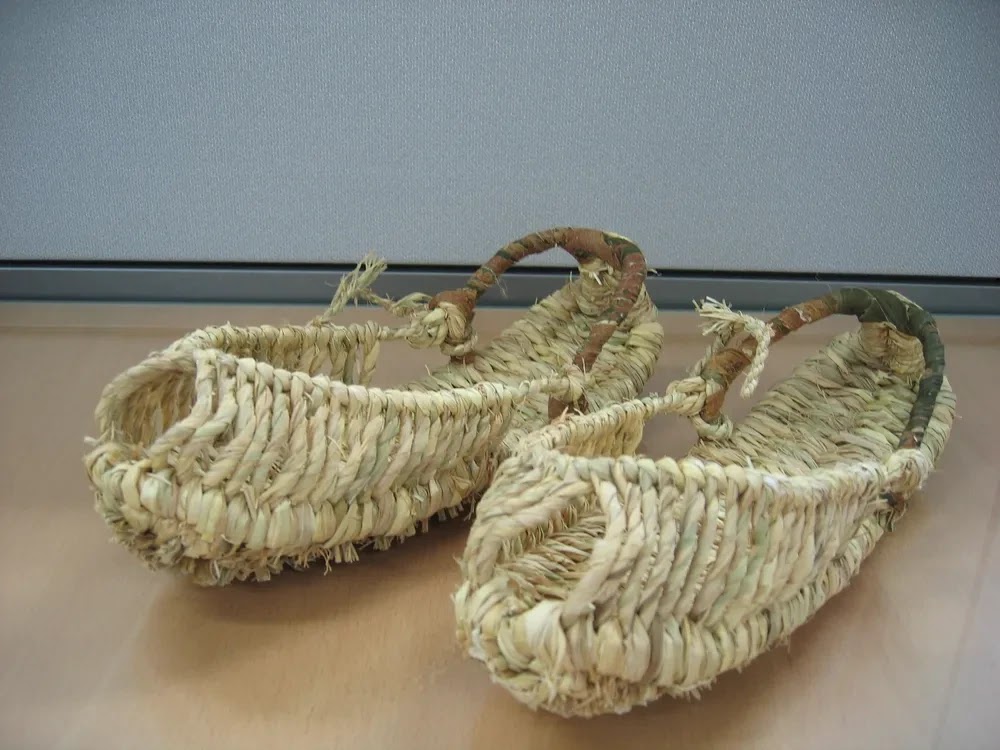
In the same exhibition, Mituri (hemp shoes) were displayed alongside Jipsin. When it rained, people wore Namaksin (wooden clogs) or oiled shoes (Jingsin).
Namaksin are often associated with the nickname Ttalgakbali.
In his essay “Ttalgakbali,” Lee Hee-seung explains that it was a nickname for the scholars of Namsangol. It refers to how, even on dry days, they wore wooden clogs, making a distinct clicking sound on the hard ground. It is also used to describe impoverished scholars who wear wooden clogs even on sunny days because they have no other shoes. It is a nickname that shows that social status as a Yangban and one’s financial circumstances did not always align.
In the history of Korean footwear, the comparison of Joseon-era shoes by material and wearer is as follows:
| Shoe Name | Main Material | Wearer and Occasion |
|---|---|---|
| Hwa (Boots) | Leather, Silk | Male officials, when wearing court dress |
| Taesahye | Fabric, Leather | Scholars/Yangban, daily wear |
| Danghye/Unhye | Silk, Leather | Women, flowered shoes |
| Mituri | Hemp | Woven shoes, same category as Jipsin |
| Jipsin (Straw sandals) | Rice straw | Commoners/Farmers |
| Namaksin (Clogs) | Wood | Rainy days; impoverished scholars on sunny days |
Did rubber shoes really erase the boundaries of social status?
In Korea, the first recorded day rubber shoes were manufactured is August 5, 1922.
Daeryuk Rubber, founded by Lee Ha-young in Cheongpa-dong, Seoul, released the ‘Daejanggun’ brand rubber shoes, and it is said that King Sunjong was the first person to wear them. They were a revolutionary product for the time, as they lasted longer than straw sandals and were waterproof; unlike imported Japanese versions, they were designed based on the shape of Jipsin.
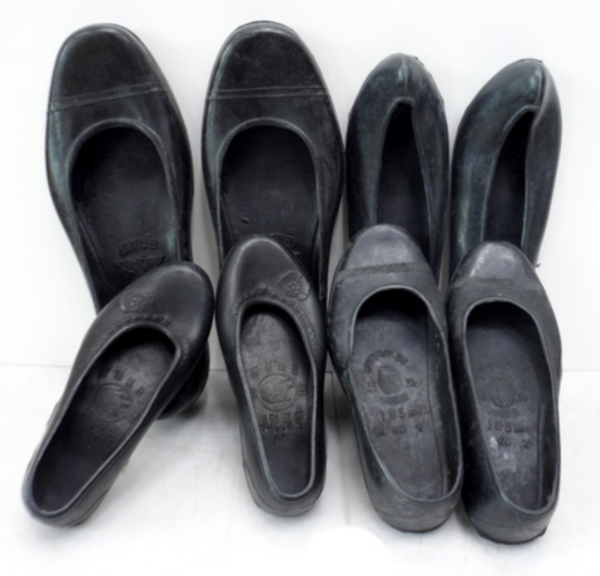
The marketing strategy was notable.
A newspaper advertisement from September 21, 1922, about a month and a half after the launch, emphasized that King Sunjong had worn them and that court ladies also loved them. In essence, they used the royal family to sell shoes to the common people.
The speed of adoption was also fast.
The number of rubber shoe factories grew from 4 in 1921 to 72 in 1933. Research from Ewha Womans University (Lee Hyo-seon, 2015) concludes that rubber shoes were adopted by all social classes for a significant period in the early-to-mid 20th century, and they tended to replace separate shoes for dry and wet weather. Until sneakers and leather shoes took over in the 1960s, it was the job of the head of the household to buy new rubber shoes for the whole family every holiday. They only came in two colors: white and black.
It is difficult to say that social boundaries disappeared overnight. However, it is fair to say that the sharp distinction at the feet, once dictated by Taesahye and Jipsin, began to fade.
How deeply rubber shoes permeated daily life is evident in proverbs. “Putting on rubber shoes backward” is a phrase used when someone who was waiting for a lover in the military changes their mind.
References
- Lee Ki-hwan's Hi-story (28) Who wore Baekje's gilt-bronze shoes?
- Signature 'Dragon' pattern engraved on Baekje luxury shoes... Silla nobles also wore them on their path to heaven
- New Treasure of Jeonbuk, Theme Exhibition of Gilt-Bronze Shoes from Bongdeok-ri, Gochang
- Gilt-bronze shoes excavated from Nodong-dong, Gyeongju
- Taesahye, Encyclopedia of Korean Culture
- Article introducing the special exhibition 'Korean Footwear, Feet and Shoes' at the Daegu National Museum
- The 'Ttalgakbali' Spirit
- [Window of Folklore] The Reincarnation of Rubber Shoes
- [Lee Sung-joo's Health Letter] No. 1346
- [Revisiting Jeonbuk Corporate History] Gyeongseong Rubber Industrial Co.
- [Revisiting Jeonbuk Corporate History] Gyeongseong Rubber Industrial Co.
- A Study on Rubber Shoes during the Japanese Colonial Period, Lee Hyo-seon
- Daeryuk Rubber, the key player in the 'Rubber Shoe Myth'
- King Sunjong, the first to wear rubber shoes