
Goryeo and Joseon crossed seas and rivers to fight on foreign soil more often than you might think.
Textbooks cover them in single lines under names like the ‘Mongol-Goryeo expedition to Japan,’ ‘Tsushima expedition,’ or ‘Rason expedition.’ Yet, within those lines lie the common people who collapsed from exhaustion while building ships, the generals caught between orders and conscience, and the kings who had to calculate moves on a board they couldn’t win.
I have traced these four overseas deployments from the perspective of the four individuals who stood at the center of the battlefield.
Kim Bang-gyeong on the Japanese coast in 1274, Park Wi on Tsushima in 1389, Gang Hong-rip on the fields of Sarhu in 1619, and Shin Yu on the Amur River in 1658. While all are grouped under the term ‘deployment,’ the answer to the question of who they were fighting for is different in every scene.
Summary of Major Overseas Deployments by Goryeo and Joseon
| Deployment Name | Year/Dynasty | Main Outcome |
|---|---|---|
| Mongol-Goryeo Expedition to Japan (1st) | 1274 / Goryeo | Failed due to typhoon, massive loss of life |
| Mongol-Goryeo Expedition to Japan (2nd) | 1281 / Goryeo | Catastrophic failure due to typhoon |
| Park Wi’s Tsushima Expedition | 1389 / Goryeo | Victory, destruction of pirate ships and rescue of captives |
| Yi Jong-mu’s Tsushima Expedition | 1419 / Joseon | Subjugation of Tsushima, led to the Gyehae Treaty |
| Deployment to the Battle of Sarhu | 1619 / Joseon | Surrender after Ming defeat, provided cause for the Injo Coup |
| Rason Expeditions (1st, 2nd) | 1654, 1658 / Joseon | Victory for the Qing-Joseon alliance |
The Mongol-Goryeo Expedition to Japan: Why Did Goryeo Build Ships for Another’s War?
In the first scene, Goryeo was mobilized for a war it had no reason to fight. After decades of fighting the Mongols, Goryeo had become a son-in-law state to the Yuan Dynasty, and Kublai Khan demanded ships and troops for the conquest of Japan.
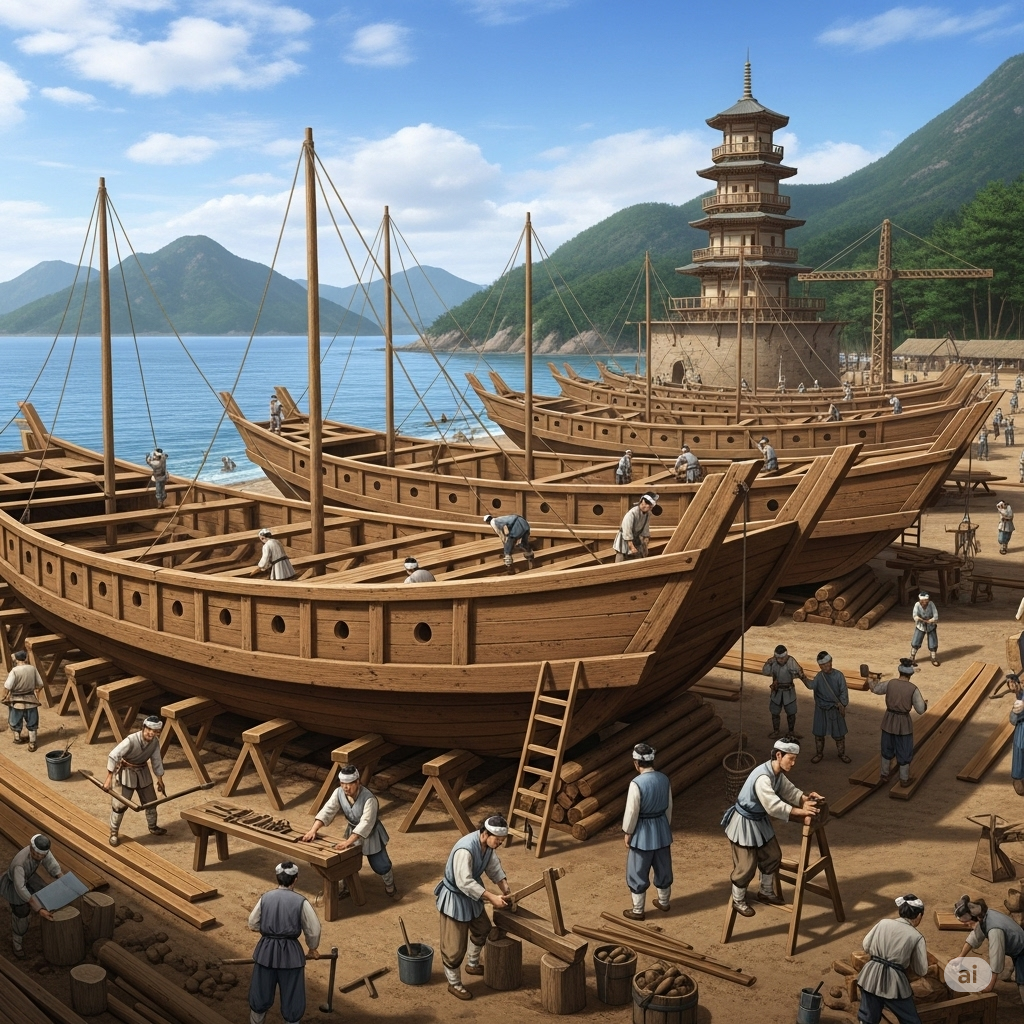
According to the Encyclopedia of Korean Culture, the preparation process in 1274 was brutal.
Goryeo was ordered to build 900 warships, mobilizing 30,500 laborers from across the country. The construction, which began in January, was completed in just four months. People collapsed from starvation so frequently that the Yuan eventually had to send grain.
That October, 25,000 Mongol-Han troops, 8,000 Goryeo troops, and 6,700 sailors and oarsmen crossed the sea.
There was significant damage to the residents of Tsushima and Iki Island, and the allied forces landed at Hakata Bay, pushing back the Japanese army. However, the Mongol command decided to retreat to their ships that night. Goryeo commander Kim Bang-gyeong argued to continue fighting, but his plea was ignored. That night, a storm struck, causing the ships to collide and break apart; over 13,500 people never returned. Japan later called this wind ‘Kamikaze.’
Kublai did not stop. Seven years later, in 1281, an expeditionary force of 140,000 was formed, consisting of the 40,000-strong Eastern Route Army from Goryeo and the 100,000-strong Jiangnan Army from southern China.
Goryeo was once again saddled with the burden of providing 900 warships and massive amounts of grain. Japan built defensive walls along the coast, and epidemics spread through the expeditionary camp. Shortly after the Jiangnan Army arrived, another typhoon struck, and most of the Jiangnan troops failed to return.
Goryeo gained nothing from these two expeditions. Despite pouring in the lives of tens of thousands and exhausting national strength, the war was the Yuan Dynasty’s from start to finish.
The Tsushima Expeditions of Park Wi and Yi Jong-mu: The First Expedition We Chose
The second scene is the opposite. This time, they drew their swords of their own volition.
Even after the Yuan retreated north, the Goryeo coast remained restless, and the Wokou (Japanese pirates) became a new disaster. Their base was Tsushima.
In 1389, Park Wi led 100 warships in a surprise attack on Tsushima. He burned over 300 pirate ships and rescued about 100 Goryeo people who had been captured. Unlike the 1274 expedition where they were dragged into battle, this was a choice made to protect their own families and shores.
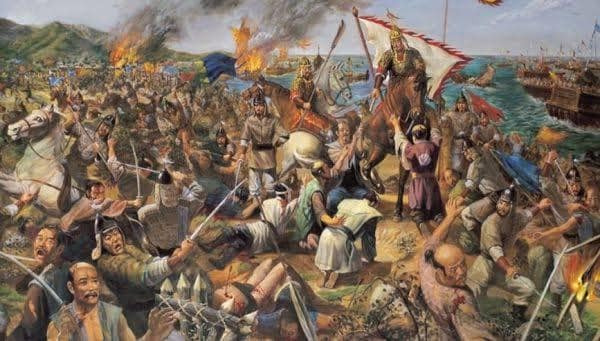
Thirty years later, Joseon repeated this on a larger scale.
In 1419, the year after King Sejong ascended to the throne, starving pirates attacked Biin-hyeon in Chungcheong-do. King Taejong, who held military authority, decided to strike Tsushima’s empty base while the main pirate force was away. A fleet of 227 ships and 17,000 troops led by Yi Jong-mu landed on Tsushima on June 20, burning 1,940 houses and 129 ships, and rescuing 131 captured Chinese people. There was also a moment where they suffered significant losses after being ambushed while deep inland.
Meanwhile, news arrived that the main pirate force, which had gone to Liaodong, had been soundly defeated by the Ming army.
Joseon recalled its troops and turned to diplomacy. Pressured by the ultimatum that Tsushima was originally Joseon territory and they must either offer the courtesies of a subject or remain enemies, the Lord of Tsushima promised submission. Based on this superior position of power, the Gyehae Treaty of 1443 was signed during King Sejong’s reign.
The process of how the treaty turned pirates into trade partners is explained in detail in my post on the history of Korean Peninsula entrepôt trade.
The Battle of Sarhu: Why Did Gang Hong-rip Surrender Without Fighting?
In the third scene, Joseon was asked to stand on the side of a lost cause.
In Manchuria, Nurhaci’s Later Jin was rising, and the Ming Dynasty, which had sent aid during the Japanese invasions of Korea, was declining. Ming demanded troops, citing the ‘debt of gratitude for restoring the nation.’
While most court officials argued that they could not abandon their ‘parent nation,’ Gwanghaegun was wary of antagonizing Later Jin until the very end. Eventually, in 1619, 13,000 Joseon troops led by Gang Hong-rip crossed the Yalu River.
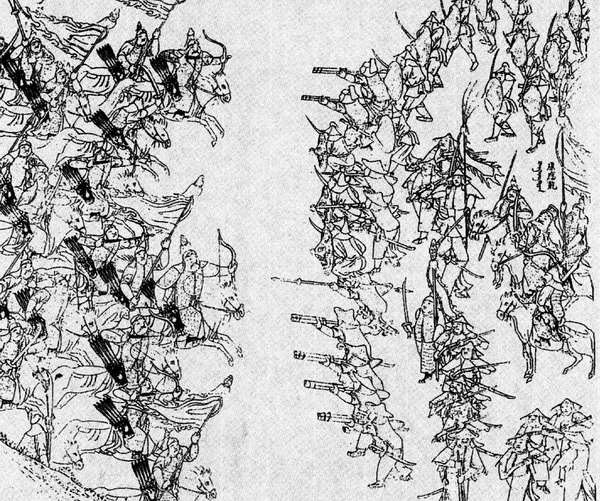
When the main Ming force collapsed around Sarhu, Gang Hong-rip led the remaining Joseon troops and surrendered to Later Jin.
It is widely believed that Gwanghaegun had issued secret orders to assess the situation before acting. However, the existence and content of such orders have not been confirmed by historical records, leading to differing interpretations among scholars. What is clear is that this surrender saved many Joseon soldiers’ lives and avoided a direct clash with Later Jin for a time.
While a military defeat, it was a diplomatic success; yet, domestically, it was a political disaster.
Opponents attacked him for betraying Ming by surrendering to ‘barbarians,’ and this ‘betrayal of Ming’ became one of the banners for the 1623 Injo Coup.
Under the new administration, which prioritized ideology, Joseon suffered two invasions by the Manchus in 1627 and 1636.
The Rason Expeditions: Why Did the Musketeers Raised to Fight Qing Fight for Them?
The fourth scene is like history’s most cruel joke.
King Hyojong, who was preparing for a ‘Northern Expedition’ to wash away the shame of the Manchu invasion, was ordered by the Qing Dynasty to send musketeers. When the ‘Rason’ (Russian) forces descended into the Amur River region and clashes became frequent, Qing decided to borrow Joseon’s musketry units.
They had to send the very troops they had raised to fight the Qing to fight on behalf of the Qing. As a vassal state, it was not a request they could refuse. In 1654, Byeon Geup led the musketeers, and in 1658, Shin Yu led them to the Amur River.
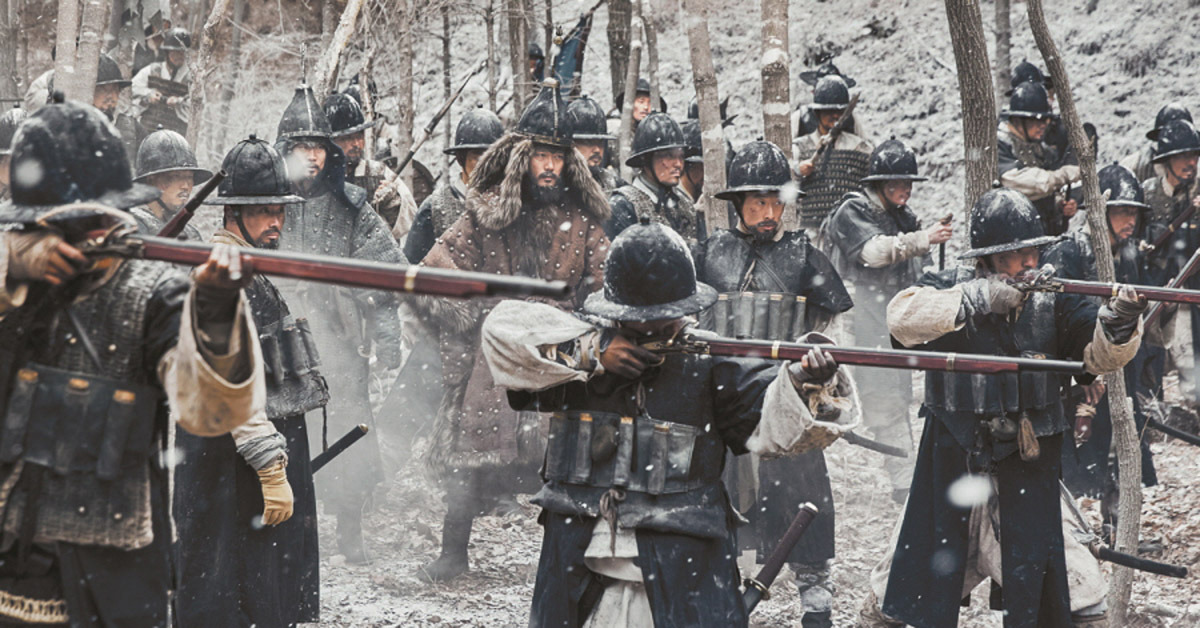
The results proved the skill of the Joseon musketeers. According to the Encyclopedia of Korean Culture, both expeditions ended in victory for the Qing-Joseon alliance. Notably, in the second expedition of 1658, the Russian fleet suffered heavy losses, while Joseon casualties were limited to 8 killed and 25 wounded. The marksmanship honed for the ‘Northern Expedition’ was ultimately used on a battlefield that was not the intended one.
Four Overseas Deployments: What Was Different?
If we categorize the four scenes by ‘who wanted it and who gained from it,’ the differences become clear.
The Japan expeditions were forced mobilizations dragged out by Yuan’s ambition, and Goryeo only lost lives and resources.
The Tsushima expeditions were defensive expeditions chosen by the state, and they gained peace by turning superior power into diplomatic order.
The Sarhu deployment was a calculated choice between two great powers, but that calculation faced a backlash within the country.
The Rason expeditions were mandatory deployments that could not be refused; while their skill was proven, the owner of that victory was the Qing.
Looking at it this way, ‘whose judgment led to the deployment’ shaped the character of the outcome more than the success or failure of the war itself.
Only in the Tsushima expeditions did Joseon decide for itself the reason for departure and the timing of the end, leaving behind a lasting order known as the Gyehae Treaty.
Kim Bang-gyeong argued to keep fighting at Hakata Bay, while Gang Hong-rip decided not to fight at Sarhu.
The judgments of the two generals were polar opposites, but they were the same in that neither was the master of the war.
References
- Encyclopedia of Korean Culture, Japan Expedition
- Hankyung, 740 years ago, why did 8,000 elite Goryeo troops go to Hakata Bay?
- Wikipedia, Tsushima Expedition
- KISS, Military development process of the Tsushima expedition during King Sejong's reign
- Encyclopedia of Korean Culture, Rason Expedition
- National Institute of Korean History, Rason Expedition