
I thought everything would change once the Yellow Envelope Act took effect. I pictured a scene where subcontracted unions, who had always stood outside the main gates of the primary contractor with picket signs, could finally walk inside and sit at a negotiation table with the contractor’s representatives. After hearing the news that the law went into effect on March 10, I think I had imagined scenes somewhat like that.
However, I paused when I saw the figures released six months later. Subcontracted unions requested negotiations from primary contractors in 1,218 cases, but actual negotiations began in only 102 of the 456 workplaces involved. That is 22.4%—barely more than one in five. There was a much larger gap than expected between what the law ‘allows’ and what actually ‘happens.’
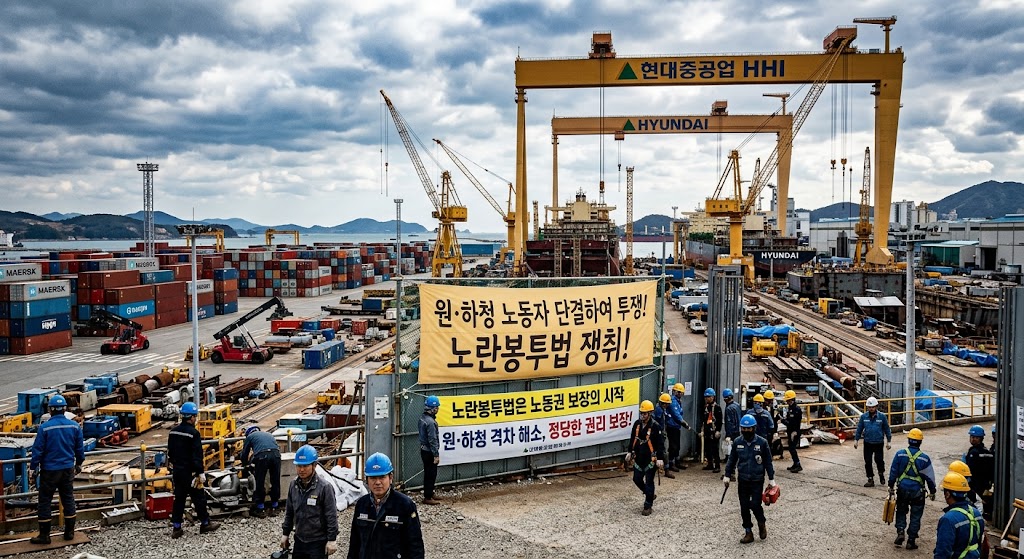
What the Yellow Envelope Act Was Meant to Do
Although it’s called the Yellow Envelope Act, its formal name is the Amendment to the Trade Union and Labor Relations Adjustment Act (Articles 2 and 3). It modified two main things. First, the expansion of the definition of an ’employer’—even if a direct labor contract was not signed, anyone who exerts “substantial and concrete” influence over a worker’s labor conditions is considered an employer. Second, it limits claims for damages against illegal industrial actions by labor unions.
The second provision is where the name originated. In 2014, when Ssangyong Motor strikers were ordered to pay 4.7 billion won in damages, citizens began sending donations in yellow paper envelopes. Therefore, the original intent of this law was that “subcontracted workers had no channel for dialogue with the entity (the primary contractor) that held the real power to decide their wages and working conditions.” Until now, they could only negotiate with the subcontracting firm’s president, who themselves were stuck within the unit prices and production volumes set by the primary contractor.
It was passed once during the 21st National Assembly but was vetoed by the Yoon Suk-yeol administration. After the change in government, it was pushed again as the Lee Jae-myung administration’s top labor legislative priority and passed the National Assembly last August. After a six-month grace period, it took effect on March 10 this year.
The Six-Month Report Card in Numbers
From the time the law took effect until August 14, there were 456 primary contractor workplaces (259 private, 197 public) that received negotiation requests from subcontracted unions. Of these, actual negotiations took place in only 102, or 22.4%. This data was obtained from the Ministry of Employment and Labor by the office of Rep. Kim So-hee of the People Power Party, a member of the National Assembly’s Climate, Energy, Environment and Labor Committee, and was first reported by the Kyunghyang Shinmun.
Six Months of the Yellow Envelope Act: Progress of Primary-Subcontractor Negotiations
| Timeline | Reached Agenda Discussion or Beyond | Main Negotiations Begun |
|—|—|—|
| June 19, 2026 | 51 sites | 10 sites |
| End of July 2026 | — | 24 sites |
| As of August 14, 2026 | Out of 456 requests | 102 (22.4%) |
Looking strictly at the numbers, it went from 10 cases in June to 24 in July, more than doubling in a month, so it might look like it’s gaining momentum. However, when you look at the denominator of 456 as of August, the story changes. Requests keep piling up, but the actual implementation rate remains stuck near one-fifth.
Why is it so slow? The reason is simple. Many primary contractors deny being the “employer” defined by the law, refusing to even acknowledge the request for negotiation, or stalling for time by seeking judgments from the Labor Relations Commission or the courts. Even though the law has broadened the concept of an employer, an additional procedure has been created to dispute whether “our company falls under that definition.”
Why the Government’s Solution Repeats the Same Problems
This is the point I want to highlight in this article. During a cabinet meeting on August 21, President Lee Jae-myung stated, “Disputes over the Yellow Envelope Act are breaking out everywhere,” and instructed that industrial action criteria be clearly defined through enforcement decrees or guidelines. However, the direction the Ministry of Labor took was not an enforcement decree, but implementation guidelines.
Why guidelines instead of an enforcement decree? The Ministry of Labor offers two explanations. First, the Yellow Envelope Act itself lacks a provision delegating authority to an enforcement decree; therefore, limiting the scope of industrial action through a decree could lead to constitutional controversy, as the executive branch might be arbitrarily narrowing a law created by the legislature. Second, while an enforcement decree requires at least three months for legislative notice and regulatory review, guidelines apply to the field immediately upon announcement.
The problem is that these guidelines have no legal binding power. In a commentary, People Power Party Chief Spokesperson Choi Bo-yoon pointed out that “unlike statutes or enforcement decrees, administrative guidelines have no legal force,” and that uncertainty in the industrial field will remain. This statement is not wrong. Past guidelines issued by the Ministry of Employment and Labor regarding ordinary wages or wage peak systems have been overturned by court rulings time and again. Guidelines do not bind the courts.
To explain why this is a problem: when a primary contractor insists, “We are not the employer,” the procedures to file for relief from unfair labor practices or apply for labor dispute mediation with the Labor Relations Commission are still open. However, the ruling at the end of that process still does not provide a final answer to the question, “Is this company the true employer?” If one disagrees with the Labor Commission’s ruling, there is no choice but to go to court, and it takes at least several years for judicial precedents to accumulate. For those who expected the guidelines to fill this gap, the fact that they carry no more weight than reference material in front of a court is disheartening.
In short, the current situation can be summarized in one line: they are trying to resolve disputes caused by the ambiguity of the ’employer’ concept with guidelines that are also ambiguously binding. The government is aware of this dilemma. Creating an enforcement decree risks constitutional debate and a three-month time lag, while creating guidelines lacks binding power from the start. This is the context in which Professor Kim Hee-sung of Kangwon National University Law School said, “Re-legislating the Union Act is the fastest way to reduce the social costs incurred while waiting for precedents to accumulate.” Ultimately, this means there is no fundamental solution other than having the National Assembly amend the law, but that is unlikely to be easy given the current composition of the National Assembly.
Disputes Moving to the Courts
Cases where parties have disobeyed Labor Commission rulings and moved to court have already emerged. Hanwha Ocean’s lawsuit against a Central Labor Relations Commission ruling is known as the “first case of non-compliance with a ruling.” The company’s argument is that the scope of what constitutes an employer was interpreted too broadly. If such lawsuits continue to pile up, the boundaries of employer status will eventually be drawn through precedents, but that process itself will take years. In the meantime, subcontracted workers must remain in a state where they “requested negotiations, but the other side won’t show up.”
An amendment proposed by People Power Party Rep. Na Kyung-won seeks to “exclude high-level management decision-making, such as personnel and management rights, from the scope of labor disputes.” Conversely, the labor sector maintains that restricting the scope of labor disputes via enforcement decrees or guidelines—regardless of the method—is in itself an infringement on the constitutional right to collective action. Both sides are saying, “The current state is not working,” while pointing in opposite directions.
Is This a Real Problem, or Is It Just How Things Are?
I want to be a bit reserved here. I wonder if it would actually be unusual for more than half of a new labor law to be settled smoothly within just six months of implementation. The Trade Union Act is an area that is typically established by refining boundaries through court precedents, and the very concept of ’employer status’ is inherently difficult to define precisely from the start.
However, one thing is certain: the uncertainty cannot be resolved in the short term using the card the government is currently playing (implementation guidelines). Guidelines are just guidelines, and in the meantime, primary contractors and subcontracted unions have no choice but to knock on the court’s door with their own favorable interpretations. There were predictions that this issue would escalate in conjunction with the 2026 spring labor struggle, and it seems highly likely that this trend will continue into the second half of the year.
References
- Kyunghyang Shinmun, Six months of Yellow Envelope Act, only 1 in 5 primary contractors engaged in subcontracted negotiations (2026-08-30)
- Kukmin Ilbo, 'Yellow Envelope Act' primary-subcontractor main negotiations, 10 to 24 cases in a month
- Korea Economic Daily, First lawsuit against Yellow Envelope Act ruling filed (2026-07-26)
- D-Today, People Power Party: "Yellow Envelope Act guidelines are a setback... poor legislation causes national confusion"
- Pen N Mike, Ministry of Labor announces 'implementation guidelines' instead of Yellow Envelope Act enforcement decree
- Wikipedia, Yellow Envelope Act
- Namuwiki, Yellow Envelope Act
- CODIT Insights, Yellow Envelope Act takes effect: Changes in labor relations environment and corporate response strategies
- Ministry of Employment and Labor/Central Labor Relations Commission announcement materials (cited by Kukmin Ilbo)
- National Assembly Climate, Energy, Environment and Labor Committee Rep. Kim So-hee's office submission materials (cited by Kyunghyang Shinmun)