
I set aside a weekend to go to a defense expo. The thought of actually seeing, in person, the equipment I had only ever watched through a screen kept nagging at me.
As it happened, COEX was hosting something called the “2026 Unmanned Vehicle X Civil-Military Cooperation Expo,” so I went along without any particular expectations.
After walking past a few booths, though, something felt off. The “main weapon systems” I had covered in an earlier piece — self-propelled howitzers, tanks, complete aircraft — had been pushed relatively to the back, and the centre of the hall was filled instead with unmanned systems: drones, counter-drone equipment, multi-legged walking robots.
This expo alone drew 88 companies across 187 booths and 13,220 visitors over three days. The scale was one thing, but what stood out was how visibly the centre of gravity had shifted. I wanted to know why, so I dug into it a bit more.
Why drones became the main act instead of tanks
Looking for the reason led straight to the Russia-Ukraine war. In the early months, the conventional wisdom that tanks and artillery were the core of ground combat still held. As time went on, that changed.
Scenes of a tank worth billions of won being neutralised by a single small drone costing a few hundred dollars kept repeating, until “drones over tanks” became the phrase used to explain Europe’s arms race.
There are figures showing that Ukraine’s naval surface drones, “Magura” and “Sea Baby,” have disabled more than eleven major Russian warships since 2022. At that point it really sinks in that drones are no longer a supporting instrument.
The market data shows the same trend in numbers. The global military drone market is projected to grow from roughly $151.1 billion in 2026 to $268.8 billion by 2035, an average of 6.6% a year.
The “drone swarm” market — multiple drones carrying out a single mission together — is climbing more steeply still, forecast to grow about 20% a year from 2026 to 2035 and reach $20 billion. Beyond building one good drone, the ability to control many at once has become a competitive field in its own right.
The expo reflected exactly that shift.
It had originally been an exhibition centred on unmanned vehicles, but from this year the scope was widened outright to include drones, counter-drone systems, command and control, and defense AI. In the space of a single year, what the event’s name stands for changed.
Why anti-drone suddenly got so big
What caught my eye as much as the drone booths was the equipment built to stop them — counter-drone systems, or C-UAS (Counter-Unmanned Aircraft System). On reflection it is the obvious consequence: as means of attack multiply, the means of defense have to grow with them. The Cheongung-II exported to the UAE intercepting Iranian ballistic missiles sits in the same broad category. The difference is that those were missile intercepts, whereas what I saw at the expo was gear built to stop far smaller, far cheaper drones.
The programme showed how seriously the field is being taken. Day two of the expo held a dedicated seminar on “Strategy for building a Korean integrated C-UAS in the age of AI,” and day three ran the World Unmanned Aircraft Forum.
There were even guided tours of the exhibition floor for defense attachés posted to Korea from the United States, India, Poland, Saudi Arabia and elsewhere — which left the impression that this field is no longer a purely domestic industry concern.
What I found interesting is that counter-drone equipment does not stop at any single method such as jamming or physical interception. Surveillance and reconnaissance sensors detect the drone first, then communications are cut, and if necessary it is shot down — several stages bundled into one system. It felt like watching, in real time, how a single threat causes technologies to stack in layers until the industrial ecosystem itself thickens.
Running into LIG again, in front of a walking robot
Working my way around the hall, I spotted a familiar name.
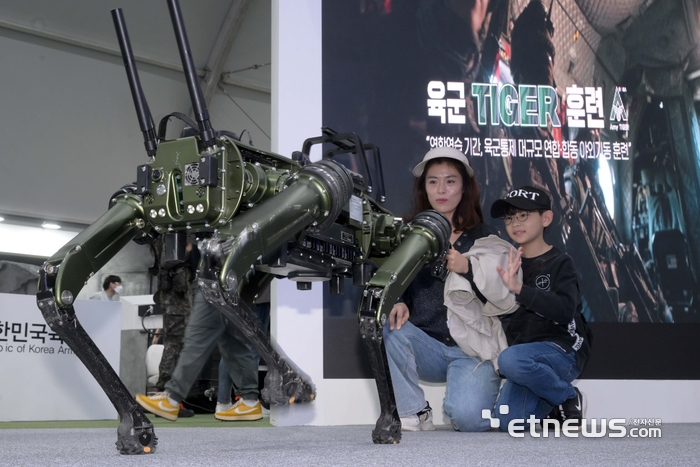
LIG D&A (formerly LIG Nex1) was exhibiting a quadruped walking robot called “Vision 60” — the direct result of LIG D&A’s acquisition of Ghost Robotics. Seeing technology bought for 314.9 billion won standing there as an actual product on a booth made an acquisition I had only read about in the news feel a good deal more concrete.
Behind the attention paid to robots like this, and to unmanned ground vehicles, is a concept called manned-unmanned teaming (MUM-T). Crewed and uncrewed platforms operate as a single team: the unmanned equipment takes the dangerous task first, while people stay back and concentrate on judgment and command. The expo displayed things like an unmanned vehicle for indoor search at fire scenes, and a mock-up of a mine-detection vehicle fitted with a remote-controlled weapon station (RCWS), all under that concept. A robot goes first into the hazardous area a person would once have had to enter, and a person judges remotely from the feed it sends back.
For Korean companies, this looks like more than a technology trend — it reads as an opportunity to diversify.
Several sources repeated the same point: the market is expanding beyond unmanned aerial vehicles to unmanned ground vehicles (UGV), unmanned surface vessels (USV), and laser air-defense weapons on top of that. Where a defense company once concentrated on building one weapon system well, it now has to cover all of these unmanned domains at once.
The make-up of the organisers suggested this is not a case of civilian on one side and defense on the other.
COEX, the Advanced Civil-Military Industry Association and the Korea Research Association for Unmanned Vehicle (KRAUV) co-hosted it, and the event ran at the same venue and in the same period as “Future Mobility Week,” an EV exhibition. You could tell from the programme alone that autonomous driving technology and defense unmanned systems come from effectively the same root. The stated aim is a two-way structure in which civilian autonomous-driving and sensor technology connects to defense demand, while technology accumulated in the military flows back out into civilian industry. Walking between the booths, there were several moments when I genuinely could not tell whether this was a defense expo or a mobility one.
What it means to train without anyone on board
One corner of the hall had simulator and virtual reality (VR) training booths. You put on a headset, sat in a virtual cockpit and operated the equipment — set up so that complex operational situations could be rehearsed repeatedly without moving any real hardware.
Why that is needed becomes clear once you think about it.
Training on real equipment brings fuel costs, maintenance costs and the risk of accidents. In a virtual environment the same situation can be repeated as often as you like, and dangerous scenarios can be attempted without consequence. This is called a “digital twin” — building a virtual model that mirrors the physical equipment, then experimenting and training inside it. Standing in the queue for the experience zone, I began to grasp why software and data capability are now counted as a pillar of defense competitiveness, every bit as much as building rugged hardware.
It also connects to the problem of producing drone operators. Flying a single drone is not especially difficult, but “swarm” operation — controlling many at once — takes trained people. Putting that many real drones in the air for training is impractical given budget and airspace constraints, so simulators fill in the training hours. In the end, how quickly you can produce the people who operate the equipment is becoming as much a part of competitiveness as how well you build it.
What this expo showed
Leafing back through the brochure I brought home, it struck me that the expo’s shift toward unmanned systems was not an accident but a fairly predictable move.
The war in Ukraine proved the “tanks versus drones” framing in actual combat, and the recent conflicts around Iran, Israel and the UAE reconfirmed the need for counter-drone capability. In between, Korean companies have been reinvesting the money and technical capability built up through conventional weapons exports into unmanned systems.
Looking back, names like the K9 self-propelled howitzer, the K2 tank and the KF-21 all describe weapon systems with people inside them.
What I saw at this expo is the opposite. People step back, and robots and drones take the dangerous position instead.
It is not that a completely new industry has appeared, but that two axes are turning at once inside the same defense ecosystem.
Where this drive toward unmanned systems finally converges is still hard to call.
Whether it ends as a performance race between individual drones and robots, or moves to a contest between the software platforms that command and control them as a whole, is not something one expo is enough to judge.
I would like to come back next year and see which booths are standing in the middle of the hall by then.
References
- RobotNews, '2026 Unmanned Vehicle X Civil-Military Cooperation Expo' opens at COEX on the 25th, 2026.08
- ZDNet Korea, Unmanned vehicles, defense AI and anti-drone tech gather in one place, 2026.08.13
- DailySecu, '2026 Unmanned Vehicle X Civil-Military Cooperation Expo' opens — a venue for civil-military technology exchange, 2026.08.25
- RobotNews, Drones, robots and autonomous systems — 'Unmanned Vehicle × Civil-Military Cooperation Expo 2026' closes successfully, 2026.08
- Defense Today, [On-site report] 2026 Unmanned Vehicle X Civil-Military Cooperation Expo, 2026.08
- IT AI Totality, [News] 'Drones over tanks' — how the war in Ukraine changed Europe's arms race, 2026.07.18
- Astute Analytica, Drone swarm market size, growth and outlook [2035]
- Market Growth Reports, Military drone market size and opportunity report (2035)
- Boan News, [Defense security column] 2026 security threat outlook: the new attack surface created by mass-produced drones
- Daum News, From 'Kumsung Precision' to 'LIG D&A' — LIG Nex1's unbroken 50 years, 2026.03.27