
In the middle of the rainy season, I finally felt relieved and pulled my blanket back up only after confirming the hygrometer had dropped to 44%. However, I woke up in the middle of the night with a damp back. The humidity was clearly low, so why was it so hot? I put my hand in front of the dehumidifier and felt not just lukewarm air, but scorching heat. Thinking it might be broken, I searched “dehumidifier hot air,” but the results were unexpected. It wasn’t broken; it was supposed to be that way.
I had many questions. Why do air conditioners blow cold air while dehumidifiers don’t? And that clear water sitting in the tank—is it safe to drink?
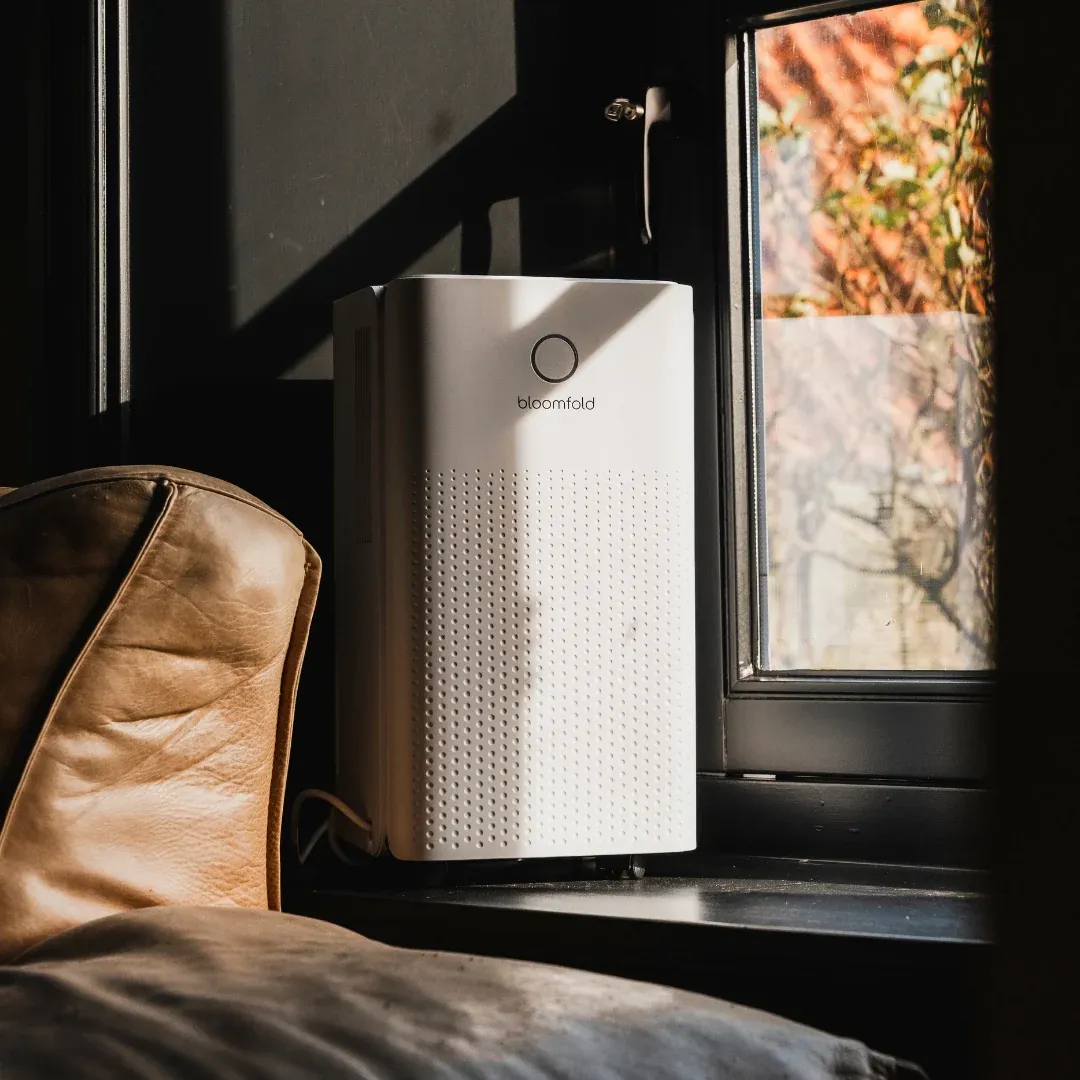
What exactly is this machine doing?
People often think a dehumidifier is a “machine that gets rid of moisture.” That’s not exactly wrong, but it’s not entirely accurate either. What a dehumidifier actually does is collect moisture scattered in the air into one place. It doesn’t eliminate it; it just moves it.
The principle is no different from a refrigerator or an air conditioner. It uses a refrigeration cycle where a refrigerant alternates between compression and expansion to lower and raise temperatures. Within this cycle, water vapor in the air condenses into droplets on the surface of a chilled metal plate (the evaporator). It’s the same phenomenon as condensation forming on the surface of a soda can just taken out of the fridge. Once that water flows down into the tank, the air is released back into the room, now dried.
Up to this point, it’s no different from what the indoor unit of an air conditioner does.
So where does all that heat go?
A dehumidifier has no door for heat to escape. This is the crucial difference from an air conditioner.
An air conditioner uses the refrigerant to carry the heat removed from the air by the evaporator through pipes all the way outside, where the outdoor unit vents it into the atmosphere. That’s why a room with an AC running sees both its temperature and humidity drop. It has an exit for the heat.
In contrast, a dehumidifier has the evaporator and condenser sitting inside the same chassis. The heat recovered by the refrigerant has nowhere to go and returns to the indoor air inside the same machine. This is why the humidity drops while the temperature remains the same or even rises slightly. There are even explanations that indoor temperatures actually rise by 1~2℃.
It becomes clearer when you look at the numbers. The power consumption of a standard household dehumidifier is usually around 300~400Wh per hour. According to the laws of physics, which state that energy cannot be destroyed, all the electricity used to run the compressor is converted into heat and remains in the room. It is effectively the same heat output as keeping a small electric heater on. The only difference is that the heat is labeled as a “byproduct of removing moisture,” making it difficult to notice that the room is heating up.
Interestingly, even air conditioners, which use the same cooling and dehumidifying principles, perform better in dehumidification mode when you only want to lower humidity. According to data released by the Samsung Electronics Air Solution Research Team, the humidity removal efficiency of the dehumidification mode is about 2.7 times higher than that of the cooling mode under the same temperature conditions. Converted into the discomfort index, it drops from 73 in cooling mode to 70 in dehumidification mode, reducing the percentage of people feeling discomfort from 50% to 10%.
Why such a difference? The goal of cooling mode is to reach a set temperature, so once the target is met, it reduces compressor output and switches to maintenance mode. Humidity removal is a secondary effect of that process. Conversely, dehumidification mode operates based on humidity rather than temperature. It focuses on capturing moisture by continuously adjusting the compressor and airflow until the target humidity is reached. Even using the same parts and the same refrigerant cycle, the results differ depending on what the machine is calibrated to prioritize.
Why aren’t there dual-function cooling dehumidifiers?
To be precise, it’s not that they aren’t made; the moment you make one, it becomes a different machine.
As soon as you attach an outdoor unit and move the condenser outside, it’s no longer a dehumidifier—it’s an air conditioner. Portable air conditioners on the market follow this design. Instead of venting heat out the window through an exhaust hose, they provide cooling and dehumidification simultaneously. However, there are issues: you have to run a hose through a window gap, negative pressure can pull in hot outside air, and the hose itself radiates heat into the room, so its efficiency is definitely lower than a wall-mounted air conditioner.
Conversely, for a dehumidifier to maintain its current portability and low power consumption while adding an outdoor unit, there must be a place to dump the recovered heat, but there isn’t one. It’s a thermodynamic problem, not a technical one. It means there is no way to bypass the law of conservation of energy in a sealed room.
Desiccants used in closets or shoe cabinets take a completely different approach. Without a compressor or refrigerant, calcium chloride absorbs moisture on its own, and the pellets dissolve into water. Since there is no need to move heat, the heating problem doesn’t exist. However, the capacity is small, making it insufficient to dry out an entire room.
Essentially, the usage is split: for drying large spaces quickly, you use a compressor type that pays the price of returning heat to the room, and for drying small spaces slowly, you use a desiccant that doesn’t generate heat.
What exactly is the clear water in the tank?
This water hasn’t gone through a single purification process. Yet, it looks clearer than water from a purifier. This is because it has almost no minerals, making it similar to distilled water. It doesn’t even develop water scale like tap water.
However, being clear is different from being clean. If you trace the path this water has taken, you’ll find the answer: indoor air → filter → aluminum/copper cooling coils → water tank. There is no purification step anywhere. The Wikipedia entry for dehumidifiers notes that trace metals like copper and aluminum from the heat exchanger can mix into the water, and unlike distilled water, this water hasn’t been boiled, so mold spores or bacteria can accumulate in the stagnant water.
An article on home appliance cleaning featured an expert comment stating that internal contamination of dehumidifiers is hard to see, making it easy to underestimate the danger, but in reality, they can harbor more bacteria than air purifiers. Just because bacteria are detected doesn’t necessarily mean it’s immediately dangerous. The variance would be large depending on the tank condition and cleaning cycle, but it is a clear fact that it is water that has not undergone any purification.
I used to pour this water into my potted plants because it felt like a waste. Thinking about it now, it was fine for ornamental plants, but if they were edible crops, I would have reconsidered. While it is likely fine for tasks like cleaning or flushing the toilet where there is no direct human consumption or contact, it is not recommended for drinking or using in an iron.
But some water is recycled for drinking
On the International Space Station (ISS), water is produced using the exact same principle as my home dehumidifier. About 400km above Earth, the process of condensing and collecting moisture from the crew’s breath and sweat is no different.
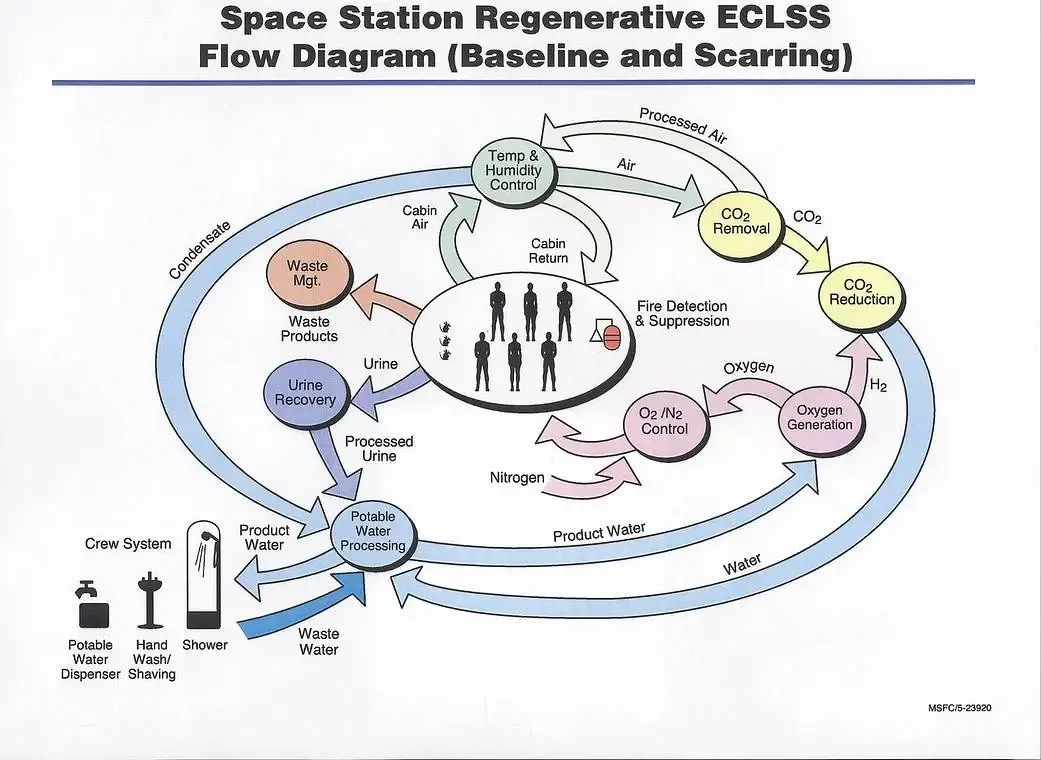
What’s different is what happens next. The ISS Water Processor Assembly does not store condensed water directly. It goes through filtration, distillation, and then a catalytic oxidation step. For American crew members, who even recycle urine, it must go through an additional Urine Processor Assembly before it becomes drinkable water. They say they’ve pushed purification rates from 93% to 98% using vacuum distillation, and the disinfection methods differ as well: the US side uses iodine, while the Russian side uses silver ions, which have antibacterial properties.
A water systems manager at NASA’s Marshall Space Flight Center once said in an interview that if you can overcome the psychological aversion to recycling urine, it tastes no different from bottled mineral water. To be honest, I cringed slightly when I first heard this. But when you think about it, the reaction isn’t that strange. The first stage of condensation is the same as my home dehumidifier, but it takes several more layers of purification to finally become safe drinking water.
The reason they put in so much effort is simple: the ISS has no easy way to bring in new water. Even the emergency water supply is only about 2,000 liters, split between the US and Russian sections. Considering the cost of launching 1 liter of water into Earth’s orbit, it is rational not to waste a single drop. Since my home dehumidifier is in an environment where water flows just by turning a tap, there is no reason to purify condensate through multiple stages to drink it. How precious the water is determines the number of purification stages.
Where did this water come from, and where is it going?
If I lay out the three questions again, the answer points to one thing. What a dehumidifier does is not to eliminate something, but to move it. It moves moisture from the air to the tank, circulates heat within the refrigerant without being able to vent it outside, and merely shifts pollutants from floating in the air to settling in the water.
If you broaden the scope a little, this story seems to go beyond just the dehumidifier. A refrigerator doesn’t eliminate the decay of food but merely slows it down, and the heat generated in that process is returned entirely to the kitchen through the radiator on the back. I read somewhere that the heat emitted by an air conditioner’s outdoor unit doesn’t disappear but rides the walls of the adjacent building, adding a drop to the urban heat island effect of the entire city. I’m not sure how significant this impact actually is, but the directionality seems similar.
These days, I peek at the tank when I empty it. Where did this water come from, and where is this heat going? There seems to be something different between knowing and not knowing when you use these things.
References
- Hankyung - The difference between 'dehumidifier' and 'AC dehumidification'... How to use them correctly (hankyung.com)
- Namuwiki - Dehumidifier entry, explanation of compressor structure and presence of outdoor units (namu.wiki)
- Wikitree - AC dehumidification function vs. using a dehumidifier, electricity bill comparison (wikitree.co.kr)
- Dehumidifier Buying Guide - 3 criteria: operating principle, dehumidification performance, and usability (nosearch.com)
- A-ha - What is the principle of an air conditioner without an outdoor unit? (a-ha.io)
- Wikipedia - Dehumidifier entry, description of heating principles and condensate hygiene (en.wikipedia.org)
- Deye Blog - Is water from a dehumidifier safe to drink? (deye.com)
- Wikitree - Dehumidifier full of bacteria, hygiene management methods (wikitree.co.kr)
- Samsung Newsroom - Tips from developers on maximizing air conditioner energy efficiency (news.samsung.com)
- Womentimes - Summer air conditioner power-saving tips from a Samsung Electronics developer (womentimes.co.kr)
- Koriscience - Are portable air conditioners really cool? Single hose vs. double hose comparison (koriscience.com)
- Summary of principles for dehumidifiers and portable air conditioners (nosearch.com)
- Kyunghyang Shinmun - US astronauts' drinking water is purified urine (khan.co.kr)
- SBS News - What kind of water do they drink on the space station? Using recycled urine as drinking water (news.sbs.co.kr)
- Popular Science Korea - Must drink sweat and urine too, astronaut survival technology (popsci.co.kr)
- ZDNet Korea - NASA, astronaut urine-to-drinking water system upgrade (zdnet.co.kr)
- NASA - Space Station Regenerative ECLSS Flow Diagram (nasa.gov)