
A few days ago, my bathroom light went out. It was an LED I had replaced less than a year ago. Checking the box, I saw “50,000-hour lifespan” printed in large letters. That should last 45 years even with 3 hours of use per day. Yet, it died in just one year.
At first, I assumed it was just a defective unit. But come to think of it, this isn’t the first time. The kitchen light died last year, the hallway light the year before. Since switching to LED, I feel like I’m replacing them more often than the old fluorescent lights. It was so strange that I started looking into it.
LED Lifespan of 50,000 Hours: Which Component Actually Fails?
The first question I had was: “Is the LED itself short-lived?” The answer is no. The theoretical lifespan of an LED light source (chip) is based on the point where brightness drops to 70% of its initial output, estimated by measuring continuous lighting for over 6,000 hours at three different temperatures (55°C, 85°C, and 105°C) to plot a light decay curve. In other words, the “50,000 hours” we see is not when the chip turns off completely, but a theoretical value based on gradual dimming.
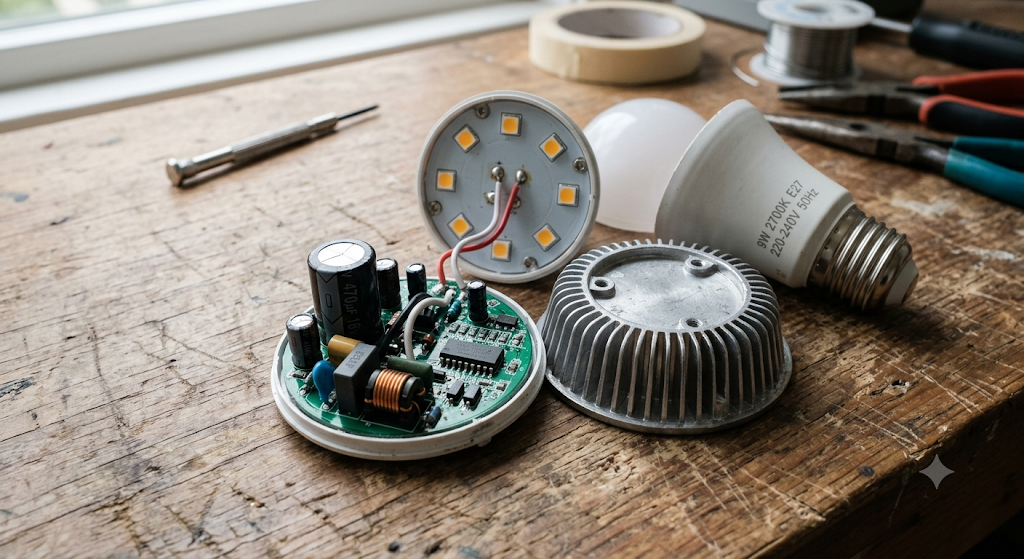
The problem is that a light bulb contains more than just an LED chip. The electricity from our wall outlets is alternating current (AC), but LEDs run on direct current (DC). Therefore, the bulb housing contains a power supply (converter) that acts like a phone charger, along with auxiliary circuits like PWM controllers to manage brightness and lifespan. If you take one apart, you’ll often find these circuit components are more sensitive to heat and generate more heat than the light-emitting chips themselves. Ultimately, when we say a bulb has “died,” it’s usually the circuit, not the LED chip, that has failed first.
I felt a bit disheartened by this. The marketing claim of “50,000-hour LED lifespan” isn’t a lie, but it refers to the “theoretical light decay lifespan of the chip,” not “the time the entire bulb remains functional.”
LED Converters and Electrolytic Capacitors: Why Are They the Problem?
So why do those circuit components fail first? Let’s dive a bit deeper.
The power supply almost always contains a component called an electrolytic capacitor. Looking into its structure, aluminum electrolytic capacitors are inherently finite-lived components. The internal electrolyte gradually evaporates through the sealing rubber depending on the temperature. Over time, its capacity decreases and resistance increases until the electrolyte dries out completely, breaking the circuit. In short, it’s a component designed with the premise that it “will eventually dry out.”
However, this drying rate is extremely sensitive to temperature. The “10-degree rule” is commonly used to predict the lifespan of aluminum electrolytic capacitors, which states that for every 10-degree Celsius increase in temperature, the lifespan is cut in half. Even in LED lighting literature, it’s said that for every 10°C rise in LED temperature, the lifespan can be reduced by up to 50%. So, if you put a bulb in a sealed socket like in a bathroom or a recessed light fixture where heat cannot escape, the capacitor is essentially trapped in a sauna, and it dries out exactly as fast as that temperature dictates.
This is likely why the problem is particularly prominent in budget products. Searching through user reviews, some budget LED lamps have shorter lifespans due to ballast circuit or heat dissipation issues, with extreme cases where two bulbs died in just 100 hours. Disassembling them revealed that it wasn’t the light-emitting part, but the internal diodes themselves that had burned out. While the claim about LED chip lifespan isn’t technically wrong, the issue is that the lifespan of the components excluding the LED chip rarely matches the chip’s own lifespan.
Budget vs. Premium LED Bulbs: Differences in Heat Sinks and Capacitors
Naturally, I wondered, “Then what’s different about the expensive ones?”
It starts with the type of capacitor. There is an alternative called a polymer aluminum capacitor, which has lower equivalent series resistance (ESR) and a longer operating life than standard aluminum electrolytic capacitors. Because they use solid polymer instead of liquid electrolyte, there’s less liquid to “dry out” in the first place. Naturally, they cost more. If a budget bulb tries to save costs here, it’s no surprise that the cheaper one fails first.
The heat sink material also makes a big difference. The primary material for LED heat sinks is aluminum, and for bulbs, floodlights, factory lights, and street lights replacing incandescent bulbs, the heat sink accounts for over one-third of the total material cost. This means that if you use thinner materials or low-quality aluminum to cut costs here, you can lower the price significantly. In fact, the industry views the heat sink as the factor that decisively influences the lifespan and price of an LED.
It was also interesting to learn that the design lifespan of the power driver itself is set shorter than the LED chip. Typically, the lifespan of the driving power supply is about 10,000 to 30,000 hours, caused by the drying of the electrolytic capacitor or the burning of the MOS transistor, while the theoretical lifespan of the LED chip itself exceeds 50,000 hours. In other words, the structure is from the start “total bulb lifespan = lifespan of the shortest-lived component,” and that shortest-lived component becomes even shorter in budget models.
Coming this far, I feel a bit cheated. We buy a single product called an “LED bulb,” but the manufacturers were actually adjusting costs based on how robustly they built the weakest link inside.
[INFOGRAPHIC: “Budget LED vs. Premium LED Internal Structure Comparison” — Shows side-by-side comparison cards for capacitor type, heat sink material, and expected lifespan. Visually points out which components are targets for cost reduction.]
Do Recessed Lights and Bathroom Fixtures Affect LED Lifespan?
It would be a shame to move on without mentioning the structure of the light fixture itself.
I wondered why they die so quickly when placed in sealed spaces like bathrooms or recessed lights, and it turns out it’s simply because there’s nowhere for the heat to escape. While the LED’s own heat generation isn’t massive, heat dissipation relies mostly on circulating air, so problems arise in structures with poor ventilation. It’s known that if the bulb surface temperature exceeds 70°C, it places a strain on the internals.
Some say that structures like bathroom globe lights with glass domes are the worst-case scenario. Because it’s a dome, heat can’t escape and accumulates, and combined with the humidity characteristic of bathrooms, it’s the worst possible environment for LED bulbs. Furthermore, if you hear a buzzing sound, it could be a sign of poor building electrical quality, which also contributes to the early death of LEDs.
This part is both frustrating and understandable. No matter how good the components are, if you stick them in a sealed recessed light, it’s just a trip to the sauna for the capacitor. Conversely, even a budget bulb might last surprisingly long if plugged into a well-ventilated desk lamp. However, I haven’t found statistics to confirm this, so this is just a deduction based on heat dissipation principles.
One more thing that confused me: what exactly does it mean when an “LED bulb’s lifespan is over”? At first, I imagined it would just turn off suddenly like a filament bulb, but looking at the L70 criteria again, it’s different. The light decay of an LED chip starts from the very first day it’s turned on, but it’s so slow at first that you can’t feel it. So, the expression “the chip’s lifespan is over” doesn’t mean it turns off completely, but that the brightness has dimmed noticeably. On the other hand, failures like my bathroom light that cut out completely are almost always a total disconnection in the converter circuit. Even though we use the same word “died,” the chip and the circuit were referring to different phenomena.
Knowing this distinction, I’m clearer on what to look for when buying bulbs. I now know that picking based only on the “rated lifespan” on the package is just looking at the theoretical value for the chip, which is a separate issue from how long it will last in my house. In fact, products that boast unusually high brightness (lumens) per watt—essentially advertising that they are abnormally bright for the same power consumption—are worth being suspicious of. It’s possible they have a configuration that forces high light output despite the heat, which could put a strain on the capacitors and heat sink. Of course, this is just based on principle, so I’m cautious about using it as an absolute standard.
What Should I Look for to Make LED Bulbs Last Longer?
It seems I need to summarize this. I’ve organized it into a table.
Budget vs. Premium LED Bulb Component & Lifespan Comparison
| Category | Budget LED Bulb | Premium LED Bulb |
| — | — | — |
| Capacitor | Standard aluminum electrolytic, low-cost parts | Higher usage of long-life parts like polymer aluminum |
| Heat Sink | Thin or low-quality material, often mixed with plastic | High aluminum content, sufficient thickness |
| Driver Design | Often designed short to cut costs | Designed with leeway, ensuring heat margin |
| Certification | Uncertified or low-cost distributed products exist | Often passed certifications like KC or KS |
| After-sales | Virtually non-existent in many cases | Brand-level warranty policies exist |
Speaking of certification, in South Korea, certifications like KS, KC, and High-Efficiency Equipment are required for manufacturing, distributing, or selling LED lights. Among these, the KS certification aims to ensure the quality and durability of LED lighting products and increase consumer trust through standardization. While KC is more about safety, KS is about quality and performance standards, so even if a product has KC certification, whether it has also received KS is a different matter. However, I haven’t found data that quantitatively compares how much the actual lifespan differs just based on this certification. Having certification likely means it “passed the minimum standard,” not a guarantee that it will “last the longest.”
From a practical usage perspective, the answer is simple: don’t put budget bulbs in sealed recessed lights or glass domes, don’t worry about buying expensive ones if the structure has good heat dissipation, and choose products from manufacturers that offer A/S rather than nameless brands. Actually, this is more about how to choose any electronic device than specifically about LEDs.
LED Bulb Lifespan: What’s the Final Answer?
Going back to the initial question, the answer to “Why do they die so quickly if LEDs have long lifespans?” is closer to “The LED didn’t die; something else did.” And that something else—the capacitor and heat sink—is designed to fail sooner in budget models.
However, I’m not confident that you can judge this 100% just by looking at the price tag. Components can differ by line-up even within the same brand, and there’s no real way to know what’s inside until you actually tear it apart. The only thing I can say for sure at this point is that if your bathroom light goes out frequently, you should suspect the socket structure before blaming the bulb itself.
References
- Daum Tips - Pros/Cons of LED bulbs, recessed socket heat issues
- Clien - Why LED bulbs keep dying despite long lifespans (Converter/PWM controller heat)
- TodaysPPC - Cases of very short-lived budget LED lamps (Diode burnout)
- Munhwa Lighting Q&A - Cases of LED light defects
- HQG Optoelectronics - LED Maintenance: 10-degree rise cuts lifespan by 50%
- Digi-Key - Characteristics by capacitor type, Aluminum Electrolytic vs Polymer capacitor lifespan differences
- Panasonic IDS Korea - Aluminum electrolytic capacitor 10℃ 2-fold rule
- NamuWiki - Capacitors, electrolytic capacitor quality variance
- Electronic Times - Next-gen materials for LED lighting heat sinks beyond aluminum
- ledrhythm - LED L70 lifespan labeling standards, power driver lifespan 10k-30k hours
- e-Nara Standards - KS C 7653 LED Lamp Standards
- cpuholic - Differences between KS, KC, and High-Efficiency Equipment certifications