
The Secrets of Your Irrational Brain: Unpacking Prospect Theory
Do you consider yourself a rational person? Let’s start with a simple test.
Have you ever held onto a losing stock, praying that it will eventually rise? Have you ever bought a lottery ticket, knowing the odds are astronomical, just to hold onto a glimmer of hope? When you found 20,000 won on the street, did the joy feel greater than the disappointment of getting a 20,000 won parking ticket?
If you nodded at any of these questions, congratulations! You are a perfectly normal human being. And this very fact has shaken the massive assumptions that have dominated economics for decades.
In the world of traditional economics, there existed a perfect protagonist known as ‘Homo Economicus’. This character was depicted as perfectly rational, calculating the best choices with computer-like precision to maximize his own benefits. While this model was neat and elegant, it had a fatal flaw: the actual behaviors observed in the real world systematically deviated from this ideal model. Our choices often changed drastically based on emotions, cognitive biases, and how problems were framed.
This seemed like a ‘bug’ that kept occurring in a well-written program. However, the two heroes who opened the door to behavioral economics, Daniel Kahneman and Amos Tversky, thought completely differently. Their brilliant insight was that these ‘bugs’ were not bugs at all, but rather unique ‘features’ of the operating system that is the human mind. They aimed to answer the descriptive question of ‘how do we actually choose?’ instead of the normative question of ‘how should we choose?’.
This conceptual shift was a revolution in economics. The inconsistencies in human behavior that traditional economics dismissed as ’errors’ or ’noise’ were reinterpreted by Kahneman and Tversky as important ‘signals’ that reveal how human psychology operates. They believed that this predictable ‘irrationality’ was the key to understanding humanity, and to explain it, they published the landmark ‘Prospect Theory’ in 1979.
| Dimension | Expected Utility Theory (Old Economics) | Prospect Theory (Behavioral Economics) |
|---|---|---|
| Core Assumption | Rational Actor (Computer-like human) | Psychology-based Actor (Human with feelings) |
| Nature of Theory | Normative (How it should be) | Descriptive (How it actually is) |
| Evaluation Criteria | Absolute value of final assets | Gains and losses relative to a reference point |
| Probability Processing | Uses objective probabilities as is | Distorts using subjective decision weights |
Chapter 1: ‘The Graph of Destiny’ - Illustrating the True Emotions of Your Wallet
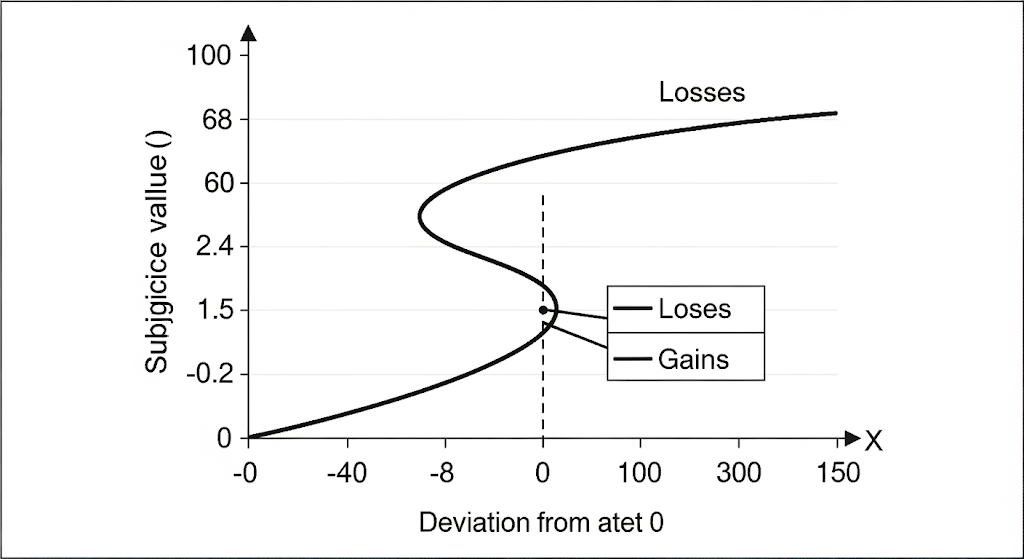
The journey of Prospect Theory begins in the ‘editing’ stage that occurs in our minds before we evaluate choices. Our brains are too busy and lazy to face complex problems directly, so we first simplify the issues. Once this mental cleanup is complete, the actual evaluation begins. At the center of this evaluation is the value function known as the ‘Graph of Destiny’.
Core Principle 1: Everything is Relative (Reference Point Dependence)
The first and most important principle of the value function is that ‘all value is relative’. We do not see the world in absolute amounts like ‘I have a total of 50.5 million won in my bank account’. Instead, we experience the world through changes from a specific reference point, such as ‘I received 500,000 won because it’s payday!’—that is, as ‘gains’ and ‘losses’.
For example, imagine you are expecting a bonus of 1 million won. If the company gives you 1.5 million won, you will rejoice at a ‘gain’ of 500,000 won. However, if they only give you 500,000 won, you will feel upset as if you have experienced a ’loss’ of 500,000 won, even though your money has increased. The starting point of how we perceive value, or the reference point, can turn the same outcome into heaven or hell.
Core Principle 2: The S-Curve of Destiny
The psychological value graphed is the unique S-shaped value function, or the ‘Graph of Destiny’. This graph contains two important secrets about the emotions of our wallets.
- Feature A: The first slice of pizza is the tastiest (Diminishing Sensitivity)
In the graph, you can see that the curve flattens out on both the gain and loss sides. This means that the joy of gaining 10,000 won from 0 won feels much greater than the joy of gaining 1,000,000 won from 1,000,000 won. The same applies to losses. Because of this ‘diminishing sensitivity’, we tend to avoid risks in the face of gains, while we seek risks in the face of losses.
- Feature B: The Deep Pain of Loss (Loss Aversion)
The most powerful discovery of Prospect Theory is this: based on the origin of the graph, the slope of the loss area is much steeper than that of the gain area. Numerous experiments have shown that people feel the pain of losing 100,000 won to be psychologically about 1.5 to 2.5 times greater than the joy of gaining 100,000 won. This fundamentally explains why we prefer the status quo, fear change, and are willing to pay costs to avoid losses.
In fact, this ‘Graph of Destiny’ is not a concept hastily created by economists to explain money. It applies a very old and fundamental psychological law that governs all human perceptual activities to economic choices. In other words, our brains use the same ancient hardware to calculate money as they do to detect light and temperature. This is why the biases explained by Prospect Theory are so powerful and difficult to shake off.
Chapter 2: The Magic Mirror of Probability - How We Distort Possibilities
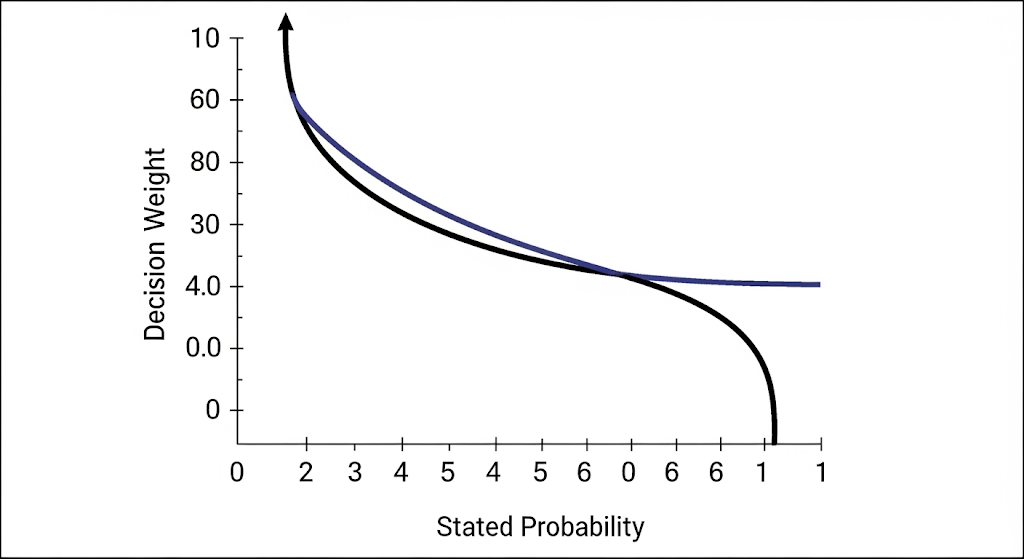
Just as we do not perceive the value of money at face value, we also do not accept probabilities objectively. Traditional economics assumes that a 50% probability is treated as exactly half the value of a 100% probability, but Kahneman and Tversky showed that this is not the case in reality. Instead of using objective probabilities, we use psychologically altered ‘decision weights’.
The phenomenon of distortion is illustrated by the ‘probability weighting function’, which reflects reality like a ‘magic mirror’. This function takes the form of an inverse S-curve and shows how our perceptions are severely distorted at both extremes of probability.
- Effect 1: The Psychology of Lottery (Overestimation of Low Probabilities)
We tend to overestimate very low probabilities that are close to 0. The jump from 0% to 1% probability gives a much greater psychological shock than the change from 50% to 51%. This is called the ‘possibility effect’. This is why we buy lottery tickets with a winning probability of only 0.00001% while thinking, ‘What if?’
- Effect 2: “Almost” is not enough (Underestimation of High Probabilities)
Conversely, we tend to slightly underestimate high probabilities that are close to 100%. The change from 99% to 100% is not just a simple 1% difference; it feels like a qualitative leap from ‘uncertainty’ to ‘complete certainty’. This is called the ‘certainty effect’. This is why a 99% survival rate still feels precarious. We are willing to pay a premium to eliminate that 1% uncertainty.
Ultimately, the true power of Prospect Theory lies in combining these two psychological distortions. First, the value function explains our ‘emotions’ regarding outcomes (gains/losses). Second, the probability weighting function explains our ‘perception’ of the likelihood of those outcomes. Only by looking at these two together can we unlock the secrets of human behavior.
Chapter 3: The Ultimate Cheat Sheet for Predicting Human Behavior - The Fourfold Pattern
Now, let’s combine the two powerful tools we examined earlier—the S-shaped value function (emotion) and the inverse S-shaped probability weighting function (perception). This gives birth to the ultimate ‘cheat sheet’ that predicts human attitudes toward risk with astonishing accuracy: the fourfold pattern.
| High Probability | Low Probability | |
|---|---|---|
| Gain | Risk Aversion (e.g., accepting a certain settlement in a lawsuit) | Risk Seeking (e.g., buying a lottery ticket) |
| Loss | Risk Seeking (e.g., additional gambling to recover losses) | Risk Aversion (e.g., taking out insurance) |
This table encapsulates the essence of Prospect Theory. Let’s examine each cell in detail.
- High Probability Gain: In a situation where there is a 95% chance of gaining 10 million won, we fear the disappointment of ‘What if I get nothing with a 5% chance?’ (certainty effect). Therefore, we exhibit risk aversion by opting for a ‘certain 9.4 million won’ even if it means a slight loss.
- Low Probability Gain: In a situation where there is a 1% chance of gaining 10 million won, we perceive the slim possibility of 1% as much larger than it actually is (possibility effect), filling us with hope. This is why we show a risk-seeking tendency and buy lottery tickets.
- High Probability Loss: In a situation where there is a 95% chance of losing 10 million won, we are in the loss domain, which generally inclines us to take risks. Coupled with the thought of ‘But there is still a 5% chance, right?’ (certainty effect), we exhibit risk-seeking behavior. This reflects the psychology of ‘desperate gambling’ where one takes on more risk to recover losses after an investment failure.
- Low Probability Loss: In a situation where there is a 1% chance of losing 10 million won, we perceive that 1% chance as a looming disaster (possibility effect), and due to the extreme pain of loss (loss aversion), we exhibit risk aversion by willingly paying a certain cost (insurance premium) to eliminate the risk.
This fourfold pattern clearly explains why one person may love risk when buying a lottery ticket at one moment, yet avoid risk to the extreme when taking out insurance at another, providing a coherent framework for seemingly contradictory behaviors.
Chapter 4: From Theory to Reality - Extraordinary Experiments that Shook Economics
No matter how plausible a theory is, it is just an empty story without evidence. The true power of Prospect Theory has been proven through numerous experiments that predict and explain behaviors in the real world.
The Asian Disease Problem: One Word Can Save 600 Lives
The experiment that dramatically illustrates the framing effect of Prospect Theory is the ‘Asian Disease Problem’. It demonstrated that even in the same situation, presenting it in the gain frame leads to risk aversion, while presenting it in the loss frame leads to risk seeking. The only thing that changed was the words ‘saves’ and ‘dies’, yet people’s choices were completely reversed. This was shocking evidence that choices are determined not by objective reality but by subjective ‘frames’.

The Secret of the Oddly Expensive Mug (Endowment Effect)
Loss aversion is not limited to money. The famous ‘mug experiment’ conducted by Kahneman, Knetsch, and Thaler proves this. The results showed that the price at which people were willing to sell a mug they owned (7 dollars) was more than double the price that buyers were willing to pay for the same mug (3 dollars). This is known as the ‘endowment effect’, demonstrating that loss aversion occurs simply from ownership. For buyers, the mug is an object of ‘gain’, but for owners, selling the mug represents a ’loss’.
Repeated Mistakes in the Stock Market (Disposition Effect)
The real financial market serves as a vast laboratory for Prospect Theory. Investors tend to sell winning stocks too quickly (realizing gains) and hold onto losing stocks for too long (avoiding loss realization), a strong tendency known as the ‘disposition effect’. This aligns perfectly with the predictions of the fourfold pattern.
Chapter 5: The Wild Side of Prospect Theory - The Power that Governs Our Lives from Supermarkets to Polling Stations
Prospect Theory is not confined to scholars’ desks. It has already seeped deeply into our lives, quietly influencing marketing, public policy, and consumer behavior.
- The World of Marketing and Sales: Phrases like ‘
Today only at this price!’, ‘Only 3 left in stock!’ create a loss frame that suggests good opportunities will be ’lost’ if one does not act now. Additionally, the ‘one month free trial’ strategy is a brilliant way to instill a ’endowment effect’ in users regarding the service. - Public Policy and ‘Nudge’: Governments utilize Prospect Theory to steer people’s choices in better directions. A representative case is when the method of agreeing to organ donation was changed to ‘opt-out’ (automatically agreeing unless one expresses a refusal), leading to a dramatic increase in donation rates.
Chapter 6: Time to Read the Fine Print - Honest Confessions about the Limitations and Upgrades of the Theory
No great theory can be perfect. Prospect Theory also has criticisms and limitations, and honestly acknowledging these is the path to a deeper understanding of the theory.
- Absence of Emotion: Prospect Theory is fundamentally a cognitive model. Therefore, it does not explicitly address powerful emotions like regret after making a choice or disappointment when expectations are not met.
- Ambiguity of Reference Points: The reference point is the heart of the theory, but it is very difficult to predict in advance what criteria an individual will adopt as their reference point in specific situations.
These limitations are not failures of the theory but part of the healthy evolution of science. Kahneman and Tversky listened to criticisms and, in 1992, published an upgraded version called Cumulative Prospect Theory (CPT) to address the technical issues of the initial model. Thanks to mathematical refinements, CPT has become a much more robust and general model. Today, when we refer to ‘Prospect Theory’ in economics, we mostly mean this CPT.
Conclusion: You are Predictably Irrational, and That is Your Superpower
The greatest legacy of Prospect Theory is breaking the myth of the perfectly rational ‘Homo Economicus’ and placing a psychologically realistic human in its place. As explored in this report, the core concepts of reference point dependence, loss aversion, and probability distortion provide a powerful lens that consistently explains a wide range of human behaviors that traditional theories could not.
The term ‘Graph of Destiny’ is not just a metaphor. That S-shaped curve serves as a map capturing our deep-seated psychological responses to risk, gain, and loss. This map reveals the terrain of human economic choices, which are predictable yet not always rational.
In conclusion, what Prospect Theory has taught us is not that humans are irrational. Rather, our ‘irrationality’ follows surprisingly systematic and predictable patterns. Understanding the hidden scripts in our minds—such as the pull of reference points, the pain of loss, and the allure of certainty—does not merely explain our quirks. It provides a new lens to understand the choices that shape ourselves, our society, and our lives more deeply. This is the map of our minds, and knowing the terrain is the first step to navigating it more wisely.