
Friends, what stories do you know about ‘black gold,’ petroleum, the fuel that makes our civilization’s heart beat? Many of you might recall the grand image of it being formed from fallen giant dinosaurs. It’s probably due to the powerful image conveyed by the name ‘fossil fuel.’
However, today, we will become scientific investigators, lifting the fog of this captivating myth to find the real culprits. The genesis of petroleum is not a tragedy of dinosaurs, but a record of a great deal struck between the sun and incredibly tiny, invisible life forms. Now, shall we open the first page of this grand case file that spans hundreds of millions of years?
Part 1: The Suspect, Dinosaur’s Alibi
The most likely suspect is, of course, the ‘dinosaur.’ But a great detective needs more than just suspicion; they need physical evidence. Surprisingly, dinosaurs had a perfect alibi.
Alibi 1: Absence from the Crime Scene
For petroleum to form, a very specific environment is required: the bottom of deep seas or lakes with almost no oxygen. This is where organic matter can be preserved intact without decaying. However, our suspect, the dinosaur, was a terrestrial animal that roamed the land. The carcasses of dinosaurs that died on land, full of oxygen, were either eaten by other animals or rapidly decomposed by microorganisms, returning to nature. The probability of dinosaurs being buried in large quantities, especially in deep, oxygen-free water, to become petroleum is close to ‘zero.’
Alibi 2: Lack of Motive
To create the immense amount of petroleum buried worldwide, the raw materials must also be beyond imagination. Even the combined weight of all dinosaurs that ever lived on Earth would be far insufficient to create the petroleum we use today. The motive, meaning the ‘quantity of raw materials,’ simply doesn’t add up.
It was you! In fact, the real culprit who spread the ‘dinosaur petroleum’ myth was the American oil company ‘Sinclair Oil’ in the 1930s. They advertised with a friendly dinosaur mascot, claiming, “Our oil is the highest quality, aged since the dinosaur era!” This strategy was a huge success and deeply ingrained in people’s minds.
Part 2: The Grand Alchemy of the Real Culprits
If dinosaurs are innocent, who are the real culprits? The scientific investigation team has finally identified the culprits: they are microscopic organisms like phytoplankton, algae, and bacteria from the ocean, invisible to our eyes! Let’s follow the process of the great alchemy these tiny giants performed over hundreds of millions of years.
Step 1: Preparing the Ingredients (Birth of Kerogen)
When the remains of small organisms sink to the bottom in an oxygen-free environment and mix with mud, they solidify to form ‘Source Rock.’ When this source rock is buried deep underground, bacteria consume the organic matter, removing unstable components through a primary maturation process called diagenesis. At the end of this process, a waxy solid mass, the mother of petroleum, called ‘Kerogen,’ is born.
💡 Chef’s Tip: Types of Kerogen Not all kerogens become the same dish. The final product varies depending on the ingredients.
Type Main Ingredient Characteristics Final Dish Type I Lacustrine algae Highest hydrogen content Premium oil Type II Marine plankton High hydrogen content Oil and gas (most oil fields) Type III Terrestrial plants Low hydrogen content Primarily natural gas
Step 2: The Main Course (The Oil Window)
When the source rock reaches deeper parts of the earth (2-5 km) and a hot kitchen at 60-150 degrees Celsius, the main cooking begins. This is catagenesis. This golden period is called the ‘Oil Window.’
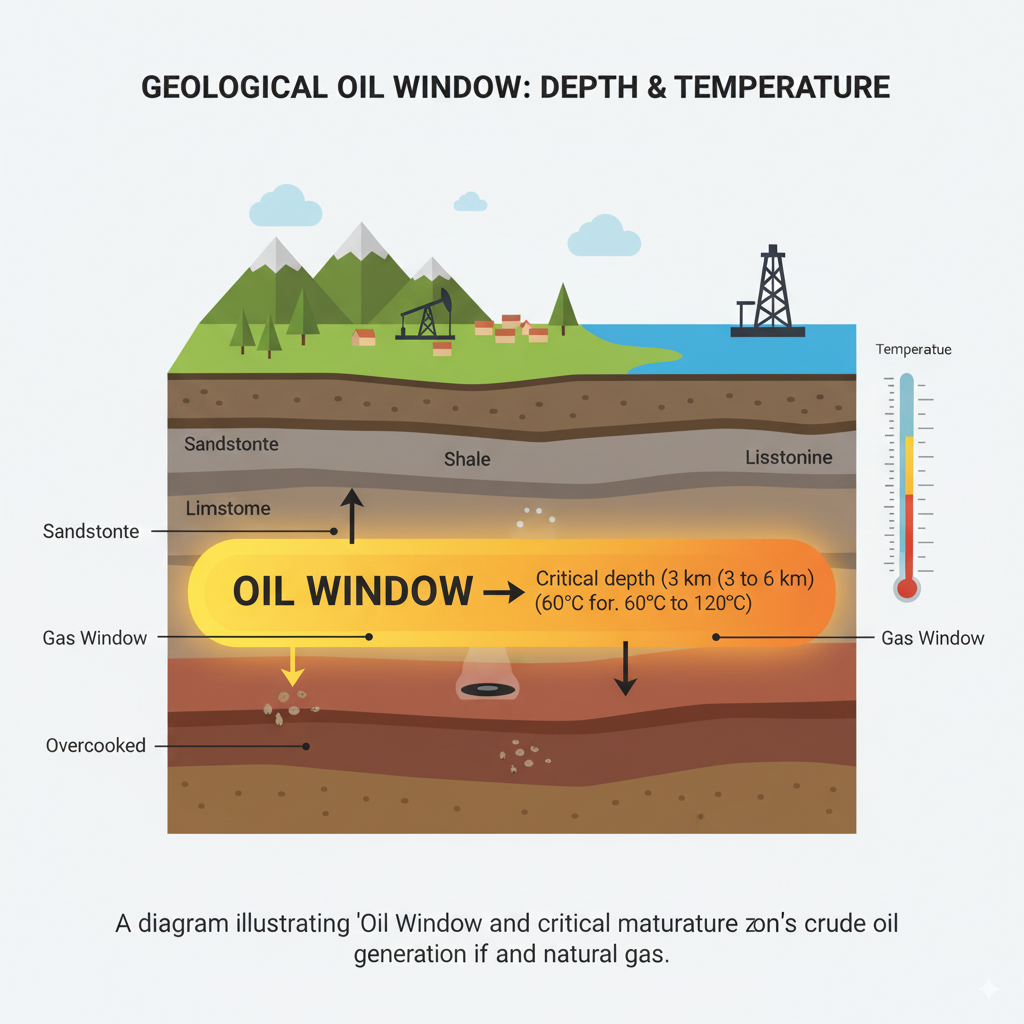
The intense heat from within the Earth breaks down the massive kerogen molecules through ’thermal cracking,’ finally giving birth to liquid crude oil as we know it. If the temperature gets any higher, even the oil will break down and turn into natural gas.
Step 3: The Great Escape and Hiding (Petroleum System)
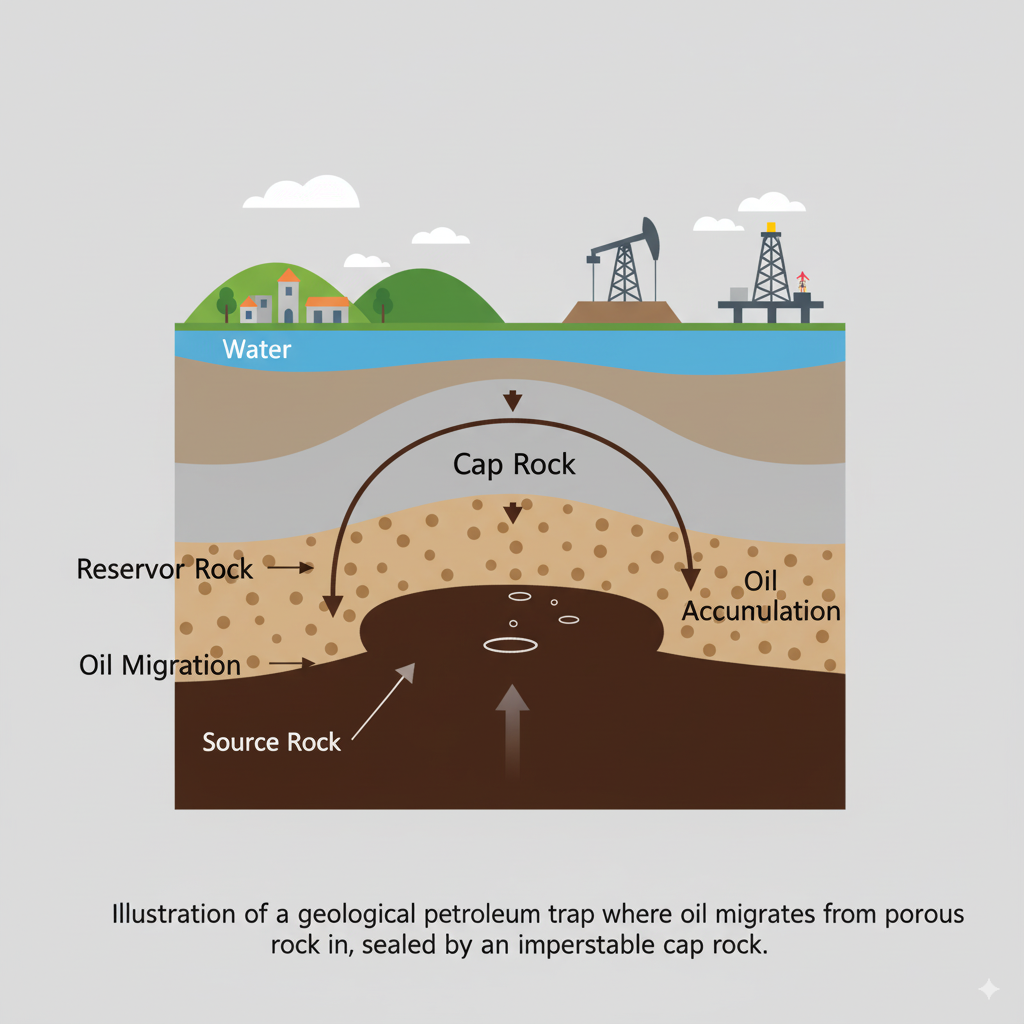
Just because the cooking is done in the kitchen doesn’t mean it’s over. Petroleum must now escape the solid source rock that imprisoned it and find a safe hiding place. This grand journey is called the ‘Petroleum System.’
- Escape (Primary Migration): As the oil and gas transform, their volume increases, creating cracks in the source rock and allowing them to escape.
- Journey (Secondary Migration): Lighter than water, petroleum rises upwards due to buoyancy.
- Hideout (Reservoir Rock & Trap): As petroleum rises, it seeps into porous ‘Reservoir Rocks’ like a sponge, but stops when it encounters impermeable ‘Cap Rocks.’ It is in these ’traps’ that petroleum accumulates to form vast Oil Fields!
Part 3: Conclusive Evidence: Scientific Investigation Files
All these stories are not mere speculation. The clear ’traces of life’ left within petroleum point to the identity of the real culprits.
File #1: Molecular Fingerprints (Biomarkers)
Petroleum contains biomarkers, also called ‘chemical fossils.’ These are unique molecular fingerprints that only living organisms can produce.
- The Smoking Gun: ‘Porphyrin’ molecules, derived from chlorophyll in plants, are found in all crude oil. This is irrefutable evidence that petroleum originates from life forms that underwent photosynthesis.
File #2: Isotopic Signatures
- Estimating Time of Death: Living organisms contain radioactive carbon ($^{14}C$), which disappears within tens of thousands of years after death. All petroleum is devoid of $^{14}C$. This proves that petroleum is the remains of ancient organisms that lived millions of years ago.
- Diet Analysis: Photosynthetic organisms prefer lighter carbon ($^{12}C$). Like living organisms, petroleum has a significantly higher proportion of lighter carbon. This is evidence that the raw materials of petroleum enjoyed a specific “menu” called ‘photosynthesis.’
File #3: Biological Chirality (Optical Activity)
Organic molecules created by living organisms have asymmetric structures, like ’left-handed’ and ‘right-handed’ forms. It’s difficult to create such characteristics through artificial chemical reactions. Surprisingly, crude oil exhibits optical activity, just like living organisms, which is one of the most profound pieces of evidence that petroleum is a product of biological activity.
Petroleum is a ‘Fossil of the Sun’
After a long investigation, we can finally reach a final verdict. Petroleum is not an inheritance from dinosaurs, but the transformed remains of countless microorganisms that stored solar energy through photosynthesis hundreds of millions of years ago. In that sense, petroleum is truly a ‘fossil fuel’ and a ‘fossil of solar energy.’
This truth delivers an important message to us. Petroleum is not an inexhaustible resource that constantly flows from deep within the Earth, but a clearly finite resource that can only be formed through an extremely slow and specific process. This black gold, which has enabled humanity’s dazzling civilization, was in fact a grand feast that the Earth prepared only once over hundreds of millions of years.
Only when we understand the weight of this grand passage of time can we begin to find the real answers on how to use this precious resource and what future we should prepare for.