

Prologue: Trojan Horse, or Digital Savior?
Let’s be honest. If 2024 was the year we got a taste of the novel toy called ‘Generative AI,’ then
2025 will be the inaugural year of ‘Agentic AI,’ where AI breaks free from the narrow confines of chat windows and roams freely across enterprise systems.
We’ve asked AI to “write a poem,” but now the level of command is different.
“Analyze last month’s sales data, draft a marketing proposal, report it to the team lead via Slack, and create a Jira ticket.”
However, amidst this monumental shift, the most vexing technical challenge was ‘connectivity.’
No matter how brilliant the brain (LLM), without connecting to the ’limbs’ like company databases or email servers, it’s just a verbose parrot.
To solve this puzzle, Anthropic’s game-changer is the Model Context Protocol (MCP).
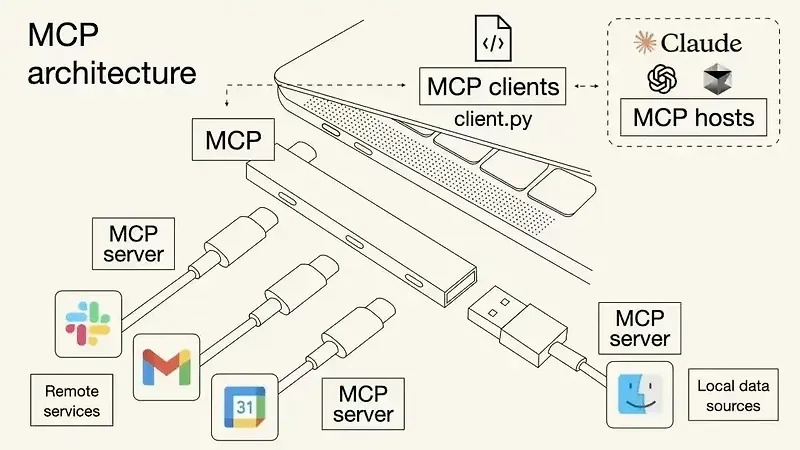
It was an ‘ASCII declaration’ for the AI industry, aiming to connect fragmented digital tools with standardized specifications.
But history proves that technological standardization always leads to shifts in power.
The absolute monarch of the cloud empire, Amazon Web Services (AWS), adopted this open standard faster and more forcefully than anyone else.
And they built a grand, comfortable castle called ‘Amazon Bedrock AgentCore’.
This article asks:
Is this captivating service offered by AWS ‘Noah’s Ark,’ rescuing developers from the swamp of hellish coding?
Or is it a ‘Digital Hotel California,’ eternally enslaving a company’s data and AI sovereignty?
Now, let’s dissect the power dynamics of technology hidden behind the mask of innovation.
1. The Connectivity Revolution: From the $M \times N$ Hell to the USB-C Salvation
1.1 The Fragmented Ecosystem and Developers’ Cries
Before MCP, developing AI agents was like ‘digital manual labor.’
Let’s imagine a scenario: Your company is testing three AI models (Claude 3.5, GPT-4o, Llama 3).
And the internal systems these AIs need to access are five (Google Drive, Slack, PostgreSQL, Salesforce, Github).
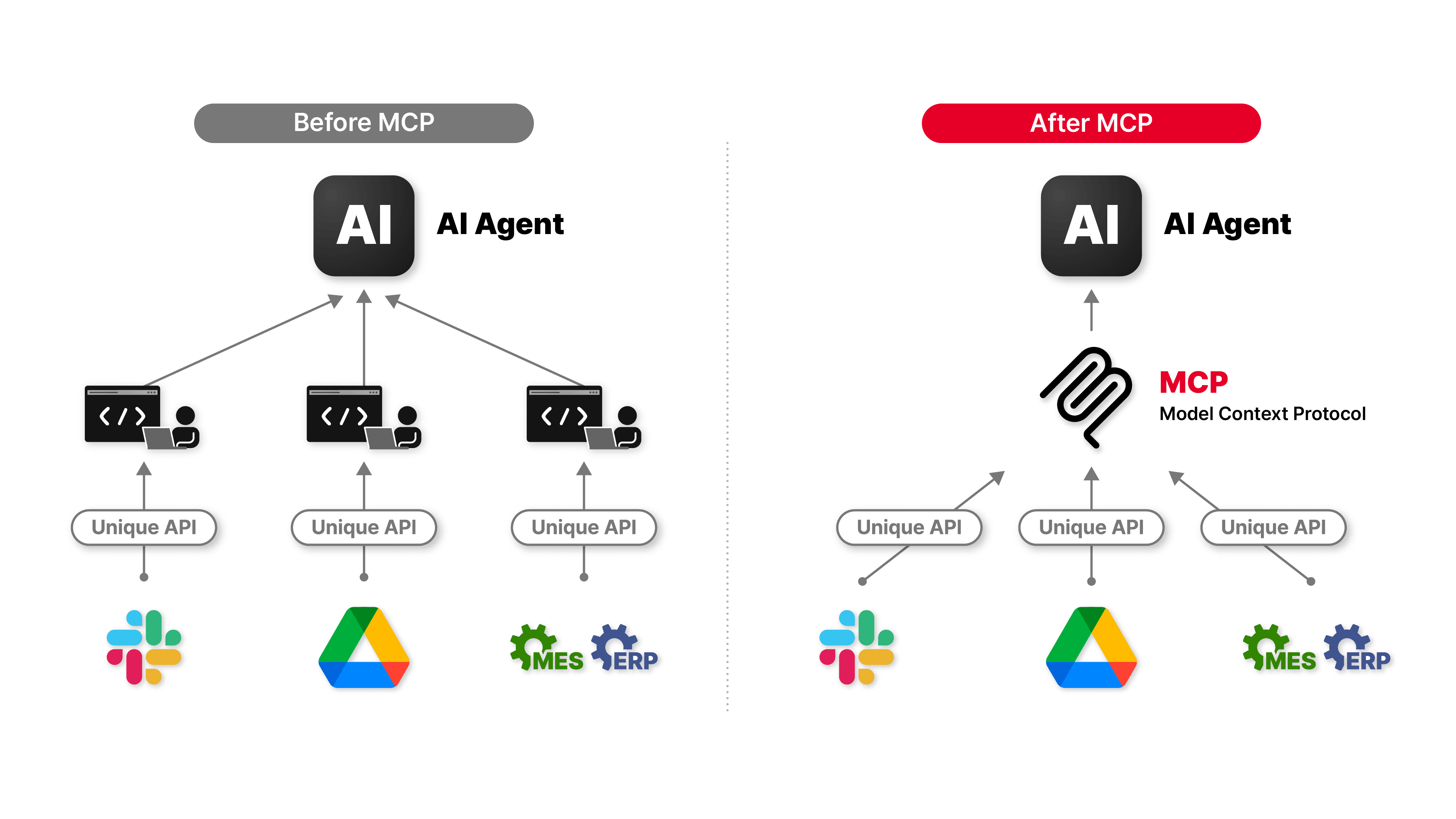
In the old way, developers would need to build a total of 15 individual integration pipelines ($3 \times 5$).
- Code for Claude to read Slack
- Code for GPT-4o to read Slack
- Code for Llama 3 to read Slack…
This is the infamous $M \times N$ problem that drives developers mad.
As each system is added, complexity explodes exponentially, and any minor API update triggers a maintenance nightmare of having to rebuild all pipelines.
1.2 MCP: The Birth of a Universal Adapter for AI
Anthropic’s proposed MCP simplifies this complex many-to-many relationship into a linear one-to-one relationship ($M + N$).
The principle is identical to the USB-C port we use daily.
- Past: There were separate ports for mice (PS/2), printers (Parallel), and monitors (VGA).
- Present: All devices just need to conform to the USB-C standard.
It’s the same in the MCP world.
If a data owner (e.g., Slack) packages their data once in a standard format called ‘MCP Server,’ any MCP-compatible AI model can instantly read and write that data without separate coding.
1.3 Deep Dive into MCP Architecture: A Harmonious Trio
MCP operates beyond simple API calls.
It’s a sophisticated protocol designed for AI to understand ‘Context’ and perform ‘Actions’.
- MCP Host: The orchestra conductor. This corresponds to IDEs like Claude Desktop app or Cursor.
- MCP Client: The actual interpreter. It operates within the host and decides, “Ah, this requires a DB query.”
- MCP Server: The service provider. It’s a wrapper around local files or databases, communicating in a standard language called JSON-RPC 2.0.
2. Dangers in the Wild: The Security Quagmire of Open-Source MCP
However, innovation always comes with risks.
The ‘openness’ of MCP, allowing anyone to create and connect freely, can become a severe security hole in enterprise environments.
And this is where cloud vendors like AWS find their opening.
2.1 CVE-2025-6514: The Moment an Agent Becomes a Hacker’s Puppet
The CVE-2025-6514 vulnerability, which shook the security world in July 2025, exposed the raw reality of the MCP ecosystem.
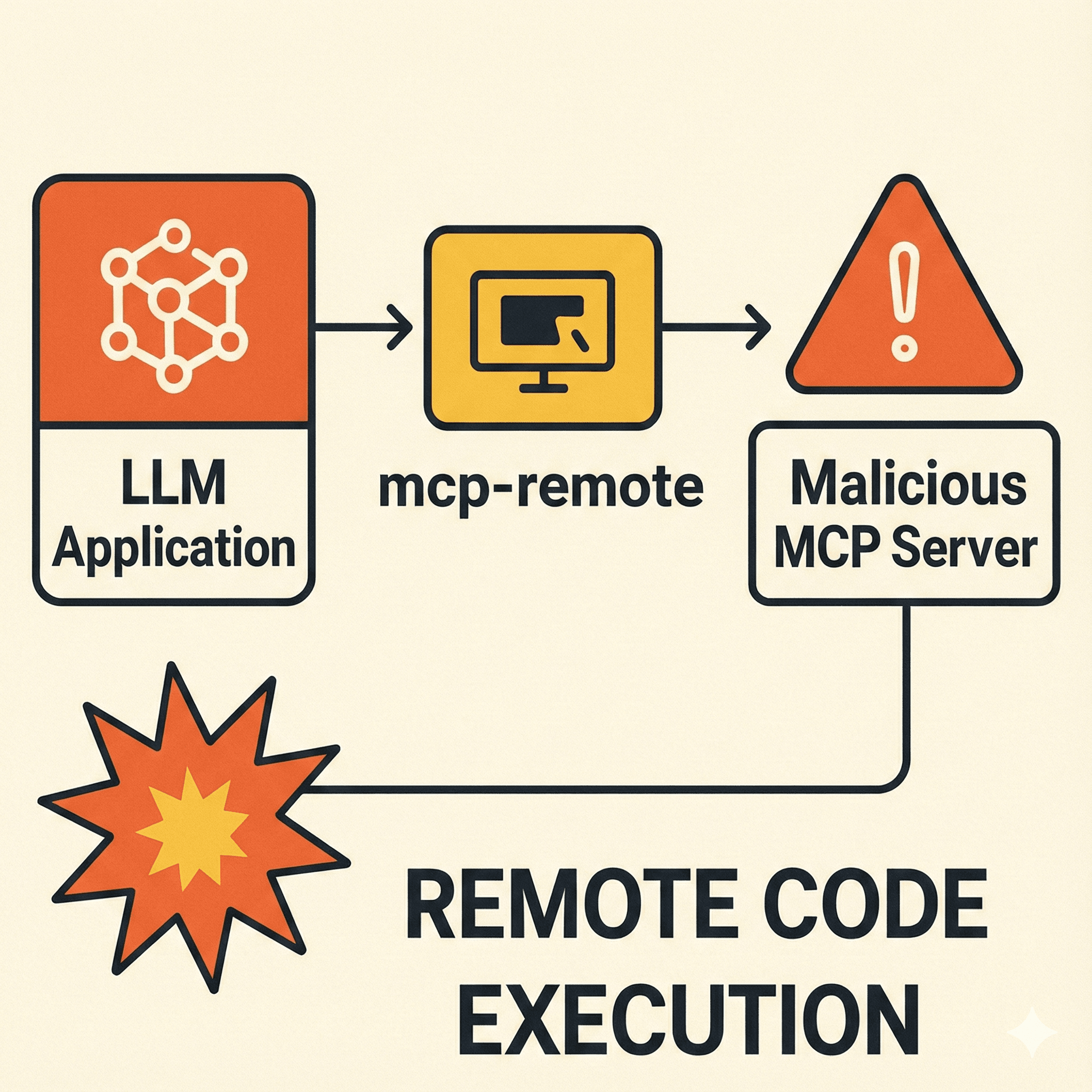
This vulnerability, found in the mcp-remote package, was critically dangerous (Critical, CVSS 9.6) due to its potential for Remote Code Execution (RCE).
\[Hacking Scenario: Friday Afternoon Disaster\]
- Trap Set: The hacker sends a developer a manipulated link disguised as “a new log analysis tool.”
- Authentication Bypass: The
mcp-remotehad a flaw where it blindly trusted the authentication URL provided by the server. The hacker exploited this by manipulating the URL.- Code Execution: Upon clicking the link, instead of an authentication page, a PowerShell command injected by the hacker is executed.
- System Compromise: Instantly, a backdoor is installed on the developer’s PC, and access to the internal network is compromised.
2.2 Excessive Permissions and Supply Chain Attacks
Beyond RCE, the inherent nature of agents, ‘permission delegation,’ is also problematic.
Developers, out of convenience, often grant agents ‘all permissions’ for GitHub.
What if an agent, intended only to read code, accidentally deletes a repository (
_delete_repo_)?Furthermore, Supply Chain Poisoning cannot be ignored.
If malicious code is embedded in a popular open-source MCP server, an agent, trusting the description “this tool is safe,” might transmit confidential documents to a hacker.
These ‘Wild West’ risks compel CIOs to look for “secure managed services,” and this is where AWS smiles and enters.
3. The Empire Strikes Back: How AWS Turned MCP into a ‘Controlled Farm’
AWS’s strategy appears to be a modern variation of Microsoft’s EEE strategy (Embrace, Extend, Eliminate).
However, the focus is on ‘Lock-in’ rather than ‘Elimination.’
They graciously embraced MCP under the name AgentCore and extended it with their proprietary technology.
3.1 AgentCore Gateway: All Roads Lead to AWS
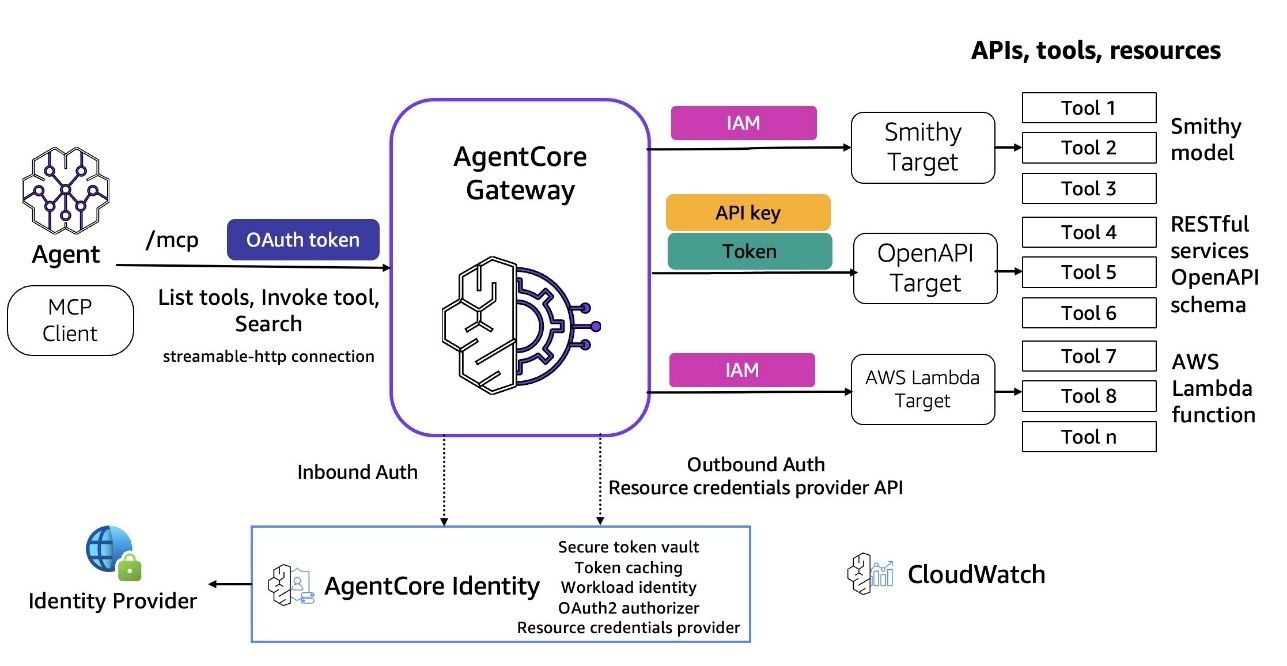
The core of AWS’s strategy is the AgentCore Gateway. This is the gateway and tollbooth between the agent and the outside world.
The Allure of Zero-Code: AWS says, “Don’t code complexly. Just upload your documents, and we’ll handle the conversion.”
It’s convenient. But in return, the company’s business logic is absorbed into AWS configurations.
Code is portable, but AWS console settings are not.
Black Box of Semantic Routing: You entrust the ‘brain’ that decides which of thousands of tools to use to AWS algorithms.
This is the moment control shifts from the developer to the platform.
3.2 AgentCore Identity: Golden Handcuffs of Dual Authentication
AWS also exclusively solved the ‘authentication’ problem, which the open-source ecosystem struggles with, through a ‘Dual-sided Authentication’ architecture.
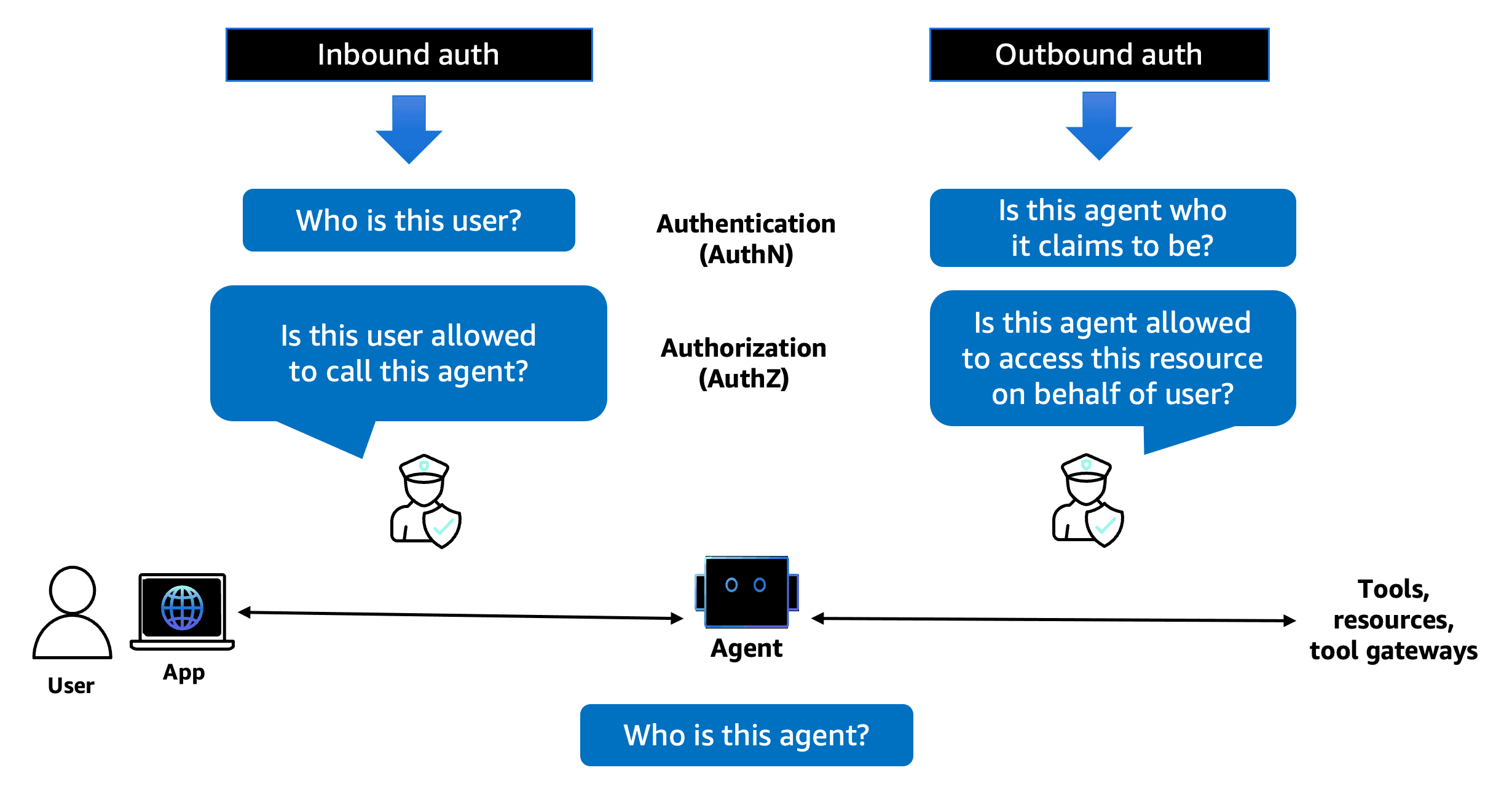
- Inbound: When an agent accesses the Gateway, it’s verified by AWS IAM/Cognito.
- Outbound: When the Gateway calls actual tools (like Salesforce), it uses secret keys from Secrets Manager.
It’s highly secure.
However, adopting this structure perfectly binds a company’s identity system to AWS Cognito and Secrets Manager.
Moving to another cloud requires rebuilding hundreds of authentication logics from scratch.
Yes, ‘golden handcuffs’ have been applied.
4. Invisible Shackles: The Bill for Convenience
AWS’s ‘controlled farm’ is undoubtedly safe and abundant.
But the bill a company must pay to live there is more than just the monthly fee.
4.1 Infrastructure Dependency: The Serverless Paradox
AgentCore Runtime is a special environment deeply dependent on the AWS SDK.
What happens if code that runs well here is deployed on Google Cloud? It won’t work. It requires a complete rewrite.
This isn’t just ’technical debt’; it’s a ‘Platform Hostage’ situation.
4.2 Economic Trap: Tool Call Storms
The billing model is also formidable. $0.005 per 1,000 calls. Seems cheap, right?
But the nature of agents must not be overlooked.
Agents are self-directed and iterative in solving problems.
What if an agent enters an infinite loop or makes thousands of inefficient API calls? This is called a ’tool call storm.’
- Self-hosted Server: Even if it runs all night, only the electricity bill goes up.
- AWS Gateway: You might wake up to a bill of thousands of dollars.
AWS is structurally designed so that “the more the agent acts, the more money they make.”
This is where a conflict of interest arises.
5. The Three-Way Split: Google, MS, and AWS
Of course, competitors aren’t just watching. Google and MS are building alternative ecosystems by targeting different layers.
| Category | AWS (AgentCore) | Google (Agent2Agent) | Microsoft (Semantic Kernel) |
|---|---|---|---|
| Core Strategy | Infrastructure Dominance (Infrastructure) | Collaboration Protocol (Collaboration) | Developer Tool Integration (Dev Experience) |
| Approach | Absorbs MCP as a Gateway component | Standardizes inter-agent communication (A2A) | Co-opts VS Code, GitHub ecosystems |
| Analogy | A walled city | A meeting room full of competent colleagues | A state-of-the-art toolkit provided to developers |
Especially Google’s Agent2Agent (A2A), while AWS focuses on “how to grab tools,” focuses on “how to talk to other agents,” charting a course for horizontal collaboration.
6. Conclusion: Will You Be a Wise Inmate or a Solitary Pioneer?
6.1 A Duet of Innovation and Restraint
Concluding the analysis, the verdict is dual.
At this moment, the fastest and most secure way for companies to build agent AI is undoubtedly AWS.
Its value in security and integration is truly immense.
However, that convenience comes at the cost of a company’s data sovereignty and technological independence.
6.2 Four Survival Strategies for Enterprises (Strategic Recommendation)
So, what should leaders do?
‘Smart utilization’ and ‘strategic distancing’ are necessary.
- Decoupling Logic: Separate the agent’s ‘brain’ from its ‘hands.’ Core business logic should be in standard Docker containers, not AWS-dependent code, allowing for future migration.
- Hybrid Architecture: Don’t route everything through the AWS Gateway. Use self-hosted servers for simple searches, and only route highly sensitive financial processing through the Gateway.
- Introduce Abstraction Layers: Implement a buffer by using neutral frameworks like LangChain or Semantic Kernel in between.
- Externalize Policies: Manage compliance rules with open engines like OPA (Open Policy Agent) to avoid fully relinquishing control to the vendor.
True innovation doesn’t come from settling into a specific platform but from the flexibility to cross boundaries freely.
AWS’s farm can be an excellent incubator, but it shouldn’t be the retirement home where your agents spend their twilight years.
The key is still in your hands. Please don’t hand that key over to AWS administrators.