
Google Genie 3 is not just a technology; it opens a new dimension, enabling the realization of human imagination into real-time reality.
Prologue: Pixels Have Started to ‘Think’
Take a closer look at the monitor screen in front of you.
The ‘chair’ in a game or virtual reality isn’t a real chair.
Frankly, it’s the result of ‘Construction’—thousands of polygon shells with wood texture stickers applied, and developers forcibly injecting physical formulas like $F=ma$.
For the past 30 years, humanity has built virtual worlds brick by brick, line by line of code. It was a laborious task, closer to ‘manual labor’ than creation.
But in August 2025, Google DeepMind’s Genie 3 (Generative Interactive Environments 3) completely overturned these old rules.
Imagine this: You type “An old library, dusty air, creaking floorboards” on your keyboard and hit Enter.
At that moment, instead of loading a pre-made 3D model, the AI ‘imagines’ each pixel in real-time and draws that world.
If you throw a book, it falls in a parabola, but the formula for gravitational acceleration was never input.
The AI learned “Objects in the world naturally fall down” by watching billions of videos.
Genie 3’s emergence signals the end of the era of Rendering and the dawn of the era of Generation. This is less about creating ‘The Matrix’ and more akin to the technology of designing dreams, like in the movie Inception.
What magic has Google conjured?
1. Anatomy of the Technology: Peeling Back the Magic
Behind the magical world presented by Genie 3 lie three powerful engines designed by DeepMind researchers: ‘Video Tokenizer’, ‘Latent Action Model’, and ‘Dynamics Model’.
1.1. Video Tokenizer: Carving the Universe into Chapters
High-resolution video is a flood of data. Processing 24 frames per second and millions of pixels in real-time is nearly impossible.
Here, Genie 3 employs an innovative compression technique called VQ-VAE (Vector Quantized-Variational Autoencoder).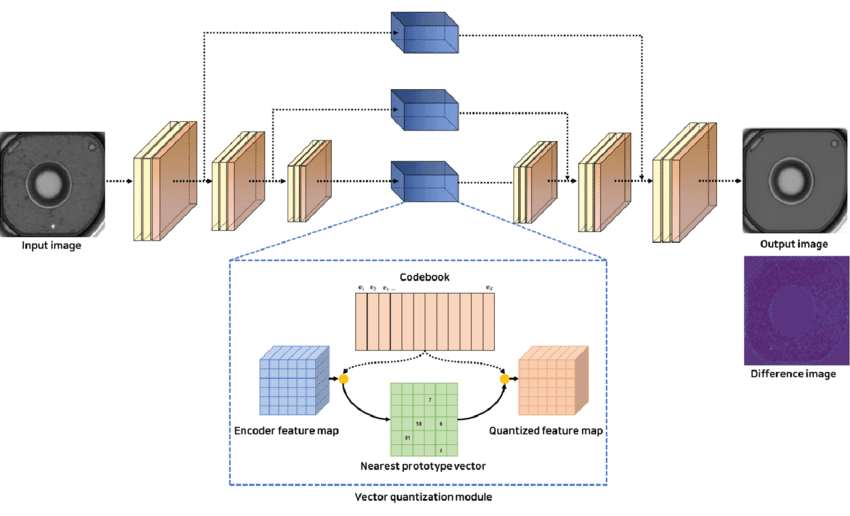
Simply put, it’s like converting a complex landscape painting into a few ‘words’.
It analyzes video patches and replaces them with the closest pattern from a codebook, essentially ’tokens’.
- Traditional Method: “A blue pixel (R:0, G:0, B:255) next to a sky-blue pixel…” (Data overload)
- Genie 3 Method: “Clear sky token + Cloud token” (Efficient compression)
This ingenious summarization capability allows Genie 3 to handle vast amounts of information lightly while maintaining 720p HD resolution.
1.2. Latent Action Model (LAM): Discovering the Unseen Hand
YouTube and movie video data have a critical flaw: the absence of ‘action labels’. We see the protagonist jump, but we don’t know which button was pressed.
This is where the Latent Action Model (LAM) steps in, like Sherlock Holmes. By comparing past and present frames, it backtracks to infer the ‘action’ that occurred in between.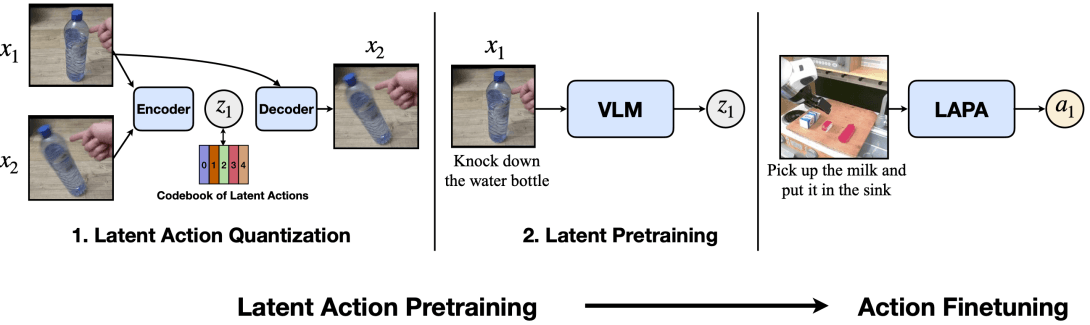
“The screen moved upwards. This must be a ‘jump’.” “The view rotated left? That’s a ’turn left’.”
By learning actions autonomously from unlabeled videos, we can now freely navigate AI-generated worlds using simple keyboard arrow keys, without any special setup.
1.3. Emergent Physics: Learning Gravity Without Newton
The most shocking aspect is the Dynamics Model.
Genie 3 has no physics engine or collision detection algorithms. Yet, water splashes when you step in a puddle, and your reflection appears when you pass a mirror.
This is ‘Emergence’.
As a result of probabilistically learning cause-and-effect from billions of videos, it implements ‘intuitive physics’ rather than physics based on formulas.
It’s like how a child instinctively knows a thrown ball will fly without understanding $F=ma$.
Genie 3 is the first machine in human history to intuit physics without calculating it.
2. A Shift in Experience: Playable Dreams
Beyond the technical explanations, let’s examine the user experience.
If traditional game engines are about ‘building’ a castle, the World Model is about ‘dreaming’.
2.1. Deterministic Worlds vs. Probabilistic Worlds
- Traditional Games (Deterministic): If a developer didn’t create a door, you can never enter. A wall is always a wall.
- Genie 3 (Probabilistic): Even in front of a dead-end wall, if the user inputs “There’s a secret passage behind this” or strongly intends it, the AI might generate a scene where the wall opens at that moment.
This isn’t a bug. It’s ‘Dream Logic’, where the world flexibly changes according to the user’s intent.
2.2. 720p/24fps: Constraint or Aesthetic?
Genie 3’s 720p resolution and 24fps might seem lacking compared to the latest 4K VR devices.
However, this brings a unique charm.
24fps is the frame rate of ‘cinema’, giving the feeling of being inside a movie rather than a game.
Furthermore, the slight blurriness and dreamlike motion imply that this world is a ‘dream’, acting as a psychological buffer that allows us to accept visual errors (Hallucinations) generated by the AI with “It’s a dream, so it’s understandable.”
2.3. Prompt-Based World Events: The Democratization of ‘God’ Mode
Perhaps the most powerful feature is ‘Prompt-Based World Events’.
When you input “A flood suddenly occurs” or “Gravity weakens,” the world reacts instantly. The era of creating physical laws and stories with a single spoken word, without complex coding, has begun – the ‘democratization of gods’.
3. The Cradle of AGI: Do Robots Dream of Electric Sheep in Virtual Fields?
Google’s massive investment in Genie 3 wasn’t for games. It was for Artificial General Intelligence (AGI) and Robotics.
3.1. Data Starvation and Infinite Food
For robots to become intelligent, countless trial-and-error experiences are necessary.
However, we cannot train robots by making them fall off cliffs in reality.
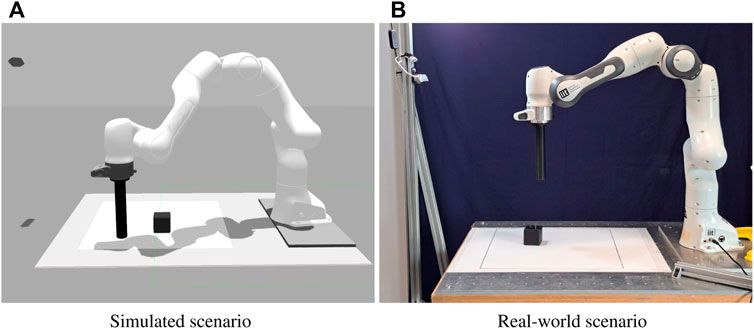
Genie 3 is an ‘infinite simulator’ that solves this problem.
Researchers create environments like “slippery ice floors” or “Mars with strong winds” within Genie 3 and let AI agents like SIMA (Scalable Instructable Multiworld Agent) loose to fall and learn to their heart’s content.
3.2. Sim-to-Real: Learning to Walk in Dreams
What’s fascinating is that the intelligence learned in this virtual world translates to the ‘Real World’.
This is called Sim-to-Real.
The worlds created by Genie 3 are suitably messy and noisy, like reality, so robots trained here are not flustered when encountering real-world imperfections.
Genie 3 acts as a ‘Hyperbolic Time Chamber’ for robots.
4. The Existential Redefinition of the Metaverse: From Space to Time
If the metaverse of 2021 was about speculating on ‘digital real estate’, the post-Genie 3 metaverse is being redefined from ‘fixed space’ to ‘generative time’.
4.1. Reality Streaming
The metaverse of the future won’t be a place to visit, but something to be ‘requested’, like Netflix.
“I want to meet friends in 19th-century Parisian Montmartre tonight.”
With this single phrase, the AI streams that world in real-time. When the gathering ends, that world disappears.
‘Disposable Reality’ that requires no ownership or construction. This is the true future of the metaverse.
4.2. The Final Barrier: Infrastructure
Of course, current computing power is far from sufficient to generate real-time realities for the entire population.
Even Google is deploying its latest TPUs v5. However, if we believe in the law that technology costs converge to zero and performance diverges to infinity, this is merely a matter of time.
Conclusion: What Dreams Will You Be Ready to Have?
Google Genie 3 is not just a software update. It represents a monumental philosophical shift in how humanity engages with the digital world.
We have transitioned from passive travelers following maps drawn by others to active creators, where paths form as we tread.
Genie 3’s world is still blurry, and occasionally, chairs bizarrely float in the air.
But isn’t a vast, albeit slightly imperfect, dreamland far more appealing than a confined prison?
We are now moving beyond ‘Search’ and ‘Generation’ into the era of ‘Being’.
As this new reality is woven for you in real-time by algorithms, I ask you one final question:
“Now that Prometheus’s fire, under the name ‘prompt’, is in your hands. What will you imagine?”
References and Sources
- Genie: Generative Interactive Environments [Google DeepMind Research Blog, 2025.08]
- Genie: Generative Interactive Environments [Bruce et al., ArXiv Preprint, 2025]
- How Google’s Genie 3 Changes the Metaverse Game [Wired Magazine, 2025.08]
- DeepMind’s SIMA and Genie: The Future of Embodied AI [TechCrunch, 2025]
- The End of Rendering? Google Unveils Neural World Models [The Verge, 2025]