
Helium is the second most abundant element in the universe after hydrogen, making up about a quarter of the universe’s total mass. On Earth, however, the situation is the exact opposite. Across the crust and atmosphere, helium exists merely as a byproduct of the extremely slow radioactive decay of uranium and thorium. The moment it leaks into the air, its light weight allows it to overcome Earth’s gravity and escape into space forever. There is no way to retrieve it. It disappears whether burned or dispersed—making helium one of the few finite resources that, once used, can never be replenished. The very helium we learned is an “abundant element in the universe” faces a starkly different reality on Earth.
This matters to all of us because helium is used in places far more critical than party balloons. Hospital MRI scanners rely on liquid helium to chill superconducting magnets down near absolute zero, and semiconductor fabrication plants use helium for wafer cooling and ultra-fine leak detection. In recent years, recurring helium shortages have directly caused delays in routine MRI maintenance and triggered supply chain vulnerabilities in the semiconductor industry. When helium runs dry, your next health checkup could be delayed, and the launch of the next flagship smartphone could be postponed. Right in the middle of this crisis, a new approach is quietly being tested: magnetic cooling technology, which drops temperatures using only magnets—without refrigerants and without helium.
Borrowing Cold vs. Owning Cold
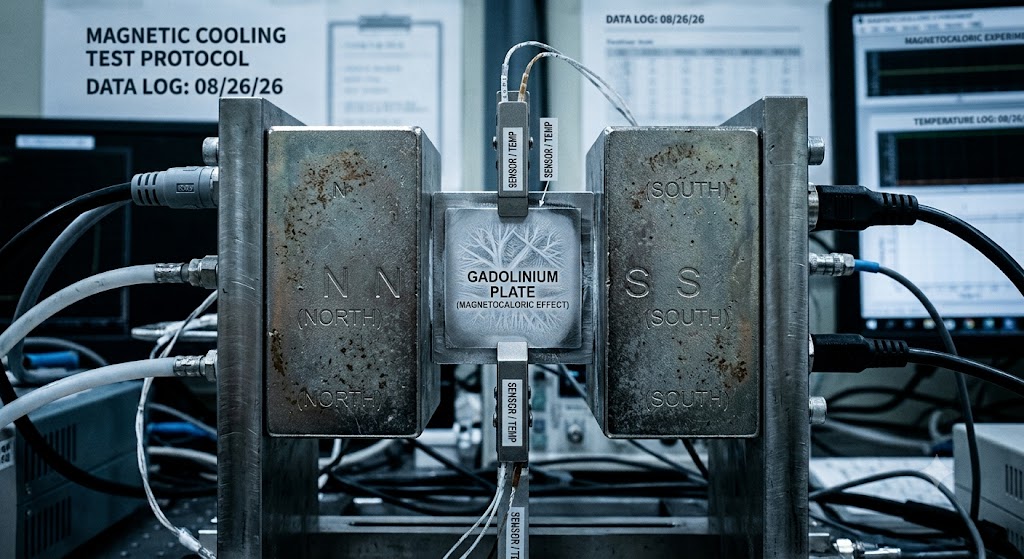
The principle behind magnetic cooling is not new physics. In 1881, German physicist Emil Warburg first observed that applying and removing a magnetic field to iron causes its temperature to subtly fluctuate. Inside a magnetic material, tiny magnetic dipoles—much like miniature compass needles—are randomly oriented. When an external magnetic field is applied, these dipoles align in a single direction. As disorder decreases, the material releases heat and warms up slightly. When the magnetic field is removed, the dipoles tend to randomize again, absorbing surrounding heat in the process and lowering the temperature. By simply repeating the cycle of applying and removing a magnetic field, you can continuously heat and cool the system.
Here lies the interesting contrast. The refrigerators and air conditioners we have used for over 130 years operate on an entirely different mechanism: vapor-compression refrigeration, which compresses and expands refrigerant gas. This method is inherently built on ongoing consumption. Refrigerants gradually leak from piping joints, compressors suffer mechanical wear, and leaked refrigerants must be periodically recharged. The real problem is that these refrigerant gases demand an enormous environmental toll. Commonly used hydrofluorocarbons (HFCs) are greenhouse gases up to 12,400 times more potent than carbon dioxide, accounting for roughly 4% of global greenhouse gas emissions—twice the total emissions of the entire aviation industry. Yet in South Korea, only 1% of distributed refrigerants are properly recovered and disposed of.
In financial terms, conventional cooling is like taking out a loan with monthly interest payments. Refrigerant-based cooling consumes something every time it runs, requiring continuous top-ups to keep operating. In contrast, the magnetic alloys used in magnetic refrigeration suffer no chemical degradation from repeated magnetization and demagnetization cycles. While the upfront cost of sourcing materials and magnets is substantial, the system functions by repeatedly recycling the very same asset. Think of it as the difference between a rental-based economy and an upfront capital investment built to last for decades.
A 143-Year Journey to Become a Refrigerator
It took a long time after Warburg’s initial observation for this phenomenon to evolve into practical cooling hardware. In 1933, American physicist William Giauque used this principle to cool materials down to an absolute temperature of 0.25 K (-272.9°C). However, this was a one-off cryogenic technique confined to laboratory settings. The first proof-of-concept for a magnetic cooling system operating at room temperature did not emerge until 1997—116 years after Warburg’s discovery. In 2015, Haier, Astronautics Corporation of America, and BASF jointly unveiled a magnetic cooling refrigerator that delivered 35% higher efficiency than conventional compressor-based units. In 2016, French company Cooltech Applications launched a commercial system, and the following year demonstrated that a 500-liter cabinet unit could replace traditional refrigeration equipment.
South Korea entered this field relatively late, yet made rapid strides. The Korea Institute of Materials Science (KIMS) achieved a domestic first by securing end-to-end technology across materials, components, and modules—from synthesizing lanthanum- and manganese-based magnetic alloys to processing them into thin plates and fine wires, and assembling them into functional modules. This milestone was published in the international journal Rare Metals in May 2025, alongside domestic patent registrations and US patent applications. It took 143 years to journey from the initial 1881 observation to this point. Market research firm Mordor Intelligence projects that this market will grow nearly 3.5-fold in just six years, expanding from $740 million in 2025 to $2.58 billion by 2031, representing a compound annual growth rate (CAGR) of 23.2%.
Strict regulations are the primary engine driving this growth. The European Union has mandated an 85% reduction in HFC consumption by 2036. Consequently, Europe, with the world’s tightest refrigerant regulations, has become the largest market, capturing 40% of global magnetic cooling demand. The Asia-Pacific region is following closely with the fastest growth, exceeding 25% annually. While commercial refrigeration still represents the largest share at 41%, the center of gravity is shifting rapidly toward data center cooling (growing at 30% annually) and medical applications (expanding at nearly 25% per year).
More tangible than market figures is just how low in temperature this technology can reach. The baseline for cold that we experience in daily life is a home freezer, at around -18°C. Liquid nitrogen drops to -196°C, and liquid helium reaches -269°C. Yet quantum computers running on superconducting qubits require an environment far deeper—cooling down to just 15 millikelvins above absolute zero. Compared to absolute zero (-273.15°C), this gap is far narrower than the difference between human body temperature and a home freezer. The technique that achieves this ultracold regime without liquid helium, using only magnets, is called Adiabatic Demagnetization Refrigeration (ADR). German company kiutra has already commercialized systems that operate two or more ADR units in tandem—allowing one to cool while the other regenerates—maintaining continuous sub-Kelvin temperatures without interruption.
Examining what happens when this technology is absent brings the role of magnetic cooling into sharper focus. Every time helium supplies falter, hospitals face delayed MRI maintenance schedules, and semiconductor fabs encounter disruptions in quality testing. NASA has long pinned its hopes on helium-free cryogenic cooling for space missions. The Astro-H (Hitomi) X-ray astronomy satellite carried an adiabatic demagnetization refrigerator into orbit to maintain its onboard detectors at cryogenic temperatures. In space, where transporting liquid helium is impractical, magnetic cooling was already the only viable option.
Data centers are standing at a similar crossroads. The International Energy Agency projects that global data center electricity demand could more than double by 2030. Oil-free chillers utilizing magnetic bearings can cut cooling costs by up to 50% compared to conventional compressors, and will be supplied sequentially to major US data centers starting in late 2026. Magnetic refrigeration is also a leading candidate in hydrogen storage and transport. Liquid hydrogen forms below -253°C, and research has already demonstrated that Active Magnetic Regenerative Refrigeration (AMRR) powered by superconducting magnets can reach this threshold without relying on helium. In the industrial heat pump sector, magnetic cooling is expanding at over 26% annually, aligning with manufacturers’ accelerated push toward carbon neutrality.
Gadolinium: The Second Helium
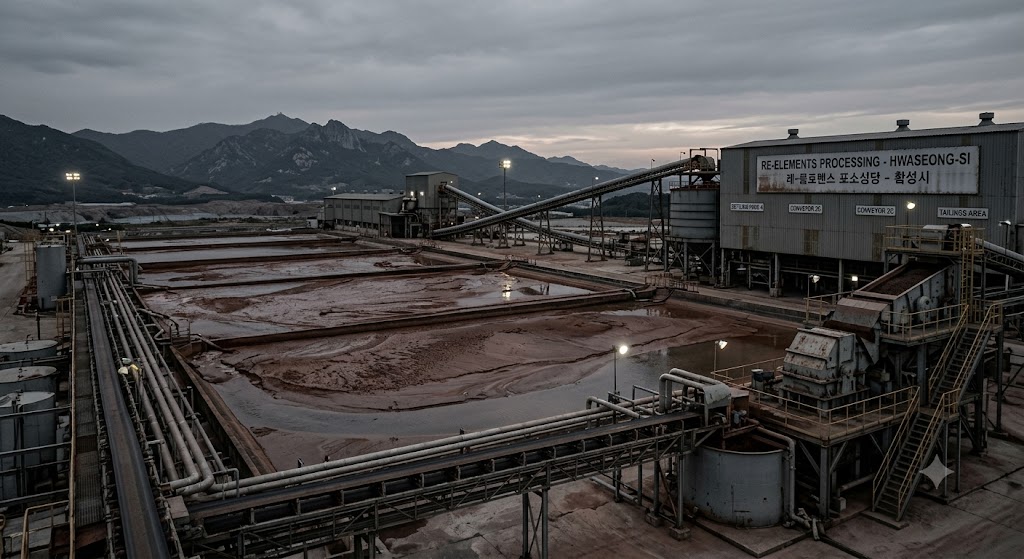
Stepping back, however, reveals a critical dilemma. Gadolinium, the most widely cited core material for magnetic cooling, is a rare earth element. Rare earth refining and supply chains are heavily concentrated in a handful of nations, a bottleneck that has repeatedly caused supply disruptions across multiple industries in recent years. In attempting to escape the depletion of helium, we risk leaning on yet another finite resource. This is why research teams, including KIMS, are actively searching for alternative materials based on relatively abundant elements such as lanthanum and manganese. As of today, however, these alternatives cannot fully match gadolinium-based alloys in both performance and cost-effectiveness.
This pattern is familiar. When chlorofluorocarbons (CFCs) were phased out to protect the ozone layer, hydrofluorocarbons (HFCs)—the very source of today’s crisis—were introduced as the substitute. Moving from one finite resource to the next to patch regulatory holes is a recurring motif in the history of cooling. Whether magnetic refrigeration can break this cycle ultimately hinges on how quickly and effectively we can develop alternatives based on abundant elements.
A deeper question remains. The physics behind magnetic cooling has been known for 143 years. Yet throughout those 143 years, humanity continued using vapor-compression systems that emit greenhouse gases over 10,000 times more potent than carbon dioxide. This was not for a lack of technology, but because compression systems were vastly cheaper while magnetic materials were expensive. The current shift is not happening because magnetic cooling suddenly improved overnight, but because the hidden costs of compression cooling are no longer affordable. We are not merely switching technologies; we are choosing which costs to pay first.
Once helium escapes into the atmosphere, it never returns to Earth. If magnetic cooling can take its place, our next challenge is ensuring that rare earths do not repeat the same mistake. When we press a button on an air conditioner remote, we rarely think about what is consumed and what is recycled behind that click. The next time you hear the low hum of an MRI machine in a hospital waiting room or read about an unexpected product delay, you might think of the silent, vanishing element behind it all. And remember that the magnets poised to replace it are also built upon another finite resource.
References
- e-Science, Race for Refrigerant-Free Cooling Technology... Will Korea Cross the Threshold of 'Magnetic Cooling' Commercialization? https://www.e-science.co.kr/news/articleView.html?idxno=131461
- Electimes, Cooling Moves Toward Decarbonization... 'Gas-Free Cooling' Becomes Reality https://www.electimes.com/news/articleView.html?idxno=365278
- Wikipedia, Magnetocaloric effect https://en.wikipedia.org/wiki/Magnetocaloric_effect
- Mordor Intelligence, Magnetic Refrigeration Market Size & Outlook 2026-2031 https://www.mordorintelligence.com/industry-reports/magnetic-refrigeration-market
- Magnetics Magazine, Surging Data Centers Drive Reliance on Magnetic Technology for Cooling https://magneticsmag.com/surging-data-centers-drive-reliance-on-magnetic-technology-for-cooling/
- Daum News, Development of 'Eco-Friendly Magnetic Cooling Technology' Without Gas Refrigerants https://v.daum.net/v/GDWUjr5ryu
- The Quantum Insider, Helium-Free Magnetic Refrigeration Supports Continuous Milli-Kelvin Temperatures For Quantum Research https://thequantuminsider.com/2026/02/23/guest-post-helium-free-magnetic-refrigeration-supports-continuous-milli-kelvin-temperatures-for-quantum-research/
- For Our Climate, Cooling Humans While Heating the Earth... Greenhouse Gases in Refrigerants Up to 10,000 Times More Potent Than CO2, Yet Management System Has 'Loopholes' https://forourclimate.org/ko/newsroom/1048
- Doctors News, Medical Helium Shortage... Is an MRI Crisis Looming? https://www.doctorsnews.co.kr/news/articleView.html?idxno=81104
- Weekly Hankook, Helium Shortage Triggers 'Red Alert' for MRI and Semiconductor Industries https://weekly.hankooki.com/news/articleView.html?idxno=7081809
- Online Gas Journal, [In-Depth Report] Helium Supply Shock Hits Semiconductor Supply Chain https://www.igasnet.com/news/articleView.html?idxno=30325
- NASA NTRS, On-Orbit Operation of the Adiabatic Demagnetization Refrigerator on the Astro-H/Hitomi Soft X-ray Spectrometer Instrument https://ntrs.nasa.gov/citations/20160008395
- NASA Goddard, Adiabatic Demagnetization Refrigeration System (ADR) https://etd.gsfc.nasa.gov/capabilities/capabilities-listing/adiabatic-demagnetization-refrigeration-systems/
- IOPscience, Active magnetic regenerative refrigeration using superconducting solenoid for hydrogen liquefaction https://iopscience.iop.org/article/10.35848/1882-0786/ac5723
- KAIST, Design of Adiabatic Demagnetization Refrigerator for Hydrogen Re-Liquefaction https://pure.kaist.ac.kr/en/publications/design-of-adiabatic-demagnetization-refrigerator-for-hydrogen-re-/