
When you open a refrigerator door, cold air touches your face. We usually say, “Cold air is coming out.” That’s wrong. A refrigerator doesn’t create cold air. It simply absorbs the heat inside the fridge and spits it out through the coils on the back. That is why it is always warm if you touch the back of a refrigerator.
An LNG plant is a facility that executes this principle on the largest scale on Earth. It doesn’t just “freeze” natural gas; it is a massive heat-relocation device that extracts heat from the gas and throws it somewhere else. And this relocation task alone often consumes power equivalent to a nuclear reactor.
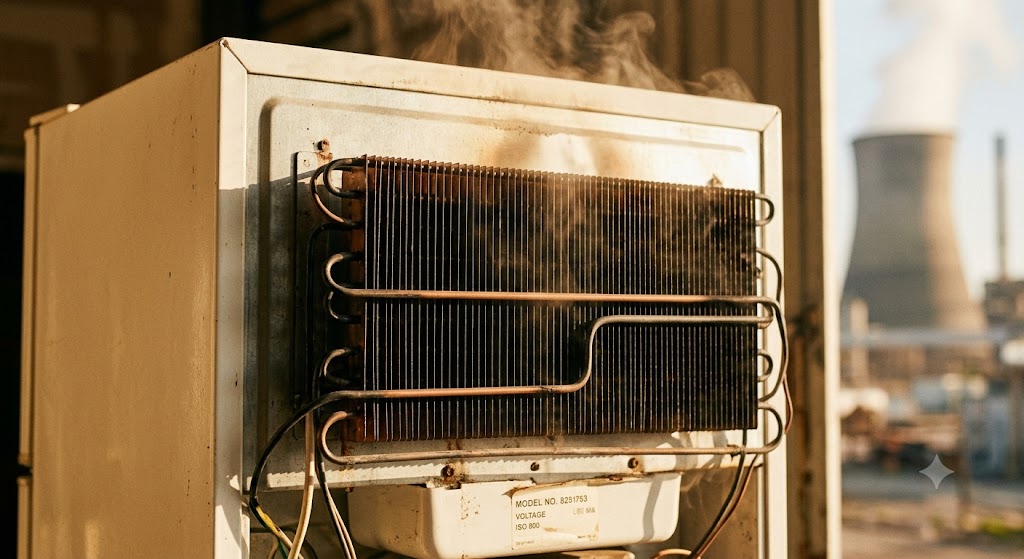
Why it takes a nuclear reactor’s worth of power to turn gas into liquid
Natural gas is a gas when extracted from underground. At room temperature and atmospheric pressure, methane molecules are far apart, moving around randomly. This causes a problem when we try to transport it by ship: the volume is too large. To carry the same amount of energy on one ship, you would need 600 tanks in a gaseous state, but only one tank if converted to liquid. This is because the volume is reduced to 1/600th of its gaseous state, making transport and storage easier.
Looking at the numbers alone, it doesn’t seem that impressive. But if you try to feel this compression physically, the story changes. Imagine taking natural gas the size of a soccer ball and keeping the volume the same while making it 600 times heavier. Or, it’s more accurate to think of it in reverse: the amount of natural gas that fills an entire apartment can be packed into a single kimchi refrigerator through the liquefaction process.
This compression is possible not because of pressure, but temperature. When methane is cooled to -162°C, molecular motion virtually stops, and the molecules clump together to become liquid. By cooling natural gas—which is primarily methane—to -162°C, a colorless, transparent, cryogenic liquid is created with a volume reduced to 1/600th. The problem isn’t the number -162°C itself, but the fact that all the heat contained in the gas must be sent somewhere while cooling it down to that temperature. That heat does not disappear. It is merely moved.
This act of moving heat is what an LNG plant is all about.
A refrigerator and a plant are the same machine
Here lies an interesting structural point. The refrigerator in your home, your car’s air conditioner, and a multi-billion dollar LNG liquefaction plant are actually the same machine. Only the scale is different; the operating principles are exactly the same.
The core of a refrigeration cycle is a refrigerant that carries heat by repeatedly compressing and expanding. When you compress the refrigerant with a compressor to increase pressure, the temperature rises. This heated refrigerant releases heat to the outside air through the condenser. Then, when the refrigerant is expanded through a narrow hole, the pressure drops rapidly, and the temperature plummets along with it. This chilled refrigerant passes through the inside of the refrigerator, absorbing the heat from the food. Then it returns to the compressor. This cycle repeats endlessly.
LNG plants use the same principle. The difference is that they don’t just use one refrigerant, but a mixture of several. The Mixed Refrigerant (MR) process uses a single refrigeration cycle that requires a refrigerant composed of a mixture of light hydrocarbons. Why mix them instead of using one? Natural gas needs to be cooled from room temperature to -162°C, and a single refrigerant cannot efficiently cover this wide temperature range. Mixed refrigerants use a specially selected blend of light hydrocarbons that can be adjusted to mimic the cooling curve of natural gas.
Components like methane, ethane, propane, and nitrogen are mixed in precise ratios to create a single refrigerant. Because this mixture consists of components with different boiling points, different components primarily evaporate and absorb heat at each stage of the cooling process. Heavier components do the work near room temperature, while lighter components handle the cryogenic stage. They overcome a temperature drop that would be impossible for a single refrigerator coil by designing the composition of the refrigerant itself.
One of the most widely used methods is a dual structure where propane is used to pre-cool the gas to a certain extent, and then a mixed refrigerant is used to push it to liquefaction. Natural gas is cooled and liquefied through processes like C3-MR (propane pre-cooled mixed refrigerant), SMR (single mixed refrigerant), DMR (dual mixed refrigerant), or AP-X, with the optimal method depending on factors like LNG production volume and site conditions. Natural gas is converted into LNG through pre-cooling, condensation, and sub-cooling using equipment such as main heat exchangers, refrigerant compressors, drivers, and heat exchangers for refrigerant cooling.
What matters here isn’t the label. Whatever process is used, the essence is the same. Compress the refrigerant and send it to the place where heat will be discarded, expand the refrigerant to make it cold, and then transfer that coldness to the natural gas. Just as a refrigerator steals heat from food and dumps it out the back, an LNG plant steals heat from natural gas and dumps it into a large cooler. The only difference is the scale.
Where does the stolen heat go?
However, there is something strange. The back of a refrigerator is only warm enough to touch with your hand. But the amount of gas an LNG plant processes every day is equivalent to millions of refrigerators. Where did all that heat go?
The answer is the air and the seawater. When the compressor compresses the refrigerant to make it hot, that heat is released into the atmosphere or the sea through giant air-cooled heat exchangers (think of a massive array of industrial fans) or cooling systems that draw in seawater. This discharge stage is exactly where power consumption is concentrated. To run the compressor that compresses the refrigerant, huge gas turbines or electric motors are required, and the power required to drive the compressors of a single large LNG plant can reach levels sufficient to light up an entire city.
At this point, let’s return to the nuclear reactor talk. The “power equivalent to a nuclear reactor” mentioned earlier is not an exaggeration. A large plant producing millions of tons of LNG annually uses hundreds of megawatts of power just to drive compressors. The sole purpose of this power is to push the heat out of the gas. The cost of building a typical liquefaction plant using the mixed refrigerant process exceeds $1 billion, but this high cost is justified by efficiency gains. Most of this cost ultimately goes into the compression equipment that pushes the heat and the power source that drives it.
So, is the LNG produced through all this process now in a safe state? Here, there is a subtle twist. A liquid at -162°C is not in a completely stable state. Even inside the storage tank, LNG continues to evaporate little by little because of minute amounts of heat seeping in from the outside. When LNG is offloaded from an LNG carrier, the pressure in the storage tank decreases by the amount offloaded; this phenomenon can lead to tank damage, so boil-off gas generated at the production terminal is supplied to the ship to compensate for the pressure. Even the cryogenic liquid that seems perfectly contained is, in fact, constantly struggling against the force that wants to turn it back into a gas. Liquefaction is not a one-time event, but a maintenance process that continues until the moment it arrives.
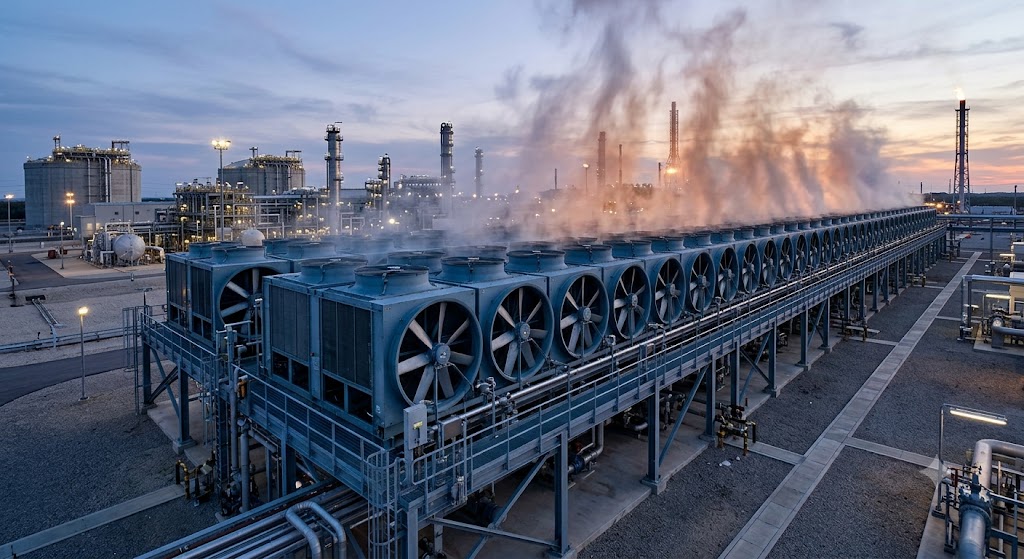
The bill we forgot about
If we summarize what we have discussed so far, we reach a strange conclusion. LNG is promoted as clean energy. Indeed, natural gas is a globally spotlighted energy source because it emits fewer greenhouse gases compared to other fossil fuels like coal and oil, and it is included in the taxonomies of Europe and South Korea. This is true. It is true when it is burned for use.
However, the stage before burning—the liquefaction process explained so far—is missing from the narrative. To reduce the volume by 1/600th, we have already consumed a significant amount of energy in advance. A large portion of that energy goes into running compressors to circulate refrigerant and throwing the heat that the refrigerant “stole” into the atmosphere. Behind the heat that a consumer sees on their gas stove, there is another amount of heat that has already been consumed to transport that gas. This hidden bill is often omitted from price tags and carbon emission calculations.
This is not a problem unique to LNG. When we say we “compress something to make it efficient,” the cost involved in the compression itself is often pushed into a blind spot. The computational cost of compressing data for transmission and the repacking cost of compressing logistics for delivery follow a similar structure. Making something smaller is not free. Only the shrunken result is visible, while the heat and energy that disappeared in the process of shrinking it are moved to the back of the bill.
Next time you light your gas stove, it’s worth thinking once about the long journey that blue flame has taken. Along with the fact that at some point on that journey, a nuclear reactor’s worth of electricity was used solely to steal heat away.
References
- Korea Gas Corporation - Natural Gas Tour: Production Stage
- Korea Gas Corporation - LNG Production Base Research & Development Materials
- SK Innovation E&S Media Room - Energy Encyclopedia: Liquefied Natural Gas (LNG)
- Korea City Gas Association - History of the LNG Industry
- Encyclopedia of Korean Culture - Korea Gas Corporation
- ScienceDirect - Comprehensive review of current natural gas liquefaction processes on technical and economic performance
- Chiyoda Corporation - LNG Plants, Transition Energy Services
- US Patent 5,916,260 - Liquefaction process
- US Patent 6,062,041 - Method for liquefying natural gas
- US Patent 4,548,629 - Process for the liquefaction of natural gas
- IEEE Xplore - Natural Gas Liquefaction Process for Small-scale LNG Project