
A few days ago, I slightly cut my finger. I rummaged through my drawer and found three different ointments: Fucidin, Madecassol, and some other tube that looked like Bepanthen. All three had caps that were half-hardened, and as always, I just picked one based on my gut feeling.
Then, it suddenly occurred to me: Can I really just apply any of these? Or is there a specific order? After looking into it, I found that the ingredients matter quite a bit. Even if they look similar, they contain different substances for different reasons.
What’s in Fucidin?
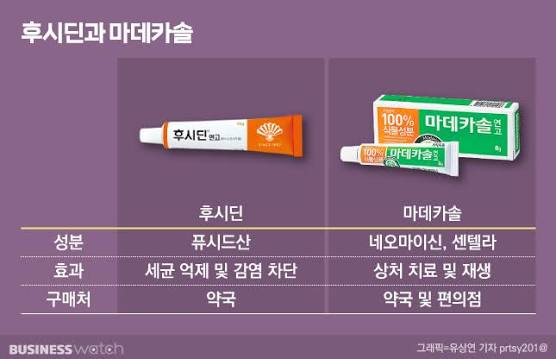
Fucidin’s active ingredient is an antibiotic called fusidic acid. It’s an over-the-counter medication available only at pharmacies, and this fusidic acid serves to block bacterial infections through the wound. In other words, it’s not really a drug that helps the wound heal faster, but rather one that prevents bacteria from invading.
Because of this, many sources summarize Fucidin’s role as preventing bacterial infection rather than accelerating healing or preventing scarring. We often group these together as “ointments that make wounds heal faster,” but the actual mechanism is a bit different. It’s more like locking the door to keep bacteria out, rather than stimulating cell regeneration.
Why are we told to use Madecassol later?
When you look at Madecassol, the story changes completely. Looking at the ingredient list, Madecassol is centered around Centella asiatica extract. Madecassol Care is formulated primarily with this extract, which is known to promote wound healing and help reduce scarring. It’s not an antibiotic; it’s a regenerative ingredient.
Interestingly, there isn’t just one product under the name “Madecassol.” The version sold in convenience stores is a quasi-drug containing only the Centella asiatica extract without antibiotics, while the pharmacy-grade Madecassol is a standard medication that adds an antibiotic (neomycin). They look similar on the outside, but they are actually different products. I wonder if people unknowingly use the convenience store version for wounds that are at risk of infection and end up not seeing any results.
So, the conclusion is that if you want to properly manage a wound from disinfection to scar care, the order is to use Fucidin first, then finish with Madecassol. Use the antibiotic to block the risk of infection in the early stages, then use the regenerative ingredients to minimize scarring once it has healed to an extent. The idea that there is an “order” to follow wasn’t just an unfounded rumor after all.
Why did Bepanthen suddenly become so popular?
For a few years now, Bepanthen has been called a “pharmacy must-have item.” Its ingredients are actually quite different from Fucidin and Madecassol. The core ingredient is dexpanthenol, which is neither an antibiotic nor a Centella asiatica extract. According to Ministry of Food and Drug Safety data, it is used for minor wounds, burns, lacerations (such as cracked nipples during breastfeeding), pressure sores, acute and chronic dermatitis, eczema, skin ulcers, diaper rash, and sunburn. It doesn’t block infection or promote scar regeneration; it’s more about soothing the skin barrier itself.
That’s why it appears more often for dermatitis, dryness, or irritated skin rather than open wounds. I’ve heard stories that it started as a common treatment for diaper rash and then gained popularity as a daily skincare item through social content by doctors and pharmacists. It seems there is a slight gap between its original purpose and its recent trend. However, there are warnings that for those with oily or acne-prone skin, it may cause breakouts or milia around the eyes if used excessively. Given that the term “all-purpose” is usually an exaggeration, it’s probably best to use it in moderation.
Why is Esroban treated differently from Fucidin?
At this point, you might think Fucidin is the strongest antibiotic ointment, but there is actually one level higher: Esroban (mupirocin). This is often prescribed by doctors and is used for more serious infection cases than Fucidin. It is indicated for most skin infections caused by Staphylococcus aureus, including methicillin-resistant strains. The mention of “methicillin-resistant strains” stands out—it means it covers bacteria that don’t respond well to standard antibiotics.
Perhaps because of this, the usage period is strictly limited compared to Fucidin. It is generally recommended to apply a small amount to the infected area 2–3 times a day for 10 days, and after 10 days of use, it should be discontinued for at least 10 days. The idea that you might develop antibiotic resistance if you keep using it just because it’s effective is actually quite frightening. If the bacteria living on your body become resistant to antibiotics, you might end up in a situation where medication doesn’t work when you actually face a serious infection.
So, what should I use in the end?
To summarize, here is the breakdown. While all four are grouped into the category of “wound ointments,” their targets are clearly different.
| Ointment | Key Ingredient | Primary Use Case | Purpose |
| — | — | — | — |
| Fucidin | Fusidic acid (Antibiotic) | Early stage of wound | Blocking bacterial infection |
| Madecassol (Pharmacy) | Centella + Neomycin | As the wound heals | Promoting regeneration + preventing infection |
| Madecassol (Convenience) | Centella only | Scar management stage | Regeneration/Scar reduction |
| Bepanthen | Dexpanthenol | Dermatitis, dryness, irritation | Soothing skin barrier |
| Esroban | Mupirocin (Antibiotic) | Doctor’s prescription | Strong antibacterial (including resistant bacteria) |
Looking at the table, it’s much clearer. Fucidin and Esroban are for blocking bacteria, Madecassol is for regeneration and scarring, and Bepanthen is for soothing and moisturizing.
However, whether you must strictly follow this order is another question. For minor scratches, it likely won’t make a big difference which one you use. You probably only need to check the ingredient list when the wound is deep or persistent. And obviously, if there are signs of infection (swelling, heat, pus), seeing a doctor is more important than choosing an ointment.
Come to think of it, every household’s first-aid kit is a little different. Families with children usually have plenty of Bepanthen, while a bachelor’s room might just have a single tube of Fucidin. Someone who has visited a hospital might have Esroban on hand. This probably isn’t due to any strict rules, but rather a natural accumulation of what was needed at the time.
Personally, after researching this, I realized I had been misinterpreting Madecassol as an “all-purpose wound cure.” I also didn’t know that the convenience store version and the pharmacy version were different products—something you’d never notice unless you carefully read the label. After all, the label doesn’t say “No antibiotics” in big bold letters.
Of course, you don’t need this level of distinction for every single scratch. If you just scraped your fingertip, any of the three will likely do the job. But if the wound is deep or if the swelling and heat don’t subside after a few days, you should think of a doctor before you think of the ointment name. The ingredient breakdown is just for reference; the final judgment is up to the person looking at the wound.
By the way, while writing this, I can’t even remember which one I actually put on my finger. I probably just grabbed whichever one was closest.
※ This post is for general information purposes only. The appropriate ointment and usage may vary depending on the actual state of the wound or individual health conditions. If you suspect an infection or have a severe wound, it is safest to consult a pharmacist or doctor.
References
- Dr. Now, What is the difference between Madecassol Care and Fucidin?
- Dr. Now, What are the differences between Fucidin, Esroban, Madecassol, and Bepanthen ointments?
- Dr. Now, Can I use Esroban again after a 10-day break?
- Bizwatch, Fucidin vs. Madecassol... I thought they were the same, but they're different?
- KMCRIC, What is the difference between Fucidin and Madecassol?
- MFDS Drug Information System, Bepanthen Ointment (Dexpanthenol) Product Info
- Bayer Bepanthen Ointment Leaflet
- Bepanthen Official Website (bepanthen.co.kr)
- Harper's Bazaar Korea, Can I use Bepanthen ointment like a cream?
- health.kr Drug Info, Esroban Ointment Leaflet
- Hudadoc Health, Mupirocin Ointment (Esroban) Efficacy/Effect Q&A