
Fighter jet-related news usually involves reports of aircraft being shot down or firing missiles.
However, an article from a few days ago was quite different. It reported that two Russian Su-35S fighter jets collided over Kursk, resulting in one crash and the death of a pilot.
It wasn’t an enemy aircraft, a missile, or an air defense system—two friendly fighter jets simply collided in clear skies. I looked into it because I wondered how 4.5-generation fighters, equipped with radar and missile warning systems, could fail to see each other and collide. It turns out this isn’t just a Russian issue, but a rather structural one. I also learned that similar accidents have occurred repeatedly in air forces across the world.
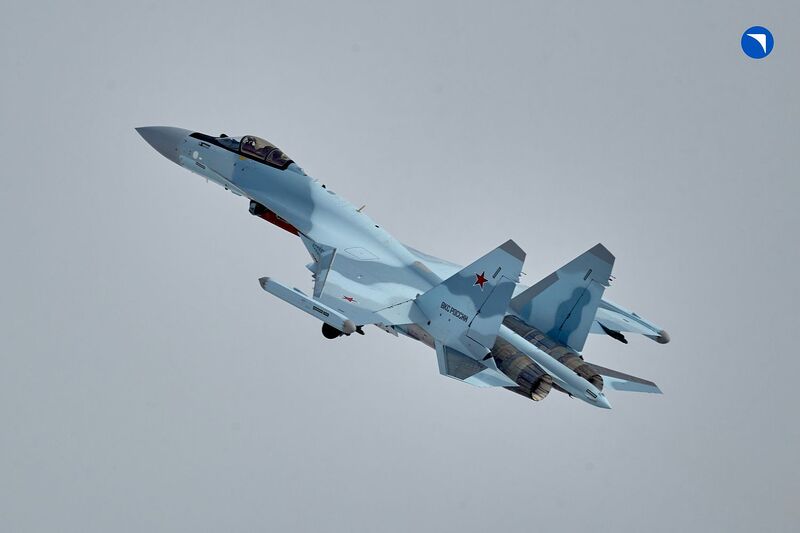
What happened in Kursk to cause two Su-35S jets to collide?
On September 7, the Telegram channel ‘Fighterbomber,’ known to be linked to the Russian Aerospace Forces, first reported that two Su-35S jets had collided in mid-air in the Kursk region. One pilot died and the other was seriously injured; the specific circumstances remain unclear. Neither the Russian Ministry of Defense nor Ukrainian authorities have officially confirmed the accident. Only a single photo of the wreckage has circulated on social media.
Kursk shares a border with Ukraine and has been a site of repeated Russian aircraft losses since the Ukrainian incursion in August 2024. A total of 10 Su-35S losses have been confirmed since the war began, and it is said that this count includes several aircraft lost to friendly fire from Russian air defense systems or engine failures, unrelated to Ukrainian attacks.
The Su-35S is a twin-engine aircraft, an upgraded 4.5-generation version of the Soviet-era Su-27. It has been considered a threat to Ukrainian pilots because it can fire the R-37M long-range air-to-air missile. The R-37M is known to have a range nearing 200km, which has fueled constant concerns that the MiG-29s or F-16s operated by the Ukrainian Air Force could be shot down from long distances before they could even approach. The Russian military has widely used the Su-35S not only for such long-range interception missions but also for air patrols and escorting attack aircraft like the Su-34 operating near the front lines. The fact that two such expensive, primary assets collided with each other in skies empty of enemies makes this incident even more bizarre.
Coincidentally, it is said that the Russian Aerospace Forces received a delivery of new Su-35S jets on August 27, just days before this accident. It must be particularly painful to have an accident occur while trying to replace aircraft consumed at the front. And while adding this accident to the list of losses, it should be noted that Ukraine has repeatedly claimed to have shot down Su-35S jets in direct combat.
Notable examples include one in Kherson in May 2023 and the claim that an F-16 shot one down over the Kursk front in June 2025.
In other words, there are three main ways the Su-35S is being lost in this war: enemy shoot-downs, friendly fire by air defenses, and, like this incident, non-combat aviation accidents. This accident stands out because of the third category, specifically its most primitive form: ‘simply bumping into each other.’
Why don’t fighter jets have collision avoidance systems like airliners?
A question naturally arises here.
Airliners are equipped with a Traffic Collision Avoidance System (TCAS) as a standard feature; why aren’t fighter jets? The impetus for making TCAS mandatory was the 1996 Charkhi Dadri mid-air collision near Delhi, India, where a Saudi Arabian Airlines Boeing 747 and a Kazakhstan Airlines Ilyushin Il-76 collided head-on, killing all 349 people on board. It is considered one of the worst mid-air collisions in history, and since then, this equipment has become effectively mandatory for large passenger aircraft.
TCAS exchanges transponder signals to calculate distance and altitude differences, and if there is a danger, it issues avoidance instructions like “climb” or “descend.” Since this is standard for civilian aircraft, mid-air collisions between large passenger jets have become quite rare.
Fighter jets cannot use this system in the same way.
For starters, keeping a transponder on can be tactically dangerous. In missions requiring low-altitude penetration or radio silence, continuously broadcasting signals is essentially revealing one’s position to the enemy. Furthermore, the avoidance logic of TCAS is built on the premise of “sufficient separation distance,” but close-formation flying and air combat training are missions that break that very premise. If TCAS were to constantly trigger avoidance warnings while flying with wingtips only a few meters apart, it would be a hindrance rather than a help.
Looking closer at TCAS, it operates in two stages.
When a danger is detected, it first gives a ‘Traffic Advisory’ for caution, and if the aircraft actually enter a collision trajectory, it gives a ‘Resolution Advisory’ with specific climb or descent instructions. It even coordinates the two aircraft to move in opposite directions to avoid each other.
The problem is that this logic is designed for the relatively gentle approach of cruising airliners. If this were applied to a fighter formation that is constantly maneuvering, changing positions, and closing and opening distances within seconds, the alarms would sound incessantly and likely hinder the pilot’s judgment.
The U.S. Air Force introduced the Automatic Ground Collision Avoidance System (Auto-GCAS) to the F-16 fleet. This system automatically pulls the nose up to prevent collisions with the ground if a pilot loses consciousness or misjudges terrain; it is credited with preventing several accidents since its deployment. However, it is strictly for preventing collisions with terrain or water, not for air-to-air collisions between aircraft.
There is talk of research into experimentally attaching air-to-air collision avoidance algorithms to the latest models like the F-35, but I haven’t heard news that it has become a standard for fighter jets in general. Consequently, collision avoidance between fighter jets still relies mostly on ‘visual clearance’—the pilot’s eyes and radio communication. While collision avoidance systems for fighter jets will eventually become possible, for now, we are in the ironic situation where the fate of these expensive assets and the lives of the pilots depend entirely on the pilot’s own hands.
References
- https://www.yna.co.kr/view/AKR20260908090600704?input=1195m
- https://nownews.seoul.co.kr/news/newsView.php?id=20260908601006
- https://www.newsweek.com/russian-su-35-fighter-jets-collide-mid-air-reports-12414511
- https://defence-blog.com/russian-su-35-fighter-jets-collide-over-kursk-killing-pilot/
- https://united24media.com/world/two-russian-su-35-jets-collide-in-mid-air-over-kursk-region-22324
- https://www.globaldefensecorp.com/2026/09/08/no-iff-no-data-link-and-no-networking/
- https://www.newsweek.com/what-leads-fighter-jets-crashing-into-each-other-11962115
- https://www.pbs.org/newshour/nation/what-to-know-about-a-midair-collision-between-2-navy-jets-at-an-idaho-air-show
- https://www.yahoo.com/news/articles/air-force-says-night-vision-140018645.html
- https://v.daum.net/v/20260304133300930
- https://www.munhwa.com/article/11572156
- https://ko.wikipedia.org/wiki/KF-16
- https://www.tribuneindia.com/news/defence/why-do-midair-aircraft-collisions-occur-and-how-can-they-be-avoided/
- https://www.luke.af.mil/Portals/58/MACA%20Pamphlet.pdf