
The Secrets of Human Decision-Making: An In-Depth Analysis of Loss Aversion and the Endowment Effect
- Understand the basic concepts of the Endowment Effect and Loss Aversion.
- Identify their impacts on our lives, including investing, real estate, and marketing.
- Learn how to overcome irrational biases and make better decisions.
Have you ever heard the term ‘dumb owner’? I have experienced hesitation when trying to sell an item I barely used on a second-hand market, thinking, ‘I can’t sell it for this price; I paid more for it.’ This psychological tendency to overvalue and cling to an item simply because we own it is known in behavioral economics as the Endowment Effect.
This irrational behavior is far from the traditional economic model of ‘Homo Economicus,’ which assumes perfect judgment based on all available information. Pioneers of behavioral economics, Daniel Kahneman and Amos Tversky, demonstrated that humans are not always rational and are, in fact, “predictably irrational.”
In this article, we will delve into two key psychological factors that manipulate our minds: Loss Aversion and the Endowment Effect, and explore ways to escape the traps of these biases.

Loss Aversion: Why the Pain of Losing is Greater than the Joy of Gaining
Loss Aversion simply means that we feel the pain of losing 100,000 won much more intensely than the joy of gaining 100,000 won. This is a core concept of Prospect Theory, for which Kahneman received the Nobel Prize in Economics.
The S-shaped ‘value function’ graph of Prospect Theory shows two things:
- Reference Point: All judgments are divided into gains and losses based on the current state.
- Asymmetry: The slope of the loss area is much steeper than that of the gain area, indicating that the pain of loss is felt more acutely than the joy of gain.
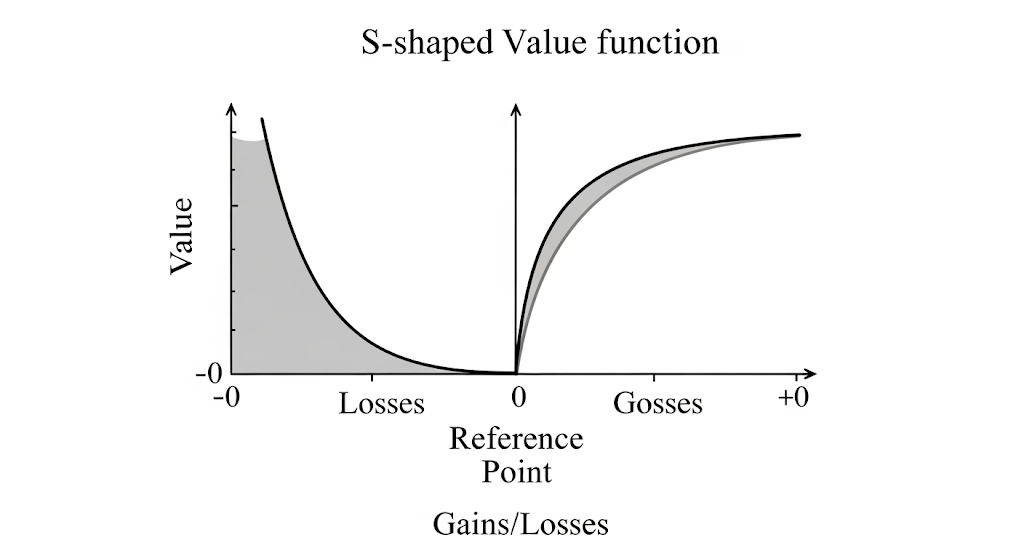
According to experiments, people wanted at least 200 dollars in profit to take the risk of losing 100 dollars. In other words, the pain of loss is felt about twice as strongly as the joy of gain. This is known as the Loss Aversion Ratio.
The Endowment Effect: Triggered the Moment Something Becomes ‘Mine’
The Endowment Effect is the phenomenon where we assign a much higher value to an item the moment we own it compared to when we do not.
In Richard Thaler’s famous ‘mug experiment,’ the selling price (WTA) of a group that received a mug for free was more than twice the average buying price (WTP) of a group wanting to buy the mug. Just a few minutes of ownership inflated its value.

This is due to a combination of attachment to possessions and the Status Quo Bias, which favors maintaining the current state.
The Endowment Effect and Loss Aversion in Real Life
These biases affect many areas of our lives.
- Investor’s Dilemma (Disposition Effect): Investors often view selling a losing stock as ‘realizing a loss’ and hesitate to sell, while they sell winning stocks too quickly to secure even small profits. This leads to the worst strategies that hinder long-term returns.
- Homeowner’s Illusion: Homeowners tend to use their highest experienced price as a reference point rather than the actual purchase price. This leads them to hold onto prices above market value, missing reasonable transactions and causing price rigidity in the real estate market.
- Marketer’s Tactic: Netflix’s ‘one-month free trial’ or ‘100% money-back guarantee’ strategies grant consumers a sense of ’temporary ownership.’ To avoid the ’loss’ of returning the product after the trial period, many consumers decide to purchase.

Comparison: Why Does the Endowment Effect Occur? The Ongoing Debate
For a long time, academia viewed the Endowment Effect as a result of Loss Aversion. It was explained that selling feels like a ’loss’ to sellers, so they must ask for a price about twice as high to offset the psychological pain compared to buyers.
However, recent experiments by Professor David Gal have presented a new perspective. He found that when he changed the question to owners, asking, “How much would you pay to keep the cup?” the price difference with buyers disappeared. This suggests that the Endowment Effect may depend more on inertia or the frame of the transaction rather than fear of loss.
Table 1: Comparison of Two Explanatory Models for the Endowment Effect
| Feature | Loss Aversion Model (Traditional Explanation) | Ownership/Inertia Model (Alternative Explanation) |
|---|---|---|
| Core Mechanism | Psychological pain of losing possessions | Psychological resistance/inertia to changing the status quo |
| Main Evidence | Classic mug experiment (selling price > buying price) | Gal’s “willingness to pay to keep” experiment (price difference disappears) |
| Frame of Transaction | Perceiving selling as a ’loss’ | Perceiving selling as ‘active relinquishment’ |
| Prediction | Owners always assign higher value than non-owners. | Price differences occur only in the ‘selling’ frame. |
Four Cognitive Tools to Escape the ‘Dumb Owner’ Mindset
While we cannot be 100% free from biases, we can make better decisions through several strategies.
- Reframing Decisions Instead of asking, “Should I sell this losing stock?” ask, “If I had cash equivalent to this stock now, would I buy it again?” This helps break emotional attachment and aids in objective judgment.
- Pre-commitment Set principles in advance before emotions take over. A good example is placing a ‘stop-loss’ order to sell mechanically when a stock reaches a certain price.
- Utilize External Perspectives Seek advice from experts or trusted friends who are not emotionally involved in your decision. This can provide an objective viewpoint.
- Separate Investment from Happiness Accept that rational investing can sometimes be psychologically uncomfortable. Remember that investing is a process of making money, not necessarily a process of feeling happy.
Conclusion: Becoming an ‘Aware Owner’
We may be designed to fear loss and develop irrational attachments to possessions once they become ours. However, thanks to behavioral economics, we have the opportunity to recognize these facts and reflect on ourselves.
Key Takeaways
- Loss Aversion: We feel the pain of loss about twice as strongly as the joy of gain.
- Endowment Effect: We overvalue items simply because we own them.
- Impact on Daily Life: These biases affect all areas of life, including investment failures, delays in real estate transactions, and marketing strategies.
Now we can strive to become ‘Aware Owners’ who understand our irrationality and work to overcome it. This insight is useful not only for tangible assets but also for reflecting on our attachment to intangible assets like game items or digital content.
Related Article: Status Quo Bias: Why Are We Afraid of Change?
Next time you sell, give up, or invest in something, why not ask yourself whether this decision is based on a truly rational value judgment or if you are hesitating simply because it is ‘mine’?
References
- [Ecostory] Episode 4: Does My Real Estate Look Better? The Endowment Effect
- [Why] [In-Sik Lee’s Wonderful Science] The ‘Endowment Effect’ - Chosun Biz
- [Current Financial Terms] Loss Aversion Bias - Yonhap Infomax
- [Column] The Debate on Loss Aversion Effect - NewsPeppermint
- Behavioral Economics in Advertising② The Psychology Behind Trade-Ins and Trial Groups | Click Economic Education
- The Weight of Behavioral Economics Rising to the Sky - Sungkyunkwan University Newspaper
- Catching Up with Behavioral Economics: Refund Guarantees and Trial Marketing Effects - Economy Chosun
- To Become Rich, You Must Escape the ‘Loss Aversion Bias’ - Weekly DongA
- Loss Aversion Bias. Your Risk Preference is Approximately 2 to 1. | PRAAMS