
In 1971, President Richard Nixon severed the link between gold and the dollar with the ‘Nixon Shock.’ This single move completely reshaped the global economy, ushering in a new era defined by the ‘Petrodollar’ system. Simply put, it mandated that oil from Saudi Arabia could only be paid for in dollars. This rule bestowed upon the United States an immense gift: an ’exorbitant privilege.’ Effectively, the U.S. became the world’s central bank, firmly holding the reins of global power.
However, no empire lasts forever. When power reaches its zenith, cracks inevitably begin to appear. As the U.S. increasingly wielded its ‘dollar system’ baton like a diplomatic ‘cudgel,’ voices began to rise from various corners questioning, “Is this really the right way?” This is the phenomenon we now know as ‘De-dollarization.’
But here’s the irony: America’s aggressive actions have inadvertently created an opportunity for a powerful counter-offensive, not from governments, but from a new form of digital dollar hegemony born in the heart of the market.
The decisive event that marked the beginning of this monumental shift occurred in February 2022. The G7’s decision to freeze the foreign exchange reserves of the Russian Central Bank. This wasn’t just a sanction; it was a shock comparable to an ’economic nuclear option.’ This incident posed an existential question to all central bankers worldwide: “Wait, the most critical national safe asset, foreign exchange reserves, can be neutralized overnight?” This single question elevated de-dollarization, once a seemingly distant concept, to a ‘matter of national security’ for countries fighting for their survival.
This article begins at this very point. We will delve deep into how the weaponization of dollar hegemony triggered geopolitical repercussions and, concurrently (whether intentionally or not), how it is unfolding new financial hegemony in the digital age.
Part 1. The Empire’s Sword: Weaponizing the Dollar and the Financial Sanctions System
America’s global dominance relies as much on its invisible financial system control as on its visible military might, like aircraft carriers and stealth fighters. What was long considered a neutral global public good, the financial network, has now become the most potent and sophisticated weapon for enforcing U.S. foreign policy. Here, we will dissect the workings of American financial power and illuminate its destructive force through concrete examples.
1.1 The Architecture of Financial Power: The Global Nervous System SWIFT
SWIFT (Society for Worldwide Interbank Financial Telecommunication). The easiest way to understand SWIFT is to think of it as a ‘secure messenger’ used by banks.
For example, if Bank A in Korea wants to send $1 million to Bank B in the U.S., Bank A doesn't literally ship stacks of cash. Instead, it sends an encrypted message through the SWIFT network to Bank B: "Our customer is sending $1 million to your customer, so please debit $1 million from our account at your bank and credit your customer’s account." Real money moves only after such standardized messages are exchanged.

Therefore, SWIFT isn’t a pipeline for moving money directly, but rather a ‘control tower’ that dictates which valves to open and close. Over 11,000 financial institutions in more than 200 countries worldwide follow the directives of this control tower, acting as the lifeblood of the global economy. The true power of SWIFT lies in its ’network effect.’ Because everyone uses it, its value is immense, and exclusion from it is tantamount to an economic death sentence – isolation from the international financial system.
Ah, but there’s an interesting twist. SWIFT’s headquarters is a private cooperative in Belgium. So how does the U.S. control it? Instead of issuing direct orders through the U.S. Treasury’s Office of Foreign Assets Control (OFAC), the U.S. exerts diplomatic pressure on the European Union (EU) and the Belgian government. EU administrative orders have the same legal force as Belgian domestic law. This allows the Belgian government to instruct SWIFT, within its territory, to ‘disconnect access for a specific country.’ This creates a sophisticated, multi-layered power structure that ingeniously leverages alliances and legal jurisdiction.
1.2 Case Study 1: The Financial Siege of Russia (2022-Present)
Following Russia’s invasion of Ukraine in 2022, the financial sanctions imposed by the Western world were unprecedented in their scope and severity. Led by the United States, key Russian state-owned banks like Sberbank were expelled from SWIFT. This meant that Russian banks could no longer ‘KakaoTalk’ with their foreign partners, effectively cutting off their avenues for receiving export payments or making import payments.
However, the most devastating blow was yet to come. It was the freezing of approximately half of Russia’s foreign exchange reserves, estimated at $640 billion. By prohibiting all transactions with the Russian Central Bank, the U.S. Treasury effectively eliminated Russia’s ability to defend the ruble’s value with these funds.
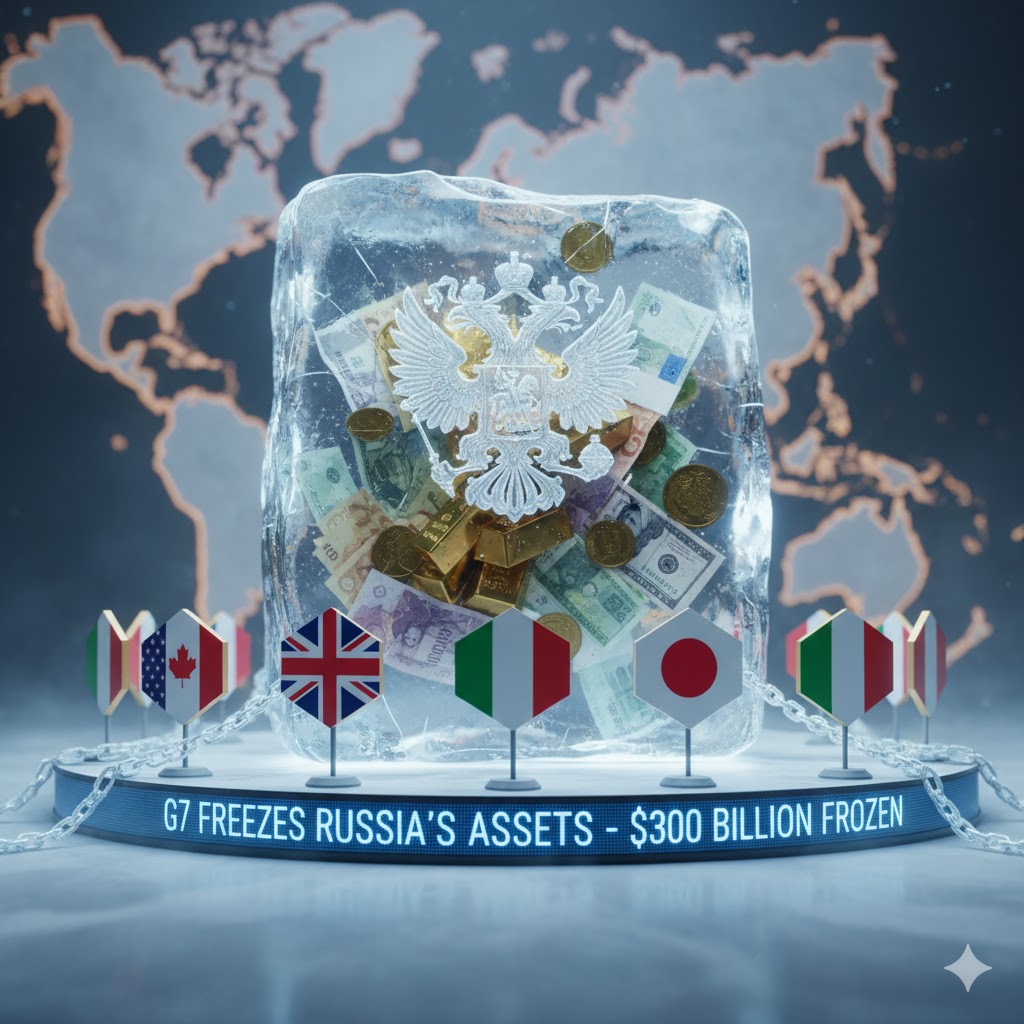
This event was more than just an economic sanction; it was a turning point that fundamentally altered the paradigm of the international financial order. It was on a different level from past sanctions against ‘rogue states’ like Iran or North Korea. Russia is a G20 member, a nuclear power, and a major global energy supplier. Freezing the central bank’s assets of such a nation shattered the very concept of a ‘reserve asset.’ If foreign exchange reserves can be seized at any moment for political reasons, how can they be considered a ‘safe asset’? This action instilled a fundamental fear in central bankers of all countries unfriendly to the U.S. – “Are our foreign reserves truly safe?” – and became the most potent motivator for de-dollarization.
1.3 Case Study 2: The Long Strangulation of Iran
America’s financial sanctions against Iran demonstrate another terrifying face of the dollar system: the power of ‘secondary sanctions.’ After unilaterally withdrawing from the Iran Nuclear Deal (JCPOA) in 2018, the Trump administration reinstated sanctions.
The core of secondary sanctions is this: even if a third-country company, not based in the U.S., engages in trade with Iran, that company will also be barred from accessing the U.S. financial system. This is effectively an unavoidable ultimatum to companies worldwide: “Do you want to be friends with Iran, or do you want to do business with us and survive?”
The reinstatement of sanctions completely choked off Iran’s economic lifeline – oil exports and financial transactions. The result, as we’ve seen, has been severe economic contraction and hyperinflation.

The case of Iran illustrates that the true power of U.S. financial sanctions extends beyond simply blocking transactions; it lies in weaponizing ‘fear and uncertainty’ through secondary sanctions.
European allies politically opposed these U.S. secondary financial sanctions. But what about giant European corporations like France’s Total and Germany’s Siemens? As soon as sanctions were reinstated, they withdrew from the Iranian market at lightning speed. Why? Because from the companies’ perspective, the existential risk of being kicked out of the U.S. financial system was incomparably greater than the profits gained from the Iranian market.
Part 2. The Alliance of the Excluded: Paradoxical Repercussions and the Practice of De-dollarization
As the dollar was wielded like a weapon, powerful backlash was inevitable. The more forcefully America’s financial sanctions whipped, the more countries facing or fearing sanctions began seeking ways to jump off the dollar system’s cart. This chapter analyzes the concrete and practical attempts at de-dollarization, moving beyond mere wishful thinking, and explores their limitations.
2.1 The Boomerang of Sanctions and the Search for New Paths
Using SWIFT as a political tool might have been highly effective in the short term. However, in the long run, it eroded trust in SWIFT’s ’neutrality.’ The core value of a network is its ‘universality’ – its accessibility to everyone. When someone is consistently excluded, the network effect inevitably weakens.
Against this backdrop, the concept of ‘financial multi-alignment’ has emerged. This is similar to non-alignment in the military sense during the Cold War. It’s a strategy to secure a nation’s economic security by maintaining relationships with various financial systems, rather than being solely dependent on a single financial hegemony (the dollar). In essence, it means, “Even if we can’t completely abandon the dollar, let’s not put all our eggs in one basket.” It’s about securing an independent financial channel outside of U.S. influence to diversify risk.

2.2 Building Parallel Systems: The Current Status of CIPS and SPFS
Challenges to dollar hegemony have led to the construction of concrete infrastructure. The most prominent examples are China’s CIPS and Russia’s SPFS.
- China’s CIPS (Cross-Border Interbank Payment System): Launched in 2015 with the goal of internationalizing the yuan, CIPS is a system for cross-border yuan payments. By June 2025, it is expected to have over 1,500 participating institutions in 121 countries, indicating rapid growth. In 2024 alone, its transaction volume exceeded 175 trillion yuan (approximately $24 trillion), a frightening increase of 42.6% year-on-year.
- Russia’s SPFS (System for Transfer of Financial Messages): Developed after facing sanctions following the annexation of Crimea in 2014, SPFS was primarily used domestically. Recently, it has been expanding its connections with friendly countries like China and India.
However, these systems still face limitations in becoming complete alternatives to SWIFT. Many experts, even within China, point out that while CIPS handles the clearing and settlement of money, the transmission of financial ‘messages’ that initiate transactions often still relies on the SWIFT network. This implies that CIPS is not entirely independent of SWIFT but rather a ‘hybrid’ system linked to SWIFT. It means it could still be vulnerable to U.S. pressure. The true significance of these alternative systems lies not in replacing SWIFT, but in serving as tools for realizing ‘financial multi-alignment’ as discussed in 2.1.
2.3 A Tempest in a Teapot or a Precursor to a Giant Tidal Wave: The BRICS Challenge
With BRICS (Brazil, Russia, India, China, South Africa) expanding to 11 member states by including Indonesia and Saudi Arabia in 2025, they have become the most significant force in politically publicizing the de-dollarization agenda. Attempts to use their own currencies for trade among member states are also increasing. According to the announcement at the July 2025 summit, approximately 90% of trade among BRICS member states is already settled in their local currencies, a significant jump from 65% just two years prior.
However, the grand dream of a common BRICS currency faces immense hurdles in reality. Member economies have different growth rates and distinct monetary policies. The political distrust between India and China alone is a major obstacle. Consequently, the current focus of BRICS is shifting away from lofty goals like a single currency towards more practical avenues, such as creating a blockchain-based payment platform like ‘BRICS Pay’ to facilitate easier local currency transactions among member states.
2.4 Visualizing the Change: The Gradual Erosion of Global Foreign Exchange Reserves
The most objective indicator that de-dollarization is more than just a slogan is the Currency Composition of Official Foreign Exchange Reserves (COFER) data published by the IMF. This data shows how central banks worldwide are storing their emergency funds.
According to the data, the share of the dollar in global foreign exchange reserves, which exceeded 71% in the early 2000s, has steadily declined to approximately 56.32% as of the second quarter of 2025. While the dollar remains dominant, this downward trend over the past two decades is clear evidence of consistent efforts by central banks worldwide to diversify their assets into currencies like the euro and the yuan.
| Year (End of Year) | U.S. Dollar (USD) | Euro (EUR) | Japanese Yen (JPY) | British Pound (GBP) | Chinese Yuan (CNY) | Other |
|---|---|---|---|---|---|---|
| 2000 | 71.1% | 18.3% | 6.1% | 2.8% | - | 1.8% |
| 2010 | 61.5% | 25.8% | 3.7% | 3.9% | - | 5.1% |
| 2020 | 58.9% | 21.3% | 6.0% | 4.7% | 2.3% | 6.7% |
| 2025 (Q2) | 56.3% | 19.8% | 5.5% | 4.8% | 2.9% | 10.7% |
This table quantitatively demonstrates that de-dollarization is not merely a political slogan but a slow but definite change occurring in the portfolios of central banks worldwide.
Part 3. The Empire Strikes Back: The Rise of Digital Dollar Hegemony

While traditional nations challenge dollar hegemony, a massive trend is emerging on a completely different level, one that paradoxically strengthens and modernizes American hegemony. This is not a government strategy, but a phenomenon called ‘Stablecoin’ born from market demand and technological innovation. In this chapter, we will analyze how stablecoins have become an ‘accidental Trojan horse’ for dollar hegemony and how the U.S. is domesticating them to its advantage.
3.1 Stablecoins: An Accidental Trojan Horse
Stablecoins. You can essentially think of them as ‘digital dollars.’ They are privately issued digital tokens designed to be pegged 1:1 in value to fiat currencies like the U.S. dollar.
The easiest analogy is a ‘casino chip.’ You give $1 and receive a $1 chip, which you can use within the casino and later exchange back for cash. Stablecoins work the same way. You deposit $1 and receive a digital token worth $1 (like USDT, USDC), which you can freely trade within the cryptocurrency world and exchange back for dollars at any time. It’s a ‘digital exchange voucher.’
1 Stablecoin = 1 USD
Their growth has been truly astonishing. The stablecoin market, which was in the billions of dollars in 2019, has now surpassed $300 billion as of 2025.
While their primary use is for transferring funds within cryptocurrency exchanges, their role is rapidly expanding. Consider countries like Turkey, Argentina, and Nigeria, where their national currencies are unstable and inflation is rampant. The irony is that while these governments are shouting “De-dollarize!” (as discussed in Part 2), their citizens and businesses, fearful of (or distrustful of) their own currencies, are voraciously buying stablecoins for their dollar-backed stability.
This is a ‘bottom-up digital dollarization’ phenomenon driven by market demand, in direct contrast to government-led ’top-down de-dollarization.’
3.2 The Treasury-Stablecoin Flywheel: A New Pillar of Power
So, why is this beneficial for the U.S.? The key lies in their ‘reserve’ structure. Major issuers like Tether and Circle must hold safe assets equal to the value of the digital tokens they issue to guarantee their value.
Initially, the opacity of these reserves led to controversy. However, as market pressure and regulatory scrutiny intensified, these issuers began to back their reserves predominantly with the safest asset in the world: ‘U.S. Treasury Bills.’
Do you see what this means?
Every time someone, somewhere in the world, buys $1 worth of a digital dollar (stablecoin), the stablecoin issuer uses that $1 to buy U.S. Treasuries. In other words, global demand for stablecoins directly translates into demand for U.S. government debt (Treasuries). Stablecoin issuers, currently numbering in the hundreds of billions of dollars, have emerged as major holders of U.S. Treasuries, rivaling major countries like Germany and Japan.
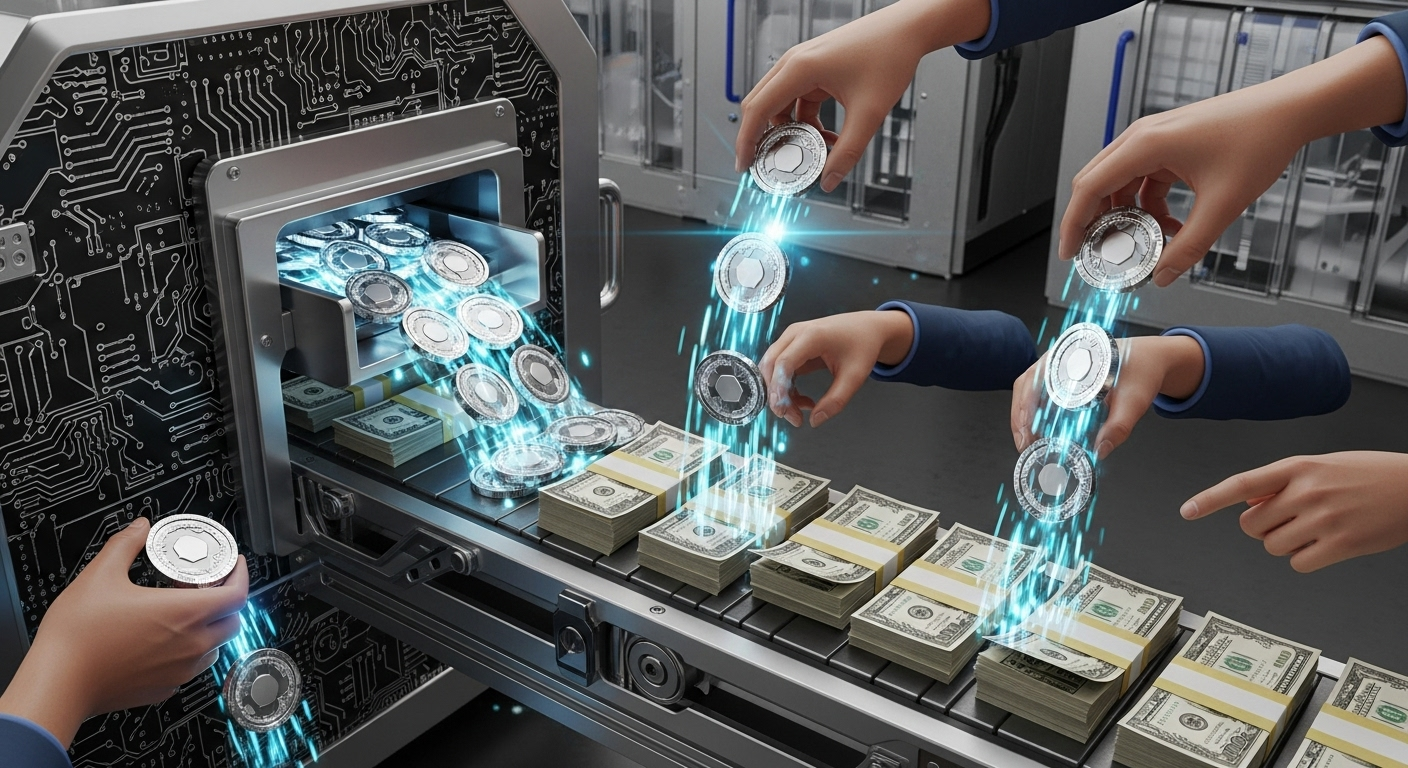
This phenomenon creates a self-reinforcing virtuous cycle that strengthens the U.S. financial system, known as the ‘Treasury-Stablecoin Flywheel.’
- (Demand Generation) Global market demand for digital dollars (stablecoins) increases.
- (Treasury Purchases) Stablecoin issuers massively purchase U.S. Treasuries to cover their reserves.
- (Fiscal Stability) New demand for U.S. Treasuries lowers the U.S. government’s borrowing costs (interest rates) and stabilizes its finances.
- (Dollar Strength) A stable U.S. fiscal situation enhances the dollar’s credibility, becoming a factor for dollar appreciation.
- (Demand Reinforcement) A strong and stable dollar further enhances the attractiveness of dollar-pegged stablecoins, stimulating demand in step 1.
This flywheel is qualitatively different from traditional dollar hegemony because it is driven by the voluntary demand of millions of market participants worldwide, rather than by political decisions of a few central bankers.
3.3 From the Wild to the Garden: America’s Co-optation Strategy
U.S. regulators are not fools. Their approach has not been to shoot down the ‘wild horse’ of stablecoins. Instead, they are employing a strategy to ‘domesticate’ them by bringing them within the ‘fences’ of federal regulation. Legislation like the ‘GENIUS Act’ is evidence of this. The goal is to mandate stablecoin issuers to hold 1:1 reserves, undergo regular external audits, and comply with bank-level regulations.
This strategy holds a very clever intention: to minimize the risk of stablecoins collapsing suddenly while maximizing the benefits of the ‘Treasury-Stablecoin Flywheel’ discussed in 3.2. By regulating and legitimizing them, the government officially recognizes private technological innovation as an ‘officially sanctioned digital extension of the dollar.’
3.4 Macroeconomic Background: The Era of Liquidity Floods
The sudden emergence of stablecoins and cryptocurrencies did not happen in a vacuum. Behind it lies the unprecedented monetary policy of the U.S. central bank, the Federal Reserve (Fed). In response to the 2008 global financial crisis and the 2020 COVID-19 pandemic, the Fed undertook massive quantitative easing (QE), printing enormous amounts of money. As a result, the Fed’s total assets have grown exponentially.

While the vast liquidity injected initially led to a prolonged period of zero interest rates, it ultimately triggered the worst inflation in decades. This macroeconomic environment compelled global investors to seek alternatives to traditional assets, and stablecoins, serving as a key liquidity provider (i.e., ‘casino chips’) for trading these alternative assets, became highly sought after, laying the foundation for explosive growth.
Part 4. Chronicles of the Digital Frontier: Key Events and Regulatory Wars
The concepts discussed in Part 3 are more clearly understood when examined through specific events occurring at the forefront of digital finance. This chapter will explore how the ideals of cryptocurrency libertarianism collide with the realities of state power, using representative examples to illustrate how digital dollar hegemony is being built and solidified.
4.1 The Ordeal of Tether: Through the Fire of Scrutiny
The history of Tether (Tether), the original originator in the stablecoin market, and indeed its original troublemaker, is a drama in itself, illustrating how market trust and regulatory power operate.
4.1.1 Investigation by the New York Attorney General (NYAG) and the Hidden Truth
In 2019, the New York Attorney General’s office (NYAG) launched an intensive investigation into Tether and its sister company, the exchange Bitfinex. The core issue was that when Bitfinex faced a $850 million funding shortfall due to issues with its payment processor, it secretly borrowed money from Tether’s reserves to cover the gap. This implied that USDT, issued by Tether, was not always fully backed by dollars on a 1:1 basis.
In February 2021, Tether and Bitfinex settled with the Attorney General’s office for $18.5 million in fines and an agreement to cease operations in New York. The most critical condition of this settlement was the obligation to regularly disclose reserve details to the public.
4.1.2 The Evolution of Trust: Reserves Undergoing Qualitative Transformation
This ‘forced transparency’ measure marked a turning point for the stablecoin market. The initial reserve disclosures by Tether shocked the market. At that time, a significant portion of the reserves consisted of relatively risky assets like commercial paper (CP) and collateralized loans.
However, under market distrust and regulatory pressure, Tether made a dramatic and desperate change to survive. Throughout 2022, Tether succeeded in reducing its controversial commercial paper holdings to ‘zero’ and radically shifted its portfolio to ultra-safe assets like U.S. Treasury Bills.
| Period | Key Direction | Details |
|---|---|---|
| 2021 | Pressure for Transparency and Regulatory Response | • Controversy over reserve quantity and lack of transparency. • Fined $41 million by the U.S. CFTC for providing false information about reserves. • Began quarterly reserve reporting in response to demands from regulators and investors. |
| 2022-2024 | Portfolio Realignment Focused on Stability | • Reduced and completely eliminated controversial commercial paper holdings. • Began large-scale purchases of U.S. Treasury Bills. • By 2024, U.S. Treasury holdings reached $118 billion. |
| 2025 | Strategic Diversification and Stability Balance | • Continued increase in U.S. Treasury holdings (reaching $127 billion by Q2). • Official inclusion of Bitcoin in the reserve portfolio (purchased 8,888 BTC in October). • Total Bitcoin holdings increased to 10,940 BTC. |
This table clearly shows how Tether has undergone ‘de-risking’ in its portfolio to gain market trust. In this process, Tether, ironically, has become one of the U.S. government’s largest creditors. There is no more vivid evidence of how the ‘Treasury-Stablecoin Flywheel’ explained in Part 3 actually works.
4.2 The War on Illicit Funds: Cryptocurrency, Crime, and the Travel Rule
Cryptocurrency’s inherent ‘pseudonymity’ carries an intrinsic dilemma: it can be exploited for illicit activities like money laundering and terrorist financing. Naturally, governments and international organizations are striving to extend the surveillance network of traditional financial systems into the cryptocurrency space.
The core regulation for this is the ‘Travel Rule,’ recommended by the Financial Action Task Force (FATF). It’s simple: just as information about the sender and receiver accompanies money transfers between banks, cryptocurrency exchanges (Virtual Asset Service Providers, or VASPs) must collect user information for transactions above a certain amount and share it with counterparty exchanges. The Travel Rule essentially transforms crypto exchange transactions from anonymous to real-name, surveillance-enabled transfers.

4.3 Case Study: The Lazarus Group and the Bitfinex Hack
To push for stringent regulations like the Travel Rule, governments need credible justifications. And the activities of the North Korea-linked hacking group ‘Lazarus Group’ have provided regulators with ample justification.
In 2016, a major hacking incident occurred at the Bitfinex exchange, with 119,754 BTC (worth billions of dollars at current values) stolen. To launder these funds, the hackers (some believed to be linked to Lazarus) employed sophisticated techniques over several years, including using mixers/tumblers (like Tornado Cash) to obscure the source of funds and engaging in ‘chain hopping’ across multiple blockchains.

The Lazarus Group is known to have used these methods to steal and launder billions of dollars in cryptocurrency, which then served as a source of foreign currency for the North Korean regime and funded its nuclear and missile development. Large-scale hacking incidents like these, especially those involving adversarial nations like North Korea, have completely altered the nature of cryptocurrency regulation discussions. While the crypto industry might argue, “This is innovation!” or “This is privacy!”, regulators can now counter with the powerful argument, “This is a national security issue!” or “This is about preventing illicit funding!”
4.4 The Battlefield of the Future: SWIFT vs. Ripple (XRP)
SWIFT, which has dominated the international payment market for decades, faces a formidable challenger in the form of blockchain technology through ‘Ripple’ and its cryptocurrency ‘XRP.’ The rivalry between these two resembles the competition between the postal system (SWIFT) for sending letters and a real-time messaging app (Ripple).
While SWIFT focuses on transmitting ‘messages’ between banks, Ripple’s RippleNet aims to complete actual fund ‘settlement’ almost in real-time by using XRP as a ‘Bridge Currency.’
For example, when sending money from London to Bangkok, the SWIFT system often takes several days and incurs high fees due to multiple correspondent banks. In contrast, RippleNet can complete the entire process – converting pounds to XRP, transmitting XRP to Thailand, and converting it back to Thai baht – in 3-5 seconds.
This innovation eliminates the need for banks to pre-deposit funds in foreign bank accounts, known as ’nostro accounts.’ Trillions of dollars globally are tied up in these accounts, and Ripple claims that by using XRP, it can liberate these assets and dramatically improve liquidity.
However, SWIFT is not standing still. It is introducing ‘gpi (global payments innovation)’ to improve remittance speed and transparency, and is also experimenting with integrating with Central Bank Digital Currencies (CBDCs), accelerating its digital transformation. Furthermore, both parties are adopting the new international financial messaging standard ISO 20022, suggesting that in the future, they might evolve into a hybrid model that combines their respective strengths rather than directly competing.
Conclusion: The End of the Beginning
Let’s wrap things up. This article has traced two massive, and seemingly opposing, battles playing out on the grand chessboard of dollar hegemony.
The first stream is the traditional and familiar geopolitical confrontation of ’nation versus nation.’ As the U.S. pressured countries like Russia and Iran by wielding the cudgel of SWIFT and the dollar system (Part 1), a counter-reaction emerged in the form of an ‘alliance of the excluded,’ centered around China, Russia, and BRICS. They have established their own payment systems like CIPS and SPFS, increased trade in their local currencies, and are taking slow but definite steps towards ‘financial multi-alignment’ away from the unipolar dollar-centric system (Part 2).
However, the real battle to watch is the second one. This is a confrontation of ’nation versus market,’ and paradoxically, it is strengthening American hegemony. Amidst global inflation and low-interest rates, the market has found its own answer to ‘digital dollars’: ‘stablecoins.’

Regardless of government intentions, countless individuals and corporations worldwide are voluntarily adopting dollar-pegged stablecoins to escape the instability of their national currencies. And as these stablecoin issuers back their reserves with U.S. Treasuries, they are powering a formidable engine known as the ‘Treasury-Stablecoin Flywheel,’ which directly links global digital demand to the U.S. government’s fiscal stability (Part 3).
In this new digital frontier, state power is co-opting this ‘wild’ innovation into the ‘institutional sphere’ through regulation (Part 4.1, 4.2) and sometimes by using the activities of criminal organizations as justification (Part 4.3). Simultaneously, as seen in the cases of SWIFT and Ripple (XRP) (Part 4.4), old infrastructure and new technology are fiercely competing for the future payment standard.
My perspective is this: The currency wars of the future will not be a simple dichotomy between the dollar and the yuan, or between the U.S. and BRICS. They will herald the birth of a complex new ecosystem where national power, decentralized technology, and private innovation collide and merge.
Frankly, the slow wave of de-dollarization, led by sovereign nations, seems likely to be simply overwhelmed by the massive tide of ‘digital dollarization’ generated voluntarily by the market. The empire, which seemed on the verge of collapse, has instead acquired a more sophisticated and powerful weapon for its counter-offensive.
This is not the end; perhaps the real beginning starts now.
References
- SWIFT as a Geopolitical Weapon, Weakening Dollar Hegemony [Tongil News]
- [Global Insight] Why are SWIFT Sanctions Called an ‘Economic Nuclear Option’? [Seoul Shinmun]
- US and Europe Exclude Some Russian Banks from SWIFT… ‘Economic Nuclear Option’ Withdrawn [Hankyoreh]
- SWIFT communication network is a system that allows international financial settlements using 8 or 11-digit codes by financial institutions in each country [AP Yonhap News]
- Analysis of Western Sanctions Against Russia Following Russia’s Invasion of Ukraine and Their Impact on the Energy Market [Korea Energy Economics Institute]
- Trends and Outlook of Russian Economic Sanctions [Jipyung]
- US Treasury: “Russian Financial Institutions Evading Sanctions Attempting to Establish New Branches in Third Countries” [VOA Korean]
- Current Status and Outlook of Russian Economic Sanctions [Institute for Peace and Unification Studies]
- Withdrawal from the Iran Nuclear Deal and the Restoration of U.S. Sanctions on Iran: Key Contents, Impacts, and Implications [Korea Institute for International Economic Policy]
- Trump’s Withdrawal from the Iran Nuclear Deal and Middle East Geopolitics [Asan Institute for Policy Studies]
- U.S. Withdrawal from the Iran Nuclear Deal (JCPOA) and Our Response Measures [Korea Institute for International Economic Policy]
- International sanctions against Iran [Wikipedia]
- President Trump Withdraws from Iran Nuclear Deal; U.S. Sanctions to be Re-Imposed [Wiley Law]
- Impact of U.S. Withdrawal from the Iran Nuclear Deal [Jones Day]
- A Brief History of US Sanctions on Iran [Columbia | SIPA]
- Re-imposition of the sanctions on Iran that had been lifted or waived under the JCPOA [U.S. Department of the Treasury]
- President Trump’s Withdrawal from the Iran Nuclear Deal [Congressional Research Service]
- Conflict between the U.S. and Iran over the Restoration of the Iran Nuclear Deal: Development Process, Key Issues, and Outlook [Insurance Research Institute]
- SWIFT Weaponization Sparks Debate Over Business Interference [Cha Hyun-jin, Bank of Korea Advisor]
- Rise of SWIFT Alternatives and U.S. Choices [Capital Market Research Institute]
- China’s CIPS & Russia’s SPFS, Still ‘Insufficient’ as SWIFT Alternatives [Korea International Trade Association]
- Russian Companies Employ ‘Multiple Correspondent Banks’ to Bypass Payment Issues [KOTRA]
- Increase in Russia’s Crude Oil Exports to China [KOTRA]
- Why BRICS De-dollarization Has a Low Chance of Success [Naver Premium Contents]
- Can a New BRICS Currency Challenge Dollar Hegemony? [EBC Financial Group]
- BRICS Major Currencies Decline in Ranking, Lagging Behind the U.S. Dollar [Vietnam Pictorial]
- IMF Data Brief: Currency Composition of Official Foreign Exchange Reserves [International Monetary Fund]
- An Historical Perspective on the Reserve Currency Status of the U.S. Dollar [U.S. Department of the Treasury]
- Currency Composition of Official Foreign Exchange Reserves (COFER) [db.nomics.world]
- The U.S. Dollar’s Share of Global Foreign Exchange Reserves is Declining [Federal Reserve]
- IMF Data [International Monetary Fund]
- BOK: “Spread of Dollar Stablecoins Could Expand Dollar’s Influence” [Yonhap News]
- Stablecoin Market Cap Expected to Grow to $1.2 Trillion… Increased Influence on US Treasury Market [Digital Today]
- Stablecoin Market Cap Surpasses $250 Billion… $245.5 Billion Pegged to Dollar [Digital Today]
- [Global] March 2025 Stablecoin and CBDC Report [Korea Internet & Security Agency]
- The Paradox of the Dollar… U.S. Weaponization Actually Strengthens Hegemony [Samjong KPMG]
- World - Stablecoin Market Capitalization [MacroMicro]
- Charted: Stablecoin Market Cap vs. the Value of U.S. Cash [Visual Capitalist]
- Stablecoin Metrics [rwa.xyz]
- Impact of U.S. Digital Asset Strategy on International Financial Markets [PwC]
- The Evolution of Tether’s Reserves [Tether.to]
- The spillover effects of crypto assets on the traditional financial system: the case of Tether [Hong Kong Monetary Authority]
- The International Role of Public and Publicly-Co-Sponsored Stablecoins [Federal Reserve]
- BOK: “Global Ripple Effects of Dollar Hegemony and US Shocks” [Edaily]
- US Stablecoin Innovation Act (GENIUS Act) [Digital Today]
- Assets: Total Assets: Total Assets (Less Eliminations from Consolidation): Wednesday Level [Federal Reserve Bank of St. Louis]
- Balance Sheet: Assets: Total Assets: Total Assets (Less Eliminations from Consolidation): Wednesday Level (FRED:WALCL) [TradingView]
- Total Assets, All Commercial Banks [Federal Reserve Bank of St. Louis]
- Consumer Price Index for All Urban Consumers: All Items in U.S. City Average [Federal Reserve Bank of St. Louis]
- Consumer Price Index for All Urban Consumers: All Items Less Food and Energy in U.S. City Average [Federal Reserve Bank of St. Louis]
- Sticky Price Consumer Price Index less Food and Energy [Federal Reserve Bank of St. Louis]
- Consumer Price Index by Category [U.S. Bureau of Labor Statistics]
- The New York Attorney General’s Office Reaches Settlement with Bitfinex and Tether [JDSUPRA]
- New York Attorney General Settles with Bitfinex and Tether for Crypto Violations, Brings Unregistered Token Action Against Coinseed [Thomson Reuters Practical Law]
- Attorney General James Ends Virtual Currency Trading Platform Bitfinex’s Illegal Activities in New York [New York State Attorney General]
- Tether and Bitfinex reach settlement with New York Attorney General’s Office [Tether.to]
- Bitfinex supposedly repays $750m loan to Tether. Why now? [CoinGeek]
- New York Attorney General Announces Settlement with Bitfinex [Hunton Andrews Kurth LLP]
- Virtual Asset Service Providers: Money Laundering Case Studies [Arctic Intelligence]
- Social Opinion Analysis on Travel Rule [Code]
- What is the Travel Rule? [Upbit Investor Protection Center]
- [Opinion] Impact of FATF Travel Rule on Corporate Virtual Asset Transactions [Digital Asset]
- 6 Notable Cryptocurrency Money Laundering Cases [Inquesta]
- Bitfinex Hacker Sentenced in Money Laundering Conspiracy Involving Billions in Stolen Cryptocurrency [U.S. Immigration and Customs Enforcement]
- Lazarus Group: North Korea’s Notorious Hacking Syndicate [Hacken.io]
- CIPS Participants Announcement No. 110 [CIPS]
- BRICS payment system: A SWIFT alternative? [GIS Reports]
- BRICS New Currency vs US Dollar: Can It Change World Trade? [EBC Financial Group]
- BRICS CURRENCY News [The Economic Times]
- ‘Can’t depend on dollar’: Brazil President Lula says ‘Brics should test a new currency’ [The Economic Times]
- When Will the BRICS Currency Be Released? What We Know So Far [EBC Financial Group]
- List of countries by foreign-exchange reserves [Wikipedia]
- US Dollar Share of Global Currency Reserves [BestBrokers.com]
- World – Official Foreign Exchange Reserves by Currency [IMF]
- IMF Data Brief: Currency Composition of Official Foreign Exchange Reserves [IMF]
- US Dollar’s Share of Foreign Reserves Is Little Changed in Exchange-Rate-Adjusted Terms [IMF]
- Stablecoins: interaction between traditional and crypto finance [Bank for International Settlements]
- Stablecoins [TradingView]
- According to the IMF, the market capitalization of stablecoins expanded from approximately $3 billion in 2019 to about $300 billion as of the end of September this year [claude.ai]
- Assets: Total Assets: Total Assets: Wednesday Level [Federal Reserve Bank of St. Louis]
- FED Balance Sheet Projection Using Technical Analysis [TradingView]
- Assets: Total Assets: Total Assets (Less Eliminations from Consolidation): Wednesday Level [FRED]
- Consumer Price Index [Federal Reserve Bank of St. Louis]
- Consumer Price Index for All Urban Consumers: All Items in U.S. City Average [FRED]
- Consumer Price Index for All Urban Consumers: All Items Less Food and Energy in U.S. City Average [FRED]
- The history behind the iFinex probe [City & State New York]
- The New York Attorney General’s Office Reaches Settlement with Bitfinex and Tether [Volkov Law Group]
- New York Attorney General’s Office Reaches $18.5M Settlement with Bitfinex and Tether [The National Trial Lawyers]
- Settlement Agreement between NYAG, Bitfinex, and Tether [NYAG]
- How the Lazarus Group orchestrated its $1.5B cryptocurrency heist [SC Media]
- How Lazarus Group is Using DeFi to Launder Stolen Crypto from KuCoin Hack [Chainalysis]
- North Korea-Linked Lazarus Group Laundered $900 Million in Crypto [Bitdefender]
- North Korea’s Lazarus Group Moves Funds Through Tornado Cash Following $625 Million Ronin Hack [TRM Labs]
- Tornado Cash was used by fraudsters to obscure the trail of funds from their criminal origins [Inquesta]
- A Comparative Analysis: Ripple vs. SWIFT – Embracing Change [Sequel Services]
- How SWIFT’s blockchain could challenge Ripple’s grip on payments [Cointelegraph]
- RippleNet (XRP) vs. SWIFT: What’s the Difference? [Webopedia]
- SWIFT vs XRP: Which is the Future of International Payments? [Rise In]
- SWIFT, Ripple, XRP: Frenemies or Just Foes? [Nasdaq]
- Transparency [Tether.to]
- Tether (USDT) Analysis Report [ByteBridge]
- The Paradox of the Dollar… U.S. Weaponization Actually Strengthens Hegemony [Samjong KPMG]
- BRICS Major Currencies Decline in Ranking, Lagging Behind the U.S. Dollar [Vietnam Pictorial]
- China launches RMB-denominated letter of credit service [shanghai.gov.cn]