
More Than Just a Meal
- Learn how the chicken became a sacred being that announces the birth of a king in the founding myth of Silla.
- Examine the process by which the chicken became a guardian deity that drives away evil spirits and a symbol of success and prosperity for scholars.
- Explore the five virtues of the chicken (계유오덕) and the traces of chickens found in history and proverbs.
Today, when we think of chickens, we often picture delicious fried chicken or samgyetang, but the symbolism of chickens in our history carries much deeper and richer meanings. An ordinary poultry has a long history of foretelling a nation’s fate, driving away darkness, and symbolizing the virtues of scholars. From the myths of Silla to the royal rituals of Joseon, and to today’s proverbs, let’s follow the fascinating narrative of how chickens have intertwined with our culture.
Chickens in Myth: The Sacred Messenger of Silla’s Founding
The Birth of Kim Al-ji and the Prophecy of the White Chicken
The story begins in the capital of Silla, Seorabeol. During the reign of King Talhae, a mysterious phenomenon was witnessed in the Shirim forest west of Geumseong. When the minister Hogong went to the forest, he found a white chicken crowing under a golden chest hanging from a branch.
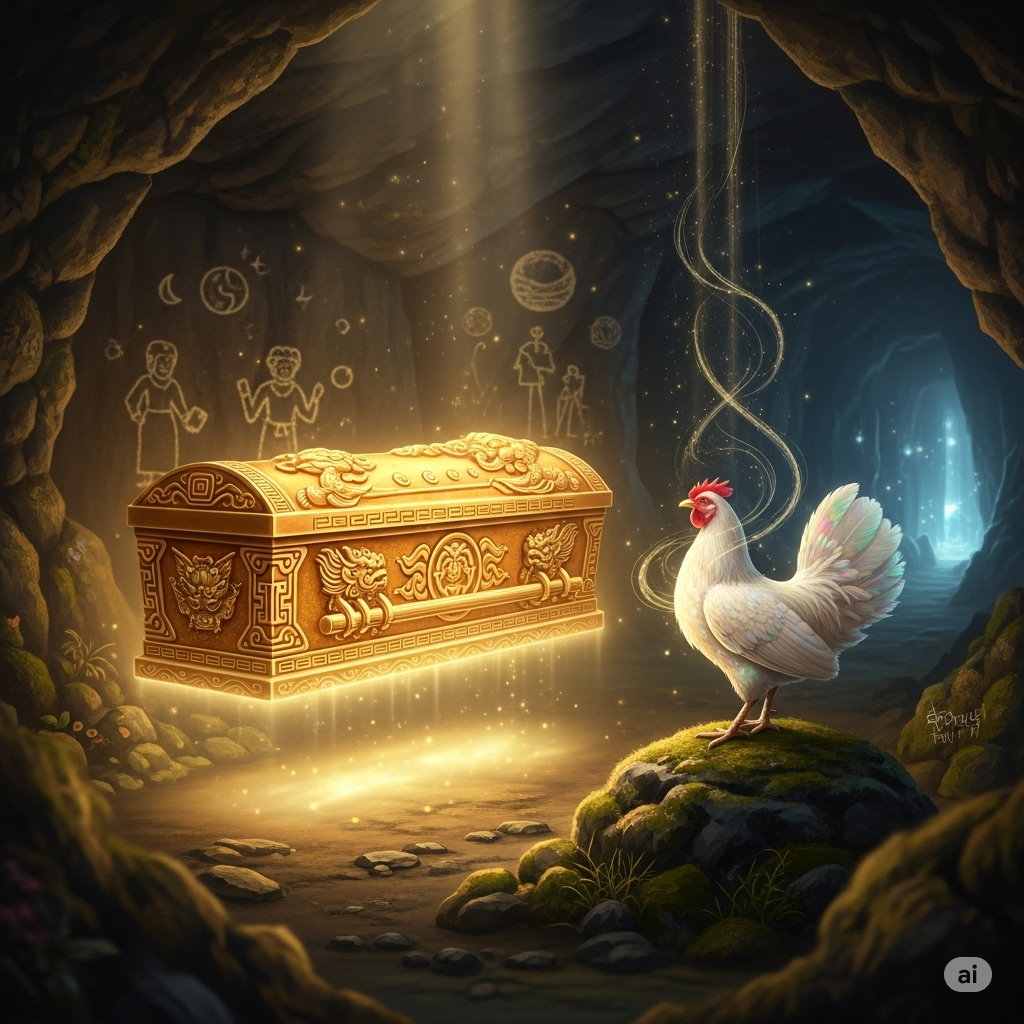
When the king opened the chest himself, an extraordinary-looking boy emerged, and the king rejoiced, naming him ‘Al-ji (閼智)’, believing him to be a descendant sent from heaven. This boy became the founder of the Silla Kim dynasty, Kim Al-ji. In honor of this event, the name of the forest was changed to Gyerim (鷄林), meaning ‘chicken forest’, which later became another name symbolizing Silla.
Dissecting the Symbol: Why is the Chicken Sacred?
In the myth of Kim Al-ji, the crowing of the chicken was a divine revelation announcing the arrival of a new ruler.
- White Chicken (白鷄): In ancient societies, white animals were considered messengers of the gods. The white chicken serves to guarantee that the child is a divine figure sent from heaven.
- Golden Chest (金櫃): Gold symbolizes nobility and absolute power, turning this event into a sacred narrative explaining the origin of a dynasty.
- Gyerim (鷄林): Changing the name of the forest officially incorporated the chicken’s sacredness into the national identity.
Insight: What is interesting here is how the myth secures political legitimacy. The newly empowered Kim faction created a narrative that their ancestor descended from heaven, evidenced by the ‘white chicken’. Through this, the chicken was endowed with a core role symbolizing the legitimacy of a dynasty, transcending mere auspiciousness.
The Chicken as a Guardian: The Power to Drive Away Darkness
The Battle of Light and Darkness
In the days before electric lights, night was a time of fear. During this time, the crowing of the rooster pierced the darkness, signaling the end of night and the arrival of the world of light. Our ancestors believed that the chicken possessed the power governing the southeast, the direction of the rising sun.
Chickens in Rituals and Folk Beliefs
This belief manifested in various customs.
- Sehwa (歲畵): On the first day of the new year, a picture of a chicken was hung on the front door to ward off misfortune. A single picture of a chicken served as a strong guardian for the household throughout the year.
- Chicken Blood (鷄血): The red blood of a chicken, symbolizing vitality, was believed to have magical power to ward off diseases and evil spirits, often painted on doors or walls.
- Shamanistic Rituals (굿): Chickens also functioned as mediums connecting humans and the spirit world. They were used to find the soul of someone who drowned.
The Rooster Leading the Path of Death
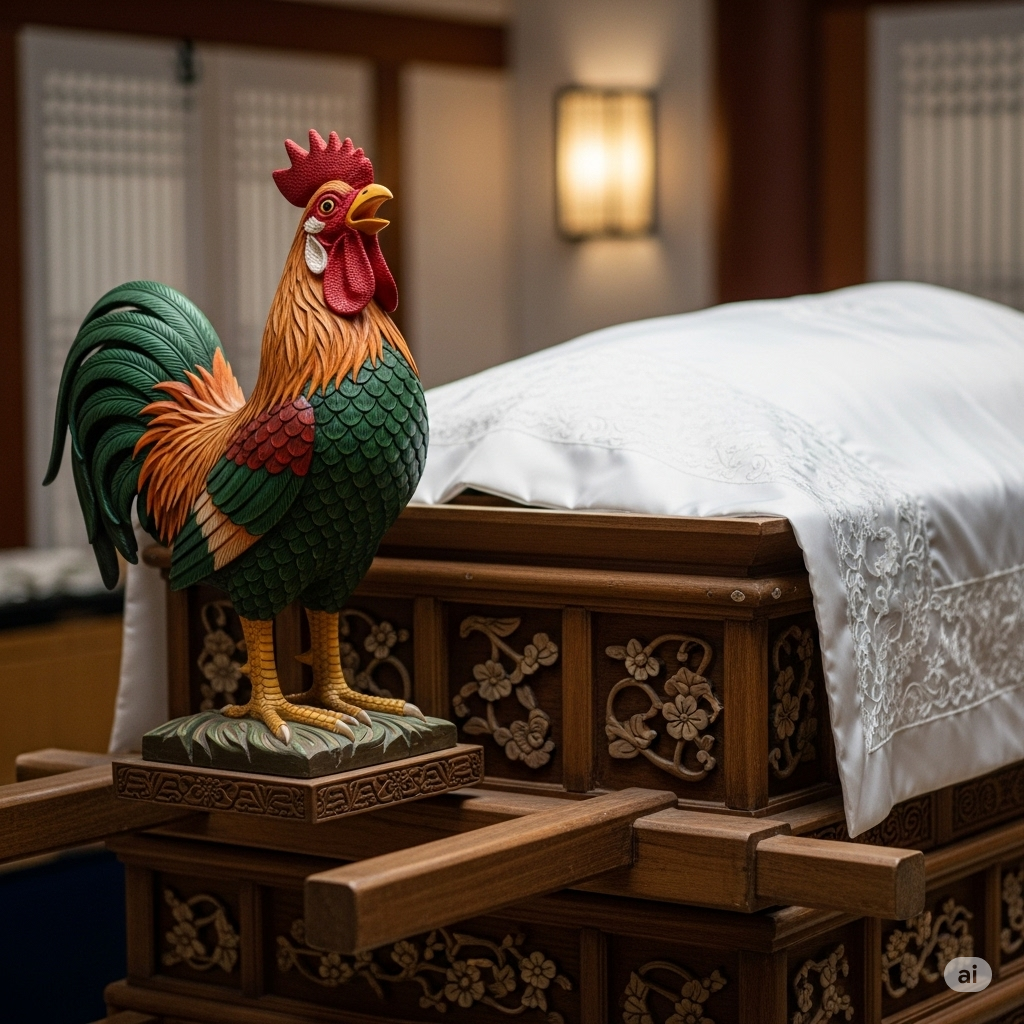
The chicken’s role as a guardian extends to the final moments of life. At the front of the funeral procession, a wooden rooster was placed. The rooster served as a sentinel protecting the soul of the deceased from evil spirits and as a guide illuminating the dark path to the afterlife.
The Symbol of Success: The Scholar’s Dream
A Symbol Created by Wordplay
In the Joseon era, centered around Confucian values, the chicken transformed into a symbol for scholars dreaming of success (입신양명). This was thanks to clever wordplay.
- Official Position: The comb of the rooster is called ‘beoseul’, which sounds the same as ‘beoseul (仕)’, meaning an official position. The chicken’s comb (鷄冠) was equated with the cap worn by officials (冠).
- Merit (功名): The crowing of the rooster (公鷄) combined with the sound of ‘merit’ (功名) formed the term ‘gongmyeong (公鳴)’, which means to achieve fame through accomplishments. The vigorous crowing of the rooster encapsulated aspirations for success.
The Grammar of Aspirations in Folk Paintings
Due to this symbolism, scholars hung pictures of chickens in their studies to strengthen their resolve. In folk paintings, they combined with other symbols to further specify their meanings.
- Chicken and Cockscomb Flower: By painting the cockscomb flower resembling the chicken’s comb, they wished for ‘adding a crown to a crown’ (관상가관), aspiring to reach the highest official position.
- Chicken and Peony: Together with the peony, a symbol of wealth, they wished for gongmyeongbugwi (功名富貴), hoping to achieve both high fame and wealth.
Insight: The changing meaning of the chicken symbol reflects shifts in social structure. What was once a sacred symbol exclusive to the royal family transformed into a ‘democratized’ symbol accessible to all scholars dreaming of success in the Joseon era. This demonstrates how wordplay is a powerful cultural device that creates and amplifies the meanings of symbols.
The Guardian of the Home: The Chicken as a Source of Fertility and Harmony
Sharing Important Life Rituals
Chickens also played a role in wishing for the well-being of individuals and families.
- Marriage (婚禮): On traditional wedding tables, a hen and rooster wrapped in blue and red silk were placed. This was a powerful symbol wishing for the harmony of the couple, warding off misfortune, and the prosperity of offspring (多産).
- Funeral (葬禮): The ‘rooster’ at the front of the funeral procession shows that chickens were important companions throughout the entire human life cycle, from birth to death.
The Ideal Family Depicted in Art
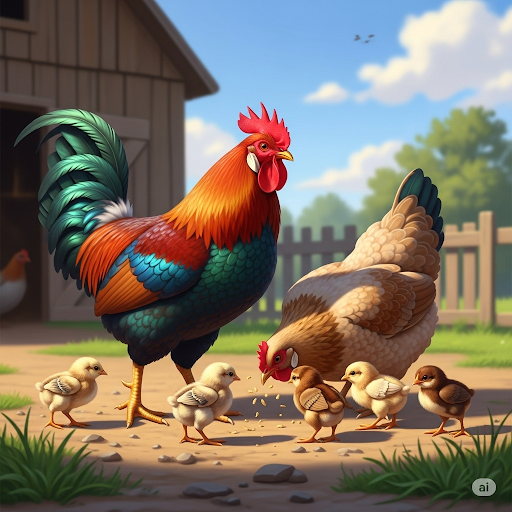
A painting of a rooster and hen with numerous chicks perfectly represented the ideal family image envisioned by our ancestors. The ecology of chickens forming large families aligned perfectly with the values of continuity in families at that time. I found this particularly striking, as a sacred animal also served as a food source by capturing the most precious hen for the son-in-law. This illustrates how the sacredness of chickens was closely connected to our lives.
The Virtues of a Gentleman Embodied in Chickens: The Meaning of 계유오덕 (鷄有五德)
Scholars of the Joseon era discovered five virtues that humans should possess from the characteristics of chickens, known as ‘계유오덕 (鷄有五德)’. They regarded the chicken as a ‘feathered gentleman’ and sought to learn from its virtues.
| Virtue (德) | Hanja (漢字) | Basis Derived from Chicken’s Characteristics |
|---|---|---|
| Literary (文) | 文 | The comb (鷄冠) resembles the cap (冠) of a scholar |
| Martial (武) | 武 | The sharp claws (며느리발톱) resemble weapons |
| Courage (勇) | 勇 | Does not retreat when facing an enemy and fights bravely |
| Benevolence (仁) | 仁 | When food is present, it does not eat alone but calls others to share |
| Trustworthiness (信) | 信 | Accurately announces dawn without fail |
Despite this ideal image, in the language of the common people, chickens were also depicted in more realistic terms, such as ‘chicken head’ (foolishness) or ‘when the hen crows, the household is doomed’ (patriarchal oppression). It is interesting to observe the gap between lofty philosophical ideals and realistic observations.
Chickens in History and Daily Life: From the King’s Table to Proverbs
Stories of Chickens in History
Chickens have also symbolized the sorrows and struggles of kings in actual history.
- King Taejong’s Grief and Chicken Meat: King Taejong, missing his son Seongnyeongdaegun who passed away early, had a chicken placed on the ritual table every five days, as it was his son’s favorite food. A single chicken encapsulated a father’s deep longing for his son.
- King Injo’s Anguish and the Sound of Chickens: During the Manchu invasion, King Injo, who took refuge in Namhan Mountain Fortress, heard the diminishing sounds of chickens and ordered that no more chicken meat be offered, believing that starving subjects would have caught the chickens to present to him. The chicken became a symbol of national crisis and the monarch’s anguish.
Chickens Living in Language
Chickens are deeply rooted in our proverbs and customs. In what situations do you use the phrase ‘a chicken instead of a pheasant’?
- Proverbs: ‘A chicken instead of a pheasant’ signifies the usefulness of a second-best option, while ‘better to be the head of a chicken than the tail of an ox’ speaks to the value of being a leader in a small group.
- Friendship and Hospitality: The idiom ’the promise of chicken and millet’ means to catch a chicken and cook rice for a friend, symbolizing humble yet sincere hospitality and friendship.
Conclusion
We have explored the diverse journey of chicken symbolism in our history. Chickens were more than mere poultry; they embodied the deep spirit of our culture.
- Sacred Messenger: Chickens were divine messengers announcing the birth of kings in the founding myth of Silla, bestowing legitimacy upon a dynasty.
- Powerful Guardian: They opened the dawn, driving away evil spirits, and served as steadfast protectors at the boundary between life and death.
- Symbol of Secular Aspirations: In the Joseon era, they symbolized the ideals of scholars aspiring for success, while in households, they represented blessings of fertility and harmony.
Next time you see a chicken, why not recall the profound stories intertwined with our history beyond the crispy fried chicken? There may be equally fascinating stories hidden in other objects around us.