
We explore the ‘just right’ moments that shaped our existence from the birth of the universe to human civilization.
- Key concepts of Big History that span 13.8 billion years (emergence, Goldilocks Conditions)
- Understanding eight major turning points (thresholds) from the Big Bang to modern revolutions
- A new perspective on the meaning of our existence and the future
What is Big History?
Pause for a moment and look at your hand. Did you know that in this extremely ordinary moment lies the entire history of the universe spanning 13.8 billion years? This is the story that Big History tells us. The calcium that makes up your bones and the iron flowing in your blood were created in the heart of some nameless star billions of years ago. The hydrogen atoms in the water you drink were born at the moment of the Big Bang 13.8 billion years ago. We are not separate from the history of the universe. We are the latest chapter of that grand story and living proof of it.
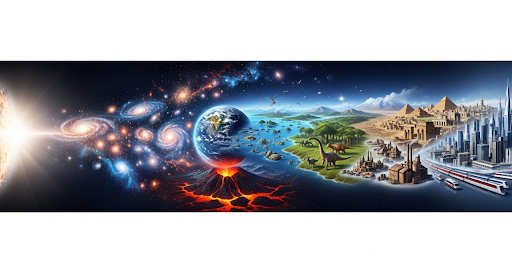
Big History is a science-based origin story for all of us, exploring how the universe evolved from simplicity to the wondrous and complex world we know today.
So how did all these changes occur? Big History explains that the formula is surprisingly simple.
Ingredients + Goldilocks Conditions = New Complexity
- Ingredients: The basic components available at a specific point in time, like hydrogen and helium atoms right after the Big Bang.
- Goldilocks Conditions: The ‘just right’ environment for something new to be born, neither too hot nor too cold.
- New Complexity: The amazing results that emerge when these two come together. The key here is Emergence, where the whole becomes greater than the sum of its parts, gaining new properties that did not exist before.
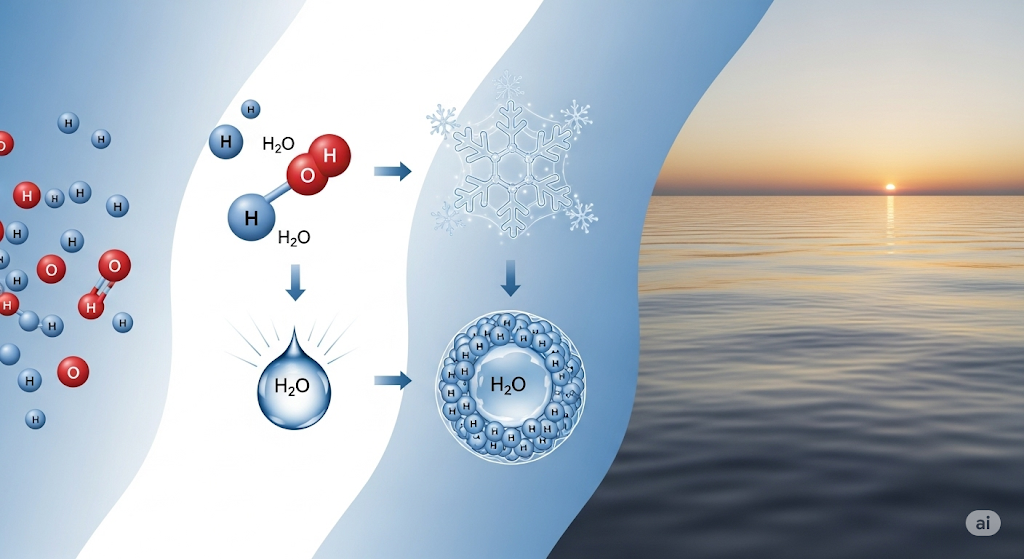
It’s like arranging the letters ‘H’, ‘Y’, ‘D’, ‘R’, ‘O’, ‘G’, ‘E’, ‘N’ (ingredients) according to the rule (Goldilocks Conditions) to form H₂O, resulting in ‘water’ (new complexity) with the emergent property of ’liquid’ that hydrogen and oxygen alone could not have imagined.
The history of the universe is a continuous story of such moments of emergence. Now, let’s embark on the wondrous and thrilling journey of 13.8 billion years along eight major turning points, or Thresholds.
| Threshold | Time | Key Ingredients |
|---|---|---|
| 1. Big Bang | 13.8 billion years ago | Unknown (energy, matter prototype) |
| 2. Emergence of Stars | 13.6 billion years ago | Hydrogen, helium, gravity |
| 3. Emergence of New Elements | 13.5 billion years ago | Aging massive stars, hydrogen, helium |
| 4. Birth of the Solar System and Earth | 4.5 billion years ago | Various elements, gas and dust clouds |
| 5. Emergence of Life | 3.8 billion years ago | Complex chemicals, energy |
| 6. Collective Learning | 200,000 years ago | Homo sapiens with powerful brains |
| 7. Beginning of Agriculture | 11,000 years ago | Collective learning, population growth |
| 8. Modern Revolution | 250 years ago | Global networks, new energy sources |
The Universe Creates Something from Nothing
Big Bang - The Beginning of Everything
The story of our universe began about 13.8 billion years ago, from an unimaginably small, hot, and dense point. This was not an explosion in space; time and space, matter and energy themselves were born at this moment.
The Goldilocks Conditions of this moment lay in the universe’s ‘fine-tuning’. If gravity had been just a little stronger, the universe would have collapsed immediately after its birth; if it had been a little weaker, matter could not have clumped together to form stars. Thanks to this perfect rule, the ‘universe’ itself, filled with infinite possibilities, emerged.
The First Stars - Light That Illuminated the Darkness
For hundreds of millions of years after the Big Bang, the universe was a dark space sparsely populated with hydrogen and helium atoms. The change came with the second threshold, the birth of stars.
The ingredients were hydrogen, helium, and gravity, and the Goldilocks Conditions were slight density differences in gas clouds. The moment gravity pulled the material together and the temperature exceeded 10 million degrees, hydrogen atoms began to fuse into helium in a process called ’nuclear fusion’.
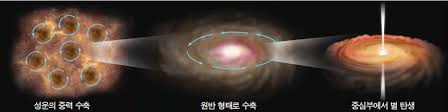
The first stars were the universe’s first complex ‘self-regulating systems’, and as these stars clustered together, they created ‘hotspots’ where fascinating events could occur in the universe.
New Elements - The Alchemy of the Universe
While the first stars existed, elements like carbon, oxygen, and iron that make up our bodies were still absent. The third threshold that created these materials was the death of stars.
Under the extreme heat and pressure inside dying massive stars, the Goldilocks Conditions allowed stars to create heavier elements. Like cosmic alchemists, they were massive furnaces that transformed simple elements into new ones.
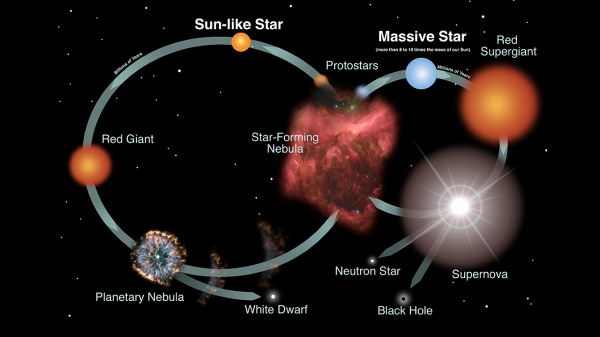
Elements heavier than iron, such as gold and uranium, were created in the extreme Goldilocks Conditions of a ‘supernova’ explosion that occurs at the end of a massive star’s life, scattering them throughout the universe. Every atom that makes up your body is the remnant of a star that exploded gloriously in the distant past, known as ‘star stuff’.
The Solar System and Earth - The Stage for Life
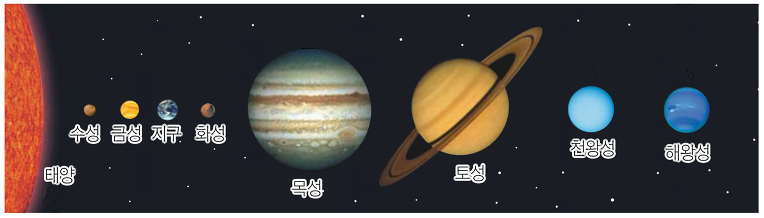
The elements scattered by supernovae became the materials for new stars and planets. About 4.6 billion years ago, these materials coalesced to form our home, the Solar System and Earth.
The Goldilocks Conditions were the ‘accretion’ process where gravity caused material to clump together, and the newly formed Earth settled at the ‘just right’ distance from the Sun, in the ‘habitable zone’ where liquid water could exist. As a result, Earth emerged as a special planet with the potential to give birth to life.
The Spark of Life and Consciousness
The Emergence of Life and the Lesson from Venus
The stage for life was set, but a crucial Goldilocks Condition was needed for life to emerge from the inanimate: the presence of ’liquid water’.
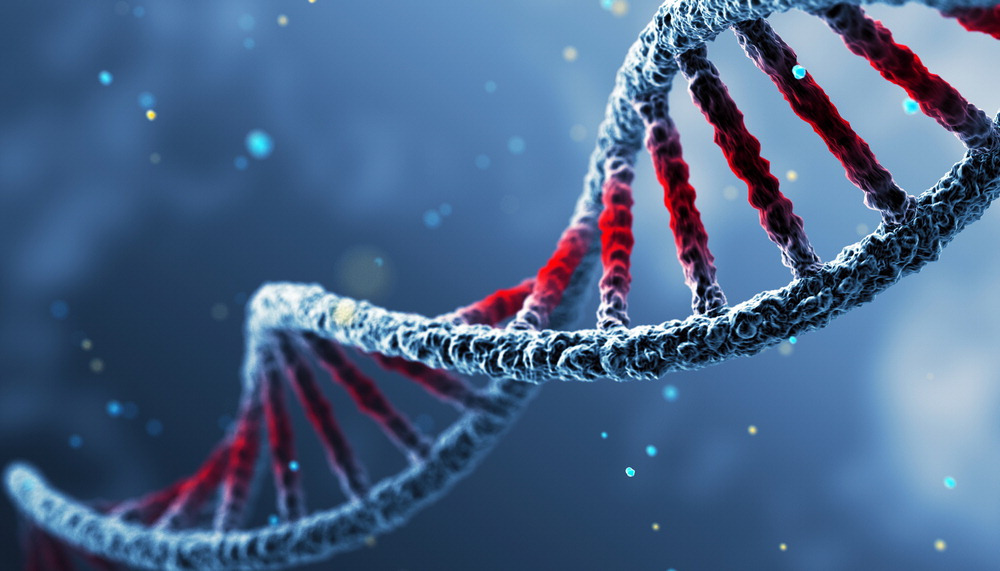
Water provides the perfect environment for various chemical molecules to meet and react. In solids, molecules are locked in place and cannot move, while in gases, they are too dispersed; liquid water is the ‘just right’ medium for complex chemical reactions to occur. In this condition, the first life forms that could process energy and replicate themselves emerged.
The miraculous nature of this moment can be understood by looking at Earth’s twin planet, Venus. Venus may have had oceans in its early days, but being slightly closer to the Sun than Earth led to a ‘runaway greenhouse effect’, causing all its oceans to boil away and turning it into a hellish planet. The diverging fates of Earth and Venus are like the results of two bakers who received the same recipe but set the oven temperature just slightly differently. That tiny difference resulted in one being a life-filled masterpiece and the other a charred failure.
Collective Learning - Humanity’s Superpower
About 200,000 years ago, Homo sapiens with an unprecedentedly powerful brain emerged. However, the decisive Goldilocks Condition was the invention of ‘symbolic language’. Human language allowed us to talk about the past, future, and abstract concepts that are not present.
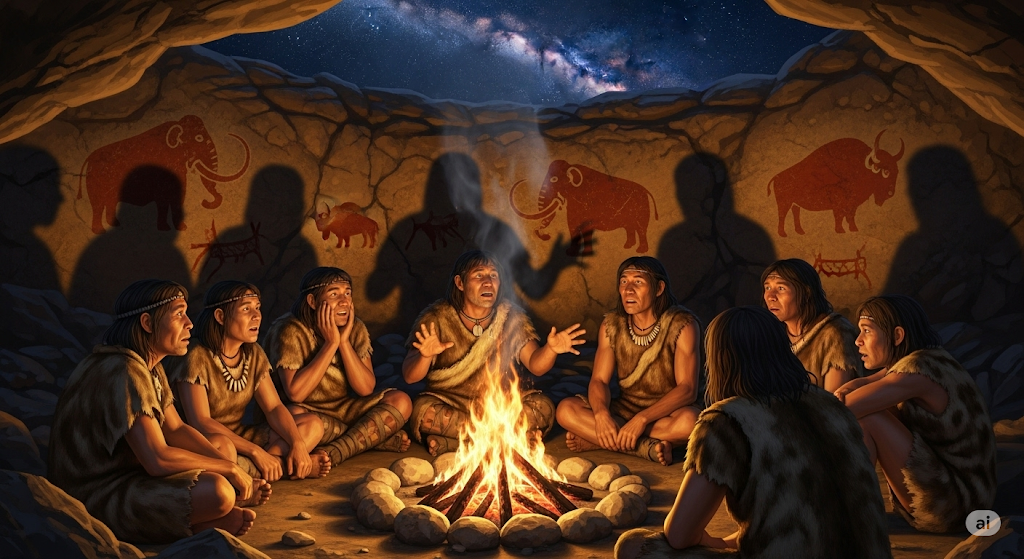
Thanks to this language, an amazing ability called ‘Collective Learning’ emerged. Knowledge learned by an individual could be accumulated and passed on to the entire community and the next generation. With the magic of ‘compound interest’ applied to knowledge, humanity’s rate of adaptation accelerated explosively. I too rely on the results of ‘collective learning’ (books, the internet) accumulated over generations to write this article. How can the new knowledge you learned today be passed on to the next generation?
Changing the Planet and Facing the Future
Agricultural Revolution - Taming Nature
About 11,000 years ago, humanity began to ’tame’ nature. This was the seventh threshold, the beginning of agriculture.
The Goldilocks Conditions were the warm and stable climate that followed the last Ice Age. This made it possible for humanity to settle in one place and reliably cultivate crops for the first time.
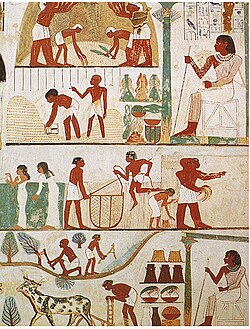
Thanks to agriculture, ‘surplus food’ emerged, leading to the specialization of labor with soldiers, priests, and artisans, and populations began to cluster in cities. As society became more complex, new systems like writing, laws, and states emerged.
Modern Revolution - Unstoppable Acceleration
About 250 years ago, the pace of change suddenly began to accelerate explosively. This was the eighth threshold, the modern revolution.
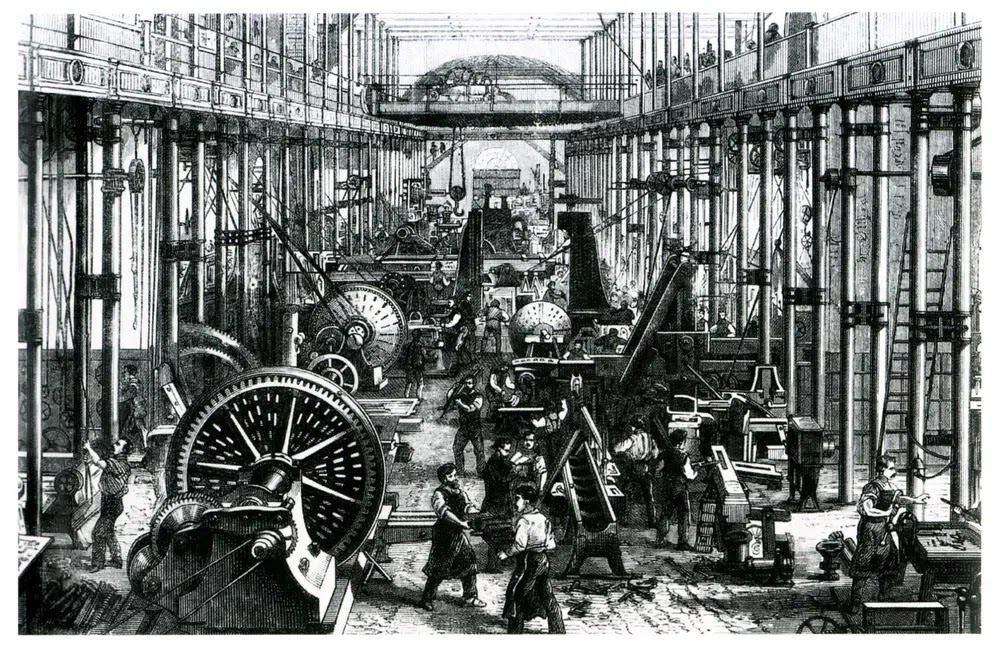
The Goldilocks Conditions formed a powerful feedback loop where the spread of information through ‘global networks’ and new energy sources like fossil fuels amplified each other. More energy created denser networks, and denser networks accelerated innovation. Thanks to this ‘information-energy’ engine, humanity became a unified global civilization and the most powerful force capable of changing the planet itself.
Where Are We Going?
The Cost of Complexity: Energy and ‘Future Shock’
A clear pattern in the journey of Big History is that as complexity increases, more energy is consumed to maintain that structure. Astrophysicist Eric Chaisson explained this with the concept of ’energy rate density’.
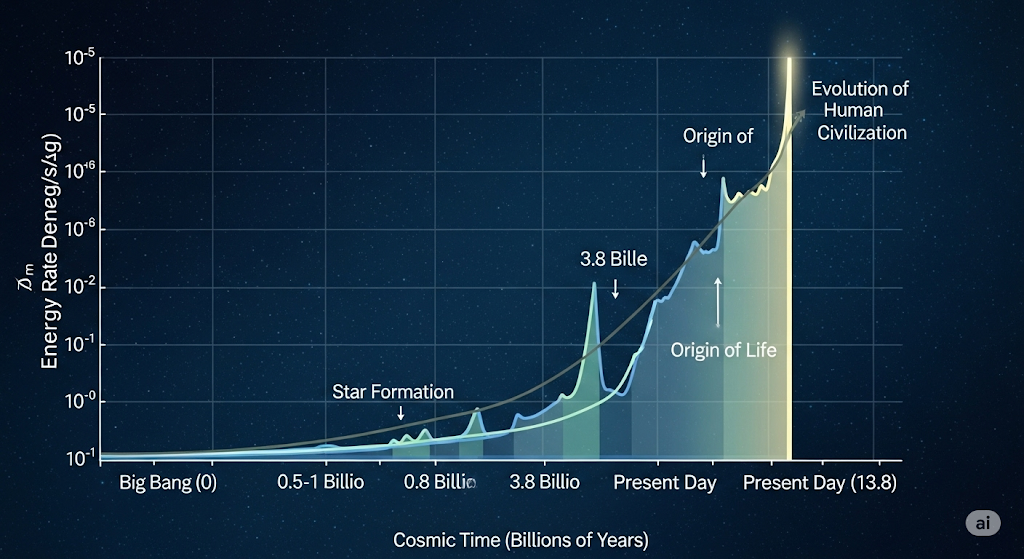
Modern human society consumes vast amounts of energy continuously, like a Formula 1 racing car, to maintain its immense complexity. This rapidly accelerating complexity leads to what futurist Alvin Toffler called ‘Future Shock’, characterized by “destructive stress and disorientation experienced by individuals due to undergoing too much change in too short a time.”
Designers of the Future
At this moment in the 13.8 billion years of cosmic history, we are in a very special position. A species on Earth has become aware of this grand origin story for the first time and has begun to understand the rules of complexity.
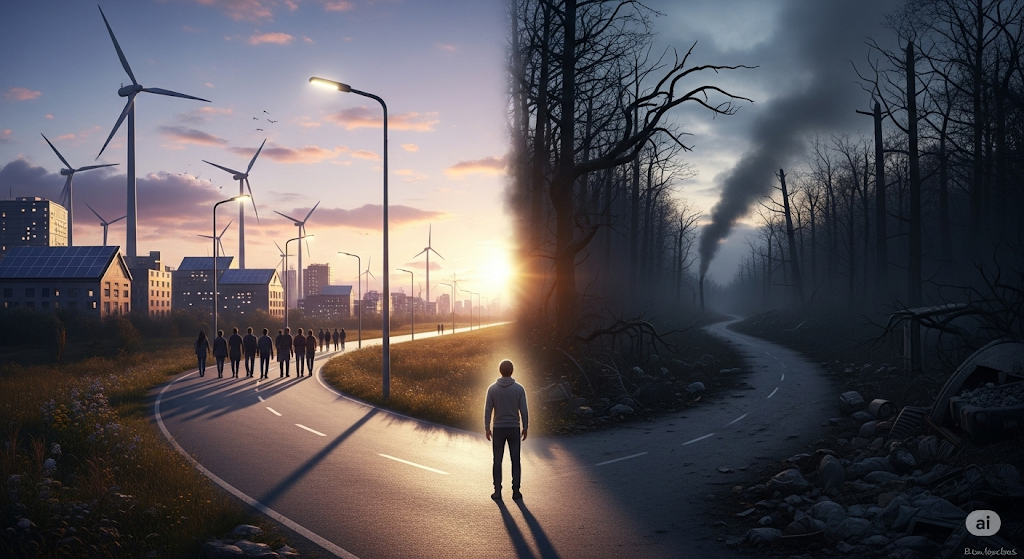
While all past thresholds were the result of unconscious processes, we are different. Humanity has gained the ability to consciously create the Goldilocks Conditions for our own future. We are no longer passive products of the story; we have the potential to become the authors of that story. What the ninth threshold will be is still undecided. It is up to us to write that answer.
Conclusion
From the simplicity of the Big Bang to the complexity of today, our existence is the result of an incredibly long and precarious chain of ‘just right’ moments.
- Key Point 1: We are made of star stuff. The elements that make up our bodies were created in the hearts of stars and supernova explosions billions of years ago.
- Key Point 2: The miracle of the ‘Goldilocks Conditions’. The history of the universe has been a process of new complexities emerging whenever the ‘just right’ conditions were met, neither too hot nor too cold.
- Key Point 3: The future is in our hands. Humanity is the first to understand this grand narrative and has the potential to consciously design the Goldilocks Conditions for the future.
Big History provides us with coordinates to locate ourselves in this vast space-time and awakens a profound sense of responsibility to write the next chapter that has yet to be written together.
What inspiration does this grand story give you? Share your thoughts in the comments and let’s ponder the next chapter of our civilization together.
References
- ASU News, Forged in the hearts of stars
- Griffith Observatory, Elements
- PBS NOVA, The Star In You
- KIAS Horizon, From the Big Bang to Humanity: What is Big History?
- David Christian, Maps of Time: An Introduction to Big History
- Aladin, [E-book] The Origin of Existence
- Daum News, [Column] Historical Moments That Satisfied the Goldilocks Conditions
- HelloDD, [Choi Byung-kwan’s A·Sa·Gwa 23] Big History
- Wikipedia, Habitable Zone