
A Chronicle of Massive Debt Created by Decades of Decisions, Historical Events, and the Privilege of the Dollar
- The historical background of how the U.S. has strategically utilized debt since its founding.
- The structural mismatch in U.S. finances, where spending increases while revenue decreases.
- Three critical crises since the 21st century that have explosively increased national debt.
- The secret weapon of the ‘dollar’ that allows only the U.S. to bear massive debt.
In our currency, 50 trillion won, equivalent to 37 trillion dollars. This unimaginable figure represents the total U.S. national debt that the government carries today. It is not merely a record in accounting books but the result of countless decisions and historical events over decades, along with the unique privileges held by the U.S.
This article is not just an accounting audit; it is a journey to find answers to the fundamental question, “How did this happen?” We will peel back the layers of history, politics, and economics to uncover the real reasons behind this debt.
1. The Beginning of Debt: From Founding Principles to Modern Habits
The story of U.S. debt begins not from mistakes but from a deliberate national construction strategy. In 1791, the first Secretary of the Treasury, Alexander Hamilton, chose to consolidate the $75.4 million debt from the Revolutionary War instead of eliminating it, using it to establish the creditworthiness of the new nation.

First Secretary of the Treasury Alexander Hamilton utilized national debt as a tool for building credit.
This gamble was dazzlingly successful, and the perception that debt is not evil but a useful tool for the nation became ingrained in America’s DNA. Historically, the U.S. has maintained a rhythm of borrowing during crises like wars and repaying during peacetime. However, since the 1980s, this historical rhythm has been disrupted as debt surged even in peacetime. The problem is not merely the fact of borrowing but the emergence of a new phenomenon: uncontrollable permanent debt.
2. Structural Cracks: Spending More and Collecting Less
At the heart of the U.S. national debt lies a core conflict: the structural mismatch between the money the government promises to spend and the money it collects in taxes.
The Unstoppable Spending Train: Mandatory Spending
A key issue in the federal budget is ‘mandatory spending,’ which is automatically spent according to law, particularly Social Security and Medicare. Due to an aging population and soaring healthcare costs, these two programs have become the largest drivers of federal spending and are considered political ‘sacred cows,’ exerting strong upward pressure on expenditures.
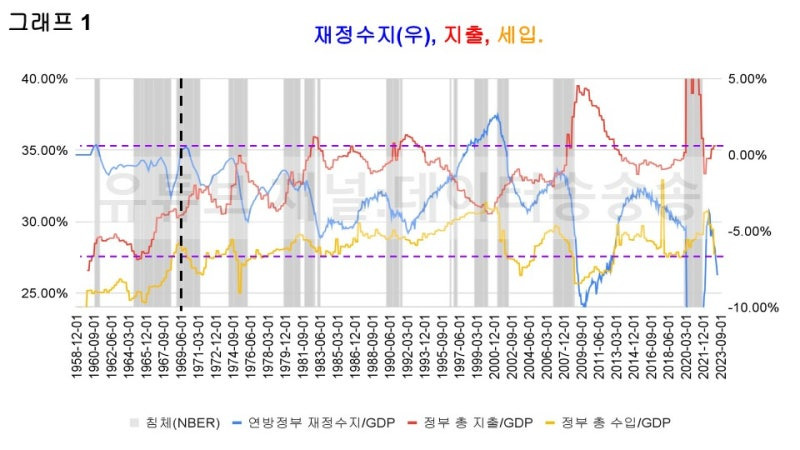
U.S. government spending (blue line) has consistently exceeded revenue (red line), creating a structural fiscal deficit.
Shrinking Revenue Base: The Era of Tax Cuts
While spending automatically increases, the revenue base has been intentionally reduced. Since the 1980s, the idea that lowering tax rates for corporations and the wealthy would stimulate economic growth and increase tax revenue gained traction. This led to significant tax cuts during the Bush administration (2001, 2003) and the Trump administration (2017).
However, the claim that ’tax cuts pay for themselves’ did not materialize, resulting in a substantial decrease in Treasury revenues and creating a structural fiscal deficit.
Summary of the U.S. Federal Budget (Fiscal Year 2024)
| Item | Amount (in trillion dollars) |
|---|---|
| Total Revenue | $4.9 |
| Total Expenditure | $6.8 |
| Fiscal Deficit | $1.8 |
3. Catalysts for Debt Surge: Three Major Crises
The slow-burning fire of structural deficits was fueled by three major crises that struck in the 21st century.
First Quake: ‘War on Terror’
The costs of the wars in Afghanistan and Iraq, which began after the 9/11 attacks, were handled through ’emergency supplemental budgets’ rather than regular budgets, leading to a phenomenon of ‘phantom budgets’ where actual costs were hidden. The total cost is estimated to reach up to $6 trillion, including future healthcare costs for veterans.
Second Quake: 2008 Financial Collapse
To prevent the collapse of the financial system, bailouts and stimulus packages led to a $6.1 trillion surge in national debt from 2008 to 2012.
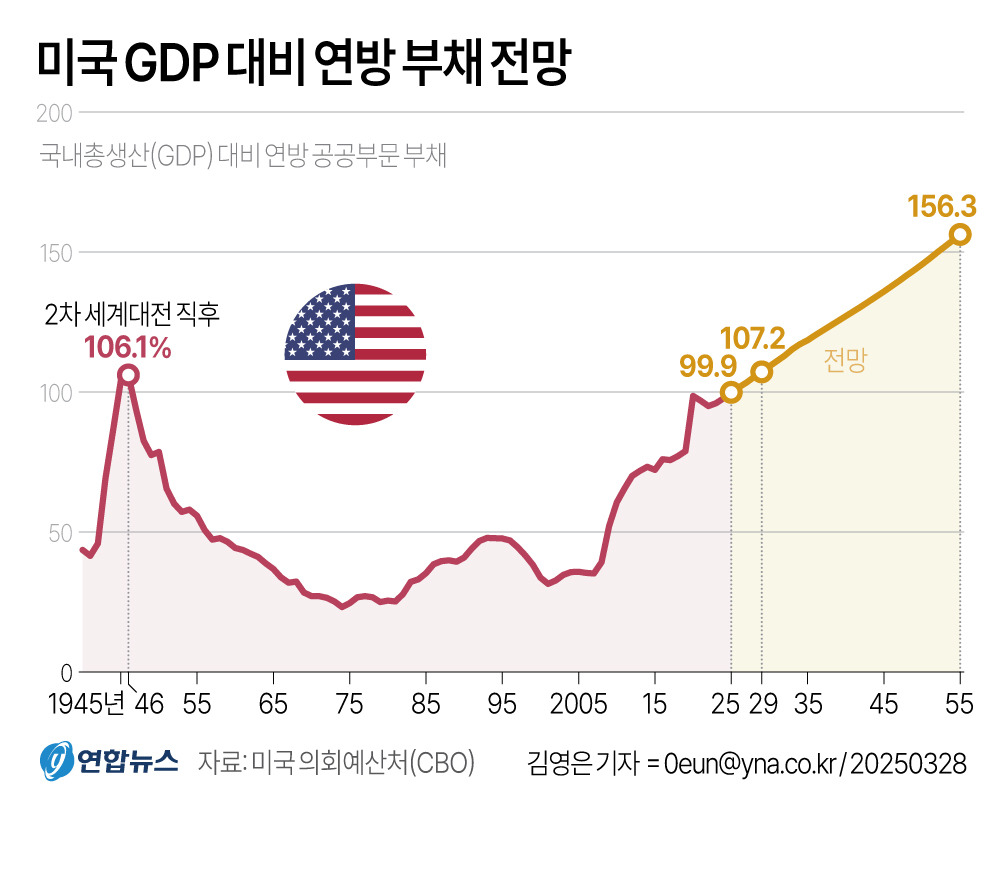
During the 2008 financial crisis and the COVID-19 pandemic, the U.S. debt-to-GDP ratio rose almost vertically.
Third Quake: COVID-19 Pandemic
In response to the pandemic, nearly $5 trillion in funding was released, causing the debt-to-GDP ratio to reach an all-time high of 132.8% in the second quarter of 2020.
These crises created a ‘ratchet effect’ that permanently elevated debt levels even after the crises passed.
Cost of Crises: Debt Impact of Major 21st Century Events
| Event | Estimated Cost/Debt Increase |
|---|---|
| Post-9/11 Wars | $4 trillion ~ $6 trillion |
| 2008 Financial Crisis | $6.1 trillion (FY08-12 increase) |
| COVID-19 Pandemic | $5.7 trillion (FY19-21 increase) |
4. Secret Weapon: How Did the Dollar Manage the Debt?
If it were any other country, it would have already faced hyperinflation or default. How is it that the U.S. can manage this massive debt?
The answer lies in the ‘absurd privilege’ of the U.S. dollar being the world’s reserve currency. Since the entire world needs dollars for trade and foreign exchange reserves, the demand for U.S. Treasury bonds is unending. This allows the U.S. to borrow money at lower interest rates than any other country, effectively subsidizing America’s deficit spending by the rest of the world.
Japan also has one of the highest debt-to-GDP ratios in the world, but most of its bonds are owned by its citizens, providing stability. In contrast, the structure of U.S. debt is uniquely supported by the entire world. Without this privilege, the fiscal policies of the past 40 years would have been impossible.
The status of the dollar as the world’s reserve currency is a key factor that enables the U.S. to manage massive debt.
5. The Never-Ending Game: Why Does Politics Inflate Debt?
Given the numbers are so clear, why do politicians not resolve the issue? This is not due to a lack of knowledge but rather a lack of political will and an incentive structure that prioritizes short-term gains.
Republicans have utilized deficit spending for tax cuts, while Democrats have done so for expanding social programs. Politicians provide immediate benefits like tax cuts or new welfare to voters, using the costs (debt increase) as a ‘fiscal illusion’ to pass onto future generations. I often feel disheartened watching politicians prioritize immediate electoral victories over long-term fiscal health.
Ultimately, the U.S. national debt is not merely an economic issue but a cumulative result of a system that prioritizes short-term political gains over long-term stability.
Conclusion
The ‘real reasons’ behind the U.S. national debt amounting to 50 trillion won are not due to a single cause but rather a combination of various factors. To summarize:
- Structural Flaws: Mandatory spending like Social Security is surging, while repeated tax cuts create a fundamental mismatch with declining revenue.
- Three Crises: The ‘War on Terror,’ financial crisis, and pandemic in the 21st century have been decisive moments that permanently raised debt levels.
- Unique Privilege: Thanks to the dollar’s status as the world’s reserve currency, the U.S. can borrow indefinitely at low costs, delaying problem resolution.
The Congressional Budget Office (CBO) warns that public debt, currently around 100% of GDP, could soar to 156% by 2055. The final chapter of this story has yet to be written. Its conclusion will depend on whether the U.S. can confront the consequences of past choices before it is too late.
References
- Understanding the National Debt U.S. Treasury Fiscal Data
- Federal Debt: Total Public Debt (GFDEBTN) FRED | St. Louis Fed
- History of the Debt TreasuryDirect
- U.S. National Debt by Year Investopedia
- National debt of the United States Wikipedia
- National Debt Clock: What Is the National Debt Right Now? Peterson Foundation
- Graphics Congressional Budget Office
- Federal Budget Econlib
- Supply-Side Economics: What You Need to Know Investopedia
- Federal Tax Cuts in the Bush, Obama, and Trump Years ITEP.org
- Key facts about the U.S. national debt Pew Research Center
- The Financial Legacy of Iraq and Afghanistan Harvard Kennedy School
- Troubled Asset Relief Program: Lifetime Cost U.S. GAO
- COVID Relief Spending USAspending
- The Dollar: The World’s Reserve Currency Council on Foreign Relations
- Fiscal Illusion and Deficit Spending Cato at Liberty Blog
- The Long-Term Budget Outlook: 2025 to 2055 Congressional Budget Office