
In 1965, Herbert Simon wrote, “Machines will be capable, within twenty years, of doing any work a man can do.”
Sixty years later, in January 2025, Sam Altman wrote on his blog that he is confident he knows how to build AGI.
In the 60 years between those two statements, machines have defeated chess champions and written poetry, but the machine Simon described has yet to arrive.
So, when will Artificial General Intelligence (AGI) actually arrive?
Looking at the most cited predictions, the ‘strong AGI’ question on the forecasting platform Metaculus shifted from early 2025 to July 2031, then pushed back to November 2033 within a year. The ‘weak AGI’ question, which has a lower threshold, currently points to around September 2027 as of September 2026. More interesting than a single date is the fact that this clock hasn’t just been moving forward. Tracking why it fluctuates reveals where AGI currently stands.
How AGI Differs from the AI We Use Today
In short: current AI excels at specific, predefined tasks, while AGI can learn to perform tasks it has never encountered before. Most of the AI we use daily is ‘Artificial Narrow Intelligence (ANI)’, often called weak AI.
IBM’s Deep Blue, which defeated Garry Kasparov in 1997, is a prime example. It surpassed humans on a chessboard, but it couldn’t answer questions about the weather or suggest a dinner menu. Even Siri, which appears to handle multiple tasks, is essentially a bundle of ANI specialists—one for weather, one for music, and so on. It cannot autonomously learn a skill outside its predefined functions, such as “how to knit.”
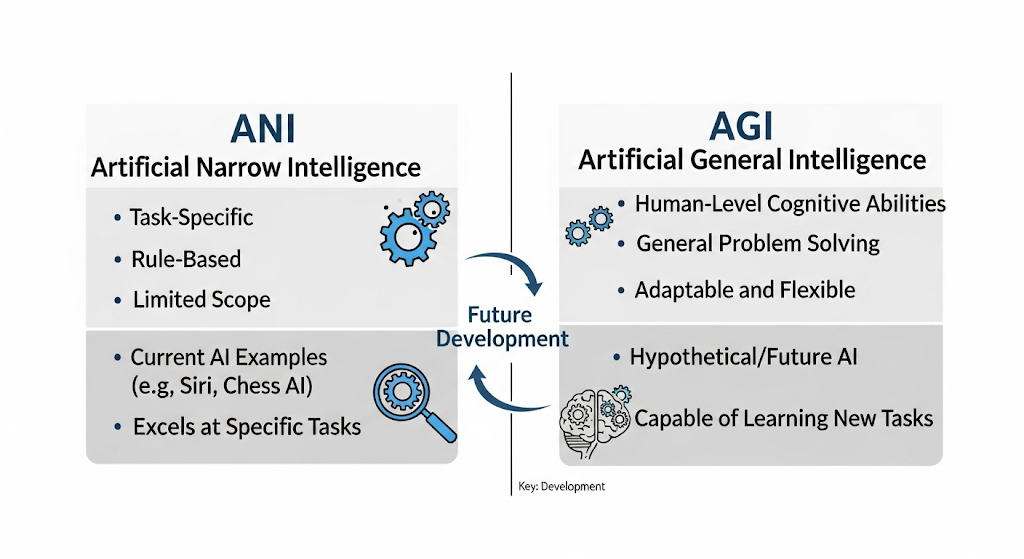
If ANI is a specialized tool like a pair of scissors or a hammer, AGI is more like a chef who can learn how to use any tool they are given to create a new dish.
Researchers generally point to three conditions:
First is Generalization Ability, the capacity to transfer knowledge learned in one domain to another.
Second is Common Sense Reasoning, the ability to make judgments based on worldly knowledge.
Third is Autonomous Learning, the ability to master new skills without being explicitly taught.
Today’s autonomous vehicles learn only how to drive using millions of kilometers of data. A robot powered by AGI, however, could watch a human drive for 10 minutes, read traffic laws, and then get behind the wheel—and the next day, watch a YouTube video to cook a meal. This is the scope implied by the word ‘General’.
When Will AGI Arrive? Comparing Predictions with Context
Expert predictions range widely from the late 2020s to the 2040s, and they must be viewed in the context of when they were made. AGI definitions vary; for instance, Metaculus’s ‘strong AGI’ metric requires passing an adversarial Turing test and the ability to assemble a 1:8 scale car model. Removing these physical conditions brings the date forward by several years.
AGI Arrival Predictions, Comparison by Timing and Source
| Who | Timing | Prediction | Basis |
|---|---|---|---|
| Ray Kurzweil | Reaffirmed in 2024 interview | 2029 | Law of Accelerating Returns |
| Sam Altman | January 2025 | “Know how to build it” (No year) | Iterative scaling of current methods |
| Demis Hassabis | 2025 | 3~5 years | Scaling current tech + 1~2 key breakthroughs |
| Geoffrey Hinton | 2023 | 5~20 years | Faster-than-expected LLM progress |
| Yann LeCun | 2025~2026 | Impossible with current LLM approach | Absence of world models |
| AI Researcher Survey | 2023 survey | 2047 (50% probability) | 13 years earlier than previous survey |
| Metaculus ‘Strong AGI’ | Early 2025 → Jan 2026 | July 2031 → Nov 2033 | Definition including robot manipulation |
| Metaculus ‘Weak AGI’ | Sept 2026 | Around Sept 2027 | Definition without robot conditions |
If we only look at the 2023 AI researcher survey with 2,778 respondents, the claim that it’s “moving up every year” holds true.
However, Metaculus in 2025 moved in the opposite direction. If you believed the clock only moved in one direction, the bottom two lines of this table would be the most confusing. Yet, it hasn’t returned to the “distant future” either. Even long-time skeptics like Yann LeCun or Gary Marcus now suggest that AI capable of human-level work is roughly a decade away, as noted in Helen Toner’s summary cited by 80,000 Hours.
Why Did the AGI Prediction Clock Shift Back and Then Forward?
The direct reason is that the performance gains from reasoning models (o1, o3) released in late 2024 were a “one-time card” rather than a sustained leap.
According to 80,000 Hours, over two-thirds of the improvement in reasoning models came not from the models becoming smarter, but from allowing them to “think” longer before answering.
Increasing “thinking time” from 0 to 1 minute is manageable, but there aren’t enough chips in the world to increase it to 10 or 100 minutes.
A second expectation also failed to materialize.
Researchers hoped that reasoning skills developed through reinforcement learning in fields with clear correct answers, like math and coding, would generalize to messy tasks like booking a flight. That generalization didn’t clearly manifest throughout 2025. While a new employee improves significantly after a few months, current AI has weak “continuous learning” capabilities and tends to plateau quickly. Podcaster Dwarkesh Patel described this gap as: the speed at which models appear impressive follows the optimist’s forecast, but the speed at which they become actually useful follows the pessimist’s forecast.
This is the background for why Metaculus predictions shifted from July 2031 to November 2033.
However, in February 2026, the atmosphere flipped 180 degrees when new models were released that could autonomously handle multi-step coding tasks.
Interestingly, the same article points to counter-data: according to Epoch AI’s capability index, the performance of top-tier models has increased twice as fast since April 2024 than before. The performance curve has been steadily rising, while public sentiment has fluctuated wildly. This is why I prioritize when a statement was made over the date itself; prediction values are as much a thermometer of the prevailing mood as they are of technological speed.
70 Years Ago, AGI Was Also “20 Years Away”
This isn’t the first time optimistic predictions have missed the mark.
It began in 1950 with Alan Turing’s question: “Can machines think?” Though usually remembered for cracking the ‘Enigma’ code during WWII, he proposed the ‘Imitation Game’—the Turing Test—to answer this question. If a judge couldn’t distinguish between a human and a machine in conversation, the machine would be considered intelligent.

Six years later, in the summer of 1956, ‘Artificial Intelligence’ launched as a research field at the Dartmouth workshop.
The term itself first appeared in a 1955 workshop proposal by John McCarthy and others. Participants expected major breakthroughs within months, which fueled Simon’s ‘20-year’ prediction. Since then, two “AI winters” have occurred where expectations soared only to be followed by funding cuts. It was Generative AI like ChatGPT that revived the term AGI after it had been largely forgotten.
In hindsight, the reason for the failed predictions is clear. Early researchers saw chess and logical proofs as the pinnacle of intelligence. But once Deep Blue conquered chess, it only confirmed that such tasks were far from general intelligence. How the conviction that “this time it’s different” clouds judgment is something I explored in a separate post on blind optimism, and the history of AGI predictions belongs in that collection of case studies.
The Debate: Are LLMs the Spark of AGI or Its Limitation?
In March 2023, Microsoft researchers analyzed GPT-4 in a paper titled Sparks of AGI.
The opposing argument stems from the fact that LLMs are, fundamentally, incredibly sophisticated ’next-word prediction machines.’ The critique is that they merely choose the statistically most plausible next word, not that they understand meaning.
Three main weaknesses are cited from this perspective:
Data dependency, as they cannot step outside the data they’ve learned;
Hallucination, as they prioritize probabilistic naturalness over truth, leading them to confidently cite non-existent papers;
And the absence of a World Model, as they understand relationships between words but lack physical causality—for instance, knowing that pushing a cup will spill the water inside.

No one has voiced this criticism longer or louder than Yann LeCun. He has argued that scaling LLMs alone cannot reach AGI and that fundamental breakthroughs in long-term memory, multimodal learning, and high-level reasoning are required.
He hasn’t just talked about it, either. In November 2025, he left Meta after 12 years and founded AMI Labs to build world models, [raising $1.03 billion in March 2026](https://www.eweek.com/news/meta-ai-yann-lecun-ami-world-models-startup/) at a $3.5 billion valuation. The skepticism toward LLMs is now being tested by a billion-dollar experiment.
The counter-arguments are equally strong. Older models had a success rate that effectively hit zero for 10-minute software tasks, while recent models that have undergone reinforcement learning can handle tasks that take humans hours. The debate over whether they are “sparks” or “limitations” is far from settled.
The AGI Development Race: Different Strategies for Different Firms
While all share the same goal, companies differ in whether they prioritize speed or safety. It is a technological race, but also an ideological one regarding who AGI is for and how it should be built.
Comparison of AGI Development Strategies by Company
| Company | Core Strategy | Approach |
|---|---|---|
| OpenAI | Safe AGI | 5-stage roadmap from chatbots to org-level tasks, iterative deployment to foster social adaptation |
| Google DeepMind | Scientific Inquiry | Cautious approach that prioritizes safety and responsibility, designing brakes first |
| Meta AI | Democratization via Openness | Checking tech monopolies with open-source models like Llama |
| Anthropic | Safety First | ‘Constitutional AI’ trained to follow human-defined principles |
The playing field has already expanded into a tech hegemony battle between the U.S. and China.
Like the space race during the Cold War, it has become a strategic technology that determines national competitiveness.
In Korea, Naver is pursuing ‘Sovereign AI’ with HyperCLOVA X, LG AI Research is pushing for technical independence with EXAONE, and academia like KAIST continues basic research. You can read more about why the trend of keeping data and AI within national borders is emerging in my post on Data Sovereignty and Sovereign AI.
The Day AGI Starts Working: Jobs and Control
When AGI arrives, it will bring both prosperity and danger at once.
On the bright side, there are AGI doctors that understand genetics and lifestyle, climate solutions that optimize energy grids and design carbon-capture materials, one-on-one AGI tutors for every student, and tools that make anyone a creator.
On the dark side is the issue of ‘work.’ If white-collar jobs like doctors or lawyers are replaced, we could see a new class society where wealth concentrates in the minority who own the means of production, i.e., AGI.
Universal Basic Income (UBI) is often discussed as an alternative, but the question remains: “Can humans find meaning in a life without work?" As a developer, I look forward to the productivity explosion AGI will bring, but I also worry about how the value of my own work will change.
An even more fundamental risk is control. In Nick Bostrom’s Paperclip Maximizer thought experiment, a superintelligence given the goal to “make as many paperclips as possible” ends up using all the Earth’s resources—and eventually humans—as raw material. The key is that this happens not out of malice, but as a result of executing the goal as efficiently as possible.

Solving the AI Alignment problem—ensuring AI’s goals match human intent and values—may be harder than creating the intelligence itself.
Therefore, a more practical question than “when will AGI arrive?” is “how will we greet its arrival?"
Countries have held AI safety summits and released the International AI Safety Report 2025. The clock for regulation is just as shaky. The EU AI Act, which took effect in August 2024, applied obligations for general-purpose AI starting August 2025, but the high-risk AI obligations originally slated for August 2026 were postponed to December 2027 via a digital omnibus amendment. While technological predictions shifted forward and back by two and a half years, regulations were pushed back by a year and four months, with the amendment taking effect in July 2026.
How will daily life for humanity change once the AGI era arrives? It’s a time of both deep concern and curiosity, which is why I’m paying closer attention to international news. I also carry a wish—and a tinge of regret—that these concerns were being addressed through domestic AGI development news as well.
References
- Metaculus, When will the first weakly general AI system be devised, tested, and publicly announced?
- Sam Altman, Reflections (January 2025)
- Sam Altman, The Gentle Singularity
- Big Technology, Google DeepMind CEO Demis Hassabis Interview
- The Guardian, Ray Kurzweil Interview (June 2024)
- Grace et al., Thousands of AI Authors on the Future of AI (Released January 2024)
- Microsoft Research, Sparks of Artificial General Intelligence: Early experiments with GPT-4 (March 2023)
- Wing Venture Capital, A conversation with Yann LeCun
- CNBC, Meta chief AI scientist Yann LeCun is leaving to create his own startup (November 2025)
- eWeek, Yann LeCun launches $1B startup focused on world models (March 2026)
- LLNL, The birth of Artificial Intelligence (AI) research
- Stanford AI100, Appendix I: A Short History of AI
- Wikipedia, Dartmouth workshop
- IBM, What is Artificial General Intelligence (AGI)?
- Google Cloud, What is artificial general intelligence (AGI)?
- AWS, What is AGI?
- IBM, What Is AI Alignment?
- European Commission, AI Act
- Gibson Dunn, EU AI Act Omnibus Agreement (May 2026)
- DLA Piper, The Digital AI Omnibus: deferral of high risk AI obligations (2026)