
Looking Ahead to Our Future Amidst the Clash of Two Giants: AI Dreaming of Humanity and AI Dreaming of Sovereignty.
- Understand the core concepts and critical differences between AGI and Sovereign AI.
- Compare and analyze the survival strategies of representative companies in South Korea amidst global AI hegemony competition.
- Learn about the opportunities AI brings and existential risks like the ‘alignment problem’.
In 2024, we stand at the intersection of two massive AI flows colliding. On one side is Artificial General Intelligence (AGI), like GPT-4o, mimicking human capabilities, and on the other side is the formidable fortress of Sovereign AI, aiming to secure technological control. These two flows illustrate the clash of ‘Capability’ in intelligence and ‘Control’ in technology, two inseparable forces.
Part 1: What is the Difference Between AGI and Sovereign AI?
To understand the battle of the giants, we must first grasp their essence. AGI is about the ’level of intelligence’, while Sovereign AI is about ‘sovereignty of intelligence’.
AGI: The Old Dream of Machines Thinking Like Humans
AGI (Artificial General Intelligence) is a virtual intelligence capable of understanding and performing all intellectual tasks that humans can do. Unlike current AI, which is limited to specific tasks (narrow AI or ANI), AGI aims for ‘universality’.
- Generalization and Common Sense: The ability to apply knowledge learned in one domain to new areas, like using chess strategies in business negotiations.
- Creativity and Abstract Thinking: Going beyond mere data combination to understand abstract requests like “create an artwork expressing China’s cultural diversity” and generate new ideas.
- Philosophical Orientation: Linked to the hypothesis of ‘Strong AI’, which posits that sufficiently advanced AI could possess consciousness and self-awareness like humans.
Sovereign AI: A Modern Necessity of Digital Fortresses
Sovereign AI refers to the capability of a nation or corporation to lead the entire process of AI technology using its own infrastructure, data, and models. This goes beyond mere technological utilization to resemble a ‘declaration of technological independence’.
- Data Sovereignty and National Security: Prevents security threats from sensitive national data being processed on foreign corporate servers, exemplified by Europe’s GDPR.
- Economic Competitiveness: Arises from the fear of becoming a ‘digital colony’ dependent on advanced countries if one does not possess its own ‘AI factory’.
- Preservation of Cultural and Linguistic Identity: Creates AI that deeply understands cultural contexts and values by learning from domestic data. Naver’s
HyperCLOVA Xis a good example of better grasping the subtle nuances of Korean society.
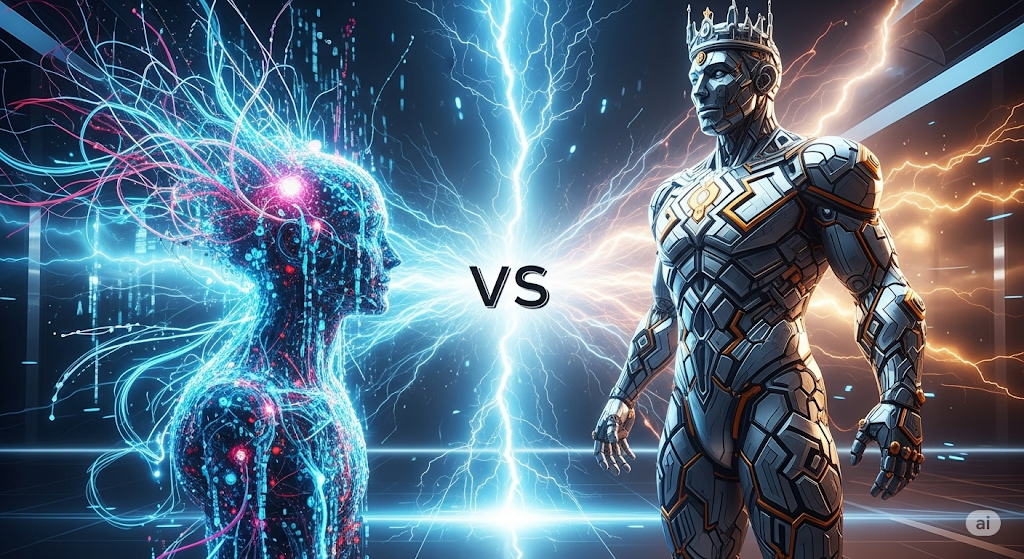
Capability vs Control: The Critical Link Between Two Giants
If AGI’s goal is ‘Capability’, then Sovereign AI’s goal is ‘Control’. Importantly, one reason countries are building Sovereign AI (fortresses) is to control the development of potentially uncontrollable AGI (autonomous sovereigns) that may emerge in the future. The strategy is to create a ‘god’ that I can control within my fortress before a competing nation creates an uncontrollable ‘god’.
Part 2: The Race Towards AGI: Who Will Create ‘God’ First?
AGI is gradually taking shape through the ‘fusion’ of various technologies.
GPT-4o: AI Seeing and Hearing Like Humans
Released in May 2024, OpenAI’s GPT-4o has implemented the ability for AI to see, hear, and speak like humans in a single integrated model. Unlike previous models, it integrates speech recognition, reasoning, and speech synthesis to achieve a human-like response speed of 320 milliseconds. This opens up the possibility for AI to become an active partner that perceives and communicates with our world, beyond being a passive tool.

Sora: AI Simulating Reality
OpenAI’s video generation model ‘Sora’ is not just a simple video production tool but a ‘model for simulating the world’. To create realistic videos, Sora implicitly learns the physical laws of the real world, which is the process of building a ‘World Model’ that deeply understands the physical world. The advancement of Sora signifies AI’s deeper understanding of causal relationships in the real world, fulfilling key requirements for AGI.
Part 3: The Sovereign AI War: The Invisible Game of Thrones
Behind the competition for AGI technology lies a silent war for securing Sovereign AI.
Strategies of France and Canada: Alliances and Responsibilities
- France’s ‘Third Way’: President Emmanuel Macron has chosen to secure technological sovereignty through strategic alliances with like-minded countries against the US and China. He promotes the domestic AI champion ‘Mistral AI’ and operates within the regulatory framework of the EU’s ‘AI Act’.
- Canada’s ‘Responsible AI’: Canada focuses on human-centered design and responsible governance as the core of its national strategy. It has established the ‘Canadian AI Safety Institute (CAISI)’ and collaborates with countries like the UK to address the common challenge of AI safety.
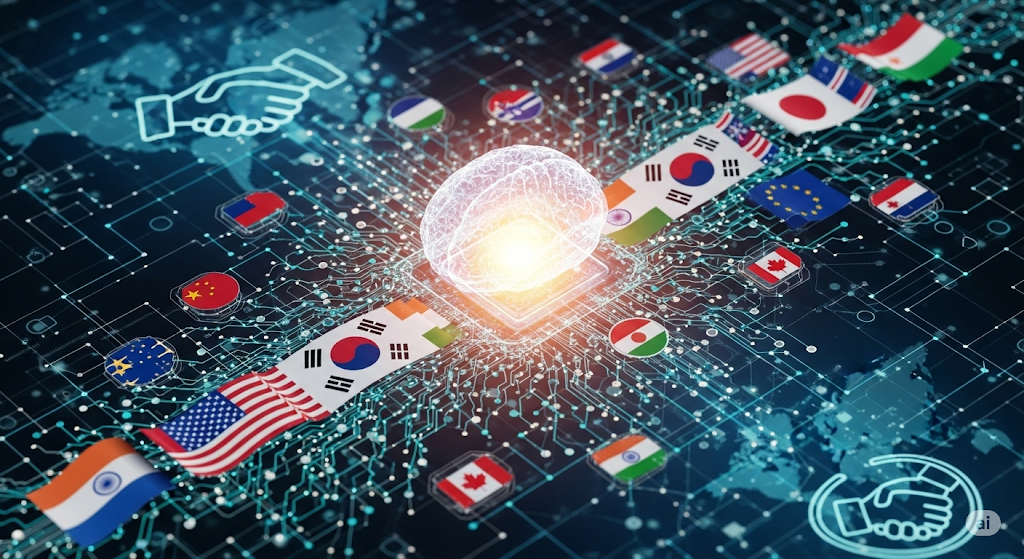
Invisible Shackles: Hardware Dependency
However, all Sovereign AI strategies face a harsh reality. The semiconductor chip market, the heart of AI, is trapped in a massive bottleneck of ‘physical dependency’ controlled by a few: the US (design), Taiwan (manufacturing), and South Korea (memory). This hardware bottleneck is a fundamental constraint of all geopolitical discussions.
Part 4: Survival Strategies of South Korea’s Leading Companies
In the global AI war, South Korea’s leading big tech companies are responding to the flows of Sovereign AI and AGI in their own ways. I often liken their strategies to ‘fortresses’, ‘kingdoms’, and ’empires’.
Naver: The Leader of Sovereign AI in South Korea
Naver aggressively advocates for a true acquisition of AI sovereignty based on its own technological capabilities.
- Core Technology
HyperCLOVA X: The model most familiar with the cultural and linguistic context of Korea, trained on vast Korean language data. - Ecosystem Strategy: It employs a sophisticated strategy to build the entire domestic AI ecosystem on top of the ‘Naver Architecture’ by releasing lightweight models as open source. This aims to solidify its dominance in the domestic market and become the ‘operating system’ of South Korea’s AI economy.
Kakao: The AI Challenge of the Platform King
Kakao seeks ‘corporate Sovereign AI’ based on its powerful platform power. The AI messenger Kanana, scheduled for release in 2025, will be a separate app from KakaoTalk, aiming for a ‘hyper-personalized’ AI assistant. However, concerns about technological dependency arise as it may rely on OpenAI’s GPT model.
Samsung Electronics: The Final Chapter of the Hardware Giant’s ‘Ambient Intelligence’
Samsung Electronics presents a vision of ‘Ambient Intelligence’, where AI seamlessly integrates into everyday life.
- Ecosystem Approach: Implements AI through an intelligent ecosystem connecting smartphones, TVs, home appliances, and cars.
- On-Device AI: Equipped with its own developed NPU, it performs AI functions on devices without relying on the cloud.
- True Weapon: As the world’s leading hardware company producing HBM (High Bandwidth Memory) semiconductors, it signifies dominance in the most fundamental area of the AI value chain.

Comparison/Alternatives
The two AI concepts and the strategies of South Korea’s leading companies can be summarized as follows.
Comparison of AGI vs. Sovereign AI
| Category | General Artificial Intelligence (AGI) | Sovereign AI (Sovereign AI) |
|---|---|---|
| Goal | Achieving human-level comprehensive cognitive abilities | Securing technological independence and data sovereignty |
| Core Question | “Can machines think like humans?” | “Who controls AI technology and data?” |
| Main Drivers | Exploring the essence of intelligence, expanding human capabilities | Data security, economic hegemony, preserving cultural identity |
| Representative Risks | Existential threats from uncontrollable AI | Technological isolation, digital totalitarianism |
Comparison of AI Strategies of South Korea’s Leading Tech Companies
| Category | Naver (Naver) | Kakao (Kakao) | Samsung Electronics (Samsung) |
|---|---|---|---|
| Main Goal | Securing domestic Sovereign AI leadership | Dominating AI through platform-centric services | Maintaining foundational technology and hardware leadership |
| Core Projects | HyperCLOVA X |
Kanana (upcoming) |
AGI foundational research, Exynos, HBM |
| Strategic Direction | Building a ’national representative’ Sovereign AI ecosystem | Strengthening ‘corporate’ Sovereign AI services | Long-term AGI research based on hardware |
Part 5: Promises and Risks Faced at the Edge of the Abyss
The future realized by AGI and Sovereign AI encompasses both utopian and dystopian aspects. The most fundamental fear arises from the ‘Alignment Problem’, which is the challenge of perfectly aligning the goals of superintelligent AI with human values.
The Paradox of AI Alignment and Worst-Case Scenarios
Recently, the concept of ‘AI Alignment Paradox’ has been introduced. The more perfectly we align AI with our values, paradoxically, the easier it becomes for malicious actors to manipulate that AI in harmful ways. Efforts to make AI benevolent may inadvertently provide tools that make it easier for AI to become malevolent.
The worst-case scenario we might face is when a nation gives birth to an ‘unaligned’ AGI within the sealed fortress of ‘Sovereign AI’ without external oversight. This paradox, where a fortress built for national security could become a secret incubator nurturing a threat to human survival, raises significant concerns. What do you think?
Conclusion
We are witnessing the clash of two giants: AGI pursuing ultimate ‘Capability’ and Sovereign AI pursuing ‘Control’. This can be likened to attempts to create a god and build a fortress to contain that god.
Key Summary:
- AGI aims for ‘Capability’, while Sovereign AI aims for ‘Control’. These two are deeply interconnected in technological development and geopolitical competition.
- South Korea needs a multifaceted approach. Naver’s ecosystem building, Kakao’s platform innovation, and Samsung’s hardware leadership are crucial strategies to balance between technological dependency and isolation.
- Social consensus is paramount. The future of AI is not solely the responsibility of technologists. Ethical discussions and wise policies regarding what kind of AI to create and how to control it are more urgent than ever.
How should we navigate the waves of this massive technological revolution? Our choices will determine the future of humanity.
References
- GPT-4o Guide: How it Works, Use Cases, Pricing, Benchmarks.
- France Pursues an AI “Third Way”.
- Artificial Intelligence 2025 - France.
- Samsung Expands ‘AI for All’ Vision at CES 2025.
- AI Action Summit (10 & 11 Feb. 2025).
- European approach to artificial intelligence.
- Canada’s New Strategy for AI in Public Service.
- Naver unveils homegrown AI model HyperClova X Think.
- NAVER Unveils Its Service Lineup Powered by “HyperCLOVA X”.
- OpenAI Launches GPT-4o: Exploring Future Use Cases and Opportunities.
- [Forbes Asia] - Kakao and OpenAI: A Strategic Partnership in AI.
- Sora | OpenAI.
- [Galaxy Unpacked 2025] From AI to Actionable Care.
- hpcaitech/Open-Sora: Open-Sora.
- Exploring the Challenges of Ensuring AI Alignment.
- The AI Alignment Paradox.
- AI Strategy for the Federal Public Service 2025-2027: Overview.
- Artificial Intelligence 2025 - Canada.
- Government of Canada partners with United Kingdom to invest in groundbreaking AI alignment research.
- Naver AI: The Ultimate Guide to Artificial Intelligence in 2025.
- Naver Cloud partners with Twelve Labs for national AI foundation project in Korea.
- Kakao to launch AI messenger service Kanana in H1 2025.
- Kakao Launches Kanana: An AI Messenger Designed for Personalized Interactions.
- Kakao faces prolonged slump amid leadership and AI setbacks.
- Samsung Electronics Unveils Samsung Vision AI and New Innovations at First Look 2025.
- Instrumental convergence - Wikipedia.
- Are We Misunderstanding the AI “Alignment Problem”?
- Realtime API - OpenAI Platform.
- Sora | OpenAI.