
The Demon Who Knows Your Deficiencies
Now, please take a seat. Close your eyes for a moment and think of your deepest desire. Is it a large sum of money that could instantly solve the soaring loan interest and harsh reality? Or is it power and honor that cannot be ignored by anyone, or wisdom that penetrates all knowledge of the world? Whatever that desire may be, it stems from your most vulnerable ‘deficiency.’
Imagine that at that moment, you hear a low voice behind you, as if it sees through everything. “You can have it all. Just give me one tiny thing in return.”
When you turn around, you see not a monster with horns or a tail, but a sophisticated gentleman dressed in a luxury suit that perfectly suits your taste, smiling at you. His gaze seems to penetrate the deepest part of your soul. His name is Mephistopheles, or simply Mephisto. He is a being that thrives on your deficiencies.

Today, we will begin a deep exploration of this attractive yet dangerous being, Mephisto. Is he truly a being like Satan or Lucifer from the Bible? Or is he another name for our desires that have evolved alongside human history? This story will go beyond mere myth analysis and pose a sharp question directed at your heart: How much is your soul worth?
Chapter 1: The Devil You Know is Not Him - The Origins of Mephisto
Many people often equate Mephisto with Satan, the king of demons mentioned in the Bible. However, surprisingly, the name Mephisto does not appear anywhere in the Bible. He is a being born not from theology, but from literature, specifically the ‘Faust legend’ of 16th-century Germany.
The Historical Figure, Dr. Faust
The story begins with a historical figure believed to be an alchemist and astrologer named ‘Georg Faust.’ He was a mysterious figure suspected of practicing magic and consorting with demons among his contemporaries. After his death, his exploits were exaggerated into bizarre tales through the mouths of the people, which eventually led to the creation of a book titled ‘The Story of Dr. Johann Fausten,’ commonly known as the ‘Popular Version of Faust.’
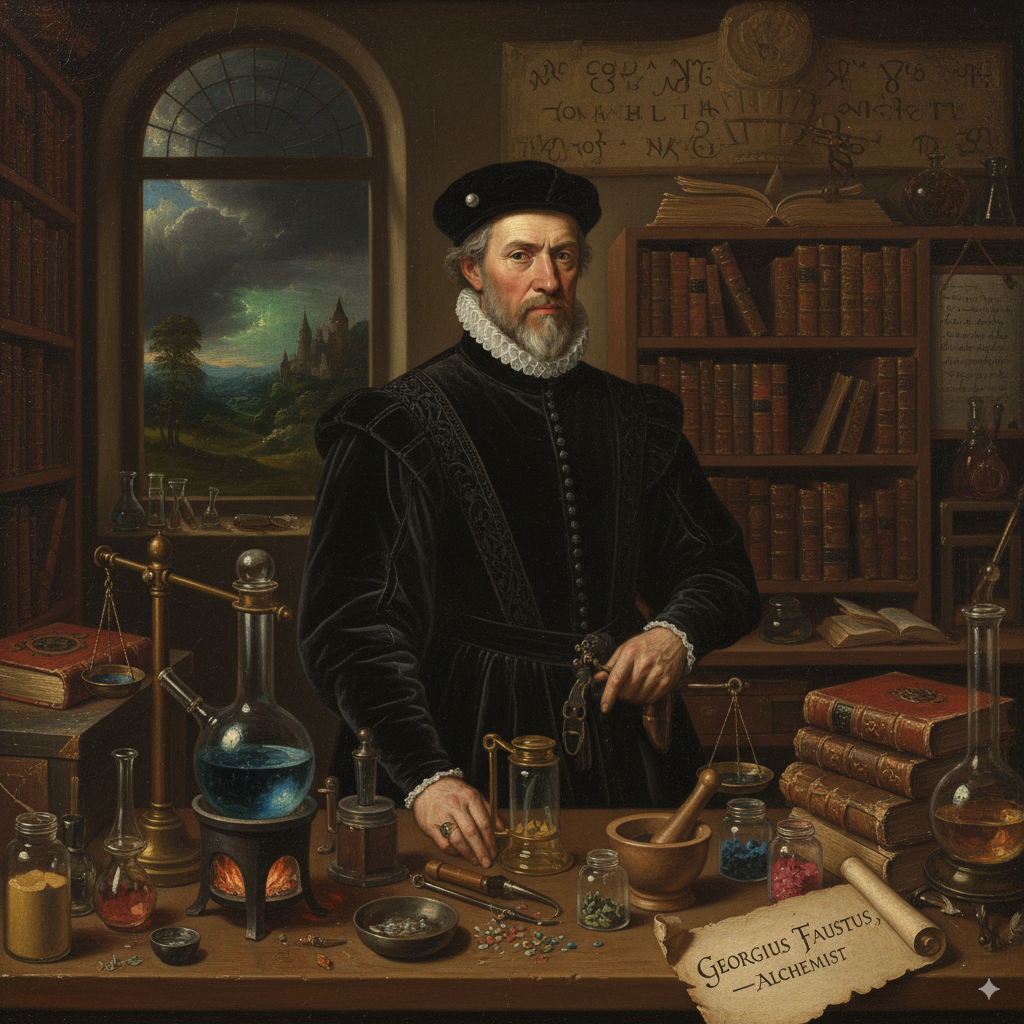
In this book, the demon named ‘Mephistopheles’ first appears. Dr. Faust summons the demon Mephisto to gain all the knowledge and pleasures of the world, making a contract for 24 years with his soul as collateral. This primal story served as a powerful warning to people of the time about the terrible destruction that could arise from defying divine providence and seeking forbidden knowledge.
‘The One Who Does Not Love Light’
The etymology of the name Mephistopheles is a key to understanding his identity. Scholars believe this name may have originated from Hebrew or Ancient Greek. The most widely accepted theory combines the Greek words ‘Me (μὴ, not)’, ‘Phos (φῶς, light)’, and ‘Philes (φιλής, loving)’, meaning ’the one who does not love light.’
This is highly symbolic. He is a being that fundamentally rejects and hates the divine ’light’ symbolizing truth, goodness, and salvation. Yet at the same time, he is also the ‘darkness’ that can only exist because of light. He proves creation through destruction and speaks of affirmation through negation, embodying a paradoxical existence. He tempts humans to undermine the greatness of God, but that very process ironically becomes part of God’s grand plan.
Goethe: Breathing New Life into the Demon
The character of Mephisto was undoubtedly completed by Johann Wolfgang von Goethe’s play ‘Faust.’ In Goethe’s hands, Mephisto transforms from a mere evil demon leading humans to ruin into an attractive gentleman and philosopher who wields cynical and intellectual humor.
In the prologue of Goethe’s ‘Faust,’ ‘The Heavenly Prelude,’ Mephisto converses with God and makes a wager. He confidently declares that he can seduce and corrupt Faust, the human whom God loves. God permits this, stating that humans will inevitably wander as long as they strive. This scene hints that Mephisto is part of a vast cosmic order under God’s control.
He introduces himself as follows:
“I am part of that power that always wishes evil and always creates good. (Ein Teil von jener Kraft, Die stets das Böse will und stets das Gute schafft.)”
This line best illustrates Mephisto’s duality. He provides Faust with all sorts of pleasures and experiences to corrupt him, but this process paradoxically becomes the driving force that leads Faust to constantly ponder, experience, and ultimately ascend to a higher dimension. He is both a destroyer trying to ruin Faust and a companion guiding him toward salvation.
Chapter 2: The Art of Soul Contracts - The Devil is in the Details
The relationship between Mephisto and humans always begins with a ‘contract.’ This soul contract is a profound philosophical metaphor about human desire, choice, and responsibility, beyond a mere fantastical device.
Terms of the Contract: He Wants Your ‘All’
What Mephisto desires is always one thing: your ‘soul.’ Here, the soul symbolizes not just a religious concept but encompasses a person’s essence, identity, humanity, and conscience. He is not interested in worldly values like money or fame. He wants your ‘all’ as a being.
In return, what he offers is the fulfillment of your most desired ‘deficiency.’
- To the knowledge-hungry Faust: All the secrets of the world and infinite intellectual experiences.
- To the power-hungry politician: Absolute power that no one can oppose.
- To the modern person weary of poverty: Wealth and economic freedom that will last a lifetime.
The contract is usually signed in blood. This symbolizes that the contract is not a mere promise but an irrevocable oath that stakes life and existence itself. However, the real trap lies not in the clauses of the contract but in the very ‘moment’ of making the contract. The moment you give up your efforts to overcome reality with your own strength and reach out to the devil for an easy path, your soul has already begun to be consumed.
The Way of Fulfilling Desires: Mirror and Magnifying Glass
Mephisto is not a god who creates being from nothing. His methods are much more cunning and psychological.
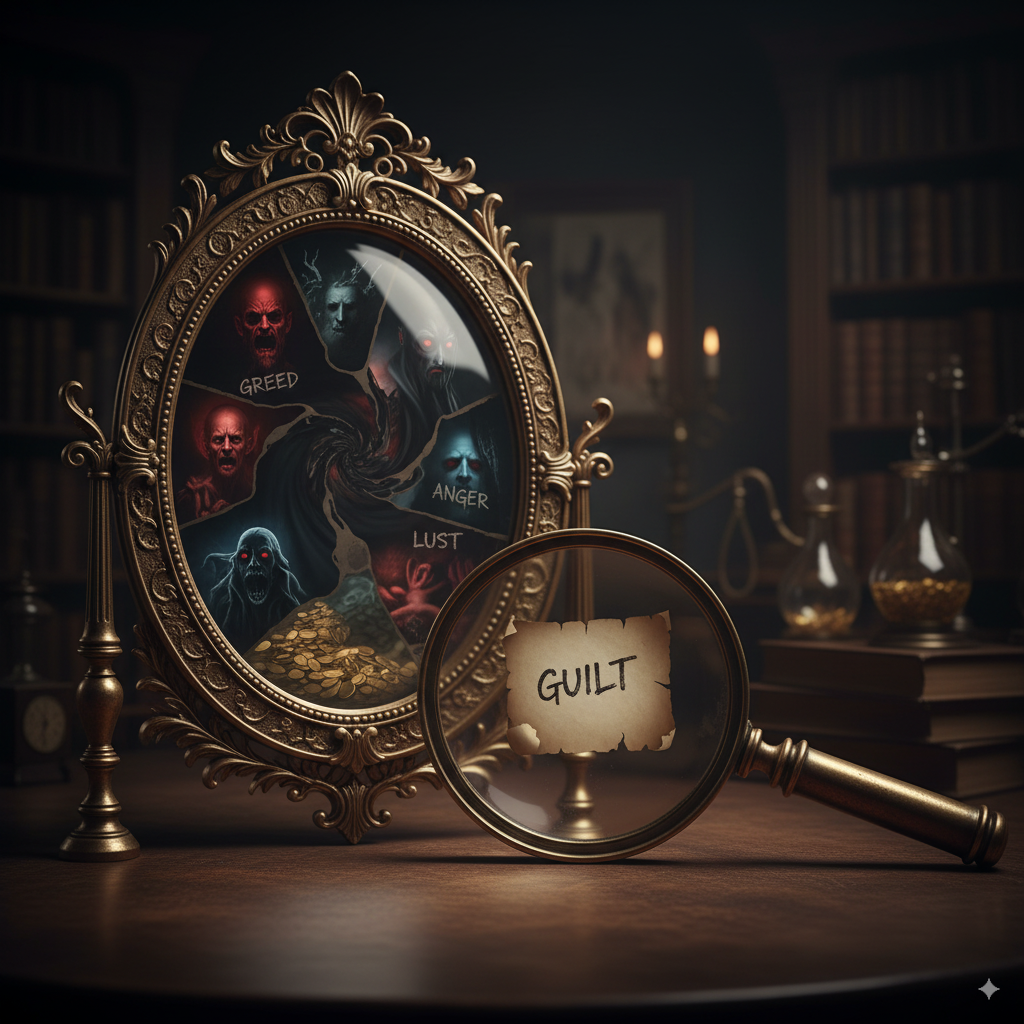
- The Mirror: He reflects the desires that already exist within you. He shows even the most ugly and selfish desires that you may not be aware of or have tried to ignore, whispering, “This is the real you.” He does not create new desires but merely fans the small spark within you into a massive flame.
- The Magnifying Glass: He fulfills your desires but makes all the moral and ethical issues that arise in the process seem trivial. “For the sake of the goal, you must make this small sacrifice,” or “Everyone lives like this,” dulling your guilt. He is an illusionist who holds a magnifying glass to your conscience, making a massive elephant appear like an ant.
Ultimately, everything Mephisto gives is like a ‘mirage.’ The youth and love Faust gains ultimately end in the tragedy of his lover Gretchen, and the banknotes he creates plunge the economy into chaos. The gifts from the devil always contain the seeds of destruction within them. They are like saltwater, which does not provide true fulfillment but instead brings about a greater thirst.
Chapter 3: The Mirror of the Times, the Evolution of the Devil
Mephisto is not a fixed being. He has constantly changed his appearance like a mirror reflecting the desires of the times.
From Medieval Menace to Modern Gentleman
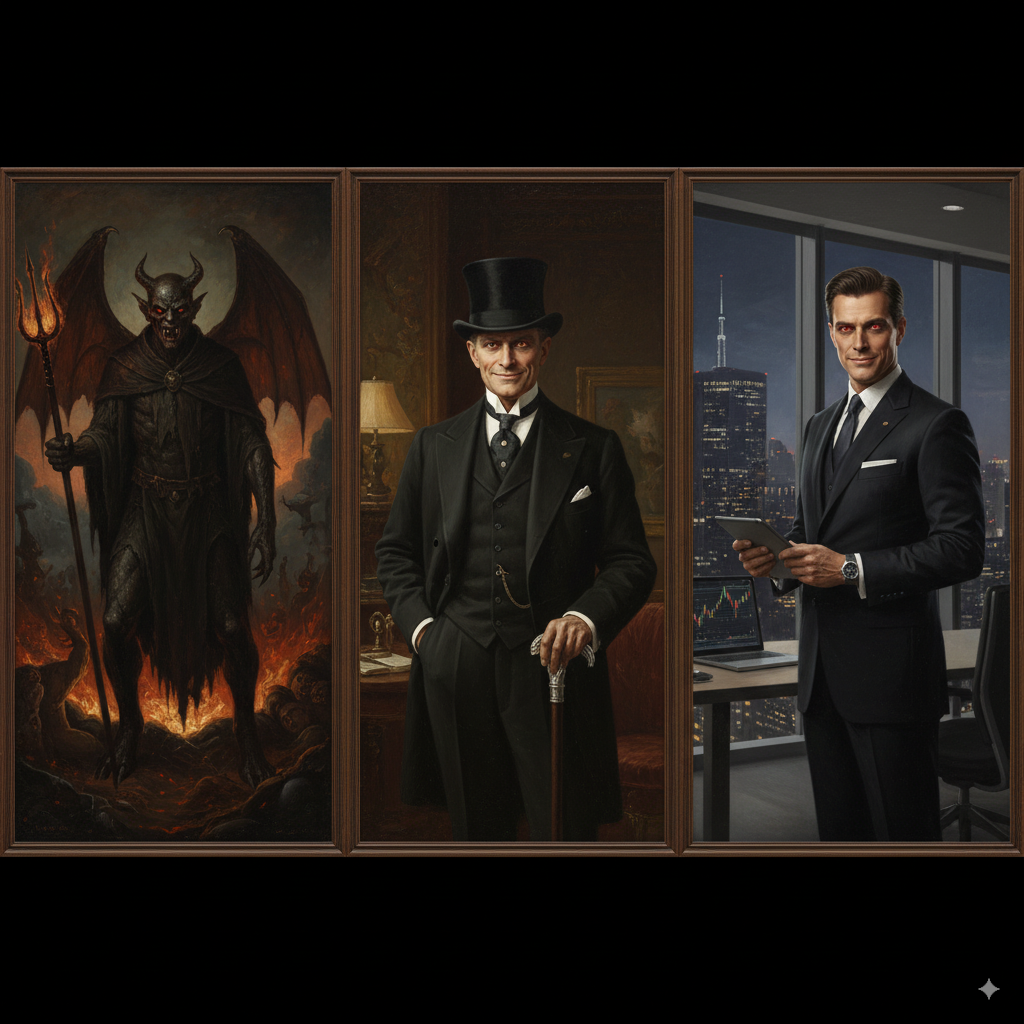
In the late Middle Ages, when the Faust legend first emerged, Mephisto was a grotesque and threatening demon. He was a being who threatened humans whose faith was wavering, reminding them of the horrors of hell and forcing obedience.
However, as the Enlightenment progressed and reason and rationality became important in modern times, Goethe transformed Mephisto into a sophisticated intellectual and cynical gentleman. He no longer appears as an object of fear but rather as a ‘partner’ capable of engaging in intellectual conversation and debate. He mocks the existence of God, ridicules human hypocrisy, and becomes the archetype of a postmodern devil who deconstructs all values.
Modern CEOs and Big Data
So, what does Mephisto look like in the 21st century? He likely exists as a CEO in a sharp suit strolling through Wall Street or as a big data algorithm that sees through everything about you.
Today, the greatest desires in our society are ‘wealth’ and ‘success.’ The modern Mephisto does not directly tell you to sell your soul. Instead, he whispers:
- “A little shortcut is okay to achieve your dreams. Everything is forgiven if you succeed.”
- “Work-life balance? That’s something only losers talk about. You must sacrifice your youth and health to reach the top.”
- “Invest in this coin, ‘gathering your soul.’ You can turn your life around with just one choice.”
He subtly encourages you to nibble away at your soul (values, conscience, relationships, health) with sweet words like ‘self-development’ and ‘growth.’ We willingly work overtime for more money and success, cancel plans with friends, and sacrifice time with family. This is the modern ‘soul contract.’ Instead of signing in blood, we may be willingly offering our time and data to the devil by pressing the ‘agree’ button on a smartphone app.
Conclusion: Answering the Mephisto Within You
Now, let’s return to the initial question. “Is Mephisto a mythical being that can address the economic concerns of modern people? Or is he a growing abyssal demon that exploits human desires?”
The solutions Mephisto offers are always ‘fake.’ He does not solve your economic problems but infinitely amplifies your ‘desire’ for money. The wealth gained by holding his hand does not bring you true happiness or satisfaction. Instead, it leaves behind a thirst for greater wealth, anxiety about losing what you have, and an emptiness for the precious things lost in the process. He is not a savior solving your problems but a cunning technician digging deeper into the abyss of your desires.
He is not a supernatural being from outside. He is another name for the ’temptation to take the easy path,’ ‘impatience that prioritizes results over process,’ and ‘selfishness that ignores the suffering of others for my own benefit’ that exists in every human heart. Faust is great not because he succumbed to the devil’s temptations but because he continually refused to settle for reality, saying, “Stop, you are truly beautiful!” amidst all those temptations and sought to move forward.
Tonight, when your deepest deficiencies and desires begin to rise, you may hear the whisper of Mephisto within you.
“If you give me your soul, I will end all this suffering.”
What will your answer be then? How much is the price tag on your soul? Or is it something so dignified that it cannot be priced? That answer is something only you can provide.