
We delve into the amazing design and operation of language, which we use as naturally as breathing.
- This article will help you understand the five key components of language.
- You will learn why human language is fundamentally different from animal communication.
- We will examine the impact of language on our way of thinking (the Sapir-Whorf hypothesis).
We live in language from the moment we wake up in the morning until we go to bed at night. Language accompanies us in every moment, whether we are messaging friends, reading the news, or humming our favorite songs. However, if someone asks, “What exactly is language?” we may find it difficult to answer. Because we use it so naturally, we rarely have the opportunity to think deeply about its essence.
In this article, I would like to invite you into the familiar yet strange world of language. Based on the amazing facts revealed by linguists, let’s embark on a journey to explore the blueprint of this great invention called language.
The Blueprint of Language: How to Assemble the World Like LEGO Blocks
The best way to understand the structure of language is to think of LEGO blocks. Just as there are countless shapes of LEGO blocks, language assembles a world of infinite meanings from a few basic elements. Linguistics explains this blueprint in five major components.
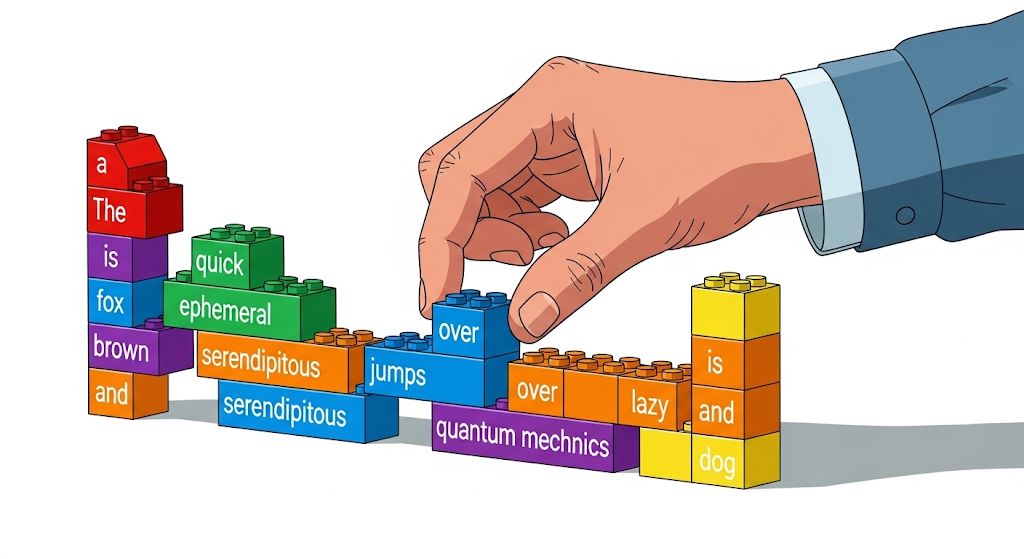
1. The Bricks of Sound (Phonology)
Every language starts with the smallest unit of sound, known as a phoneme. Consonants and vowels like ‘ㄱ, ㄴ, ㅏ, ㅓ’ in Korean or ‘p, b, i, e’ in English are phonemes. These sound bricks have no meaning on their own, but they are the basic materials of all speech.
2. The Blocks of Meaning (Morphology)
When meaningless sound bricks (phonemes) combine, they create the smallest blocks with meaning, called morphemes. For example, the sounds ‘ㄱ’, ‘ㅏ’, ‘ㅁ’ come together to form the block meaning ‘감’ (persimmon). The word ‘이야기책’ (storybook) consists of two meaning blocks: ‘이야기’ (story) and ‘책’ (book), while ‘먹보’ (glutton) combines the blocks ‘먹-’ (eat) and ‘-보’ (to be).
3. The Skeleton of Sentences (Syntax)
The rules for arranging meaningful blocks (morphemes, words) into sentences are called syntax. The most representative rule is ‘word order’. In Korean, the order is “나는(주어) 너를(목적어) 사랑해(동사)” (SOV), while in English, it is “I(주어) love(동사) you(목적어)” (SVO). Each language creates sentence structures with its unique grammatical rules.
4. Dictionary Meaning and Hidden Meaning (Semantics & Pragmatics)
Semantics deals with the dictionary and literal meanings of words and sentences. The sentence “The window is open” simply means that the window is in an open state.
On the other hand, pragmatics studies how the meaning of the same sentence can change depending on the situation (context). For example, the phrase “Isn’t it a bit cold here?” is often used to mean “Could you close the window?” The final meaning of language is not just the sum of word meanings; it must pass through the filter of ‘context’ to be complete.
The Special Recipe of Human Language
There are countless ways of communication in the world, but what makes human language special? It is due to several ‘special recipes’ that are unique to human language.
- Arbitrariness: Just as the sound ’tree’ does not resemble an actual tree, there is no necessary relationship between the sounds and meanings of language. It is merely a social ‘agreement’. This allows language to create symbols freely without being tied to reality.
- Creativity/Productivity: We can create and understand an infinite number of sentences, such as “A pink elephant eats spaghetti on Mars,” using a limited number of words and rules.
- Displacement: We can talk about lunch we had yesterday, vacation plans for next year, or even non-existent unicorns. This ability to communicate beyond ’now and here’ also provides the basis for ’lying’.
- Duality of Patterning: This two-tier structure combines meaningless sounds (first-order segmentation) like ‘ㄱ, ㅏ, ㅁ’ to create meaningful units (second-order segmentation) like ‘감’. This structure allows for the incredible efficiency of creating hundreds of thousands of words from just a few dozen sounds.
Did Animals Also Have ‘Language’?
Can we call the dance of bees or the ultrasound of dolphins ’language’? When compared to the characteristics of human language, the differences become clear.
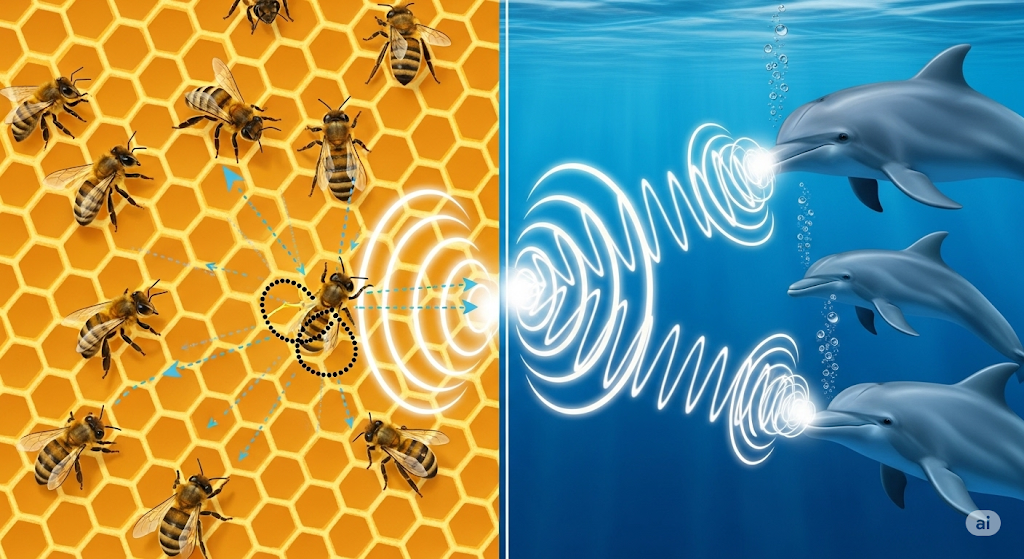
- Bee’s 8-shaped Dance: It accurately conveys the direction and distance of the location of honey, but it cannot create new messages like “Be careful, there is a spider near the honey.” It lacks creativity.
- Dolphin’s Ultrasound: They have unique ’names (signature whistles)’ and regional ‘dialects’, but there is no decisive evidence that they possess complete displacement or creativity to freely talk about the past, future, or imagination.
Comparison/Alternatives
Comparison of Human and Animal Communication
| Feature | Human Language | Bee’s Dance | Dolphin’s Sound |
|---|---|---|---|
| Arbitrariness | O | X (Iconic) | △ (Under study) |
| Productivity | O (Infinite) | X (Fixed) | △ (Limited) |
| Displacement | O (Past, future, fiction) | △ (Recent past) | △ (Under study) |
| Duality of Patterning | O | X | X |
Does the Language We Use Determine the World We See?
The claim that “Without language, there is no thought” is known as the ‘Sapir-Whorf hypothesis’. This hypothesis suggests that the way we perceive the world is influenced by the language we use.
- Linguistic Determinism (Strong Version): This claim states that language completely determines thought. For example, if there is no word for ‘freedom’, one cannot even think of freedom. However, most linguists today do not accept this.
- Linguistic Relativity (Weak Version): This is a widely accepted idea today, suggesting that language does not determine thought but ‘influences’ it. Language is not a prison but rather a pair of ‘glasses’ that makes the world appear in a certain color. For instance, emotional words in Korean like ‘정(情)’ and ‘한(恨)’, which are difficult to translate accurately into other languages, help Korean speakers recognize specific emotions more finely.
Language is Alive: A Playground of Creation and Play
Language is not a fossil in a museum but a living organism that constantly changes and is born anew. I felt the generational gap when I first heard new words like ‘어쩔티비’, but understanding the simplicity and playfulness embedded in them made me feel the vitality of language once again.
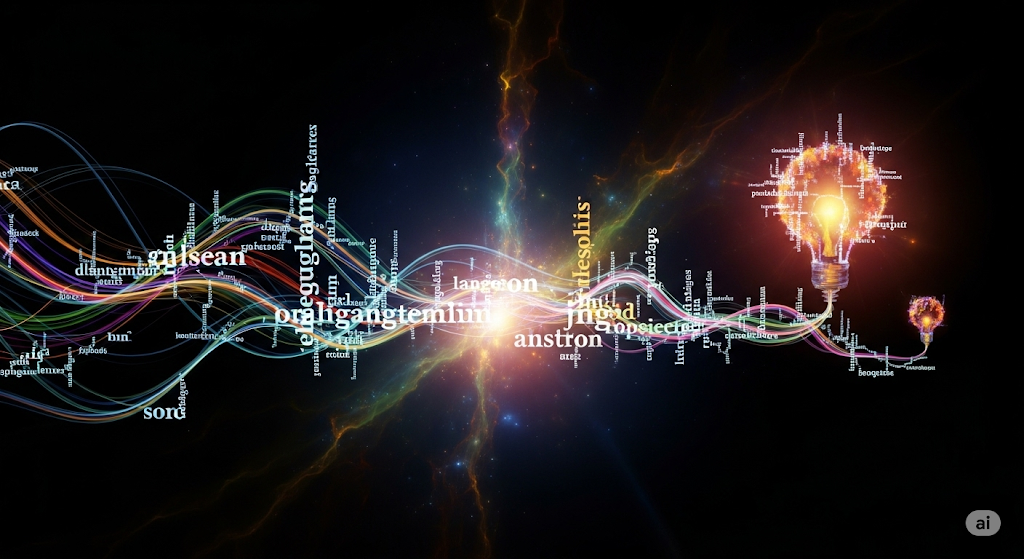
- New Words and Trends: New words like ‘세젤예’ and ‘낄끼빠빠’ reflect the culture and values of the people living in that era.
- Poetry and Songs: The intentional destruction of spelling for emotional amplification, as seen in “노오란”, demonstrates the artistic nature of language through poetic license.
- Language Play: Puns like “How long has it been since you ate an orange?” utilize sound similarity to showcase the flexibility and fun of language.
Conclusion
So, what exactly is language? Through this long journey, we realize that it is difficult to define language in a single sentence.
- First, language is a sophisticated structural system. It starts from meaningless sounds and builds a world of infinite meanings through words and sentences.
- Second, language is a unique cognitive tool of humans. It is completed with special recipes like creativity and displacement that no other animal can imitate.
- Third, language is a living organism. It reflects society and culture, constantly changes, and serves as a material for art and play.
Ultimately, exploring language is a process of exploring ourselves. What thoughts and cultures do the words and sentences you use today contain?