
July 31, 2026, Camp David, Maryland. A single memo lay on the table during a cabinet meeting of the Donald Trump administration.
It was placed before Treasury Secretary Scott Bessant. The note read: .
“To Do: Buy $5-10 billion of Japanese Yen.”
Before this memo was captured by a Reuters camera, no financial market participant in the world had anticipated this statement.
The US buying yen meant selling dollars. The issuer of the world’s strongest currency was selling its own money to prop up the currency that had suffered from weakness for the longest time.
This was the first time in 28 years. It was the first time since the 1998 Asian Financial Crisis that the US had taken the side of buying yen.
Even then, the US had intervened out of concern for the collapsing Asian economies.
This time, the superficial reason was the same: the yen’s weakness had reached dangerous levels, and someone had to stop it.
Yet, something is peculiar. If we trace the actual beneficiaries of this intervention, a name appears before the yen. US Treasuries.
Japan is the largest holder of US Treasury bonds. As of the end of May 2026, it held $1.1431 trillion worth. This significantly exceeded the second-largest holder, the UK ($948.6 billion), and the third-largest, China ($659.3 billion).
The more the yen collapsed, the greater the pressure on Japan to sell its holdings of US Treasuries to defend its currency.
As the amount to be sold grew, the US Treasury market itself began to shake.
This meant that the price of what was considered the safest asset in the world could fluctuate due to a currency crisis in the country that held the largest amount of that asset.
So, we must ask again:
Did the US truly aim to save the yen, or did it aim to save its own Treasury bonds?
The answer to this question forces us to re-examine the very foundation upon which the entire international financial order stands, not just a single event. And on that foundation, the South Korean won also stands.
Let’s try to grasp the scale with numbers. The $5-10 billion that the US Treasury noted it would buy in a single day is comparable to South Korea’s average daily foreign exchange trading volume.
This means that a number scribbled on a memo by a nation’s Treasury Secretary during a cabinet meeting is equivalent to the volume that an entire foreign exchange market of another country handles in a single day.
And three days after this memo was put into action, the numbers on the exchange rate boards in Seoul, on the other side of the globe, began to move as well.
Yen Weakness After 40 Years, and a Reversal That Seemed Inevitable
The story stretches back much further than the summer of 2026.
The Japanese yen had been in a structural weakening phase since 2022.
As the US aggressively raised interest rates to combat inflation, the Bank of Japan maintained its ultra-low interest rate policy.
The interest rate differential between the two countries widened significantly, and money flowed out of yen and into dollars accordingly.
In the first half of 2026, this trend reached its peak.
Military tensions with Iran in the Middle East drove up oil prices, putting dual pressure on the Japanese economy, which is highly dependent on oil imports.
The exchange rate, which had briefly fallen to 159 yen to the dollar in March, surpassed 163.7 yen in early trading on July 30 in New York. This was the lowest level since the 1980s.
At the same time, the rhetoric from Japanese currency authorities was escalating.
Masato Mimura, the top foreign exchange official, repeatedly warned that “the government will take decisive action if necessary.”
The market interpreted these remarks as a precursor to intervention, but it had already learned from numerous past experiences that intervention alone could not reverse the trend.
In April alone, the Japanese government injected 11.7349 trillion yen in intervention funds. On April 30 alone, 6.2787 trillion yen was deployed. This was the largest amount ever for yen-buying intervention.
Despite this, the exchange rate briefly fell to 155 yen after the intervention before returning to around 160 yen.
It wasn’t working alone. That’s why the US joined on July 31.
Let’s take a moment to go back even further.
This was not Japan’s first intervention, nor its first setback.
On September 22, 2022, Japan intervened in the foreign exchange market for the first time in 24 years to prevent yen depreciation.
At that time, the market seemed to calm down briefly, but on October 20 of that year, the exchange rate eventually surpassed 150 yen to the dollar.
In July 2024, Tokyo intervened once again, and the line drawn at 160 yen subsequently became a psychological defense line in the market.
Placing these events side-by-side reveals that Japan’s intervention history has repeatedly followed the same pattern:
Sharp yen depreciation → Solo intervention → Temporary rebound → Trend resumption.
The only difference in the summer of 2026 was that this time, the US joined Japan, not just Japan alone.

According to reports from Kyodo News and NHK, Japanese Finance Minister Satsuki Katayama officially announced that Japan and the US conducted a joint intervention to buy yen on July 31.
She explained that this measure was taken in accordance with the joint statement by the finance ministers of Japan and the US announced in September of the previous year.
In other words, this intervention was not a sudden decision but the execution of an already planned agreement.
The effect was immediate and powerful.
The dollar-yen exchange rate, which had exceeded 163.7 yen in early New York trading, plummeted to 157.3 yen on the 31st.
According to data from the Korea Center for International Finance, the yen appreciated by 2.43% against the dollar that day, and by an additional 0.36% in the Tokyo Asian market the following day, August 3.
The euro-yen exchange rate also fell from the 187 yen range before the intervention to the 181 yen range, showing a broad strengthening of the yen not only against the dollar but also against other major currencies.
Here’s a point worth noting.
The Federal Reserve Bank of New York didn’t just observe; it directly intervened.
It is known that the New York Fed conducted rate checks (a preliminary step for market intervention to confirm quotes with major banks) on the dollar-yen exchange rate and then executed transactions selling euros and buying yen.
Around the same time, there were indications that the South Korean foreign exchange authorities were also taking market stabilization measures, leading the market to interpret this as de facto cooperation between South Korea, the US, and Japan.
The Name of the Defense Line: FIMA Repo
Three days after the joint intervention was confirmed, a more concrete picture emerged.
On August 3, Finance Minister Katayama officially confirmed that Japan had utilized the US Federal Reserve’s FIMA repo facility during this intervention.
FIMA stands for ‘Foreign and International Monetary Authorities’.
This facility was created by the Fed in March 2020 to respond to the global dollar liquidity crunch caused by the COVID-19 pandemic.
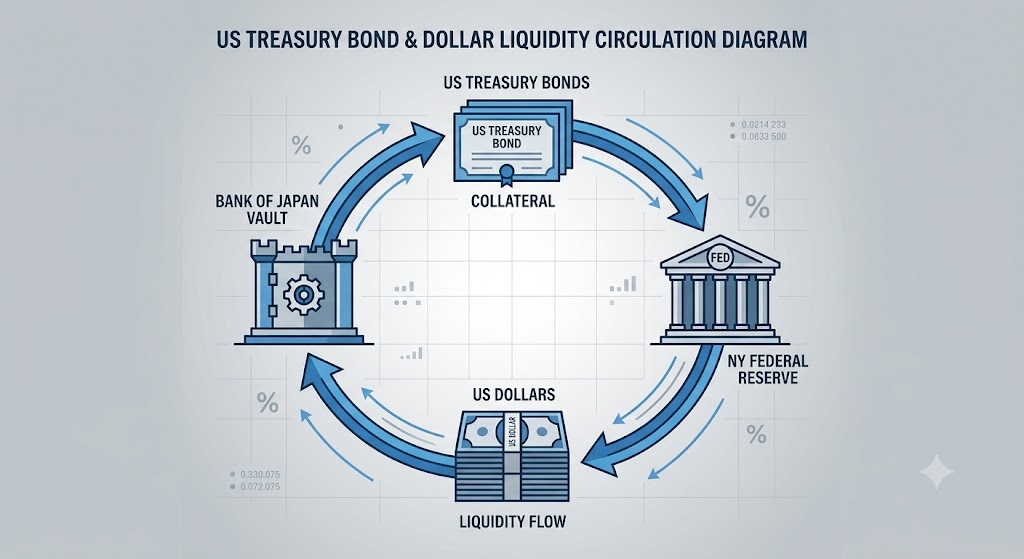
The operating principle is simple: foreign central banks deposit US Treasury bonds they hold as collateral with the Fed, and in return, the Fed lends them dollars.
It’s a type of repurchase agreement, or repo transaction.
Why did this facility become central to this situation? The answer lies in the dilemma Japan faced.
To defend the yen, Japan needed to sell dollars and buy yen in the market. However, the readily available dollar liquidity Japan possessed was limited.
The easiest way to procure dollars was to directly sell its holdings of US Treasury bonds in the market.
The problem was that this method had side effects.
If the largest holder of Treasury bonds, with over $1.1 trillion in holdings, began selling, the price of Treasuries would fall, and interest rates would spike. This would increase the US government’s borrowing costs and could shake the entire US financial market.
The FIMA repo was a way to circumvent this dilemma.
It allowed Japan to borrow dollars by pledging its Treasury bonds as collateral, without selling them.
From Japan’s perspective, it was a way to secure liquidity without disposing of assets, and from the US perspective, it helped avoid a massive sell-off shock to its Treasury market.
Market participants interpreted this measure as a choice to prevent Japan from selling its US Treasury bonds.
Here, the first twist that permeates this situation is revealed.
Superficially, this intervention was reported as an event where “the US helped Japan.”
However, examining the method of implementation reveals that what the US protected was not the value of the yen, but the stability of its own Treasury market.
Helping Japan was, in essence, the most certain way to help itself.
Some in the market also interpreted the background of this intervention as a preemptive measure to prevent a “second Truss shock.”
In 2022, when the Truss government in the UK announced an unfunded tax cut, bond yields surged, leading pension funds to dump Treasuries due to margin calls in a vicious cycle.
The situation in Japan was structurally similar.
If yen depreciation and a surge in Treasury yields occurred simultaneously, the attractiveness of overseas assets held by Japanese institutional investors, such as life insurers and pension funds—a significant portion of which were US Treasuries—would falter. Simultaneously, to stabilize domestic bond yields, pension funds would increase their investment in domestic assets, increasing their incentive to sell US Treasuries.
If this selling further shocked the US 30-year Treasury yield, which was already at its highest since 2007, the repercussions could have spread beyond Japan to the entire US financial system.
To illustrate this twist with a more concrete scenario:
Suppose the Japanese Ministry of Finance actually sold a large amount of Treasury bonds.
This sale, by itself, would drive down US Treasury prices and push up yields. As US Treasury yields rise, the interest rate on 30-year mortgages, which are benchmarked against those yields, would also increase.
A US household’s monthly mortgage payments would increase, and those considering new home purchases would postpone their contracts.
The interest rates that companies have to pay when issuing corporate bonds would also rise, and plans for capital investment would be re-examined.
A single decision to sell Treasury bonds made in a Ministry of Finance office in Tokyo would, weeks later, appear as a different number on a housing contract in some American city.
It was a natural choice for the US to preemptively sever this chain.
In addition, there is another motive explaining the US intervention.
It concerns the large-scale investments that South Korea and Japan promised to the US.
Both countries had pledged to increase their investments in the US during trade negotiations with the Trump administration.
However, if the values of the won and yen fluctuated chaotically, there was a risk that these investment plans themselves would be jeopardized.
It is difficult to make decisions to send large sums of money overseas in a situation of rapidly changing currency values, and conversely, forcing investments during unstable times could exacerbate foreign exchange market instability.
From the US perspective, it had an incentive to manage the currency values of these two countries within a certain range to ensure the smooth reception of their investments.
A researcher at the Chinese Academy of Social Sciences summarized the US motives as a combination of political considerations, defense of its own Treasury market, and yen stabilization aimed at reducing its trade deficit with Japan.
Treasury Secretary Bessant went a step further.
He suggested that expanding the FIMA repo limit, currently set at $60 billion, or even abolishing it, would be reasonable, hinting at the possibility of expanding the facility.
The tool that was temporarily used as a safety net in times of crisis was showing signs of being elevated to a regular intervention tool.
However, this measure came with unexpected side effects.
On August 6, The Wall Street Journal pointed out that this intervention was having unintended consequences on the market.
It stated that the process of the Fed lending dollars to Japan through the FIMA repo facility, in itself, expands the Fed’s balance sheet and injects billions of dollars of liquidity into the economy, similar to quantitative easing (QE). At a time when tightening is needed to curb inflation, a contradiction arises where money is effectively being pumped out under the guise of exchange rate defense.
The WSJ described this as “the exact opposite direction of tightening.”
However, based on the actual execution scale, this concern has not yet materialized.
As of August 6, the FIMA repo balance remained at ‘zero,’ the same as the previous week. It had been zero for eight consecutive weeks since the third week of June.
The Fed’s reported maximum usage for the year was only $3 billion in the first and second weeks of February, and $105 million, respectively.
Market participants speculate that Japan’s ammunition is held in this window, but it has not yet been confirmed by official statistics.
This implies that the existence of the facility and the possibility of its expansion are having a much greater impact on market sentiment than the actual execution volume.
The Moment the Lender of $1 Trillion Becomes the Subordinate
There’s an old saying at bank loan counters:
If you borrow 1 million won, you depend on the bank; if you borrow 10 billion won, the bank depends on you.
Once the debt reaches a certain threshold, the positions of creditor and debtor are reversed.
The lender becomes fearful of not being able to recover the money, while the borrower gains leverage to postpone repayment or renegotiate terms.
In the financial industry, this is sometimes referred to as “too big to fail,” and non-performing loan practitioners more bluntly call it “large debts are the debtor’s weapon.”
Looking at the relationship between the US and Japan through this lens reveals a different picture than the one we are accustomed to.
The superficial narrative is as follows:
The US is the world’s superpower and the issuer of the reserve currency.
Japan borrows that currency and buys its Treasury bonds.
Although Japan is the creditor and the US is the debtor, the balance of power appears to be with the US.
This is because the dollar is an asset desired by the world, and Japan is the one lining up to buy that safe asset.
However, when the holdings exceed $1.1431 trillion, the balance of this relationship shifts.
If Japan decides to sell these bonds in large quantities, the price of US Treasuries will be shaken, and yields will soar. This will affect the US government’s borrowing costs, and by extension, the mortgage rates for US households and the cost of issuing corporate bonds for companies.
Japan is no longer just a ‘bondholder’; it is in a position to influence the stability of the US financial system.
The fact that the US is the one in debt suddenly carries weight.
This is precisely why this intervention must be read differently.
The US intervention to defend the yen was not out of goodwill towards Japan, but a self-defense to manage the fallout that would occur if the creditor of its own debt fell into crisis.
It is essentially the same as a bank extending additional loans to a large corporation showing signs of distress.
This is not to save that large corporation, but because if that corporation collapses, the bank’s own balance sheet will collapse with it.
Seen through this lens, several facts are rearranged.
The fact that the FIMA repo was an alternative route to secure dollars without selling Treasuries means that the debtor (the US) created a situation where the creditor (Japan) could avoid selling pressure while holding collateral.
Treasury Secretary Bessant’s mention of expanding the FIMA repo limit can also be interpreted as the US itself anticipating such situations to repeat.
Power always resides with those who possess resources, as we are taught.
However, some resources, when accumulated too much, can hold their possessor hostage.
The US and Japan have maintained this interdependence for their mutual benefit for decades.
The US managed its finances by selling Treasuries cheaply, and Japan accumulated safe assets while maintaining export competitiveness through yen depreciation.
Now that the balance is taut, it has become clear that if either side lets go, both will be harmed.
What is interesting about this mutual hostage situation is that the apparent size of power does not necessarily match the actual bargaining power.
In terms of GDP, the US economy is more than five times larger than Japan’s.
The US has overwhelming advantages in military power, reserve currency issuance, and influence in international organizations.
Yet, the reason why the US Treasury Secretary felt compelled to leave a hasty memo during a cabinet meeting and take the unprecedented step of selling its own currency to buy the other country’s currency is that this power gap is reversed within the specific channel of Treasury bonds.
It’s a situation where the overwhelmingly superior party in overall weight class must pay attention to the other party due to a single specific point of contact. Interdependence in international finance hides such points where power dynamics are locally reversed.
Why Did the Won Move in Tandem?
If all of this feels like it started with a memo from a finance ministry across the Pacific, let’s head to a currency exchange booth in Myeongdong, Seoul.
In early August, the numbers on the exchange rate boards on that street changed overnight.
On August 3, the won-dollar exchange rate closed at 1,429.8 won per dollar in the Seoul foreign exchange market, up 5.8 won from the previous trading day.
However, this trend soon reversed.
On August 5, it fell by 8.0 won to 1,424.5 won, and on August 7, it even dropped to 1,407.4 won intraday, closing at 1,411 won.
The won-dollar exchange rate fell by 125.4 won on a closing basis in July alone.
This was the largest monthly decline since the Global Financial Crisis in March 2009.
And on August 19, it closed at 1,397.7 won, falling to 1,388.5 won intraday, re-entering the 1,300 won range for the first time in 11 months.
On August 21, it fell to 1,380.3 won intraday.
What these numbers tell us is one thing:
As the yen recovered strength due to the US-Japan coordinated intervention, the overall dollar strength weakened, and its ripple effect led to a simultaneous strengthening of Asian currencies, including the won.
Experts explain this as “the weakening of the dollar and the easing of the yen’s sharp decline had a favorable effect on Asian currencies, including the won.”
Of course, the yen alone cannot explain the won’s strengthening.
At the same time, South Korea’s exports increased by 62.8% year-on-year to $98.89 billion, and the trade balance recorded a surplus of $30.32 billion.
Sales of dollars from semiconductor companies like Samsung Electronics and SK Hynix consistently flowed into the market, and forward selling by heavy industries further pressured the exchange rate downwards.
Domestic supply and demand also clearly played an independent role.
However, these two forces—the external shock from the yen and the internal supply and demand from semiconductors—did not offset each other but overlapped in the same direction.
The result is dramatically demonstrated in another indicator, the won-yen exchange rate.
As of August 13, the won-yen exchange rate (per 100 yen) was 887.84 won, down to its lowest level since July 23, 2024 (884.1 won).
The won-yen exchange rate, which had been moving around 950 won in the first half of the year, fell by more than 60 won in just over a month.
When the yen strengthens, it is natural for the won-yen exchange rate to rise, but the won strengthened even more, causing the won-yen exchange rate to fall instead.
This is where the reader’s connection to this event becomes clear.
The decline in the won-yen exchange rate directly affects the cost of traveling to Japan, the prices of imported goods from Japan, and the export competitiveness of domestic companies to Japan.
While the strengthening of the won is favorable for overseas study or travel, it is a burden on the profitability of export-oriented companies.
The won-denominated value of overseas assets held by pension funds, including the National Pension Service, also fluctuates daily according to this exchange rate.
This means that a single memo from a finance minister across the Pacific is within the circuit that shakes the numbers related to the salaries and retirement funds of Koreans.
Let’s translate this trend into a more concrete scenario.
Consider a Seoul office worker preparing for a summer vacation in Tokyo.
If they planned their accommodation and budget based on an exchange rate of around 950 won per 100 yen in early July, their travel expenses in mid-August would effectively be reduced by more than 6 percent.
Conversely, for the representative of a small and medium-sized manufacturing company in Busan that exports parts to Tokyo, the same number holds the opposite meaning.
Every time they convert the yen they receive into won, the won amount they get in hand decreases, even if they sell the same volume.
A single exchange rate number gives some people the leeway to pack an extra suitcase, while for others, it means shelving their next quarter’s hiring plans.
A Person at the Fund Management Headquarters
In April, an asset manager at the National Pension Service Fund Management Center opened the won-denominated return report for their overseas equity portfolio and encountered unusual numbers.
Although the dollar-denominated returns of the actual invested stocks were not bad, the final returns converted to won appeared much better.
This was an illusion created by the rise in exchange rates, meaning the weakening of the won.
Even without earning in dollars, the book value of returns increased simply because the value of the won fell.
As this phenomenon repeated, controversy arose.
Some in the market even raised suspicions, asking, “Is the National Pension Service investing in a direction that encourages exchange rate increases to receive higher performance bonuses?”
It is impossible to verify if such an intention existed.
However, this controversy itself illustrates how sensitively the calculations of an institution managing over 700 trillion won react to a single line of the won’s exchange rate.
The National Pension Service has long adopted a “currency open” strategy.
Since 2018, it has hardly hedged foreign exchange for its overseas investment assets. This was because being fully exposed to overseas stocks without hedging was more beneficial for long-term returns than defending against currency losses.
However, in April 2026, as the won-dollar exchange rate threatened the 1,500 won range, the Fund Management Committee changed direction.
It decided to increase the strategic foreign exchange hedging ratio from the existing 10% to 15%.
Combined with the tactical hedging (±5 percentage points) that the Fund Management Center adjusts depending on the situation, the ability to manage foreign exchange risk increased to up to 20%.
This decision has implications beyond mere numbers.
An increase in the foreign exchange hedging ratio means that the National Pension Service will increasingly engage in transactions to sell dollars it expects to receive at the current price in advance.
This increases the amount of dollar selling pressure in the market, effectively lowering the upward pressure on the exchange rate.
An institution considered one of the top three pension funds globally has transitioned from being solely a profit-seeker to acting as a “buffer” for exchange rate defense.
Kim Sung-joo, Chairman of the National Pension Service, stated in a foreign media interview that “the early 1,400 won range is an appropriate balance level.”
It was unusual for the head of a pension fund to specify a particular exchange rate target.
Experts’ reactions were mixed.
Professor Kim Dae-jong of Sejong University pointed out that while an increase in hedging could play a supplementary role in buffering downward pressure on the won in the short term, exchange rates are fundamentally determined by macroeconomic variables like interest rate differentials, making it difficult to change the structural trend itself.
There was also the issue of market absorption capacity.
The volume generated by the National Pension Service’s increased hedging was estimated to be between 44 and 88 trillion won.
It was beyond the capacity of the domestic foreign exchange market to absorb this volume all at once, and consequently, the National Pension Service began to consider alternative methods such as directly issuing foreign currency bonds.
This represented a further escalation in the response, moving beyond foreign exchange hedging to directly procuring dollars.
Underlying all these measures is a single fear.
It is the fear that if the won fluctuates uncontrollably and rapidly, the shock will be fully transmitted to the investment performance of the retirement funds of over 20 million citizens.
The finance minister’s memo across the Pacific and the crisis awareness index at the Fund Management Center in Yoido, Seoul, are writing the same sentence in different languages.
[IMAGE: A quiet, realistic photograph of a single empty office chair in front of multiple trading-desk monitors showing exchange rate charts, taken at dusk through a window overlooking a Seoul financial district skyline, conveying the weight of institutional decision-making behind a single number. Documentary photography style, cool blue tones, no visible logos or identifiable branding.]

The Place That Almost Caught Fire
There is a word that market participants watching this situation fear the most: liquidation of yen carry trades.
Carry trades operate on a simple principle.
Borrow in a currency with a low interest rate and invest in assets with high interest rates or yields.
Japan, having maintained ultra-low interest rates for a long time, was a “near-free funding source” for investors worldwide.
A significant portion of the money borrowed in yen to buy US stocks, emerging market bonds, and invest in the South Korean or Taiwanese stock markets flowed through these channels.
The moment this structure collapses is predetermined.
If the yen suddenly strengthens, or if Japanese interest rates rise, the burden of repaying the borrowed money increases.
Investors rush to close their positions and start buying back yen.
This act of buying back further strengthens the yen, and the strengthening, in turn, triggers more liquidations.
It’s a feedback loop that accelerates like a rolling snowball.
In August 2024, this scenario actually unfolded.
At a time when weak US employment data fueled recession fears, the Bank of Japan raised interest rates, leading to the simultaneous liquidation of yen carry positions.
As a result, the KOSPI and KOSDAQ plunged by 8.8% and 11.3%, respectively.
At the time, a Deutsche Bank report estimating the scale of yen carry trades at $20 trillion fueled panic, but this was later revealed to be untrue.
Nevertheless, the shock to the market was real.
In December 2025, a different outcome occurred.
Although the Bank of Japan raised its benchmark interest rate to 0.75%, the highest in 30 years, global financial markets did not shake.
Asian stock markets, including the KOSPI, passed without significant volatility. The difference lay in the positions.
As of March of that year, non-commercial yen net positions were a net purchase of 1.7 trillion yen, meaning the market had already anticipated interest rate hikes and yen strengthening and had preemptively bought yen.
There was no fuse to ignite the fire, so to speak.
In the summer of 2026, the fuse was laid again.
According to the US Commodity Futures Trading Commission (CFTC) investor position report, as of July 28, speculative net positions on the yen were recorded at -163,400 contracts.
This is a situation where selling (short) overwhelmingly outweighs buying (long).
This is similar to the concentration seen just before the sharp decline in Asian stock markets on “Black Monday” in August 2024.
Furthermore, in early 2026, Japanese government bond yields, particularly for the 10-year maturity, surged, leading to assessments that the risk of yen carry trade liquidation was imminent, unlike in 2024.
This was compounded by the Bank of Japan’s interest rate hike.
In June, the Bank of Japan raised its policy rate to 1%, the highest level in 31 years.
In an August 22 report, the Korea Institute of Finance warned that a simultaneous convergence of the US-Japan foreign exchange market coordinated intervention and the Bank of Japan’s interest rate hike could cause a sharp change in global capital flows and increase volatility in the domestic financial market.
It stated that the yen carry trade had been maintained under three conditions: the US-Japan interest rate differential, yen depreciation, and low volatility, and in the summer of 2026, these three conditions began to shake simultaneously.
Looking back at that day in August 2024 on an hourly basis, we can understand how quickly this feedback loop is completed.
Immediately after US employment data was released weaker than expected, hedge funds holding yen carry positions flooded the market with liquidation orders within hours.
Those sales pushed the yen up, and the rising yen amplified the losses of other positions, triggering further liquidations.
This chain caused the KOSPI to fall by 8.8% and the KOSDAQ by 11.3% in a single day.
For those sitting at trading desks in Yoido, Seoul, that day is remembered as a day when a single number, decided neither in Tokyo nor Washington, completely changed the portfolio they had constructed that morning into something entirely different by the afternoon.
However, there is still no basis to conclude that a crisis is imminent.
The Korea Center for International Finance stated in a previous report that while a rapid yen appreciation stimulates liquidation incentives, there has been no fundamental change in the structure of carry trade funding and operation.
While the Bank of Japan’s monetary policy normalization has increased the possibility of liquidation, it is considered premature to view it as the starting point of a full-blown liquidation.
There is also a paradoxical stabilizing factor.
Analysis suggests that since the market is already aware of the possibility of further intervention, it has become more difficult to aggressively sell yen in the short term.
As interventions are repeated, they themselves act as a check that makes subsequent bets hesitant.
However, this check is not indefinitely effective.
On August 14, despite the US-Japan joint intervention, the yen turned weak again. Coupled with the strengthening of the won, the won-yen exchange rate fell to its lowest level in over two years at 887.8 won per 100 yen.
Foreign exchange authorities and market participants predict that the intervention capacity of the US and Japan is limited, and given Japan’s expansionary fiscal policy and low growth potential, it is difficult for the yen to rebound in trend.
This means that while intervention can temporarily alter the direction, it cannot reverse the underlying structure.
Countries Preventing the Same Problem in Their Own Ways
In this phase, the responses taken by the three countries—the US, Japan, and South Korea—used different tools but ultimately targeted the same problem.
It was uncontrolled volatility.
The US used intervention itself and its framing as its tool.
This included direct purchases by the Treasury, indirect liquidity supply through FIMA repos, and packaging all these measures into the language of “helping allies.”
However, within the Fed, there is a sense of internal tension that these actions conflict with the original policy objective of curbing inflation.
It is tasked with the contradictory mission of simultaneously controlling prices and increasing liquidity.
Japan combined traditional direct intervention with interest rate normalization.
In April alone, it injected over 11 trillion yen unilaterally, and in June, it raised its policy rate to its highest level in 31 years.
However, these two measures originated from different objectives. Intervention was an emergency measure to suppress short-term volatility, while the interest rate hike was a separate task of inflation management.
As both measures coincidentally pointed in the same direction—yen appreciation—they paradoxically amplified the risk of sharp liquidation that could occur when they overlapped.
South Korea’s response was the most multi-layered among the three countries.
The Bank of Korea kept its benchmark interest rate unchanged, conserving policy ammunition.
The National Pension Service increased its hedging ratio from 10% to 15% and introduced a new “Crisis Awareness Index” divided into two stages—crisis trigger (60 points) and crisis severity (80 points)—to establish a phased response system.
The Financial Supervisory Service moved to strengthen the foreign exchange risk management of individual investors engaging in overseas investments, the so-called “Seohak Gaemi” (retail investors buying foreign assets).
In addition, the extension of the $65 billion foreign currency swap agreement between the Bank of Korea and the National Pension Service until the end of the year created a structure where policy authorities and the pension fund jointly formed a defense line.
The temperature differences between the three countries were also distinct.
The US and Japan used explicit and visible “intervention” cards.
This is a method of directly signaling to the market.
South Korea used quieter cards.
Instead of directly impacting the market, it focused on enhancing the institutional buffer, such as adjusting the hedging ratio of the pension fund and introducing the crisis index.
This difference is not coincidental. The US and Japan are issuers whose currency values can be directly influenced, but South Korea relies on external variables—the yen, the dollar, the US-Japan interest rate differential—for a significant portion of its power to determine the won’s exchange rate.
The types of cards they can play are simply different.
This asymmetry is demonstrated from another angle by a statistic.
The amount Japan spent on its solo intervention in April alone was 11.7349 trillion yen, which, converted to won, exceeded 100 trillion won.
This means that an amount equivalent to the budget of some ministries within South Korea’s annual budget was injected into the market for a single month, for a single purpose.
In contrast, South Korea’s response was to turn the knob of an existing institution, the National Pension Service.
Instead of printing new money and throwing it into the market, it indirectly signaled to the market by adjusting the management methods of the accumulated fund of over 700 trillion won.
It was not the size of the ammunition, but the way the ammunition was handled that differed.
Despite this asymmetry, policymakers in the three countries faced a common dilemma.
It is the dilemma that measures taken to defend the exchange rate conflict with other policy objectives of each country.
The US needed to curb inflation, but intervention increased liquidity; Japan needed to worry about fiscal soundness, but interest rate hikes increased bond interest burdens; and South Korea needed to maximize pension fund returns, but increased hedging was a potential factor that would erode those returns.
In essence, all three countries are paying a price in different areas to protect a single number, the exchange rate.
A Scene That Almost Caught Fire 28 Years Ago
The term “historic event” has been used by many market analysts to describe this intervention.
However, this scene is not entirely new. There was a crisis of almost the same nature 28 years ago.
In June 1997, the yen’s value, which was around 110 yen to the dollar, fell to 146 yen the following year.
At that time, Japan was in the midst of a financial crisis. The US also helped to stop this yen depreciation.
On June 17, 1998, the US and Japan jointly intervened in the market by buying yen.
This was preceded by an agreement between then-Japanese Prime Minister Ryutaro Hashimoto and then-US President Bill Clinton.
The two leaders shared the understanding that “yen stability is important for the Asian and global economies,” and in return, Japan promised to respond promptly to the issue of non-performing loans in its financial institutions.
Placing this old scene alongside the scene from the summer of 2026 reveals a recurring pattern.
In a yen depreciation phase that Japan cannot handle on its own, the US extends a hand, and in return, Japan offers something else that the US desires—then, the resolution of non-performing loans; now, the fulfillment of investments in the US and the strengthening of security alliances.
Although packaged in the language of friendship and cooperation, there has always been an exchange logic behind it.
The Nikkei Shimbun offered a poignant diagnosis of this intervention.
“We must have a greater sense of crisis over the currency defeat of the yen, unable to stop its fall on its own and having to ask for help from the US.”
This was the opposite diagnosis from a Japanese Ministry of Finance official in charge of foreign exchange policy, who described the same joint intervention as “the perfected form of the US-Japan currency alliance.”
In other words, one side read the same event as an achievement of cooperation, while the other read it as a failure of self-reliance.
The Nikkei pointed out that both the 1998 and 2026 joint interventions were conducted in unequal relationships.
This means that the positions of the one requesting help and the one providing help remained the same, despite a 28-year time difference.
The 2011 case shows this asymmetry from the opposite direction.
Immediately after the Great East Japan Earthquake in March of that year, the yen actually surged.
Speculative buying was triggered by expectations that Japanese companies would sell overseas assets and repatriate yen for reconstruction funds.
At that time, the G7 countries jointly intervened to sell yen. Although the direction was opposite, this was also a case where major countries intervened in a situation that Japan could not handle alone.
The 2026 joint intervention was the first G7 cooperation in 15 years since 2011, and the first time in 28 years since 1998 that yen was bought.
There is a common thread running through these three moments—1998, 2011, and 2026.
Each time the yen deviated in a direction that Japan could not manage, it ultimately relied on external intervention.
Whether that external force was the US alone or the entire G7, the structure was the same, though the form differed.
Japan’s inability to determine the fate of its own currency and its reliance on the decisions of a greater power has not changed at all during these three crises.
Goldman Sachs diagnosed after this intervention that “since the fundamental cause of yen weakness has not been resolved, the downward pressure will likely increase again over time if there are no changes in global conditions or policies.”
Indeed, during the joint intervention in 1998, the exchange rate, which was around 146 yen, returned to 147 yen within two months. Interventions have always been painkillers that temporarily alleviate the pain, but they have never cured the cause of the disease.
The Saying “The Market Decides” and Its Flip Side
Economics textbooks explain exchange rates as follows:
Under a free floating exchange rate system, currency values are determined by market supply and demand. The principle is that governments do not interfere, and intervention is exceptional and temporary.
This situation forces us to re-read this statement.
The foreign exchange market, described as the deepest and most liquid in the world—a market with trillions of dollars in daily trading volume—changed direction with a single memo from a finance minister and a few days of coordination between currency authorities.
The exchange rate, which was 163.7 yen on July 30, fell to the 157 yen range in three days.
This was closer to a scenario where the intentions of a few policymakers suppressed the entire market, rather than the cumulative result of individual judgments by millions of market participants.
This leads to a question that needs to be answered in retrospect:
Was our belief that “the market determines the exchange rate” actually a conditional truth, meaning “the market is allowed to decide under normal circumstances, but when a critical point is reached, a few countries intervene to reverse the direction”?
The free floating exchange rate system is closer to a state where the threshold for intervention is set high, rather than a state without intervention.
And the power to decide whether to lower or raise that threshold, and when to cross it, lies in the hands of a few.
This asymmetry of power is repeated in the structure of Treasury holdings.
As we examined earlier, Japan’s over $1 trillion in US Treasury bonds gives it a certain degree of leverage.
However, this leverage is not a card that Japan can freely use whenever it wishes. The moment it tries to protect its currency by selling Treasuries, that sale itself shakes the US financial market, and the shaken US financial market, in turn, sends shockwaves back to the global economy, including Japan.
Interdependence means holding each other hostage, not guaranteeing equal bargaining power.
Within that hostage situation, the ones who set the stage and the rules are always the issuers of the reserve currency.
Where does South Korea stand within this framework? The won is not a reserve currency.
It also lacks the power to shake another country’s market by selling a large amount of Treasury bonds.
However, it is not a complete bystander either.
The dollar inflows generated by semiconductor exports, the hundreds of trillions of won in overseas assets held by the National Pension Service, and the scale of foreign exchange reserves—all of these make South Korea a participant in this circuit.
However, the way it participates is different from the US or Japan. South Korea is not the one setting the stage, but rather the one enduring by adjusting its buffer mechanisms whenever the stage shakes.
The Weight of a Single Memo
Let’s return to that memo from Camp David.
“Buy $5-10 billion of Japanese Yen.” A few words accidentally captured by the camera.
However, those few words turned the direction of the global foreign exchange market in three days, and the ripple effects extended from Tokyo to the conference room of the National Pension Service Fund Management Committee in Seoul, and to the electronic boards of currency exchange booths in Myeongdong.
When people first encountered this situation, their prevailing emotion was usually relief.
The yen depreciation stopped, someone stepped in, the market calmed down.
However, if we peel back just one layer of that relief, a different picture emerges.
What the US protected was not the yen, but its own Treasury market; what Japan secured was not stability, but time; and what South Korea took was not control, but a buffer.
No one fundamentally changed this structure. Everyone merely bought time until the next shock arrived, each in their own position.
The Nikkei calling this intervention a “currency defeat” and a Japanese Ministry of Finance official calling the same event “the perfected form of the US-Japan currency alliance”—these two expressions are actually different names for the same fact.
The recipient of help can call that help a failure of self-reliance or an achievement of cooperation. Regardless of which term is used, the fact itself does not change.
Japan propped up its currency value, which it could not manage on its own, by relying on the US’s decision.
And within this structure, even the choice of language to attach a name was not entirely Japan’s prerogative.
When President Trump explained this intervention as being due to “friendly relations with Japan,” the voice setting the frame for that explanation also came first from the US side.
So, the question changes to this:
When a similar memo appears next time, and the yen or the won once again fluctuates significantly,
Will South Korea remain a participant merely enduring that moment, or will it solidify its position within this circuit even a little?
The dollars earned from semiconductor exports, the overseas assets accumulated by the National Pension Service, and the institutional mechanisms newly devised during crises are already the ingredients for that answer.
However, no one has yet fully determined how to assemble those ingredients into a picture.
References
- Money Today, “US Treasury Department Intervened in Foreign Exchange Market… Protected US Treasuries, Not Yen” (2026.8.16)
- Asia Economy, “‘First Time Since 1998’… Reasons for US and Japan’s Intervention to Defend the Yen [Weekend Money]” (2026.8.8)
- Kookmin Ilbo, “No Major Earthquake or Financial Crisis… Reasons for US Intervention to ‘Save the Yen’” (2026.8.3)
- Herald Economy, “WSJ: ‘US Yen Intervention Has Unexpected Side Effects’… More Dollars Pumped into the Market” (2026.8.7)
- Seoul Economy, “Japan Mobilizes US for Yen Defense… Nikkei: ‘Currency Defeat’” (2026.8.12)
- Aju Business Daily, “[US-Japan Currency Cooperation Aftermath] Yen Rebounds on Joint Intervention… Where Will the Won-Dollar Go?” (2026.8.4)
- Financial News, “Yen Surges on US-Japan Joint Intervention… Won-Dollar Also in the 1420 Won Range” (2026.8.3)
- Financial News, “US and Japan Formalize ‘Yen Rescue’… ‘Will Not Hesitate for Further Joint Intervention’” (2026.8.3)
- Herald Economy, “Yen Weakness Unstoppable Even with US-Japan Intervention… ‘All Efforts Futile’” (2026.8.14)
- MBC News, “US’s Unprecedented Foreign Exchange Market Intervention… Large-Scale Buying to Curb Yen Weakness” (2026.8.1)
- News Vision e, “Japan and US Conduct Joint Currency Intervention for the First Time in 15 Years… Urgent Response to Record Yen Weakness”
- Moin Overseas Remittance Blog, “[1st Week of August 2026] Will Downward Pressure on Exchange Rates Continue? Effects of Foreign Exchange Authority Intervention and Key Variables”
- Namuwiki, “2025-2026 Won High Exchange Rate Crisis”
- Namuwiki, “Japanese Yen / Trends by Year”
- Namuwiki, “Carry Trade”
- Herald Economy, “Yen Short Exceeds 2 Trillion Yen… Will the Nightmare of Carry Liquidation in 2024 Be Repeated? [Deep Spot]” (2026.8.9)
- EBN News Center, “Growing Concern over ‘Yen Carry Liquidation’ due to Yen Strength… Monitoring Financial Markets for Volatility” (2026.8.22)
- Sisa World, “Yen Carry Trade Liquidation Risk Increases… Need for Financial Market Monitoring Following US-Japan Foreign Exchange Intervention” (2026.8.22)
- KCIF International Finance Center, “Analysis of Yen Carry Trade Liquidation Possibility”
- KDI Economic Information Center, “Impact and Implications of the Fed’s FIMA Repo Facility Becoming Permanent”
- KB’s Thought, “[Global Chart] Fed’s FIMA, Launched by Bessant and Supported by Japan, Still ‘Zero’” (2026.8.7)
- Board of Governors of the Federal Reserve System, “Foreign and International Monetary Authorities (FIMA) Repo Facility” (federalreserve.gov)
- Seoul Shinmun, “National Pension Service Increases Hedging Ratio to 15%… All-Out Effort to Defend Exchange Rate” (2026.4.15)
- Invest Chosun, “National Pension Service Becomes Foreign Exchange Breakwater, Going Beyond Hedging to Dollar Procurement”
- ASEAN Express, “[ASEAN Express] Bank of Korea and National Pension Service Extend Strategic Hedging for One Year” (2025.12.21)