
Exploring the Old Whispers Entangled in the Darkness of Laundry Lines and the Amazing Wisdom They Contain.
- Psychological, historical, and spiritual backgrounds that go beyond a simple superstition
- The surprising intersection of ancestral wisdom and modern science
- Practical advice for a healthy and pleasant living environment
Have you ever hesitated while looking at damp clothes in your yard at dusk? The voice of your grandmother echoes in your ears, “Don’t hang laundry at night.” Is this old warning just an outdated superstition? No, it is not. The taboo of hanging laundry at night carries practical wisdom, spiritual beliefs, and historical memories passed down through generations. This article aims to unravel this taboo and explore the rich fabric of Korean culture.
The Optical Illusion of Night: Ghosts of Military Barracks and Pareidolia
The most primal fear associated with the taboo of ‘hanging laundry at night’ arises from visual illusions. In environments with insufficient light, our brains tend to seek familiar patterns, especially human shapes, from incomplete information, a phenomenon known as pareidolia.
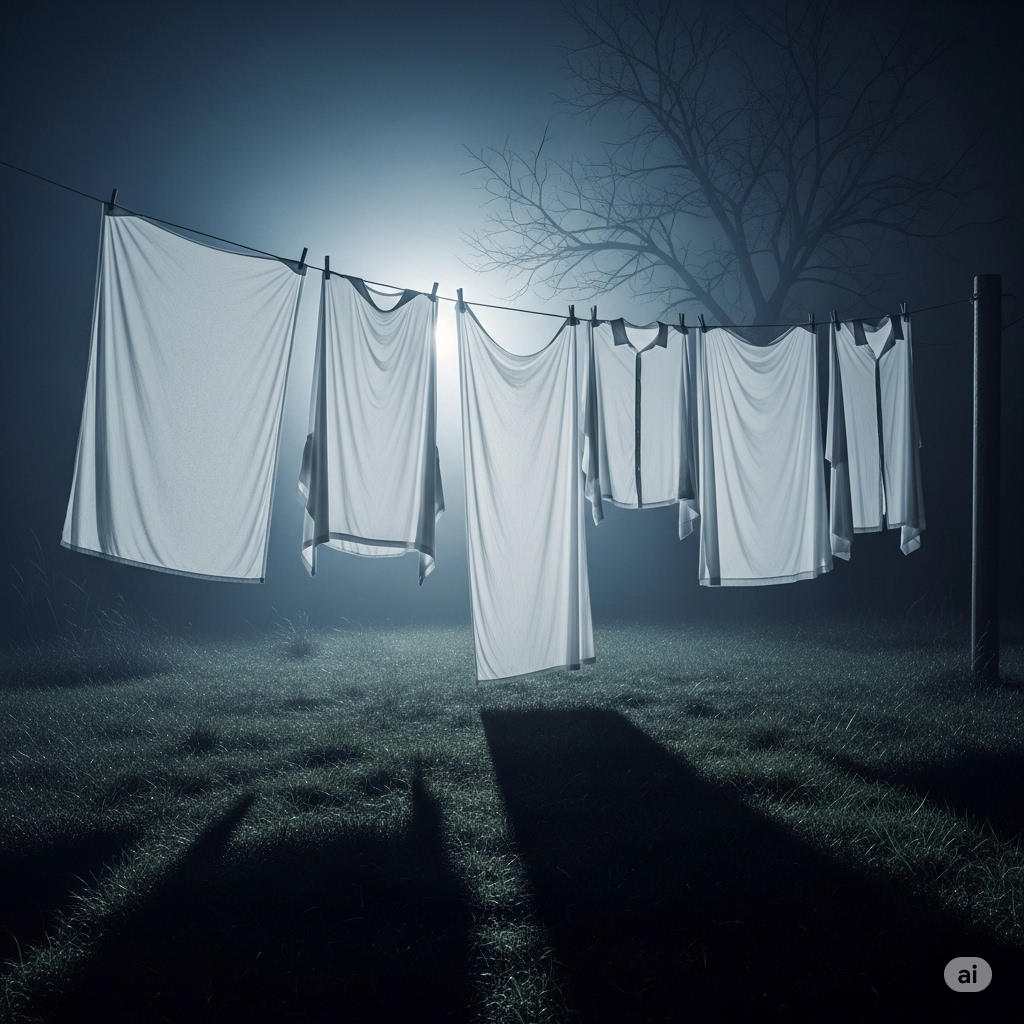
In the dark, work clothes can resemble a human silhouette.
A military officer’s experience vividly illustrates this. While on patrol, he mistook a swaying shape beyond the maintenance shop window for a hanging person, causing chaos in the barracks. The cause was merely work clothes hanging on a coat rack. I also vividly remember being terrified as a child at my grandmother’s house in the countryside when I saw white clothes hanging in the yard at night, thinking they were ghosts.
Such experiences extend beyond individual fears to consideration for community peace. Hanging laundry at night can unintentionally startle others, so avoiding it is a practical and empathetic guideline that takes into account the feelings of neighbors and family.
The Rules of Darkness: Traditional Nighttime Taboos in Korea
In Korean folklore, night was not merely a time without sunlight. It was a special time when the boundaries between the living and the dead, the real and the spiritual world, became blurred. The nighttime curfew system during the Joseon Dynasty and stories of ’night-dwelling ghosts’ reinforced the notion that night is a dangerous time when activities should cease.
The taboo of ‘hanging laundry at night’ was part of this comprehensive system of nighttime prohibitions. Like other nighttime taboos such as whistling and cutting nails, it was an intricate survival strategy encoded in supernatural language by our ancestors.
Table 1: Patterns of Caution: Representative Nighttime Taboos in Korea
| Taboo (禁忌) | Superstitious Outcome | Cultural Interpretation (Logic) |
|---|---|---|
| Whistling at Night | Attracts snakes or ghosts. | A warning that sounds can travel far in the stillness of night, drawing unwanted attention. |
| Cutting Nails at Night | Rats will eat them and create your clone. | A reflection of fear that poor lighting can lead to injury, and one should not carelessly dispose of body parts. |
| Hanging Laundry at Night | Attracts ghosts or blocks the owner’s fortune. | A taboo intertwined with psychological, spiritual, and practical risks. |
The Value of Labor: The Weight of Water and Women’s History
Unlike modern washing machines, laundry in pre-modern times was incredibly labor-intensive. Using ’lye’ made from burnt rice straw or ‘urine’ as detergent, clothes had to be vigorously beaten at the riverside laundry spot. Even Isabella Bird Bishop, who visited Korea at the end of the Joseon Dynasty, noted that Korean women spent all day beating laundry.
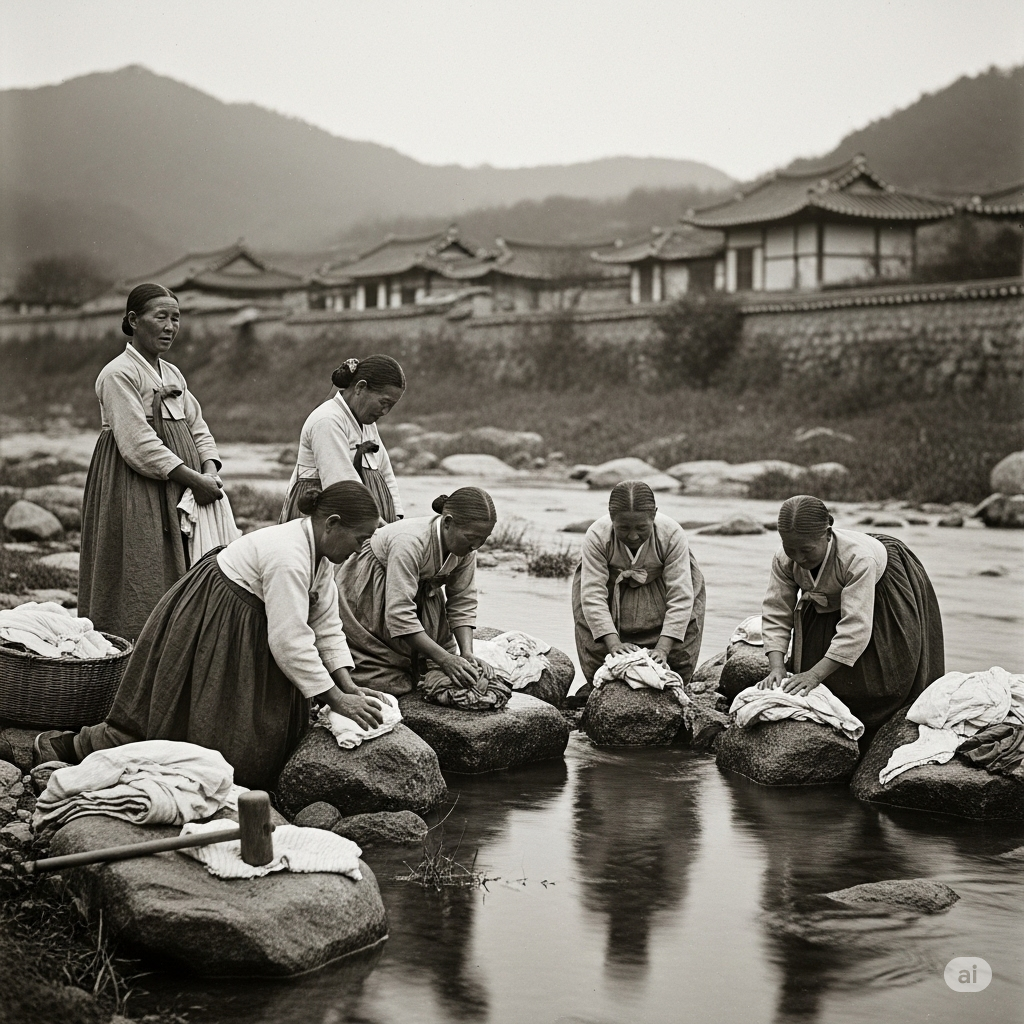
Laundry was hard labor and an important communication space for women.
Hanging laundry outside overnight after such hard work would have been practically foolish. The cold, damp air of the night, especially dew, could make laundry even wetter, potentially nullifying a day’s effort. The saying ’the owner’s future is blocked’ is not an abstract curse but a poetic warning compressing specific causal relationships leading to wasted labor, economic loss, health deterioration, and social disgrace.
Spiritual Pathways: Laundry Lines and Invisible Guests
The taboo of ‘hanging laundry at night’ extends its meaning into the spiritual realm. Particularly important is the saying, “If you don’t take down the laundry line during a ritual, the ancestral spirits cannot enter.” This implies that clothes hanging on the line can act as a ‘spiritual barrier’ blocking the path of benevolent spirits.
Expanding this logic, laundry hung at night could be seen as a ‘bait’ attracting wandering spirits (雜鬼) infused with the energy of the living or a ’trap’ absorbing negative energy (陰氣) of the night. Feng Shui philosophy also explains that damp laundry attracts stagnant negative energy at night, harming the home’s energy.
The Science of Superstition: The Encounter of Yin Energy and Microbes
Surprisingly, the folkloric warnings about yin energy and wandering spirits align perfectly with modern scientific principles. This proves that superstition was an intuitive health guideline ahead of its time.
At night, temperatures drop and relative humidity rises, prolonging the drying time of laundry. This damp environment provides optimal breeding conditions for microbes.
- Bacterial Growth: Bacteria like ‘Micrococcus’ proliferate exponentially in damp fibers, becoming the source of unpleasant odors.
- Mold and Allergies: Wet laundry increases indoor humidity, promoting the growth of mold and dust mites, which can exacerbate asthma, rhinitis, and atopic dermatitis.
- Chemical Irritants: Residual detergent in fibers can concentrate in the stagnant air overnight, irritating the respiratory system.

Damp laundry can become a breeding ground for bacteria and mold.
Ultimately, the folkloric expression ‘yin energy weighs down the body’ was a practical physiological response of the body to inhaling mold spores, bacteria, and damp air overnight. ‘Yin energy’ was an excellent folkloric metaphor explaining microbial phenomena. It creates an environment similar to running a humidifier indoors without ventilation all night. Have you ever woken up feeling sluggish and the air damp? Perhaps the laundry hung overnight was the cause.
Conclusion
The taboo of ’not hanging laundry at night’ is a complex cultural heritage with multiple layers of meaning beyond a mere superstition.
-
Key Summary:
- Psychological Safety Device: Protects us from fear and shock caused by visual illusions in the dark.
- Community Consideration: A social promise not to startle others and a consideration for neighbors.
- Scientific Health Guideline: Practical advice to prevent respiratory diseases and allergies by stopping the growth of bacteria and mold due to humidity.
Today, fears of ghosts have faded, but the wisdom of health, community, and respect for the invisible world embedded in this taboo remains valid. How about starting to take down laundry before sunset from today? It could be a small practice for a healthier and more pleasant life.
References
- Taboo (禁忌) - Encyclopedia of Korean Culture Link
- News from the National Museum of Korean History Vol.38 (Bi-monthly) Link
- Folk Beliefs (民間信仰) - Encyclopedia of Korean Culture Link
- [Cultural Storehouse] Why Did Old Women Beat Clothes with Laundry Mallets? - Cheonji Ilbo Link
- Laundry - Namu Wiki Link
- Laundry - Encyclopedia of Korean Culture Link
- Washing (洗濯) - Encyclopedia of Korean Folklore Link
- Recommended Essay - Don’t Hang Laundry at Night / Shin Bok-hee - Association of Fun Essay Writers Link
- “What Happens If You Hang Laundry at Night?” Fatigue Sticks Overnight | Showroom - Daum Link
- Drying Laundry Indoors in Winter is Actually ‘Poison’ - SBS News Link