
Small things can create mountains or bring everything down.
- The principle of how small cracks can lead to massive disasters like the Seongsu Bridge collapse.
- The power of ‘positive accumulation,’ the secret to the success of Warren Buffett and Toyota.
- How to identify the ‘broken windows’ in my life and plant the ‘acorns of growth.’
The small things around us have two faces. Snowflakes falling from the sky have no power on their own, but when they accumulate, they can create an avalanche that covers the world or a beautiful winter landscape. This article embarks on a journey to explore how the persistent accumulation of small things can lead to both great results and terrible tragedies.
Disasters Caused by Small Cracks: The Avalanche Model
Let’s first look at the dark side of the accumulation of small things. How small negligence and complacency can spiral into uncontrollable disasters.
Broken Windows Theory: The Beginning of Collapse
The ‘Broken Windows Theory’ proposed by sociologists James Wilson and George Kelling suggests that neglecting a single broken window in a building can lead to larger crimes. This provides insight into system collapse. Minor disorder sends the signal that ’no one cares here,’ ultimately leading to the collapse of the entire system.

- Case 1: Seongsu Bridge Collapse (1994) The direct cause of the Seongsu Bridge collapse in the heart of Seoul in 1994 was a small defect of poor welding. However, behind this was a ‘fast-fast’ culture that prioritized speed over safety and a design that lacked redundancy, where if one part failed, the whole system collapsed. The entire system that tolerated a small ‘broken window’ fell apart.
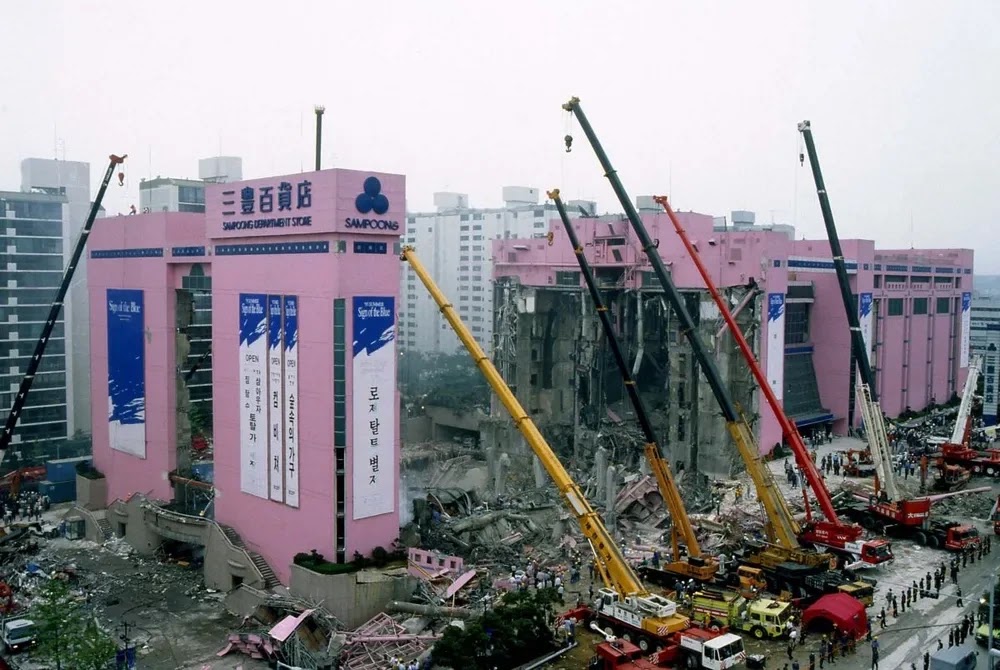
- Case 2: Sampoong Department Store Collapse (1995) This was a disaster that was foretold by thousands of small wrong decisions such as illegal changes in use, the use of substandard materials, and the installation of cooling towers exceeding design loads. The complacency of thinking ’this is okay’ led to a tragedy caused by the ‘Normalization of Deviance’ that eroded the system’s safety margins.
The Curse of Speed: The Modern ‘Fast-Fast’ Culture
The past ‘fast-fast’ culture has been reborn today as the motto “Move Fast and Break Things.” However, this often results in sacrificing stability and quality.
- Case 1: Samsung Galaxy Note 7 Fires (2016) The eagerness to seize the market ahead of competitors led to disaster. In the rush, a slight defect in the battery was overlooked, and this small component defect resulted in a global recall and damage to the brand’s image.
- Case 2: Cyberpunk 2077 Release (2020) The pressure of the release date led to a neglect of quality control, resulting in numerous bugs that shattered fans’ expectations. For mature companies, there is no longer anything that can be ‘broken’ lightly. What they break is the trust of their customers.
Miracles Created by Small Seeds: The Oak Model
Now it’s time to look at the other side of the coin. How small seeds of patience and consistency can grow into a massive oak tree.
The Magic of Compounding: The Power of Building Wealth and Wisdom
As the saying goes, “A mighty oak grows from a little acorn,” the most dramatic demonstration of positive accumulation is ‘Compounding.’
The investment genius Warren Buffett accumulated 99% of his wealth after the age of 50. This is the strongest evidence of the magic of compounding. However, most people underestimate exponential growth due to ’exponential growth bias,’ leading them to become disappointed with the initial slow growth and stop the magic machine of compounding.
Having personally invested small amounts for the long term, I felt a strong urge to give up during the first few years when profits were hardly noticeable. But believing in Buffett’s advice and continuing to invest, I eventually experienced my assets snowballing. The key to successful investing is not genius but the patience to endure time.

The Kaizen Revolution: Thousands of Small Steps
In manufacturing, the Japanese philosophy of ‘Kaizen (改善)’, meaning ‘change for the better,’ produces effects similar to compounding.
Toyota encouraged every worker on the shop floor to continuously suggest and implement very small improvements instead of grand innovations. Small activities like stopping the line immediately when a defect is found (‘Andon Code’) and finding the root cause of a problem (‘5 Whys’) have accumulated over decades to make Toyota the world’s leading manufacturing company.
The Kaizen model is an ‘Antifragile’ system that becomes stronger through small shocks and stresses. A culture of learning and improving from small failures drives continuous growth.
The Power of Small Things Proven in Life
How do these principles operate in our lives?
People Who Fueled Their Success with Failure
Sometimes, small negative events can become the acorns of great success.
- Michael Jordan turned the humiliation of being cut from his high school basketball team into lifelong motivation.
- J.K. Rowling enchanted the world with her manuscript written daily in a café despite poverty and depression.
- Frida Kahlo transformed the pain of her broken body from a horrific accident into some of the most intense art of the 20th century.
These individuals gained the energy to start a long accumulation process through ‘narrative reconstruction,’ rewriting the ‘meaning’ of their failures.

A Single Story That Changed the World
Sometimes, a single honest story from one person can change the world.
A good example is the speech given by RM, the leader of BTS, at the UN General Assembly. He shared the personal confession of ‘Kim Namjoon,’ a boy who lost himself in the eyes of others, rather than a global star. This unembellished, honest story formed deep empathy and connection with countless young people around the world, growing the ‘LOVE MYSELF’ campaign into a massive movement.

Comparison: Avalanche Model vs. Oak Model
By comparing the key differences between the two models, we can gain wisdom in dealing with small things.
| Feature | Avalanche Model (Negative Accumulation) | Oak Model (Positive Accumulation) |
|---|---|---|
| Core Driver | Speed, impatience, greed | Patience, consistency, long-term perspective |
| Result | Sudden and destructive collapse | Slow but solid and exponential growth |
| Attitude Towards Failure | Ignoring and concealing small defects | Learning from small failures and strengthening the system |
| Key Examples | Seongsu Bridge, Sampoong Department Store, Galaxy Note 7 | Warren Buffett, Toyota (Kaizen) |
Checklist: Finding My Cracks and Acorns
Which model is closer to your life? Check by answering the following questions.
-
Finding My ‘Broken Windows’
- What small problems or bad habits am I postponing by saying ’this is okay’?
- Am I ignoring recent signs of stress or burnout?
- Am I chasing speed or deadlines rather than the quality of the output?
-
Planting My ‘Acorns’
- What very small action can I start today for the next 5 or 10 years? (e.g., reading for 10 minutes a day, saving 1% of income)
- Can I reinterpret my experiences of failure as fuel for growth?
- Am I practicing small compliments or encouragements that can positively impact colleagues or family?
Conclusion
Our lives are not made up of a few dramatic events but rather the sum of very small choices made every day. Let’s revisit the key points of this article.
- Beware of small cracks: Complacency that builds up with ’this is okay’ can lead to disasters that collapse everything.
- Grow acorns with patience: Steady positive accumulation, like compounding and Kaizen, brings results beyond imagination over time.
- Reconstruct my story: The power to turn even failure and pain into fuel for growth lies within ourselves.
What are the ‘broken windows’ left unattended in your life? And more importantly, what ‘acorn’ can you plant today?
The most terrible tragedies and the most brilliant achievements are ultimately stories written in the smallest letters. What story you will write depends on your very next small action right now.
References
- Broken windows theory | EBSCO Research Starters link
- About — Museum of Broken Windows link
- Broken windows theory - Wikipedia link
- Broken Windows Theory of Policing (Wilson & Kelling) - Simply Psychology link
- The Broken Windows Theory: Origins, Issues, and Uses - Verywell Mind link
- Broken windows theory | Definition, Policing, Criminology, & Examples - Britannica link
- The absurd cause of the Seongsu Bridge collapse ‘poor welding’ #TheDayThatFollows #2021tail #SBSstory - YouTube link
- Arrest warrants for 6 people involved in the poor construction of the Seongsu Bridge - KBS News link
- [Opinion] The ‘fast-fast’ culture of Koreans - Kyungsang Ilbo link
- The department store built on corruption and the Han River bridge collapsed while people were inside… link
- Seongsu Bridge collapse accident - National Archives link
- Seongsu Bridge collapse accident - Namu Wiki link
- Seongsu Bridge collapse incident - Encyclopedia of Korean Culture link
- [Planning] 25 years since the collapse nightmare, but… still remnants of the second Sampoong Department Store - Daum link
- Sampoong Department Store collapse, the worst illegal expansion accident… recorded the 10th highest number of victims in the world - Seoul Economic Daily link
- (Building Collapse Case) Causes of the ‘Sampoong Department Store Collapse’ and Changed Building Laws - MidasCAD link
- [History of Collapse] ② ‘Unchanging Causes of Accidents’.. The cause of the Sampoong Department Store collapse 27 years ago was also ‘cost reduction’ link
- Move Fast and Break Things — Book Journalism link