
Your name is more than just a title; it is a living fossil that contains the history of a nation.
- Understand the difference between ‘surname (姓)’ and ‘clan (氏)’ from ancient China, the origin of Korean surnames.
- Learn how the Korean surname system was formed from the Three Kingdoms period through Goryeo and Joseon.
- Discover why the surnames Kim, Lee, and Park are particularly numerous and the uniqueness of the ‘bon-gwan’ system.
What does your name tell you?
One in five Koreans has the surname Kim (金). The concentration of Korean surnames is a rare phenomenon globally. Have you ever wondered why there are so many Kims, Lees, and Parks, and what story your name carries?
The term ‘surname (姓氏)’ we use contains two concepts: ‘surname (姓)’ and ‘clan (氏)’. These two concepts crossed over to the Korean Peninsula and merged, embedding the grand history of the rise and fall of numerous dynasties and individual destinies into our names. Let’s follow that journey now.
Chapter 1: The Birth of Surname (姓) - In the Beginning, There Was a Mother
The character for surname (姓) is a combination of woman (女) and birth (生), meaning ‘born of a woman’. This is strong evidence that the oldest concept of kinship in humanity contains memories of a matriarchal society.
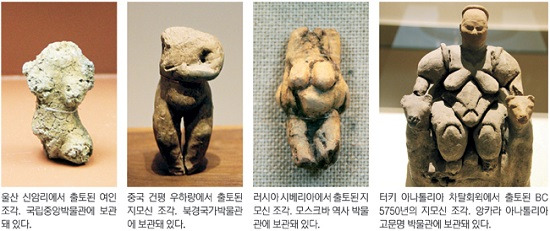
In ancient Chinese mythology, the surname of the Yellow Emperor (黃帝) was Ji (姬), as his mother gave birth to him by the river Ji (姬水). Thus, the most important function of a surname was to distinguish the range of kinship and prevent incest. The surname was a mark of blood that should not be mixed.
Chapter 2: The Emergence of Clan (氏) - A Man’s Place in the World
Around the 11th century BC, as the Zhou (周) dynasty in China entered a powerful patrilineal feudal society, the concept of ‘clan (氏)’ emerged.
Unlike ‘surname’, which is based on blood, ‘clan’ was assigned based on territory, official titles, and the social and political status of men. For example, while the royal family of the Zhou dynasty had the surname Ji (姬), descendants who were granted the fief of Qi (齊) began to use the surname Qi (齊).
The original name of Qin Shi Huang was ‘Ying surname Zhao clan Zheng (嬴姓 趙氏 政)’, clearly showing the distinction between surname and clan. However, as the noble order collapsed, the distinction between surname and clan gradually became blurred, and the patrilineal ‘clan’ absorbed the functions of ‘surname’, integrating into the single concept of ‘surname’ we know today.
Table 1: Original Distinction Between Surname (姓) and Clan (氏) in Ancient China
| Category | Surname (姓) | Clan (氏) |
|---|---|---|
| Origin | Mythical, matriarchal kinship community | Political, patrilineal social factions |
| Inheritance | Matriarchal (母系) centered | Patrilineal (父系) centered |
| Main Function | Indicates the source of lineage, prevents incest | Indicates social status and branched families |
| Marriage Rules | Prohibition of marriage among the same surname (exogamy) | Marriage possible among different clans if surnames differ |
Chapter 3: Introduction of Korean Surnames During the Three Kingdoms Period
The concept of surnames landed on the Korean Peninsula as a strategic decision by the ruling classes of Goguryeo, Baekje, and Silla. The royal families adopted Chinese-style surnames for diplomacy with China and internal governance, creating founding myths to sanctify their authority.
Case Study 1: The King Born from Park (朴), Park Hyeokgeose
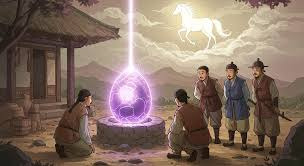
The founding myth of the Silla Park clan states that the founder was born from an egg resembling a park, hence the surname ‘Park (朴)’. Here, the white horse, the egg, and the well are all symbolic devices supporting the divine royal authority of Park Hyeokgeose.
Case Study 2: The Child in the Golden Chest, Kim Alji
The founder of the Silla Kim clan, Kim Alji, was said to have emerged from a golden chest, thus the surname ‘Kim (金)’. The golden chest and the white hen are symbols emphasizing the divine origin of the Kim dynasty. Thus, the surnames of the Three Kingdoms period served as powerful ‘political branding’ to strengthen royal authority.
Table 2: Adoption of Surnames by Royal Families During the Three Kingdoms Period
| Kingdom | Royal Surname | Mythical Founder | Estimated Historical Use of Surname |
|---|---|---|---|
| Goguryeo | Go (高) | Go Jumong | 5th Century (during King Jangsu) |
| Baekje | Buyeo (夫餘)/Yeo (餘) | Onjo | Mid-4th Century (during King Gunchogo) |
| Silla | Park (朴), Seok (昔), Kim (金) | Park Hyeokgeose, Seok Talhae, Kim Alji | Mid-6th Century (during King Jinheung, Kim) |
Chapter 4: Goryeo Dynasty, Uniting the Nation Through Names
Goryeo’s founder Wang Geon utilized surnames as a tool for national unification. He strengthened the centralization system through the ‘saseong (賜姓)’ policy of granting surnames to loyal local leaders and the ‘bon-gwan (本貫)’ system that formalized the regional bases of each family.
A representative example is when the local leader Kim Haeng (金幸) of Andong was granted the surname Kwon (權) for his contributions, becoming the founder of the Andong Kwon clan. Thus, a unique Korean surname system was completed, where even the same surname, like ‘Gyeongju Kim’ and ‘Gimhae Kim’, is distinguished as different clans based on their bon-gwan, a system unparalleled in the world.
Chapter 5: Joseon Dynasty, Everyone Comes to Have a Surname
Until the mid-Joseon period, surnames were the privilege of the yangban (nobility). However, as the class system was shaken by the Imjin War and the Manchu invasions, commoners and slaves began to adopt surnames.
Through the rampant issuance of ‘gongmyeongcheop’ for state financial expansion and the ‘sale of genealogies’ by wealthy classes, surnames rapidly became widespread. In this process, many chose surnames like Kim, Lee, and Park, which were associated with royal or influential families, directly leading to the concentration of certain surnames today. The process of a slave named ‘Subong’ being registered as ‘Kim Subong’ years later illustrates that surnames were no longer inherited but could be acquired, marking a social revolution.
Chapter 6: Trials of Modernity, Name Change and Completion of Surnames
With the implementation of the ‘Minjeok Law’ in 1909, all citizens were legally required to have a surname and bon-gwan, but in 1940, the Japanese forced ‘changsi gaemyeong’ (name change) to obliterate national consciousness. This was a cultural violence aimed at destroying Korea’s unique kinship and bon-gwan centered family system, incorporating it into the Japanese-style ‘ka (家, ie)’ system.
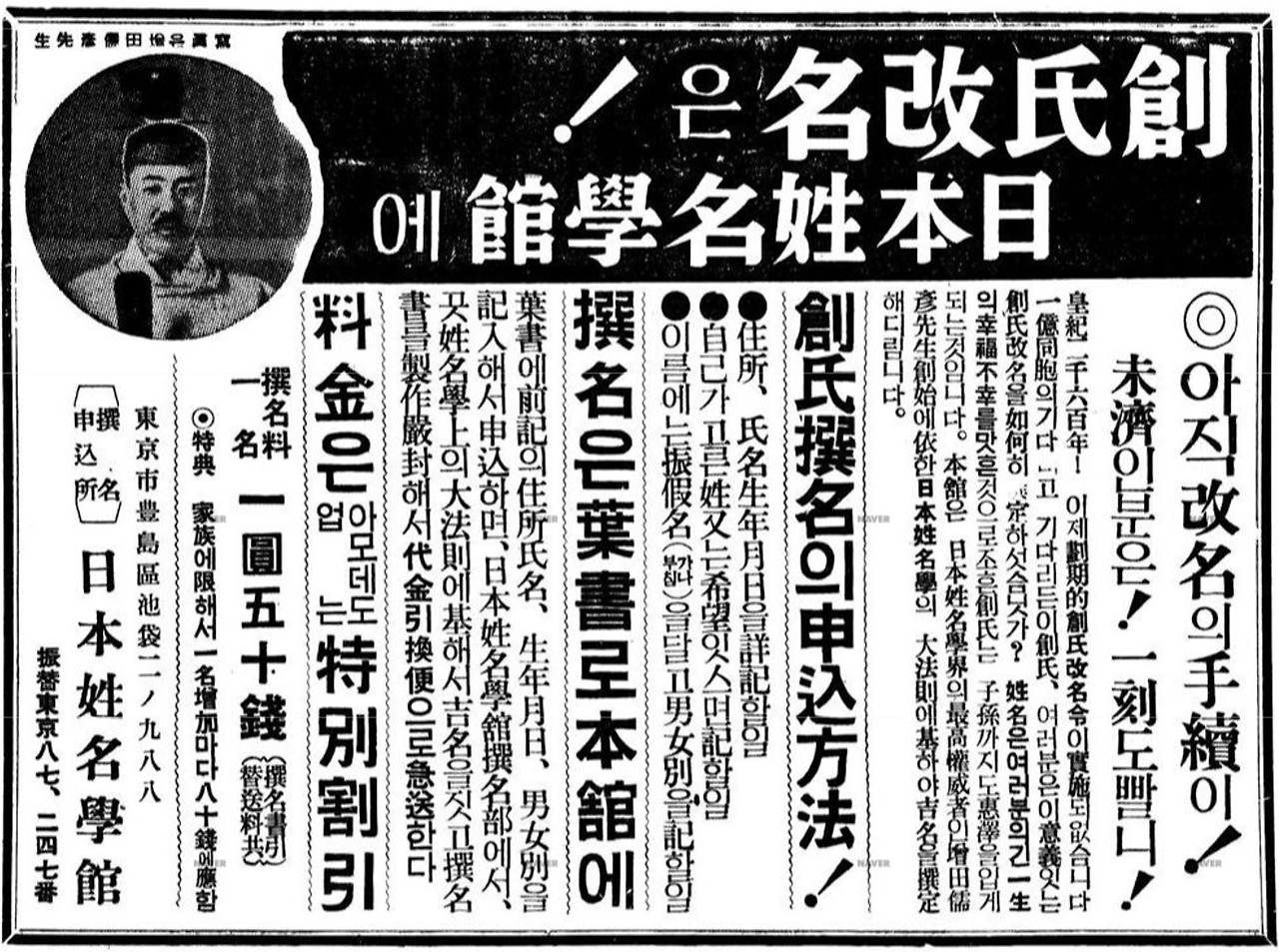
Despite this oppression, many resisted by adopting their bon-gwan as their clan (e.g., Gimhae Kim → Kaneumi (金海)), or deriving names from founding myths (e.g., the Najung well of Park Hyeokgeose → Arai (新井)). The moment they regained their names through the ‘Restoration of Joseon Names’ after liberation was a historical event confirming that surnames were the last bastion of national identity for Koreans.
Comparison: The Uniqueness of the Korean Surname System
The Korean surname system originated from China but possesses unique characteristics due to the existence of the ‘bon-gwan (本貫)’ system.
- Korea: Combines surname + bon-gwan to identify clans. (e.g., Gyeongju Lee ≠ Jeonju Lee). This became the origin of the custom of not marrying within the same clan.
- China: Represents clans solely by surname (姓), with regional distinctions known as ‘junwang (郡望)’, but lacking the strong legal and social binding power of Korea’s bon-gwan.
- Japan: Had both clan (氏, Uji) and surname (姓, Kabane), but unified under ‘myoji (苗字, Myoji)’ after the Meiji Restoration. Many derived from place names or occupations, differing from Korea’s kinship-centered surnames.
Thus, the bon-gwan system has made Korean surnames a symbol of unique identity combining blood relations and regional ties.
Conclusion
Writing this has made me reflect once again on the origin of my name. A Korean’s name is not just a symbol but an epic compressed into thousands of years of history.
-
Key Summary:
- Origin: Korean surnames started from the fusion of matriarchal ‘surname (姓)’ and patrilineal ‘clan (氏)’.
- Development: Completed the unique Korean system through the political introduction of royal families during the Three Kingdoms period and the establishment of the ‘bon-gwan’ system in the Goryeo period.
- Popularization: The collapse of the class system in the late Joseon period led to the widespread adoption of surnames, resulting in significant increases in certain surnames like Kim, Lee, and Park.
What story does your name carry? How about taking this opportunity to explore the origins of your surname and bon-gwan? It will be an exciting journey to explore Korean history.
References
- Jeungsando Monthly Gae Byeok Korean Surnames
- Encyclopedia of Korean Ethnic Culture Surnames (姓氏)
- Gyeongnam Daily Surnames (姓氏)
- Namu Wiki Surnames
- Archive News What is the difference between Surname (姓) and Clan (氏)?
- Graduation Thesis on the Roots of Chinese People in Chinese Surname Culture - Link
- Historical Educational Material When, by whom, and why did we start using the term “surname (姓氏)”?
- National History Compilation Committee Our History Net Myth of Park Hyeokgeose
- Encyclopedia of Korean Folklore Myth of Kim Alji (金阏智神话)
- Namu Wiki Saseong Policy
- Wikipedia Bon-gwan
- YouTube The Path of Humanity, Episode 18: The Origins and Derivation of Chinese Surnames Part 1 by Kim Seon-joo
- YouTube Most Korean Surnames and Genealogies are Fake | The Real Reason Why There Are So Many ‘Kim, Lee, Park’ Surnames
- Hankyoreh Becoming a Yangban of Commoners: ‘Surnames and Genealogies in My Hands’
- Our History Net Changsi Gaemyeong 1940
- Wikipedia Changsi Gaemyeong