
How can the awakening of Baekdu Mountain beneath its tranquil beauty trigger the chain collapse of hyper-connected modern civilization?
- Understand the historical lessons that the Millennium Eruption 1,000 years ago teaches us today.
- Predict the catastrophic impacts of a Baekdu Mountain eruption on key systems of modern society (aviation, semiconductor supply chains).
- Analyze the potential for geopolitical crises in Northeast Asia and confirm the urgency of cross-border cooperation.
The Two Faces of Baekdu Mountain: A Serene Sacred Mountain and a Sleeping Volcano
Baekdu Mountain, the highest peak on the Korean Peninsula, symbolizes majestic and serene beauty as the spirit of the nation. However, beneath this tranquil landscape lies the potential for a massive Baekdu Mountain eruption that could awaken at any moment. Viewed through the lens of science, Baekdu Mountain is an active volcano harboring a vast magma chamber several kilometers below the surface, continuing to exhibit subtle activity.
The crux of this article is that Baekdu Mountain’s volcanic activity is not merely a local disaster. The re-eruption of Baekdu Mountain is a potential trigger for a series of global crises that test the hyper-connected global economy, Just-in-Time supply chains, and the geopolitical balance in Northeast Asia.
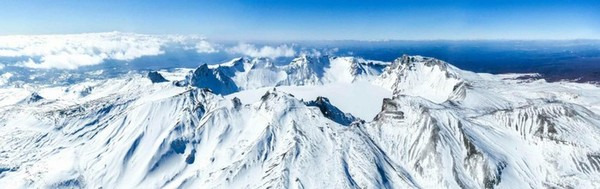
The serene beauty of Baekdu Mountain’s Heaven Lake. However, beneath it, hot magma is stirring.
Notably, from 2002 to 2005, there was a significant increase in volcanic earthquakes and surface uplift, making it clear that this mountain is a living volcanic system. However, this scientific reality is obscured by cultural symbolism, dulling the public’s sense of crisis. It is crucial to bridge this “gap in perception” and clarify the reality of the threat.
A Warning from 1,000 Years Ago: The Millennium Eruption of 946
In the year 946, one of the most powerful volcanic eruptions in human history occurred in Northeast Asia, where Goryeo and Khitan coexisted.
Records of Great Catastrophe
The Goryeo History records that “the drum of heaven sounded (天鼓鳴)” in the capital Gaegyeong, while Japan recorded that “white ash fell like snow (白灰散如雪).” This testifies to the explosion’s sound being audible as far as approximately 470 km away and volcanic ash reaching Japan via westerly winds, providing decisive evidence of the Volcanic Explosivity Index (VEI) 7 scale of the Millennium Eruption. This power was dozens of times greater than that of Mount Vesuvius, which destroyed Pompeii, and over 1,000 times that of the Icelandic volcano that caused the 2010 European air traffic disruption.
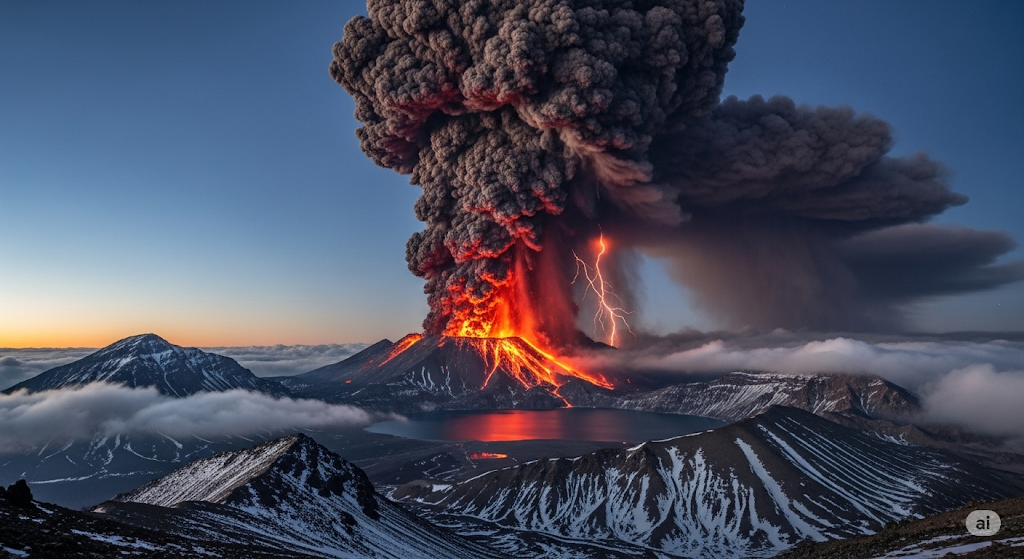
During the 946 eruption, volcanic ash spread so widely that it was found not only in Japan but also in Greenland’s glaciers.
The Secret of the Explosion: Magma Mixing
Such explosive power was generated by the violent mixing of two different types of magma underground. When hot, fluid rhyolitic magma mixed with gas-rich, viscous comenditic magma, the dissolved gases rapidly vaporized, causing explosive Plinian eruptions akin to a champagne bottle bursting.
This discovery is crucial. It warns that future eruptions of Baekdu Mountain may also possess catastrophic explosive potential, similar to that of the 10th century, rather than being mere lava flows.
The Past to the Future: Case Studies of Volcanic Disasters
To understand the future threat of Baekdu Mountain, we must analyze three significant historical volcanic eruption cases.
1. Pompeii (79 AD): The Prototype of Local Catastrophe
The eruption of Mount Vesuvius demonstrates how deadly pyroclastic flows can be. Hundreds of degrees of high-temperature gases and volcanic ash covered the city at hundreds of kilometers per hour, burning and suffocating everything. This serves as a model for the immediate damage that areas within a 100 km radius would experience during a Baekdu Mountain eruption, especially if combined with the 2 billion tons of water in Heaven Lake, potentially forming massive volcanic mudflows (lahars) that could cause even more extensive destruction in the Amnok and Tumen River basins.
2. Tambora (1815): The Beginning of Global Famine
The Tambora volcano in Indonesia (VEI 7) emitted enormous amounts of sulfur dioxide into the stratosphere, blocking sunlight and turning 1816 into the “Year Without a Summer.” This led to global cooling, poor harvests, widespread famine, and outbreaks of disease. Considering the VEI 7 scale of the Baekdu Mountain Millennium Eruption, this suggests unimaginable shocks to modern global food systems.
3. Eyjafjallajökull (2010): Paralyzing Modern Civilization
The eruption of the small Icelandic volcano (VEI 4) demonstrated that fine volcanic ash can stop jet engines, paralyzing the European air network. This caused the collapse of Just-in-Time supply chains, resulting in massive economic losses across aviation, manufacturing, and agriculture.
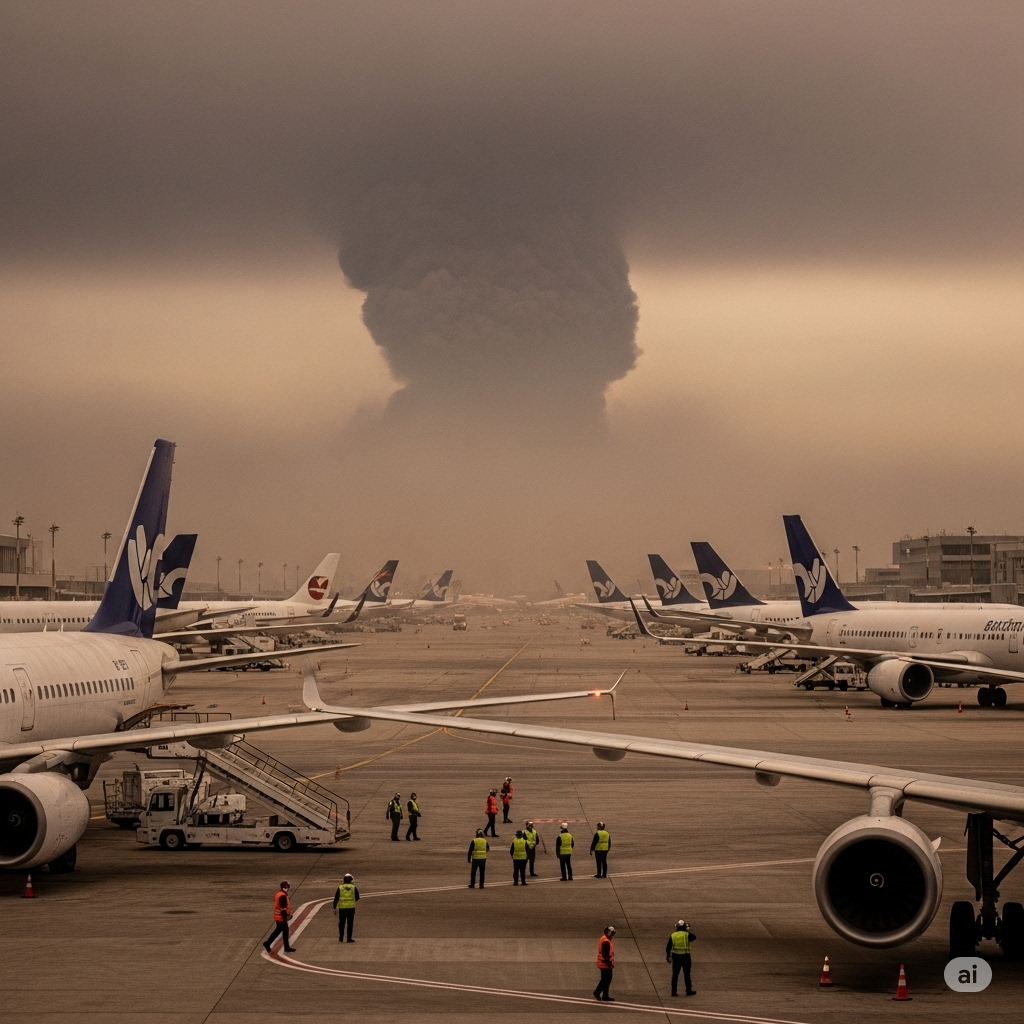
The 2010 Eyjafjallajökull eruption was relatively small in scale, yet it revealed the vulnerabilities of modern air networks and global supply chains.
This raises a question for me: If a small Icelandic volcano can paralyze Europe, what would be the consequences of a large-scale eruption occurring in the heart of Northeast Asia, the world’s economic hub? This could mean a complete severing of the busiest air routes connecting Seoul, Tokyo, and Beijing, as well as the global high-tech industrial supply chain.
21st Century Chain Collapse Scenario (Assuming VEI 7)
If a large-scale eruption of Baekdu Mountain were to occur in today’s hyper-connected world, the consequences would be chain reactions and catastrophic.
The First Week: Paralysis in Northeast Asia and Suffocation of Supply Chains
Immediately after the eruption, lahars and pyroclastic flows would devastate North Korea’s Yanggang Province and China’s Jilin Province, while volcanic ash would blanket the entire Korean Peninsula and Japan, depending on the seasonal winds. Northeast Asian air routes would be immediately blocked, and the air network connecting the Pacific and Eurasia would be paralyzed.
More critically, the ’electrical conductivity’ of moisture-laden volcanic ash poses a significant threat. If this ash clings to power lines, it could cause widespread blackouts, leading to a chain collapse of all societal systems reliant on the power grid, including communication, finance, and transportation.
This would be a direct attack on the global semiconductor supply chain.
- Production Halt: Semiconductor fabs, which require extremely clean environments, would have to cease operations due to volcanic ash in the atmosphere.
- Logistics Disruption: The lifeline of the semiconductor industry, which relies entirely on air cargo, would be severed.
- Global Ripple Effect: If production in Taiwan and South Korea, which produce over 90% of the world’s cutting-edge semiconductors, stops, a global crisis would ensue within weeks, halting all manufacturing from smartphones to AI servers.
The First Year: Climate Shock and Geopolitical Tremors
Similar to the Tambora case, a ‘volcanic winter’ would lead to a drop in temperatures in the Northern Hemisphere, resulting in a sharp decline in global grain production and a food crisis.
The most unpredictable variable is the wildcard of North Korea.
- Catalyst for Regime Collapse: The destruction of northern regions and agricultural collapse would overwhelm the regime’s governance capabilities, and the eruption of Baekdu Mountain, a symbol of idolization, would severely damage its legitimacy.
- Humanitarian Disaster: A large-scale famine and an influx of North Korean defectors could lead to millions of refugees.
- WMD Nightmare: The worst-case scenario is the ’loose nukes’ problem, where nuclear and chemical weapons become uncontrollable during the regime’s collapse process. This could trigger military intervention from neighboring countries, creating an extremely dangerous situation.
Comparison/Alternatives
The threat of a Baekdu Mountain eruption embodies a complex nature that combines the destructive power of past disasters.
Table 1: Comparative Analysis of Major Volcanic Eruptions
| Characteristics | Vesuvius (79 AD) | Tambora (1815) | Eyjafjallajökull (2010) | Baekdu Mountain (Future Scenario) |
|---|---|---|---|---|
| VEI | 5 | 7 | 4 | 4~7 |
| Major Disasters | Pyroclastic flows, volcanic ash fall | Climate change, famine | Aviation/economic paralysis | Pyroclastic flows, lahars, aviation paralysis, climate change |
| Impact Area | Local (city destruction) | Global | Regional-Global | Local-Global (Complex Disaster) |
| Implications | Model for adjacent area destruction | Model for global food/climate crisis | Model for high-tech supply chain paralysis | Possibility of simultaneous occurrence of the three threats above |
Step-by-Step Guide: Recommendations for Global Governance
This borderless threat requires a response that transcends borders. The focus of disaster management must shift from scientific observation to establishing robust and integrated emergency plans.
- Establish Economic Resilience Plans: Strategies for securing alternative production and logistics routes to mitigate shocks to key supply chains like semiconductors should be developed at national and international levels.
- Create Geopolitical Conflict Prevention Protocols: In the event of a sudden change in North Korea, relevant countries should establish pre-agreed protocols for humanitarian assistance and WMD security crisis response to prevent accidental military conflicts.
- Restore Transnational Scientific Diplomacy: Excluding political logic, efforts should be made to establish an ‘International Baekdu Volcano Joint Observation Center’ where all relevant countries, including North Korea, transparently share data.
Conclusion
The most significant realization I had while analyzing these materials is that the danger of Baekdu Mountain lies not only in the mountain itself but also in the interconnectedness and vulnerabilities inherent in the global systems we have built.
Three Key Points:
- Chain Crisis: The eruption of Baekdu Mountain is a complex disaster that begins as a geological event and escalates into economic, supply chain, food, and geopolitical crises.
- System Vulnerability: The global semiconductor supply chain and geopolitical instability in Northeast Asia will be the most critical weaknesses during a Baekdu Mountain eruption.
- Lack of Cooperation: The current geopolitical deadlock is the greatest obstacle to effective crisis response, and restoring transnational scientific cooperation is urgent.
The tranquil silence of Baekdu Mountain gives us time to prepare. It is now time to recognize Baekdu Mountain as a realistic challenge that tests our ability to prepare for 21st-century complex crises, beyond its symbolic meaning as the sacred mountain of the nation, and to urge the international community for a joint response.