
From the Paradoxical Advice of a Billionaire Investor to Six Techniques for Regaining Control of Happiness
Have you ever felt a chill in your heart while scrolling through social media? Friends’ glamorous photos from their European vacations, colleagues’ promotion announcements, and seemingly perfect family outings of acquaintances. As we browse through these posts, we can’t help but sigh, thinking, “Everyone seems to be doing so well, and I’m falling behind.” This subtle yet sharp anxiety is a feeling all too familiar to those of us living in modern society. The advancement of technology has delivered others’ lives to us in real-time, resulting in an era where comparison is easier than ever, known as the age of ’expectation inflation.'

At this juncture, an unexpected figure throws down a provocative challenge regarding happiness: Charlie Munger, a 98-year-old billionaire investor who has lived at the pinnacle of wealth and success. In his final interview, when asked about the secret to a happy life, he replied, “The first principle for a happy life is to lower your expectations.” Isn’t that strange? Someone who seems to have experienced everything in the world advises not to aim ‘higher and further,’ but rather to ’lower expectations.’
This article does not simply agree or disagree with this paradoxical statement. Instead, we aim to dissect this powerful sentence and embark on a long journey. Is lowering expectations truly a wise secret to achieving peace of mind, or is it a dangerous trap that leads to complacency? From the psychological mechanisms of disappointment to the invisible prisons of expectations hidden throughout our lives, and the wisdom of ancient philosophers alongside modern psychological tools, by the end of this article, we will have concrete ’expectation management’ techniques to regain control of our happiness.
The Psychology of Expectation and Disappointment: Why Do We Book Our Own Unhappiness?
Did you know that our happiness and unhappiness are determined by a surprisingly simple formula? In consumer psychology, there is a concept called ‘Expectation Disconfirmation Theory.’ It sounds complicated, but the essence is simple. Our satisfaction is not determined solely by how good the experience itself was, but rather by how that experience compares to our ’expectations.’ Expressed as a formula:
Satisfaction = Actual Performance (Experience) - Expectations
Let’s examine how this formula operates in our daily lives through a few examples:
- Example 1: The Betrayal of an Instagram Hotspot
After seeing a visually stunning dessert photo on social media, you visit a café with high expectations. The dessert in the photo deserves a perfect 10 out of 10. However, when you taste it, it turns out to be a decent 7. Instead of feeling satisfied, you feel disappointed, thinking, “It’s not as good as the picture.” This results in dissatisfaction of -3 points: Actual Experience (7) - Expectations (10). - Example 2: Rediscovering a Run-Down Local Restaurant
You randomly enter a small local restaurant with almost zero expectations. To your surprise, the food is outstanding. Objectively, it deserves an 8, but because it exceeded your expectations, you feel a 10-level delight. The principle here is that you experience a high satisfaction of +6 points: Actual Experience (8) - Expectations (2). - Example 3: The ‘Innovative’ New Smartphone
Consider a new product heavily marketed as having “revolutionary performance that will change the world.” Consumers expect a completely different experience, but when they try it, they find only slight performance improvements. As a result, despite the product being decent, negative reviews flood in, and buyers regret their purchases because it fell “below expectations.”
Thus, our emotions are influenced by the ‘gap’ between reality and expectations. So, what is the real problem? Why have our expectations become unrealistically high?
Charlie Munger stated, “What moves the world is not greed but envy.” Similarly, the philosopher Montesquieu noted 275 years ago, “If you simply want to be happy, that goal can be easily achieved. But we want to be happier than others, which is always difficult because we believe others are happier than they actually are.”
These insights accurately pinpoint the pain points of modern society. Today’s social media acts as a massive amplifier for this feeling of ’envy.’ We constantly watch edited ‘highlight reels’ of others’ lives, where their successes and happiness are exaggerated while their pain and failures are hidden. We compare their edited outcomes with our stark realities, continuously raising our expectations. Ultimately, we find ourselves participating in an unwinnable comparison game, booking our own unhappiness.
The Invisible Prison: Expectations That Dominate Our Lives
Expectations create invisible prisons that extend beyond personal desires, affecting all areas of our lives. How do the implicit expectations imposed by relationships, workplaces, and society eat away at our happiness?

Relationships: Unspoken Contracts and Silent Resentments
One of the most common and painful tragedies in relationships is the pattern of ’expecting alone and being disappointed alone.’ One party assigns specific roles to the other (e.g., believing they will always be on their side, expecting them to check in without prompting) and enters into an ‘implicit contract’ without expressing it verbally. The other party, unaware of this secret contract, may inadvertently let down those expectations while living their own life.
- Example: A Slowly Drifting Friend
Once inseparable friends A and B find themselves growing apart. A expects B to prioritize them and reach out first as usual. However, B becomes busy with a new job and romance, unable to check in on A as before. A feels hurt but concludes, “I’m the only one putting effort into this relationship,” and shuts down emotionally. Ultimately, their relationship withers slowly, leaving behind wounds and resentments from uncommunicated expectations without any major conflict. The true cause of this tragedy lies not in B’s negligence but in A’s unilaterally set expectations of ‘friend roles.’
Workplace: ‘30% Work’ with ‘50% Expectations’
The workplace is also a battlefield filled with opaque expectations. Many bosses assign tasks that constitute about 30% of the workload while secretly expecting 50% initiative and results. Here lies the irony: an employee who perfectly executes the assigned 30% of work is often labeled as a ‘passive employee who only does what they’re told’ rather than being praised.
Such an environment drives employees to burnout and ‘quiet quitting.’ They feel powerless to meet their boss’s endlessly expanding implicit expectations, which go beyond simply ‘doing the job well’ to ‘reading the boss’s mind and exceeding expectations.’ This creates a perfect formula for chronic stress and dissatisfaction.
Society: The Cruel Schedule of ‘Ageism’
In South Korea, there exists a particularly strong and oppressive social expectation known as ‘ageism.’ This schedule imposes an unspoken pressure to complete specific tasks (graduation, employment, marriage, home ownership, childbirth, etc.) by certain ages.
This pressure varies in weight depending on gender. Men bear the enormous expectation of economic stability, responsible for supporting a family despite entering society later due to military service. Women, on the other hand, face the dual pressures of building a career while being subjected to societal and biological clocks regarding ‘marriageable age’ and ‘golden time for childbirth,’ exposing them to the risk of career interruption. Deviating even slightly from this predetermined path leads to a dual suffering of social prejudice and personal anxiety.
Literature: The Tragic Fall of The Great Gatsby
The literary archetype that encapsulates the dangers of these expectations is ‘The Great Gatsby.’ Gatsby’s immense wealth, the lavish parties he held every night, and even his name and existence were all aimed at fulfilling one colossal expectation: to turn back time and reclaim his love for Daisy in an ideal form.
His tragedy lies in the fact that he loved not the real Daisy but the perfect illusion he had sculpted in his mind over five years. When the real Daisy failed to meet his rigid expectations (“Tell me you never loved Tom!”), the entire world he had built crumbled in an instant, leading to his lonely and tragic death. Gatsby’s life serves as the ultimate warning of how a single stubborn expectation can lead an entire life to ruin.
Lowering Expectations: A Wise Surrender or a Dangerous Trap?
So, is the solution really just to ’lower expectations’? Within this seemingly simple advice lies both profound wisdom and dangerous traps. Let’s explore both sides to find that delicate balance.

Reasons to Lower Expectations: Wisdom from Ancient Philosophers and Billionaires
- The Stoic Perspective: The Dichotomy of Control
Ancient Roman Stoic philosophers believed that the key to happiness lies in clearly distinguishing between what we can control and what we cannot. What we can control is only our judgments, attitudes, and reactions. In contrast, external events, others’ evaluations, health, and wealth are beyond our control. Therefore, expecting a specific outcome is foolish. A wise person expects to do their best but leaves the results to the realm of the divine. This can be likened to gardening: we can pull weeds and water (what we can control), but we cannot change the weather or pests (what we cannot control). - The Radical Freedom of Cynicism: The Anecdote of Diogenes
The most radical form of lowering expectations can be found in the life of the philosopher Diogenes, who lived in a barrel. When Alexander the Great, who had conquered the world, came to him and offered to grant any wish, Diogenes simply replied, “Stand out of my sunlight.” This illustrates a state of complete freedom and satisfaction not through acquiring more but through needing nothing at all. Diogenes’ happiness was independent of any external conditions, making it something no one could take away. - The Paradox of Billionaires
Returning to Charlie Munger, the conclusion drawn by someone who was at the top of the capitalist game being ’lower expectations’ is highly significant. It serves as powerful evidence that even if one possesses all the wealth and fame in the world, the void created by unrealistic expectations can never be filled.
The Traps of Lowering Expectations: Critical Reflection
- The Engine of Growth: The Power of High Goals
Setting challenging goals is fundamental to motivation, personal growth, and achieving greatness. If we only expect easy things, we will never surpass our limits or discover our potential. If society collectively lowers expectations, it will inevitably stagnate. The key point here is that ‘high goals’ and ‘rigid expectations about outcomes’ are different. - The Real Enemy: The Obsession for Recognition
At this point, we encounter the most crucial insight of this article. The real issue may not be the ’expectations’ themselves but rather the ‘desire for others’ recognition of those expectations,’ or the ‘obsession for recognition.’ Japanese psychologist Hajime Ota explains the magnitude of the pressure we feel with the following formula:
Pressure = (Expectations others have of me - Belief in my abilities) × Importance of the situation
This formula completely shifts the perspective on problem-solving. It shows that the solution is not simply to lower ’expectations.’ We can effectively manage pressure by either increasing our ‘self-efficacy’ (building skills and confidence) or lowering the ‘importance’ of the task (diversifying life’s values rather than going all-in on one). This guides us towards a higher-level strategy of managing our inner world rather than a simple resignation of “just give up.”
The Techniques of ‘Expectation Management’: Six Ways to Regain Control of Happiness
We are now nearing our final destination. Our goal is not to lower expectations aimlessly and fall into apathy. Instead, we aim to consciously ‘manage’ expectations to make them healthy, realistic, and flexible. Here are six specific ways to become the operator who holds the steering wheel rather than a passive passenger on the rollercoaster of hope and disappointment.
1. Equip Yourself with a ‘Growth Mindset’: Turn Evaluations into Feedback
Professor Carol Dweck from Stanford University states that our mindsets can be divided into ‘fixed mindset’ and ‘growth mindset.’ The difference between these two becomes stark when expectations are thwarted.
- Fixed Mindset sees failure as a final ’evaluation’ of one’s innate abilities. “I guess I just don’t have talent.” Such thoughts lead to a fear of challenges and render efforts meaningless.
- Growth Mindset views failure as useful ‘data’ and ‘feedback.’ “This method didn’t work. What can I learn to try differently?” By seeing failure as an essential part of growth, one develops strong resilience and does not crumble under frustration while pursuing high goals.
The differences between these two mindsets can be understood more clearly through the table below.
Fixed Mindset vs Growth Mindset
| Situation | Response of Fixed Mindset | Response of Growth Mindset |
|---|---|---|
| Project Failure | “I must not have talent for this. My limits are here.” | “This method didn’t work. I need to analyze the causes of failure and try differently next time.” |
| Difficult Challenge | “I’m afraid of failing and revealing my incompetence. Avoiding it is the best option.” | “It will be difficult, but I can learn a lot from this process. It’s worth the challenge.” |
| Colleague’s Success | “That person is naturally talented, and I’m not. I feel threatened by the comparison.” | “That’s amazing! What are the secrets to their success? I should learn and get inspired.” |
2. Fall in Love with the ‘Process’ Rather than the Result
Instead of pinning all emotions on a massive outcome, focus on the ‘process’ of daily effort and improvement. For instance, if you obsess over the result of “losing 10kg,” you will fluctuate emotionally with the numbers on the scale. However, if you focus on processes like “walking for 30 minutes every day” or “eating one healthy meal a day,” you can feel satisfaction and a sense of achievement simply by consistently following those processes. This is an effective way to break down the emotional weight of a massive goal into manageable pieces.
3. Practice Strategic Indifference (Modern Stoicism)
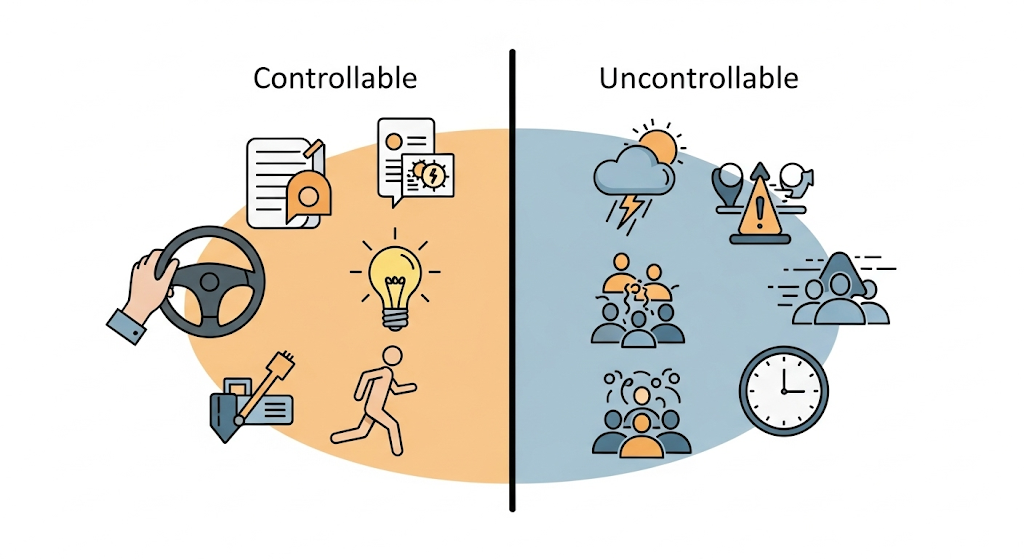
This is a training to apply the Stoic philosophy of ‘dichotomy of control’ in real life. When a goal arises, take out a piece of paper and draw two columns. In the left column, write down ‘What I can control’ (e.g., my effort, my attitude, my response to failure, learning plans), and in the right column, write ‘What I cannot control’ (e.g., final outcomes, others’ evaluations, market conditions, competitors’ actions). The rule is simple: pour all your emotional and physical energy into the left column and consciously decide to be ‘indifferent’ to the items in the right column. This practice calms anxiety and creates immense psychological stability.
4. Cultivate an Abundant Mind through ‘Gratitude’
Expectations often arise when we focus on ‘what we lack.’ In contrast, gratitude is a practice of consciously focusing on ‘what I have right now.’
- Practical Tip: 3-Minute Gratitude Journal
Every night before bed, write down three things you are grateful for that day, along with specific reasons. “I’m thankful for the warm coffee I had this morning. It allowed me to have a moment of calm before starting a hectic day.” Research shows that this simple habit rewires the brain to better capture the positive, enhancing happiness, improving health, and strengthening relationships.
5. Transform the Implicit into Explicit: Communicate Expectations
To avoid the tragedies of relationships discussed in Chapter 2, we need the courage to turn vague expectations into clear ‘conversations.’
- At Work: Instead of silently complaining about a lack of support from your boss, request a meeting to clarify goals and roles. Directly ask, “What does exceeding your expectations look like for this project?”
- In Relationships: Replace silent assumptions with honest communication. Instead of getting angry that a friend hasn’t reached out first, say, “I feel upset that we’ve been a bit distant lately. Our relationship is really important to me. Can we have a quick call next week?”
6. Master the Moment with ‘Mindfulness’
When feelings of disappointment hit hard, we can easily get swept away in the emotional whirlwind. Mindfulness is the practice of quietly ‘observing’ those emotions rather than denying or suppressing them.
- Simple Practice: Five-Finger Breathing Technique
Open one hand and slowly trace the fingers with the index finger of the other hand. Breathe deeply as you trace up the fingers and exhale slowly as you trace down. Repeat until you have traced all five fingers. This simple physical sensation brings us to the present moment, breaking the cycle of negative thoughts and instantly alleviating stress responses.
Conclusion: Happiness = Reality - Expectations (How to Complete Your Own Formula)
Through this article, we began by understanding the psychological formula of disappointment, witnessed how that formula governs our lives, and completed a long journey traversing ancient wisdom and modern management techniques.
Let’s recall the happiness equation summarized by Morgan Housel. Happiness consists of two elements: ‘what you have (reality)’ and ‘what you expect (expectations).’ We strive desperately throughout our lives to increase ‘what we have’—better homes, higher salaries, better reputations. However, this article has shown us that we have another powerful lever: the variable of ‘what we expect.’ And this variable is under our control more than anything else.
The ultimate goal is not passive resignation or apathetic surrender. It is to become an active designer of our inner world. By choosing a growth mindset, focusing on the process, practicing gratitude, and communicating clearly, we do not merely lower expectations; we ’tune’ them with wisdom and intention. We no longer hold our happiness hostage to external outcomes but build a solid fortress from within. Now, it’s time to complete your own happiness formula.
Sources
- [The First Principle for Happiness is to Lower Expectations!](https://brunch.co.kr/@richboy/309)
- e-Professionalism, Ethical and Dignified SNS - Daily Vet
- Social Network Service/Criticism - Namu Wiki
- Episode 4: Lowering Expectations Brings Wealth and Happiness - Brunch
- OA Journal - Korean Journal of Hospitality and Tourism - Understanding Local Residents’ Behavioral Intentions and Support for Tourism Events Based on Expectation Disconfirmation Theory and Theory of Planned Behavior - OAK National Repository
- Why Do We Feel Disappointed When Expectations and Reality Differ? - Expectation Disconfirmation Theory - Brunch
- 9-8. The Theory of Relationships: Expecting Alone and Being Disappointed Alone - Brunch
- 15 Ways to Experience Less Disappointment in Relationships - Brunch
- [The Inner Thoughts of Workers] Three Work Styles That Dig Their Own Graves - Job Korea
- Building a High-Difficulty ‘Company Life Game’ - Channel Yes
- ‘Ageism’ Society - Hankyoreh 21
- Things That Are Hard to Do After Turning 30 in Korea - Brunch
- What It Means to Get Older - Brunch
- F. Scott Fitzgerald’s ‘The Great Gatsby’ - Monthly Recruit
- Scott Fitzgerald’s ‘The Great Gatsby’ - Dadok Dadok - Tistory
- Episode 7: Happiness According to Stoic Philosophy - Brunch
- When Life Feels Overwhelming, Turn to Stoic Philosophy - Aladin
- [Philosopher’s Study] A Pioneer Ahead of His Time, Diogenes - Hakuna Ryu Blog
- [Namyangju News] The Happiness of Diogenes
- How Effective Goal Setting Improves Performance Evaluation - FasterCapital
- The Importance of Goal Setting: How to Set and Achieve Realistic Goals - Anpigon Growth Blog
- Reasons to Have High Goals - Brunch
- [Kim Ji-soo’s Interstellar] “Lower Others’ Expectations” for Those Tired of the Obsession for Recognition
- Growth Mindset (Mindset) - Carol Dweck - Kaden Sungbin Cho - Tistory
- Mindset Stanford Human Growth Project - Aladin
- Mindset - Wikipedia, the Free Encyclopedia
- Mindset, The Power of Attitude to Achieve What You Want
- Mindset Towards Growth: Understanding Fixed and Growth Mindsets - Brunch
- Carol Dweck - Summary of Mindset - StoryShots
- [Coaching Theory Every Coach Must Know] Growth Mindset Theory
- How to Solve Common Time Management Problems: The Ultimate Guide - ClickUp
- How to Recognize and Overcome Burnout Syndrome - Experience Dropbox
- Four Ways to Practice Mindfulness Meditation | Mabo Blog
- Mindfulness Education (mindfulness education) - Basic Edition - YouTube