
The Journey to Stability in the Digital ‘Wild West’
Once upon a time, a vital ‘blood’ began to flow through the grand city of our civilization: ‘money’. This blood facilitated the exchange of goods and services, served as a measure of value, and acted as a vault for accumulating wealth, bringing the city to life. Then, in 2009, a new entity called Bitcoin emerged, challenging all these rules. The advent of ‘digital gold,’ capable of transferring value without banks or governments, was nothing short of a revolution.
However, the land of this revolution was akin to a rugged ‘Wild West.’ A place where Bitcoin, worth the price of a car yesterday, could plummet to the value of a motorcycle today – utterly unpredictable. Such extreme volatility was a massive barrier preventing cryptocurrencies from being used as everyday money.

People yearned for something that could offer the advantages of the new blockchain technology while maintaining stable value, like the money we use daily. They needed a strong ‘anchor’ to calm the turbulent waves of volatility.
Then, as if responding to the market’s call, Stablecoins appeared. As their name suggests, they are ‘stable coins.’ By pegging their value 1:1 to real-world assets like the US dollar, they became ‘digital dollars’ operating on the blockchain.
But this story doesn’t end here. Stablecoins have evolved beyond mere technical solutions for volatility, becoming a grand ‘bridge’ connecting two different worlds. One is the world of Traditional Finance (TradFi), driven by trust and regulation. The other is the world of Innovative Finance (DeFi), driven by code and autonomy. Stablecoins have effectively become the ’lingua franca’ enabling these two worlds to communicate.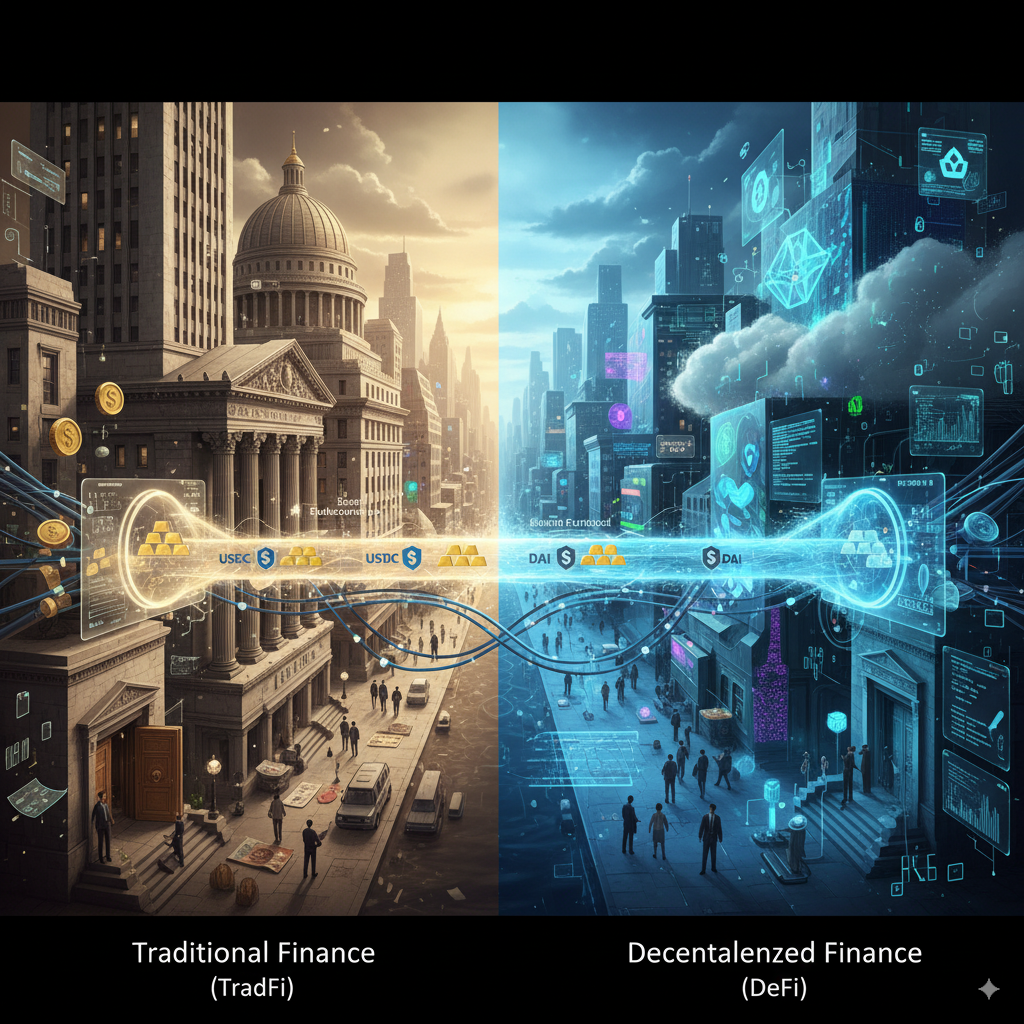
From here on, we will explore together how this amazing bridge was built, what role it plays, and where it is heading. We’ll unravel everything about stablecoins through an easy and fun story, from the secret recipe for stability to real-world tales that change people’s lives, and even a future where money thinks and works for itself.
Chapter 1: The Secret Recipe for Stability - The Four Faces of Stablecoins
The core of stablecoins is ‘stability,’ but the methods for achieving this stability vary. It’s like how each chef has their own secret recipe. Let’s explore the four main recipes one by one.
1. Fiat-Collateralized Stablecoins: The Most Trustworthy Digital Vault
This is the most intuitive and widely used recipe. It’s very simple. For every 1 stablecoin (e.g., 1 USDC) created in the digital world, a real dollar is deposited in a vault at a bank in the real world. This 1:1 promise is the key to stability.
How is the $1 value maintained? An invisible hand called ‘arbitrage’ works.
- **When the price is $0.99:** Savvy investors buy 1 USDC on the market for $0.99 and take it to the issuing company. The company, as promised, exchanges it for a real $1. The investor makes a profit of one cent, and this buying pressure causes the USDC price to return to $1.
- **When the price is $1.01:** Conversely, investors give $1 to the company to mint new 1 USDC. They then sell it on the market for $1.01, pocketing a one-cent profit. This selling pressure causes the price to drop back to $1.

Therefore, the most crucial element is ’trust.’ We must believe the issuing company’s claim that “they genuinely hold an amount of money in their vault equivalent to the coins they have issued.” That’s why leading players like USDT (Tether) and USDC (USD Coin) strive to earn this trust in different ways.
- USDT: As a pioneer of the market, it relies on its speed and wide range of applications, but it has faced suspicion in the past regarding the opacity of its vault assets.
- USDC: Prioritizing regulation and transparency from the outset, it has built trust by filling its vaults solely with cash and safe U.S. Treasury bonds and by publicly disclosing monthly audits by accounting firms.
2. Crypto-Collateralized Stablecoins: The Self-Operating Digital Central Bank
“What if we can’t trust banks? Let’s create our own digital bank!” This is the thinking behind the crypto-collateralized model. It involves depositing other cryptocurrencies like Ethereum (ETH) as collateral to borrow stablecoins.
But doesn’t the price of Ethereum itself fluctuate? That’s why an ‘over-collateralization’ safety net is in place. For example, to borrow DAI, a stablecoin worth $100, you might need to deposit Ethereum worth $150. This extra $50 acts as a buffer against price drops. If the collateral value falls to a dangerous level, the system has an ‘automatic liquidation’ function that automatically sells the collateral to repay the debt.
The leading player in this model, MakerDAO, acts like a mini-central bank built on code, striving to keep DAI’s value at $1 by adjusting interest rates. However, this model also faces the interesting challenge of the ‘decentralization paradox’ – relying heavily on centralized USDC for a significant portion of its collateral assets.
3. Commodity-Collateralized Stablecoins: Gold from the Vault, Digitally
This recipe is similar to the first one, but instead of dollars, physical commodities like gold or oil are held in the vault. Tokens like PAXG signify ownership of 1 ounce of gold stored in a real vault. This allows people to invest in gold and send it to anyone, anytime, 24/7, without physically handling heavy gold. 
4. Algorithmic Stablecoins: An Ambitious Experiment That Ended in Tragedy
This was the most ambitious, and at the same time, the most dangerous recipe. It was an attempt to maintain a $1 value solely by adjusting the money supply based on a clever algorithm, without any collateral.
However, in May 2022, the collapse of TerraUSD (UST) demonstrated just how risky this experiment was. UST’s value was supported by its sister token, LUNA. When market confidence evaporated in an instant, everything spiraled into a ‘Death Spiral.’ The loss of trillions of dollars in just a few days served as a painful lesson about how fragile ‘collateral-free trust’ can be. 
Chapter 2: Stablecoins in the Real World - Stories That Change the World
Stablecoins are no longer just toys for tech enthusiasts. They are permeating our lives, solving long-standing problems. Let me share a few stories.
1. Visa and PayPal Enter the Arena: Faster and Cheaper Corporate Payments
Sending money to overseas partners used to take 3-5 days and incur high fees by going through multiple banks. However, giant payment companies like Visa have started using stablecoins as a new ‘payment highway.’ They process cross-border payments using USDC, nearly in real-time and at low cost, 24/7. PayPal has even launched its own stablecoin, PYUSD, allowing its 400 million users to freely send and receive money within the app. This marks the beginning of a massive shift as the old financial system gets an upgrade.
2. Argentina’s Refuge: Digital Dollars for Preserving Value
For Argentinians experiencing hyperinflation, where prices rise by hundreds of percent annually, their domestic currency, the Peso, is like melting ice cream. They rush to convert their salaries into the stable US dollar as soon as they receive them, but government restrictions make this difficult. In this context, stablecoins have become a survival tool as ‘digital dollars.’ They offer a refuge where anyone with a smartphone can protect their assets without government interference.

3. Hope for Filipino Overseas Workers: More Money for Families
When sending hard-earned money from abroad to families in the Philippines, traditional remittance services used to take hefty fees of 6-8%. However, by using stablecoins, fees are reduced to less than 1%, and money that used to take days arrives in minutes. This isn’t just technological advancement; it’s a heartwarming change that significantly benefits the livelihoods of millions of families.
Chapter 3: The Heart of DeFi - The Reserve Currency of This New Financial World
Decentralized Finance, or DeFi, is a new financial playground operating solely on code and rules, without banks or brokerage firms. In this playground, stablecoins are not just one of many toys but the ‘reserve currency’ that forms the foundation and the center of all activities. 
- Fuel for the Lending Market: Users deposit assets like Ethereum, which they expect to appreciate, and borrow stablecoins with stable value to invest elsewhere. Conversely, those seeking stable interest income lend out stablecoins. Stablecoins act as a bridge connecting capital willing to take risks and capital seeking stability.
- Efficient Exchange: Platforms like Curve Finance specialize in exchanging only stablecoins. This allows for the exchange of millions of dollars with almost no loss and very low fees. It has become the most important hub where all stablecoins in the DeFi world converge.
Chapter 4: The Next Frontier - A Future Where Money Works for Itself
The journey of stablecoins is just beginning a new chapter. They are evolving beyond simply storing and transferring value to become ‘Lego blocks’ that fundamentally change financial systems.
1. Programmable Money: Embedding Logic into Money
Until now, money has been a passive entity that only does what we tell it to. But when stablecoins meet smart contracts, they become ‘programmable money’ that can automatically verify conditions and execute transactions.
- “When the goods arrive at the warehouse, automatically pay the shipping company!”
- “Every time my song is streamed, send royalties to my wallet within a second!”
Contracts that were complex and required multiple steps can now be handled instantly, transparently, and automatically by intelligent money.

2. Tokenization of Real-World Assets (RWA): Bringing Everything in the World to the Blockchain
This is the dream called the ‘holy grail’ of blockchain technology. It involves attaching digital tokens, or certificates, to all real-world assets (RWAs) like U.S. Treasury bonds, real estate, and artwork. Experts predict this market could grow to a staggering $1.6 quadrillion by 2030. 
- Why is it important? Until now, DeFi has been confined within the cryptocurrency world. However, if stable and massive real assets like U.S. Treasury bonds are tokenized and enter DeFi, it opens the door for trillions of dollars in institutional capital to flow in.
- Projects like Ondo Finance have already created tokens that allow users to earn stable interest from U.S. Treasury bonds on the blockchain, and Centrifuge is opening new avenues for fundraising by tokenizing the accounts receivable of small and medium-sized enterprises.
Standing at the Dawn of a Grand Transition
Stablecoins were born to solve the small problem of volatility, but they have evolved to revolutionize global payment systems, become the heart of the new financial world of DeFi, and are now creating a massive wave that is bringing all real-world assets into the digital realm.
Of course, challenges remain. There’s the risk of external shocks like bank failures (de-pegging risk), the centralization risk of relying on a few companies, and the still uncertain regulatory landscape.
The future will likely find solutions within the ‘stablecoin trilemma.’ This is because it’s difficult to perfectly achieve all three goals simultaneously: decentralization, stability, and capital efficiency.
- USDC has chosen stability, partially sacrificing decentralization.
- DAI attempts to maintain decentralization, sacrificing some capital efficiency.
- The ill-fated UST abandoned stability.
Ultimately, instead of one perfect stablecoin dominating everything, a world will emerge where various stablecoins coexist, each fulfilling its specific role and purpose. They will form a bridge connecting traditional finance and DeFi, act as censorship-resistant free money, and serve as the foundation for a new token economy. All of these will intertwine, creating a more efficient and transparent financial system of the future. We are standing at the dawn of that grand transition.