
When you send money to a stranger, it triples upon arrival, but you have no way of knowing how much you will get back. In a 1995 Trust Game experiment, participants sent an average of $5.16 out of the $10 they received.
If you only cared about your own share, the logical move would be to send nothing at all, so handing over nearly half is significant. The concept that explains such choices is “social preference.”
What is social preference, and why is a tumbler not evidence?
In economics, if you prefer X over Y, you are said to have a “preference for X over Y.” Economists have often argued that if preferences are well-defined, they should be treated as given conditions for analysis, and there is no need to dig into why one has those preferences. However, some scholars have continued to delve into that very “why.”
If a person decides what is better based solely on the outcome for themselves, they are said to have “self-regarding preferences.”
If they consider the outcome for others alongside their own share, it is “other-regarding preferences,” or social preference.
Let’s consider someone who carries a tumbler instead of using paper cups, even though it’s inconvenient.
Since they are choosing what is better for everyone at the cost of their own inconvenience, it looks like social preference.
However, if the underlying motive is to gain a reputation as an “environmentally conscious person” to benefit later, it is a calculation for long-term personal gain, which reverts to self-regarding preference.
The key is that you cannot distinguish between the two based on outward behavior alone. That is why economists have conducted experiments in labs where the opportunity for reputation-building is removed—specifically, in conditions where two strangers meet anonymously for a single interaction—to verify the existence of true social preference.
Three experiments showing social preference: Predictions vs. results at a glance
For all three experiments, the behavior of a “person who only cares about their own share” can be clearly calculated. Here is how those predictions compare to the actual results.
Social Preference Experiment 3: Selfish Predictions vs. Actual Results
| Experiment | Prediction (Self-Interest Only) | Actual Result | Revealed Tendency |
|---|---|---|---|
| Trust Game | Sender sends $0, Receiver returns nothing | Sender sends average $5.16 (nearly half), Receiver returns ~30% | Reciprocity |
| Ultimatum Game | Proposer offers minimum, Responder accepts anything | Offers below 25% are usually rejected; most offers are 30~50% | Commitment to Fairness |
| Dictator Game | Gives nothing | Gives around 30% on average | Altruism |
The Trust Game: How much of the money sent to a stranger returned?
This experiment was created by Joyce Berg and her team in 1995.
Two people each receive $10. If A sends some of their money to B, that amount triples by the time it reaches B. B then decides how much of the increased amount to return to A. Both the initial sending and the returning can be $0.
An “egotistical” B would return nothing, as returning money reduces their own share. Anticipating this, A would not send anything to begin with.
However, the research results show that 30 out of the first 32 participants sent money, with an average of $5.16. B received an average of $15.48 and returned about $4.60—roughly 30% of the money received.
The more A sent, the more B returned. Those who sent $5 received an average of $7.17 back, while those who sent $10 received an average of $10.20. However, if you break this down by the $15 and $30 received, the return rate actually drops from about 48% to 34%.
This means that receiving more did not necessarily make them more generous with their return ratio.
Fewer than half of the B participants returned more than the amount sent, and A’s average return was slightly less than the amount sent.
Still, there is a reason why this result is interpreted as evidence of reciprocity.
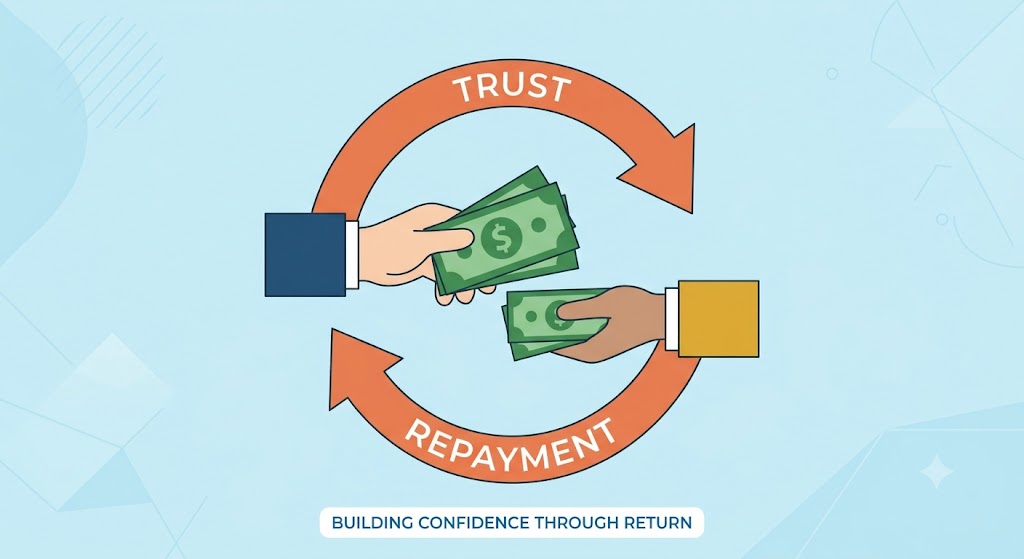
Reciprocity is the principle of returning kindness for kindness and hostility for hostility. Since a significant number of B participants acted in response to being trusted without any external enforcement, it shows reciprocity. Because A’s transfer might involve a desire to help others rather than just trust, subsequent studies (Cox, 2004) were designed to separate the two. A representative tool for measuring altruism separately is the Dictator Game, which follows.
The Ultimatum Game: If it’s only 2,000 won, I’d rather both get zero
The second is the Ultimatum Game, first introduced in an experiment by German economist Werner Güth and his team in 1982.
A receives 10,000 won and proposes a split with B. If B accepts, they split it as proposed. If B rejects, neither gets anything.
If B only cared about their own share, they would accept any offer—whether 5,000 won, 1,000 won, or even 1 won—because it is more than 0. Knowing this, A would offer a very small amount. However, according to a literature review, offers below 25% were generally rejected in reality, and most offers clustered between 30~50%.
B’s rejection is the most interesting part of this experiment. If offered 2,000 won out of 10,000 won, rejecting it means I lose 2,000 won. However, A, who made the unfair offer, also loses 8,000 won. Participants chose to punish unfairness even at the cost of sacrificing their own share. This tendency to stand up against unfairness, even by sacrificing one’s own share, is a commitment to fairness.
It is also worth noting that A offered 30~50%.
While it could be pure kindness, it can also be interpreted as a calculation that B might be someone who cares about fairness. If you offer too little and get rejected, you end up with 0 as well.
People not only care about fairness themselves but also act with the knowledge that others do, too. I believe this second fact is a greater force that keeps society running.

Does social preference remain when the fear of rejection is removed? The Dictator Game
So, to what extent is A’s generous offer motivated by kindness versus the fear of rejection? The Dictator Game was designed to distinguish this.
It is the same as the Ultimatum Game, but B has no power to reject. The money is divided as A decides, and B simply receives it.
In Forsythe’s 1994 experiment, the results of the two games were noticeably different.
This means that fairness alone cannot explain the offers in the Ultimatum Game; other factors like the fear of rejection drove the offers higher. Even so, in the Dictator Game, students handed over an average of around 30% of their money to the other party (Oberholzer-Gee & Eichenberger, 2008). While lower than the 30~50% in the Ultimatum Game, it is far from the 0% predicted by selfishness.
Altruism is the tendency to act in a way that benefits others even if it results in a personal loss. This means that at least some people possess this, at least partially. However, since there are reports that the variance in the percentage given varies quite a bit between studies, 30% is just an average figure, not the share of every individual.
Is social preference irrational? Redefining rationality
When you overlay the three experiments, the driving force behind these choices includes not only one’s own share but also the gain of others, fairness, and reciprocity.
Some people help others even at a loss (altruism), some resist unfairness (commitment to fairness), and some respond to trust with reciprocation (reciprocity). Collectively, these are called social preferences.
There is no need to view this as irrational.
In economics, being rational means that one’s preferences are consistently well-defined; it does not mean that those preferences must contain only one’s own share.
If someone’s preferences include the shares of others and fairness, then B, who rejected the 2,000 won offer, made a choice faithful to their own preferences.
All these results were obtained under conditions where two strangers met anonymously for a single encounter.
References
- Berg, Dickhaut & McCabe (1995), Trust, Reciprocity, and Social History, Games and Economic Behavior 10(1), 122–142. https://iro.uiowa.edu/esploro/outputs/journalArticle/Trust-reciprocity-and-social-history/9984962889802771
- EconPort (Georgia State University), Summary of Trust, Reciprocity, and Social History experiment. https://econport.gsu.edu/content/handbook/trustreciprocity/experiments/TRSHistory.html
- Forsythe, Horowitz, Savin & Sefton (1994), Fairness in Simple Bargaining Experiments, Games and Economic Behavior 6(3), 347–369. https://iro.uiowa.edu/esploro/outputs/journalArticle/Fairness-in-simple-bargaining-experiments/9984963198702771
- Social versus Moral preferences in the Ultimatum Game: A theoretical model and an experiment (arXiv:1804.01044), Literature review of the Ultimatum Game. https://arxiv.org/pdf/1804.01044
- Bolton, Katok & Zwick (1998), Dictator game giving: Rules of fairness versus acts of kindness, International Journal of Game Theory 27. https://personal.utdallas.edu/~ekatok/45K5E4WC73MJF1WQ.pdf