
An Invitation to a Lifelong Adventure
- Understand how the language you use defines you.
- Learn to analyze your thought patterns using tools of logical reasoning.
- Realize the importance of the ability to create your own narrative and learn how to check for cognitive biases.
In a quiet moment, a small whisper might arise in your heart: “Who am I?” This age-old question sometimes feels too profound, and at other times, too vast to ever find an answer. But what if, instead of viewing it as a difficult homework assignment to be solved, we considered it an exciting adventure of self-discovery to be enjoyed throughout life? The goal is not to find a single, static answer, but a dynamic journey that enjoys the process of discovery itself.
This article aims to show that the answer to “Who am I?” is not found somewhere far away, but is woven within the deepest parts of ourselves—in the language we use, the way we think, the stories we create, and the mistakes we sometimes make. Let’s embark on four special explorations to discover the “self” together, starting now.
First Journey: Discovering Myself Through the Mirror of Language
The language we use is more than just a tool for conveying information. It is a powerful force that shapes our perceptions, defines the communities we belong to, and gives voice to our unique inner worlds.
How Language Shapes Me and the World
The ‘Sapir-Whorf hypothesis’ is the theory that the language we use influences our way of thinking and our framework for perceiving reality. A fascinating example is traffic lights. Many older generations in Korea often refer to the green light as ‘blue light’ (파란불). This is because the linguistic system they grew up with grouped green and blue within the broader category of ‘blue.’ In this way, language is like a pair of ‘glasses’ through which we perceive the world.

Language determines how we perceive the world.
This influence also applies to how we perceive emotions. Feelings like ‘jeong’ (정) or ‘seounham’ (서운함) in Korean are difficult to translate perfectly with a single English word. Someone with a rich and nuanced vocabulary for emotions can recognize and understand their inner state more clearly. Ultimately, to know myself better, I must enrich my own language.
‘Us’ and ‘Me’ in My Words
Newly coined words and regional dialects recently gain popularity, forming social bonds and a sense of belonging. The moment you use a word like ‘masang’ (마상, meaning hurt feelings), you reveal yourself as a member of a particular generation or group, and a part of your identity is defined within the community of ‘us.’
On the other hand, like ‘poetic license’ in literature, we sometimes twist rules to express our individuality. Just as Jeong Hyun-jong’s line “Every moment is enough” (모든 순간이 다아), we reveal our unique color through inside jokes or peculiar catchphrases shared only among friends. Understanding the balance between language that fosters a sense of belonging to a group and language that expresses personal uniqueness is a crucial part of self-discovery.
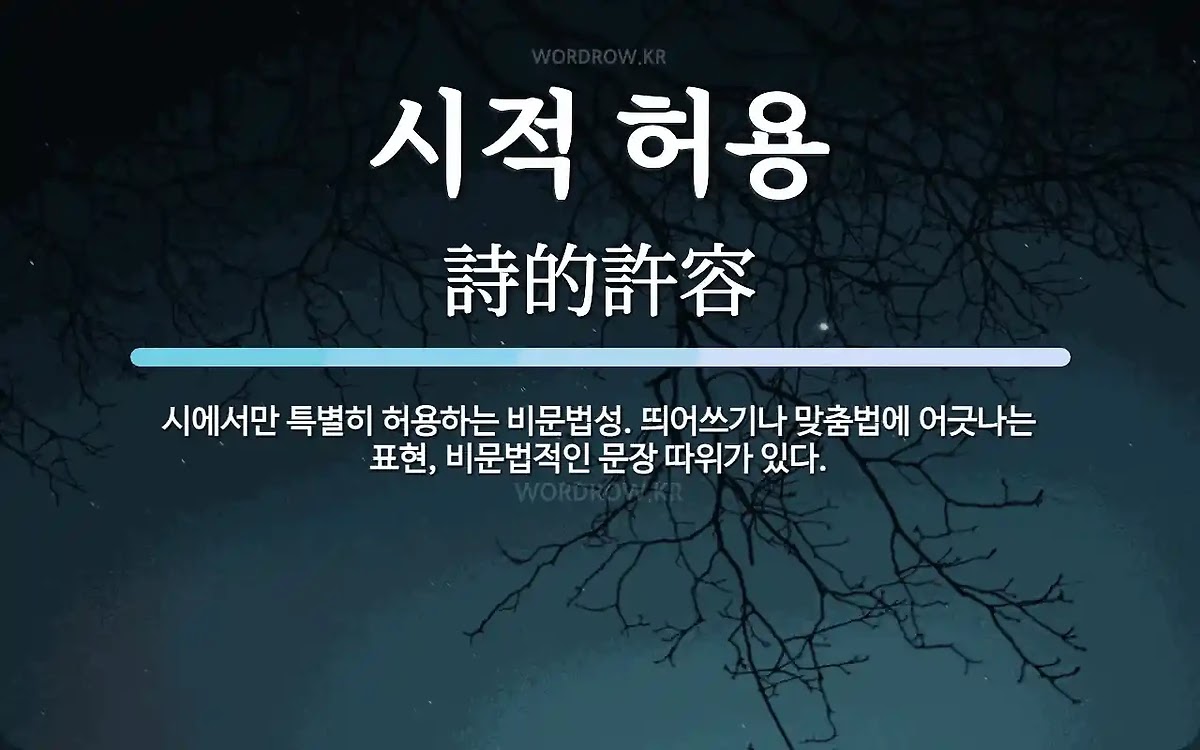
You can express your unique personality by twisting language.
Second Journey: Investigating Myself Like a Detective Through Reasoning
If the process of introspection feels overwhelming, why not think of yourself as a detective investigating the case of “Me”? For this investigation of self-exploration, we use three core reasoning tools: deduction, induction, and abduction.
| Type of Reasoning | ‘Beans in a Bag’ Example | ‘Who Am I?’ Example |
|---|---|---|
| Deduction (Top-down) |
Rule: All beans in this bag are white. Case: This bean came from this bag. Conclusion: This bean is white. |
Belief: “I am an introverted person, and introverts lose energy after social activities." Situation: “I have to go to a party tonight." Conclusion: “I will definitely be exhausted after the party.” |
| Induction (Bottom-up) |
Observation: I took out 100 beans from this bag, and they were all white. Conclusion: All the beans in this bag are probably white. |
Observation: “For the last three project deadlines, I became completely exhausted and irritable." Conclusion: “I tend to burn out easily when under strong deadline pressure.” |
| Abduction (Inference to the best explanation) |
Observation: There are white beans on the table. Rule: All beans in that bag are white. Conclusion: These beans probably came from that bag. |
Observation: “I feel inexplicably anxious today for no particular reason." Hypothesis: “Ah, perhaps my subconscious is worried about the important presentation next week. If so, this anxiety is explained.” |
The process of “finding myself” doesn’t end with a single revelation. It is a dynamic cycle of observation (induction), hypothesis formation (abduction), and prediction (deduction) that repeats endlessly. This is the essence of self-exploration, a mental skill we must hone throughout our lives.
Third Journey: Creating My Identity Through Story
The most fundamental difference distinguishing humans from other animals is our ability to create narratives, that is, stories about ourselves. Our identity is essentially the story we tell ourselves.
Bees communicate the location of honey through dances, and dolphins communicate through ultrasound, but their communication is largely bound to the ‘here and now.’
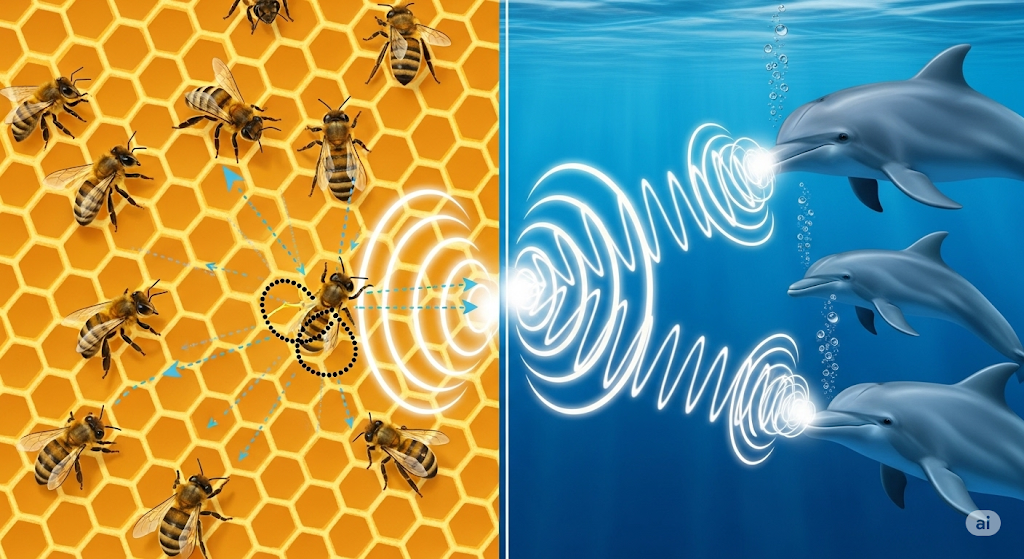
Bee communication is limited to the ‘here and now.’
On the other hand, the most significant characteristic of human language is ‘displacement,’ the ability to talk about the past and future, and about imagination, which are not present before our eyes.
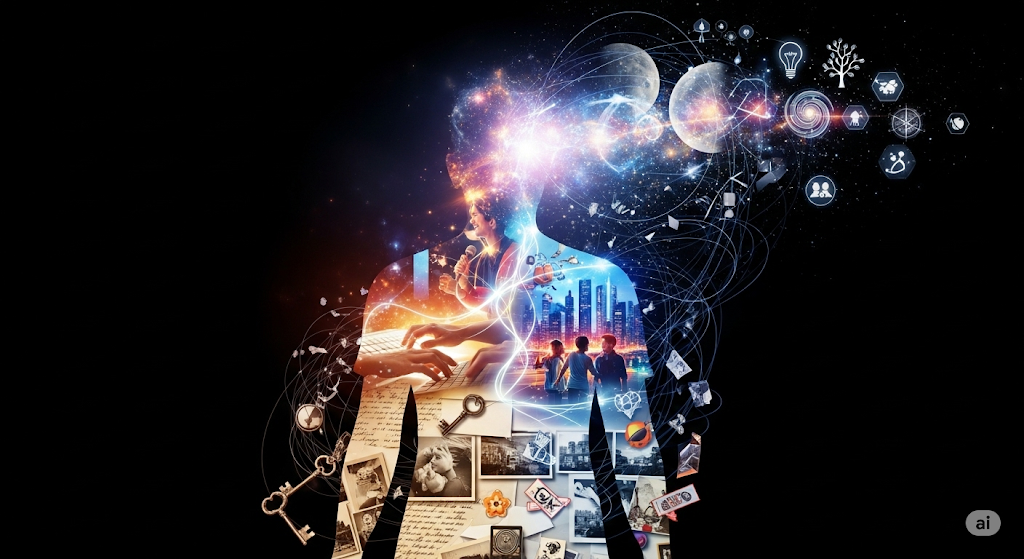
Human language transcends time and space.
The answer to “Who am I?” is not a list of adjectives. It is the ‘story’ I tell myself. That narrative, which connects past experiences, present actions, and future hopes, is my identity.
Fourth Journey: Wiping Away the Glasses of Cognitive Bias
True self-understanding begins with honestly acknowledging our own imperfections. Our minds are equipped with shortcuts for making quick and efficient judgments about the world—‘cognitive biases.’ These biases act like ‘smudged glasses’ that distort our self-perception.
- Anchoring Bias: The first piece of information encountered serves as an anchor, influencing subsequent judgments. Does the statement “You are timid,” heard in childhood, still define you?
- Confirmation Bias: The tendency to seek only information that supports one’s beliefs and ignore contradictory information. I myself have experienced reinforcing the belief that “I am not a good writer” by ignoring well-written pieces and dwelling on memories of my shortcomings.
- Availability Heuristic: The tendency to place greater weight on the most easily recalled information (vivid, emotional, or recent). If a single recent mistake feels larger than the achievements of the past few months, you are likely influenced by this bias.

The anchoring effect, where initial information becomes the reference point for judgment.
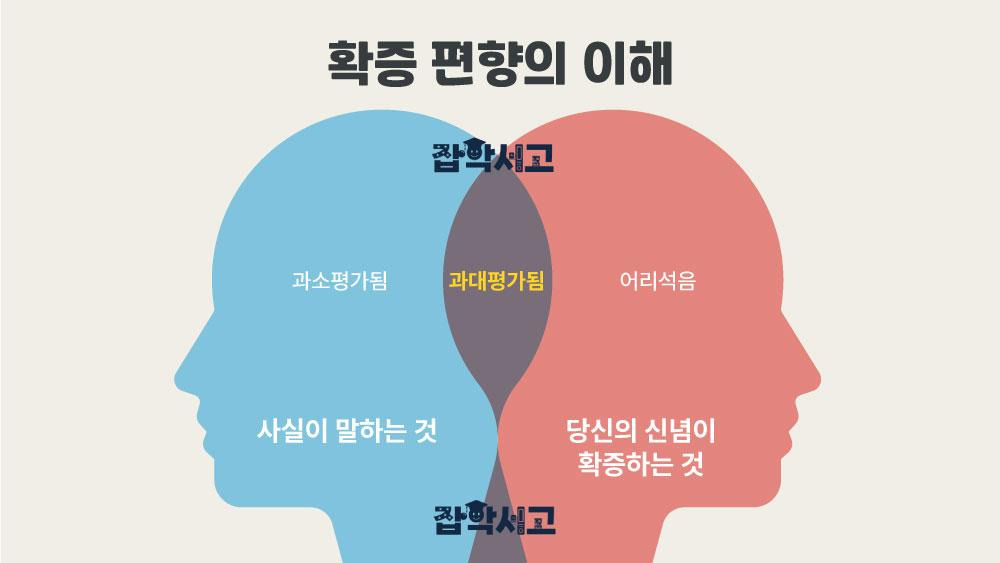
Selectively accepting only the information we want to believe.
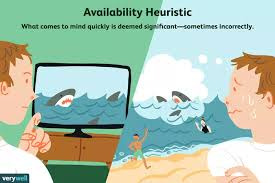
Recent intense memories influencing judgment.
True self-exploration requires critically reflecting on our own thoughts—that is, ’thinking about thinking’ (metacognition) is essential. By asking yourself, “Why do I believe this?”, and wiping away the distorted lenses, you can finally begin to see yourself with clearer eyes.
It requires training metacognition, the ability to observe one’s thoughts from a distance.
Practical Guide for Self-Discovery
This journey is not about finding an answer, but about ‘creating’ an answer. Here are some practical habits to sustain this adventure:
- Read Widely: Encounter new words and concepts to enrich your language and broaden your horizons of thought.
- Constantly Ask “Why?”: Practice logical reasoning by digging into the true causes behind your emotions and actions.
- Write: Give concrete form to the scattered thoughts and stories in your mind. Writing is the best way to clarify your thinking.
- Converse: Share your thoughts with others to gain new perspectives and test your logic.
Conclusion
There is no single answer to the question, “Who am I?” Through this journey, we can realize that my identity is not a fixed noun, but a verb that is constantly ‘becoming.’
-
Key Takeaways:
- I am the language I use: Language is the window through which I see the world and the tool I use to express myself.
- I am a thinking detective: I can logically explore myself through the cycle of induction, deduction, and abduction.
- I am a storytelling animal: My unique narrative, connecting past, present, and future, is my identity.
Readers, why not start with something small today? Try giving a new name to your emotions, or ask yourself “Why did I do that?” about something you did today. That small question will be the first step on your grand journey of self-discovery.
References
- Wikipedia Language
- velog What is Language?
- Namu Wiki Linguistics
- Wikipedia Sapir-Whorf Hypothesis
- Yes24 Sapir-Whorf Hypothesis - Sarak Post
- The University of Seoul Newspaper The Power of Language to Contain Thought: ‘Linguistic Anthropology’
- Namu Wiki Linguistic Relativity
- YouTube [Cultural Psychology] Sapir-Whorf Hypothesis](https://www.youtube.com/watch?v=rzWBrM4UE9g)
- SeoulTech Times New Words, Language Destruction, and Culture
- Urimal Saem “Is it hard to bear new words during conversation?” Different thoughts on new words
- Yonhap News TV Do you know ‘Seljepyeo’, ‘Masang’, ‘Kkikkipappa’? Two perspectives on new words
- Wikipedia Poetic License
- Urimal Saem Poetic License, To what extent is it possible?
- Namu Wiki Poetic License
- Brunch About Poetic License
- Wikipedia Puns
- National Institute of Korean Language Wordplay in Stories and Songs
- Reddit Explain Like I’m 5: Inductive vs. Deductive Reasoning
- Enago Inductive and Deductive Reasoning
- Tistory Logic of Persuasion 5. Sherlock Holmes’s Deduction Method _ Abduction and Hypothetico-Deductive Method
- Korea Science Abduction as Mathematical Reasoning
- YouTube Reading Comprehension is Connection. Understanding Abduction, Deduction & Induction
- Brunch Easy Habits to Develop Logical Thinking Skills
- YouTube Habits You Must Cultivate to Speak Coherently and Logically
- Yeongnam Ilbo Our Language and Korean Literature: Bee Language and Human Exceptionalism
- Happy Campus Communication of Bees and Characteristics of Human Language
- YTN Science Science ZOO: Dolphins, Friends of Intelligent People
- Namu Wiki Dolphin
- SKKU Times Can Humans Communicate with Animals?
- Tistory 1. Tasks of Linguistics / 2. Animal Language
- YouTube Differences Between Other Animal Species and Humans, and the Reasons for the Development of Sociality
- S-Space Literature as Linguistic Activity
- FasterCapital Understanding Cognitive Biases: A Comprehensive Guide
- Wikipedia Cognitive Bias
- Yonhap Infomax Financial Terminology: Anchoring Effect
- Brunch The Best Rule for Winning Negotiations
- NewsPeppermint A Comprehensive Overview of Our Cognitive Biases
- Psychology Brain How to Use Cognitive Biases in Marketing
- FasterCapital The Impact of Availability Heuristic on Decision Making
- Brunch Opportunity to Create Attractive Products: Comprehensive Cognitive Biases 1
- Korea Daily To Develop Critical Thinking Skills, Read Newspapers
- Eduplus Jaehak Jeon’s Column: “It’s not being difficult”… Let’s strengthen critical thinking education
- Edujin How to Cultivate ‘Inferential Habits’ in Daily Life!
- Brunch Episode 9: 5 Methods for Logical Problem Solving
- YouTube Tips for Developing Logical Thinking Skills!
- Psychiatric News 5 Ways to Improve Thinking Skills