
If your local primary care doctor asks, “Would you like to register as a primary care patient?”, what should you consider first?
The Primary Care Innovation Pilot Program, which began on September 29, allows anyone aged 50 or older to register by visiting a participating clinic, with no additional out-of-pocket costs. However, since there are only 120 participating clinics nationwide, you must first check if one is available in your area.
Who Can Apply for the Primary Care Innovation Pilot, and at What Cost?
Eligibility is open to individuals aged 50 or older who are health insurance subscribers, their dependents, and medical aid beneficiaries.
The official name is the ‘Community Primary Care Innovation Pilot Program,’ and the Ministry of Health and Welfare announced its launch in a press release on September 28.
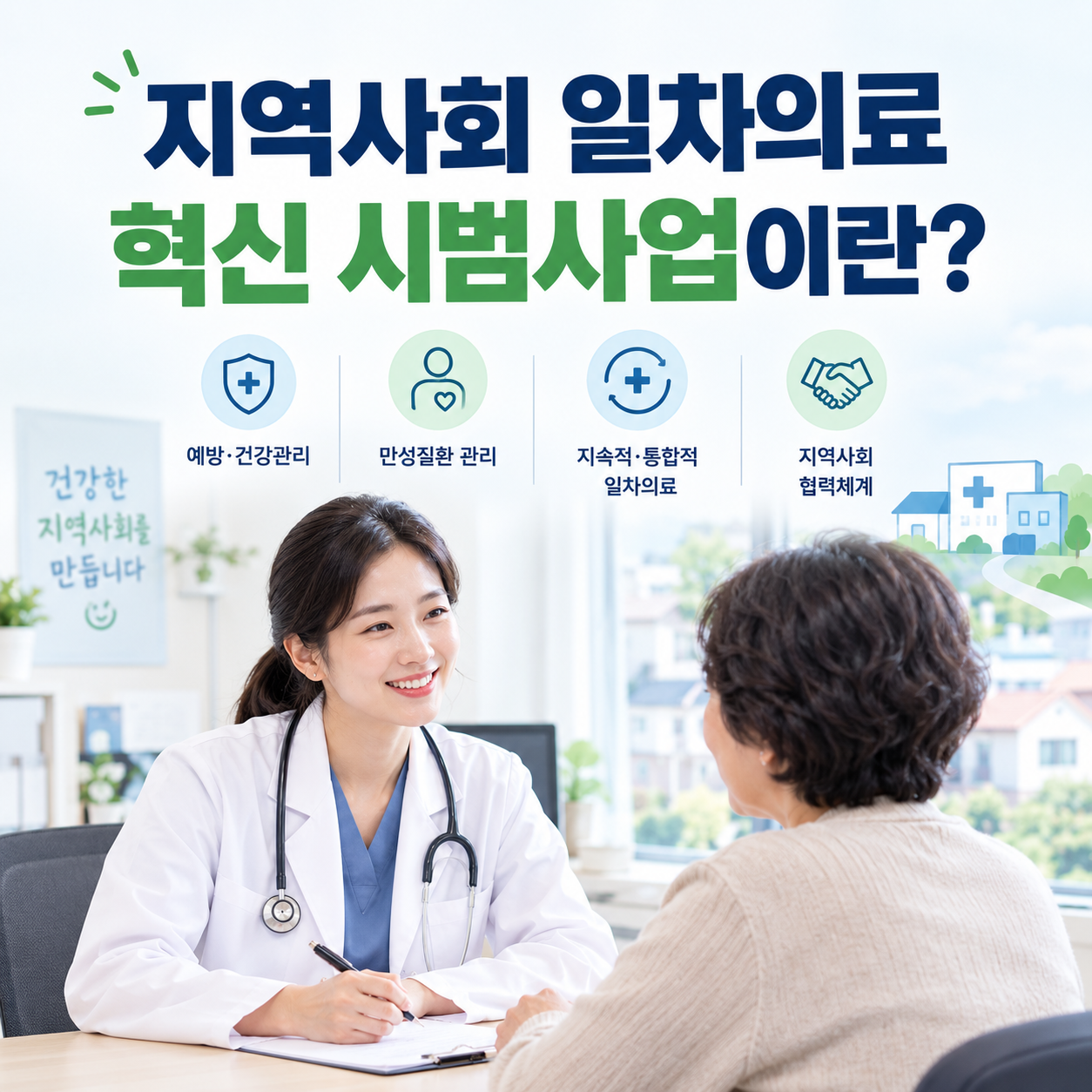
The requirements for the Primary Care Innovation Pilot Program are summarized below.
| Item | Details |
|---|---|
| Eligibility | Health insurance subscribers/dependents aged 50+, medical aid beneficiaries |
| Cost | No additional cost (same co-pay as standard medical visits) |
| Period | September 2026 ~ September 2029 |
| Inquiries | Health Insurance Review & Assessment Service (HIRA) Customer Center 1644-2000 |
Financial matters are simpler than you might think. Registering does not change your co-pay for visits, and there are no extra fees for participating in the program. As reported by the Hospital Newspaper, the program will run for approximately three years until September 2029.
Why start at age 50?
The Ministry of Health and Welfare stated during the Health Insurance Policy Deliberation Committee meeting last December that they plan to start with the age group having the highest demand for integrated care and expand later based on research into healthcare costs and pilot data related to patient health risks. Given that this age often coincides with the onset of taking medication for conditions like hypertension or diabetes, it makes sense as a starting point.
Registration Begins with a Single Visit to a Participating Clinic
There is no mention of an online registration portal in the guidelines. The process outlined by the Ministry involves five steps: visiting the clinic, applying for participation, a comprehensive assessment, service provision, and continuous management.
The comprehensive assessment is the core of this program.
The clinic evaluates the patient’s health status to create a customized management plan, which then guides future care. Since the service includes consultations on health checkup results, bringing your recent checkup report will make the first consultation much more productive.
It is better to call ahead and ask if they are accepting new registrations before visiting.
Participating clinics began accepting patients on the 29th, but the way multidisciplinary teams operate varies from clinic to clinic.
How to Find Participating Clinics: Two HIRA Search Paths
You can search for participating clinics through the Health Insurance Review & Assessment Service (HIRA). The process differs for PC and mobile users.
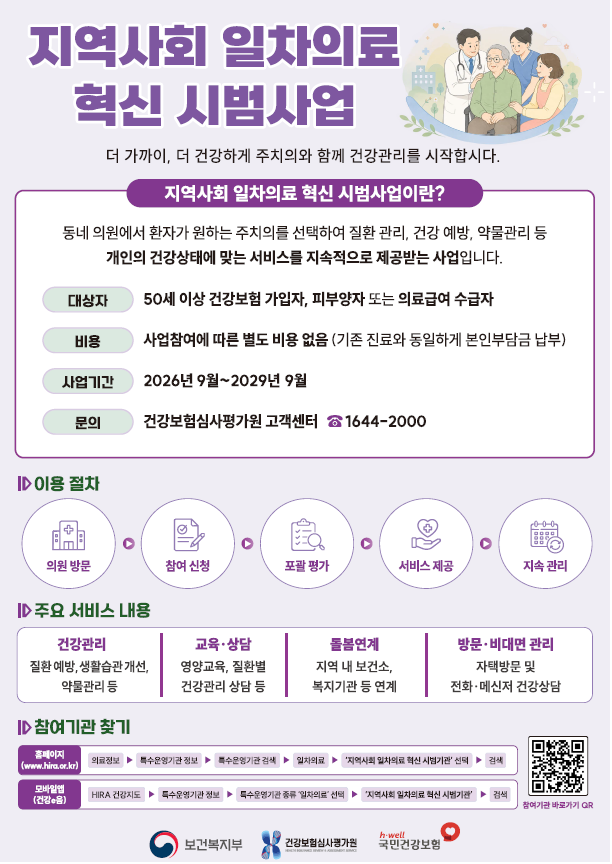
On a PC, go to the HIRA website, navigate to Medical Information > Special Operation Institution Information > Search Special Operation Institutions, select ‘Primary Care,’ and choose ‘Community Primary Care Innovation Pilot Institution.’
On a mobile phone, use the ‘Health e-Eum’ app, go to the HIRA Health Map, select ‘Special Operation Institution Information,’ set the type to ‘Primary Care,’ and the sub-category to ‘Community Primary Care Innovation Pilot Institution.’
If the menu names are too long or confusing, it is faster to scan the QR code in the guide or call 1644-2000.
Where Are the 120 Participating Clinics Located?
I counted the list attached to the press release line by line.
Out of 674 applicants, 120 were selected. They are divided into 20 ‘independent model’ clinics that have formed their own internal teams, and 100 ‘cooperative model’ clinics that partner with hub institutions.
Half of the 20 independent model clinics (10) are located in Gyeonggi-do (Goyang, Namyangju, Bucheon, Suwon, Ansan, Anseong, Anyang, Uijeongbu, Pyeongtaek). The rest are in Seoul (4: Gangbuk, Mapo, Seocho, Eunpyeong), Incheon (3: Michuhol, Bupyeong), and one each in Daegu Suseong-gu, Daejeon Daedeok-gu, and Gyeongnam Hadong-gun.
The 100 cooperative model clinics are clustered in 8 regions. The distribution of cooperative model clinics by region is as follows:
| Region | Hub Support Institution | Number of Clinics |
|---|---|---|
| Seoul Seongbuk-gu | Care Clinic | 11 |
| Jeonnam Gwangju Buk-gu | Buk-gu Public Health Center | 20 |
| Jeonnam Gwangju Gwangsan-gu | Our Neighborhood Clinic | 7 |
| Busan Seo-gu | Samyook Busan Hospital | 12 |
| Incheon Gyeyang-gu | Incheon Sejong Hospital | 12 |
| Gyeonggi Goyang-si | National Health Insurance Ilsan Hospital | 12 |
| Jeonbuk Jeonju-si | Jesus Hospital | 11 |
| Jeju Island | Jeju Medical Center | 15 |
There are notable gaps. There are no participating clinics in Gangwon, Chungbuk, Chungnam, Gyeongbuk, Ulsan, or Sejong.
Because the cooperative model is organized by region, it is difficult to find a nearby clinic if you do not live in the specific district within a metropolitan area. The Ministry only stated that they could increase the number of participating institutions based on operational status.
Four Primary Care Services You Receive Upon Registration
The guidelines divide services into health management, education/counseling, care coordination, and home/non-face-to-face management.
Health management includes disease prevention, lifestyle improvement, and medication management.
Education/counseling includes nutrition education and disease-specific health management counseling.
Care coordination involves connecting patients to local public health centers or social welfare institutions.
Home/non-face-to-face management refers to home visits and phone/messenger consultations.
This is made possible by a multidisciplinary team. In addition to doctors and nurses, nutritionists, physical therapists, occupational therapists, and social workers see the patient together. Independent model clinics have this team in-house, while cooperative model clinics share teams with hub institutions like public health centers or hospitals.
Personally, what stood out most was the nutrition counseling. It creates a space for a nutritionist to step into a scene that previously ended with a local doctor simply saying, “Watch what you eat” after checking blood sugar levels.
If I Register, Can I Not Visit Other Hospitals?
This is the most common question.
Nowhere in the press release does it state that registered patients are prohibited from using other clinics. In fact, it says that the primary care doctor will consult on and coordinate medical use with specialized clinics or hospitals if necessary.
Restrictions are not on the patient, but on the clinic’s side.
In the detailed plan released during the public offering in July, there was a structure to incorporate the proportion of registered patients visiting other clinics—the so-called ’leakage rate’—into the bundled payment formula and performance evaluation. It is designed so that the primary care physician’s compensation decreases as their registered patients visit other places more frequently.
This was the point the medical community protested against the most.
The Korean Medical Association argued that patients have the right to choose medical institutions appropriate for their disease and severity, and that labeling this as ’leakage’ contradicts the principles of the medical delivery system. There were also concerns that if cases where a primary care doctor refers a patient for specialized care are included in the leakage rate, necessary referrals might be discouraged. It is unclear how this indicator was adjusted in the final version, as it was not mentioned in this press release.
From a patient’s perspective, the task is clear.
If you already visit an ophthalmologist, orthopedist, or dentist, it is helpful to disclose this when registering so that a proper management plan can be created. The primary care doctor needs to know your entire medical utilization to prevent duplicate medications.
Bundled Payment: Why Is It Provided Annually Instead of Per Visit?
Currently, local clinics are paid under a fee-for-service system. Each visit, test, and procedure has a price tag. In this structure, seeing many patients in the same amount of time is more profitable than spending 20 minutes counseling one patient. This is why it is said that the “3-minute consultation” is a result of the compensation structure rather than a lack of sincerity.
This pilot program partially reverses this formula.
It provides a bundled payment, conceptually an annual management fee, based on the patient’s health status and demographic characteristics. Bundled payments are applied to primary care services like education and counseling, and clinics choose whether to also receive payment for exams and procedures through the bundled system. Performance-based incentives for multidisciplinary team operation and management outcomes are added to this. Since they are paid per person annually, the system is structured so that the clinic retains more if the patient is managed to be healthier.
The counter-argument is also significant.
The Korean Medical Association criticized the fixed-payment structure, stating it contains elements of capitation and is focused on controlling medical costs and suppressing utilization. The concern is that “under-treatment” could occur, where even necessary care is reduced to stay within the fixed budget. The government stated that it would use this program to create a foundation for institutionalizing a Korean-style family doctor model, and the basis for that judgment will be the data of registered patients accumulated at 120 clinics until September 2029.
As a general healthcare consumer who hopes for the establishment of a Korean-style family doctor system, I only hope that this system will be well-established through various improvements.
References
- Ministry of Health and Welfare Press Release, "'Community Primary Care Innovation Pilot Program' Begins, Offering Comprehensive Health Management Beyond Treatment at Local Clinics," 2026.9.28 (Includes Attachment 1: Guidelines, Attachment 2: List of Participating Institutions)
- Medical News, "Controversy Expected Over 'Leakage Rate' Calculation Method for Primary Care Innovation Program Bundled Payments"
- "A Modified Family Doctor System"… Korean Medical Association Calls for Halt to Primary Care Pilot Program
- Health Insurance Review & Assessment Service, https://www.hira.or.kr