
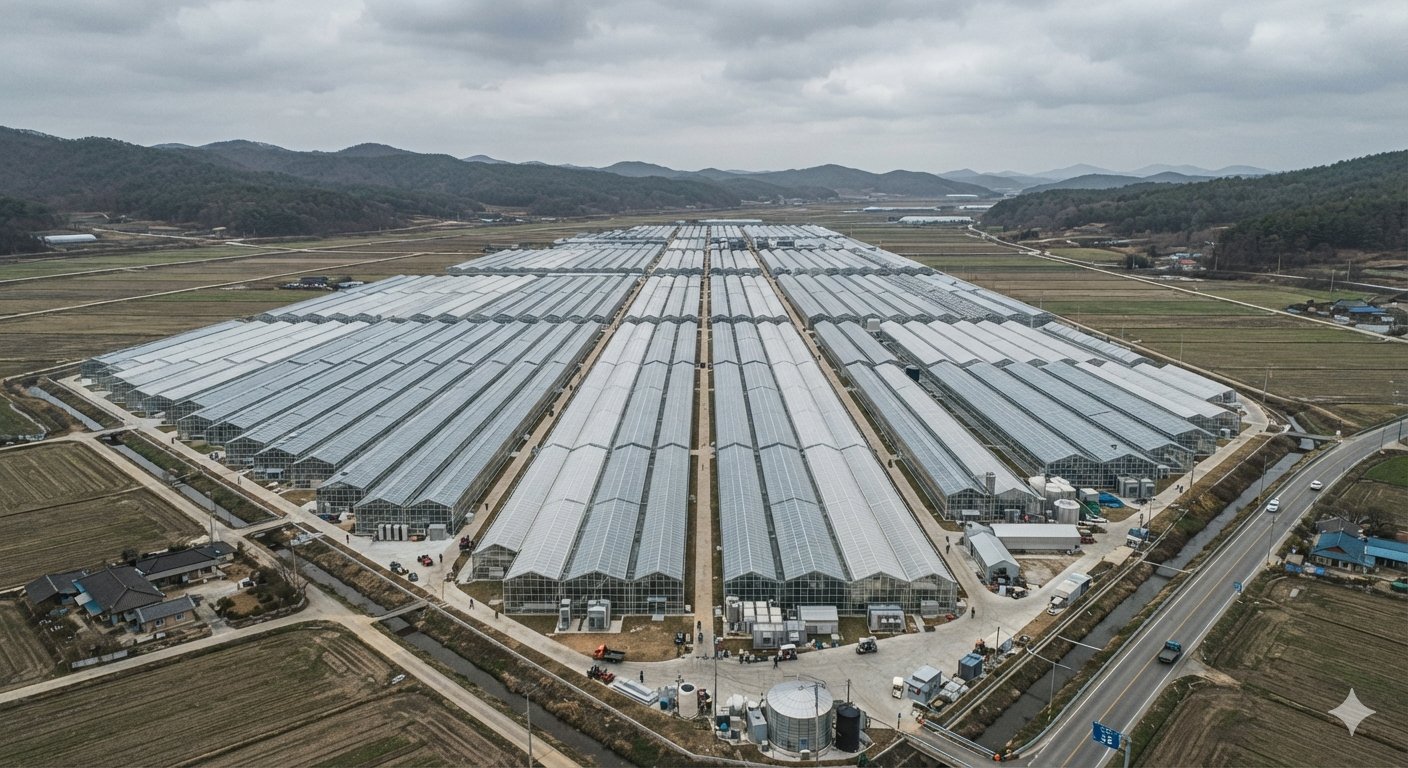
When driving through the Jeonbuk region near Baekgu-myeon, Gimje, you suddenly encounter a complex of glass and plastic roofs that fill the horizon.
At first, I thought it was a massive logistics center, but it turned out to be the famous (?) Gimje Smart Farm Innovation Valley verification complex.
I had heard the term “Smart Farm Innovation Valley” in passing on the news, but I had no idea what it actually did, why it was in Gimje, or whether it was still running effectively.
Upon digging deeper, I found that this wasn’t just a large-scale greenhouse; it was a long-term government policy experiment that had recently been plagued by budget and defect controversies.
Why Gimje for the Smart Farm Innovation Valley?
The Smart Farm Innovation Valley project originated from the government’s “Smart Farm Diffusion Plan” in 2018.
The goal was to create a hub that integrates education, startups, and verification to address the shrinking and aging agricultural population, as smart farm technologies were still fragmented at the individual farm level. Four regions were selected nationwide—Gimje, Sangju, Miryang, and Goheung—with Gimje chosen as a site in August 2018.
Looking at the timeline, construction began in December 2019 and was completed in November 2021, spanning the height of the COVID-19 pandemic. The total project cost is known to be around 100 billion won. Since it is rare to pour this much budget into a single agricultural infrastructure, it was dubbed the “Jeonbuk Smart Farm Landmark” at the time of completion.
The location is 1079 Hwangto-ro, Baekgu-myeon, Gimje-si, Jeollabuk-do. The Gimje plains are naturally flat and receive decent sunshine, making them suitable for large-scale facility horticulture. However, it wasn’t just geography; I suspect the policy symbolism of being near Saemangeum also played a role—though I haven’t found definitive evidence, so I’ll leave this as a speculation.
What Exactly Is in the Gimje Smart Farm Innovation Valley?
The total site is about 21ha, with the core facilities—nursery, rental, and verification greenhouses, along with a support center—covering about 9ha. To put that in perspective, 21ha is roughly the size of 30 soccer fields (0.71ha each). It makes sense that such a large area was needed, as it houses greenhouses, a startup incubator, a verification center, and a big data center all in one complex.
Operations are managed by the Korea Agriculture Technology Promotion Agency (KOAT), with the local verification center handling day-to-day tasks.
Focusing on the verification complex, it consists of verification greenhouses, testing equipment, greenhouse hardware, and monitoring systems, which interested companies or research institutions can apply to use.
They recruit tenant companies in the first and second halves of each year. Looking at the 2025 first-round recruitment notice, applications are submitted via email, and a specific staff member is listed, suggesting the administrative system is still relatively modest in scale.
A Three-Pillar Structure: Education, Startups, and Verification
The name “Innovation Valley” comes from its three-layered functionality.
- Education: Operates a 20-month smart farm theory and practice course for aspiring young farmers. It emphasizes hands-on crop cultivation in real greenhouses rather than just lectures.
- Startup Support: Those who complete the training are provided with a rental smart farm for three years. The key benefit is the ability to start farming in a state-of-the-art facility without initial capital.
- Verification: Provides facilities and equipment for smart farm-related companies to test new technologies and products in real agricultural environments.
In short, the goal is: “Young people learn to farm here, and companies test their technologies here.” Theoretically, it is a well-designed plan.
The intended cycle is for young farmers to gain experience at a low cost, companies to secure real-world data, and the government to use that data to boost the localization and export competitiveness of smart farms.
How Are Sangju, Miryang, and Goheung Different from Gimje?
Even under the same “Innovation Valley” banner, the four locations operate differently, focusing on different crops for their rental smart farms.
For example, data from Sangju shows that one rental section is specialized for strawberries, while others focus on cucumbers, tomatoes, and melons.
Gimje seems to have a stronger focus on a model that links everything from seed development for functional crops to product commercialization.
Comparing all four locations in detail would take us too far afield, so I will summarize it as: “The nation didn’t just copy the same greenhouse everywhere; the verification focus varies slightly by region.”
Nevertheless, Gimje appears in the news more frequently, likely because it is known for having the largest project budget and, consequently, the most significant defect controversies.
5th-Year Verification Results: Achievements by the Numbers
As the complex enters its fifth year, a session to review its performance was held.
The ‘Verification Results Sharing Session’ held by the Gimje and Sangju complexes in late 2025 brought together 80 officials from the Ministry of Agriculture, Food and Rural Affairs, local governments, and tenant companies. It was reported that 40 companies had used the two complexes cumulatively, with four highlighted as top-performing entities.
The core of the presentation was that equipment like smart farm ICT devices, agricultural robots, and complex environmental controllers had been tested and verified in real greenhouse environments.
Honestly, it’s hard to judge based on these numbers alone.
Is 40 companies over 5 years a lot or a little? And did these companies actually move on to commercialization or exports after finishing their verification? This wasn’t clear from the press coverage of the sharing session. However, the goal of creating a system that connects research (Rural Development Administration) to verification and certification is the right direction, so it seems we need more time to observe.
118 Facility Defects: The Cost of Choosing Plastic Over Glass
I must address this point, as focusing only on achievements would be a half-truth.
Reports from around 2024 indicate that 118 facility defects were recorded in the three years following completion.
The problems were particularly severe in the rental units occupied by young farmers. It’s reported that water leaked from the ceilings every rainy season, and shading curtains were repeatedly damaged. There was even a period when automated temperature and humidity control systems failed, forcing people to operate them manually.
Tracing the cause reveals a frustrating reality.
The original design called for glass ceilings, but the material was changed to plastic during construction due to budget shortfalls. Furthermore, the arched roof structure caused rainwater to pool at the joints and pour down like a waterfall through the narrow gaps. As a result, the young farmers lost crops and suffered economic losses, and the dispute over liability for compensation remained unresolved for a long time.
A 100 billion won landmark and a roof covered in plastic instead of glass due to budget cuts—it feels strange that these two sentences describe the same complex. Perhaps the budget allocation for detailed construction stages wasn’t as precise as the total project budget, but I will leave this as speculation since I cannot know the internal situation.
Youth Settlement: What Happens After the 3-Year Support Ends?
I also re-examined the fact that the rental smart farm support period is limited to 3 years.
Three years is just when one begins to get the hang of things after initial trial and error, and support ends right at that moment.
It is worrying whether young farmers who have gone through the period of greenhouse defects will have the capacity to secure their own facilities and become independent after three years. This is a point frequently raised in general smart farm policies—while entry barriers are lowered, how solid the bridge to self-reliance is remains a question mark.
How Should We View This Complex?
After reviewing everything, the Gimje Smart Farm Innovation Valley verification complex sits in an ambiguous position between a success and a failure.
There is a clear track record of training about 220 young people annually and verifying the technologies of 40 companies, but the fact that 118 defects occurred in the same facility, causing real losses to young farmers, cannot be erased.
It feels like the gap between the ‘high-tech’ image of the term “smart farm” and the reality of farming under a leaking ceiling is compressed into this single complex.
Ultimately, this case shows that no matter how much money is spent on hardware, if construction details or post-management systems are lacking, the entire purpose can be undermined.
By the next verification sharing session, I wonder if defect repairs and prevention measures will be on the list of achievements, or if only performance figures will be highlighted—we will have to wait and see.
Personally, I have a recurring thought whenever I pass by this complex.
Under those vast glass and plastic roofs, someone must have been filled with the expectation of finally owning their own greenhouse after a 20-month training course, while someone else was probably looking up at a leaking ceiling during the rainy season and giving up on that year’s farming.
The fact that both existed in the same space and time shows how bumpy a policy can become when it touches reality, making it difficult to end this story on a purely positive note.
References
- https://gj.koat.or.kr/
- https://innovalley.smartfarmkorea.net/gimje/
- https://www.kamnews.co.kr/news/articleView.html?idxno=7525
- https://www.jbci.or.kr/sub/business_1_view.html?id=4897
- https://www.newsfm.kr/mobile/article.html?no=6431
- https://www.jbsori.com/news/articleView.html?idxno=14297
- https://www.foodicon.co.kr/news/articleView.html?idxno=31677
- https://www.busan.com/view/busan/view.php?code=2025120215100076482
- http://www.ikpnews.net/news/articleView.html?idxno=64833
- https://www.nabis.go.kr/termsDetailView.do?menucd=189&gbnCode=S51&eventNo=340
- https://www.mafra.go.kr/home/5281/subview.do
- https://www.gimje.go.kr/agro/
- https://www.bizinfo.go.kr/biz/bizb/selectBIZB200Detail.do?mvnEntrprsRcritPblancId=83388