
What do 19th-century cobra hunters, 21st-century bankers, and kindergarteners with markers have in common? They are all influenced by the invisible force that drives the world: ‘incentives’.
- Successful examples of incentives and the failure represented by the ‘Cobra Effect’
- Psychological reasons why incentives can backfire (overjustification, cognitive dissonance)
- Wise motivation strategies that go beyond simple rewards: ‘Nudge’
The Clear Power of Incentives: Carrots and Sticks
The Basic Principle that Moves the World
We live surrounded by incentives, which are rewards or punishments that motivate certain behaviors. Most people weigh the benefits and costs of their actions before responding.
From receiving praise in childhood for good grades to making one more sales call as an adult for commission, incentives are like visible pillars supporting our economy and social structure.
Successful Incentive Design Examples (Ford & Netflix)
Well-designed incentives can be a powerful force for positive change. A classic example is Henry Ford, who doubled workers’ wages and consequently exploded productivity. This is a representative case of the ’efficiency wage theory’, where high wages led to increased loyalty and reduced turnover, resulting in greater profits.
Today, Netflix attracts and retains top talent with industry-leading salaries, based on the belief that one exceptional employee is worth more than several average ones. Successful incentives are not just monetary transactions; they are powerful communication tools that convey the organization’s values. How you give is much more important than what you give.

The Trap of Twisted Incentives: The Cobra Effect
What is the Cobra Effect?
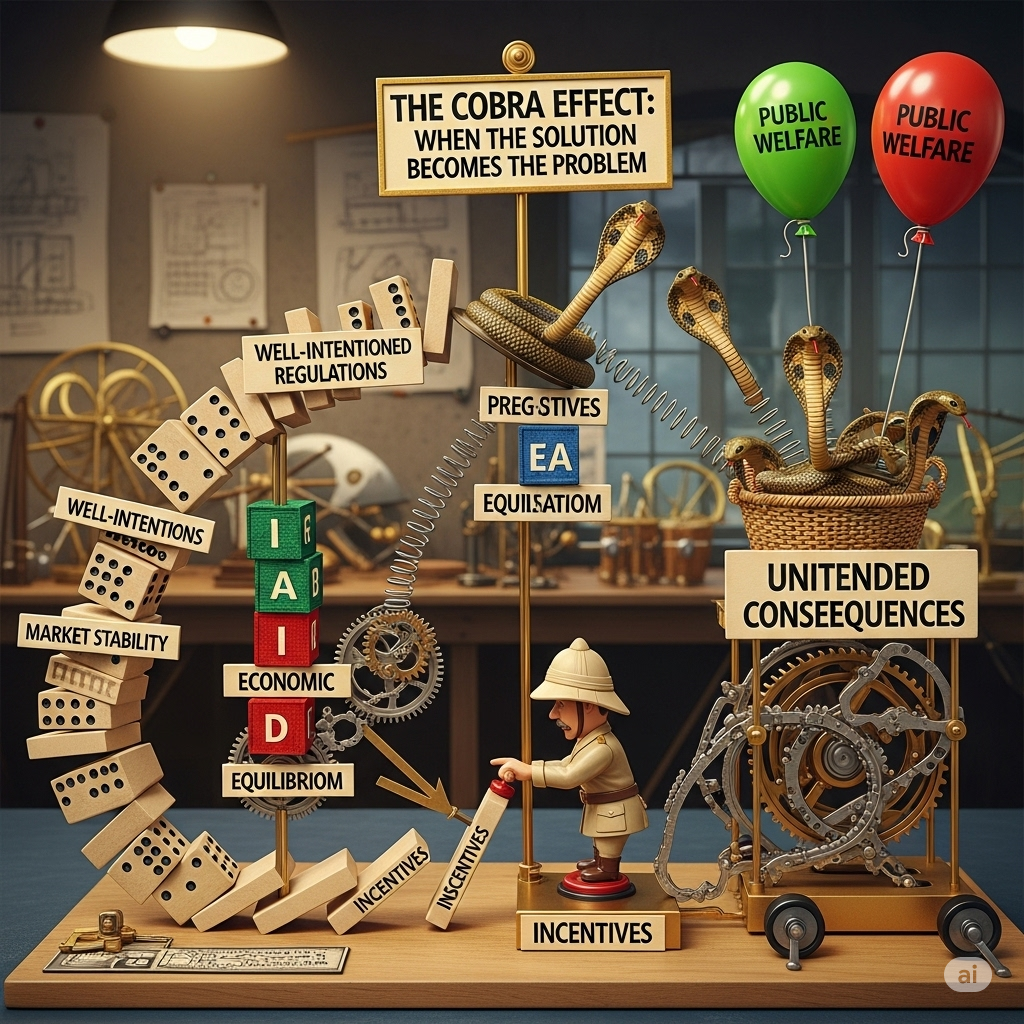
Now it’s time to explore the dark side of incentives. In colonial India, the British government offered a bounty for dead cobras to eliminate them. Initially, it seemed effective, but soon people began to breed cobras at home instead of catching wild ones to earn money.
When the government eventually abolished the bounty system, the now useless cobras were released back into the city. As a result, the cobra population skyrocketed, leading to a disaster far worse than before the policy was implemented. This phenomenon, where a well-intentioned policy dramatically worsens the problem, is known as the ‘Cobra Effect’ or ‘Perverse Incentive’.
Outrageous Failure Cases Worldwide
The Cobra Effect has repeatedly appeared throughout history.
| Policy/Incentive | Intended Behavior | Actual ‘Insane’ Behavior |
|---|---|---|
| Rat Tail Bounty (Vietnam) | Eliminate city rats | Cut off tails and release rats to breed. |
| Fossil Fragment Reward (China) | Encourage fossil excavation | Shatter complete fossils into pieces for submission. |
| Vehicle Driving Ban (Mexico City) | Reduce air pollution | Purchase older, more polluting used cars. |
| Carbon Credit Reward (UN) | Reduce greenhouse gases | Produce more pollutants to receive rewards. |
In-Depth Analysis: Wells Fargo’s Ghost Account Scandal
A prime example of twisted incentives manifesting in a corporate environment is the Wells Fargo scandal. The bank implemented an aggressive incentive policy requiring employees to sell a minimum of eight financial products per customer.
Faced with unrealistic quotas, employees cheated the system to survive. They opened millions of ghost deposit accounts and credit cards without customer consent. This was not merely a few rogue employees; it was a systemic failure akin to the ‘boiling frog syndrome’, where the management ignored the toxic incentive system, leading to a complete paralysis of organizational reality. An obsession with short-term performance metrics trampled core values of honesty and customer priority.
The Psychology of Backfire: Why Good Intentions Fail
Overjustification Effect: Killing Joy with Money
Incentives can spoil not only bad behavior but also ‘good’ behavior. This is known as the ‘Overjustification Effect’. It refers to the phenomenon where providing external rewards (e.g., money) for activities already enjoyed reduces intrinsic motivation for those activities.
In the famous ‘Marker Experiment’, when kindergarteners who loved drawing were promised a certificate for drawing (an expected reward), they stopped drawing once the reward was removed. Their intrinsic motivation of “I draw because it’s fun” was replaced by the extrinsic motivation of “I draw to get a certificate”.

Intel Factory Experiment: Pizza, Praise, and Cash Bonuses
Behavioral economist Dan Ariely’s Intel factory experiment clearly demonstrated this effect. Employees were offered one of three incentives: cash bonuses, free pizza, or praise from their boss to improve productivity.
- First Day Performance: Pizza (6.7%) > Praise (6.6%) > Cash (4.9%)
- One Week Later: The productivity of the cash bonus group plummeted by 13.2% from baseline. Only the praise group maintained consistently high productivity.
Cash creates a ’transactional relationship’, sending the message, “Your effort is worth exactly $30,” while praise forms a ‘relational contract’, signaling, “We value your effort.”
The Art of Rationalization: Justifying Everything in the Brain
Cognitive Dissonance: The Uncomfortable Itch in the Brain
Why do people engage in irrational behavior under twisted incentives while justifying themselves? Psychologist Leon Festinger’s ‘Cognitive Dissonance’ theory provides the answer. Our brains crave consistency, and when our beliefs and actions conflict, we feel strong discomfort.
To resolve this discomfort, we use rationalization to change our behavior, distort our beliefs, or create plausible excuses. Wells Fargo employees resolved the dissonance between the belief “I am honest” and the action “I am creating ghost accounts” by rationalizing, “I am just doing what the manager tells me.”

The Shield of Responsibility Created by Authority and Group Psychology
Individual rationalization is amplified in a social context.
- Milgram Experiment (Obedience to Authority): People can commit terrible acts against their conscience when they believe an authority figure will take responsibility.
- Asch Experiment (Conformity to the Group): People conform to obviously wrong answers to avoid discomfort from differing opinions.
Twisted incentives, pressure from authority, and group conformity create a ’toxic cocktail’. The Wells Fargo scandal was possible because these three elements combined to create an environment where unethical behavior was easily rationalized.
Smarter Incentives: The Art of Nudge
Beyond simple carrots and sticks, we need more sophisticated tools. This is ‘Nudge’, a design of choices that encourages better decisions without restricting freedom. It is more about guiding people towards the path they naturally want to follow rather than pushing them.
- Fly in the Urinal: Amsterdam Airport painted a fly in the urinal, drastically reducing cleaning costs.
- The Power of Defaults: Changing retirement plans to ‘automatic enrollment’ or organ donation to ‘opt-out’ dramatically increased enrollment and donation rates.
A New Horizon of Motivation: Google and Patagonia
- Google’s OKRs: Separating ambitious goal setting from direct monetary rewards encourages employees to take bold risks without fear of failure. True incentives are not bonuses but Conversations, Feedback, and Recognition (CFR).
- Patagonia’s Culture: Providing benefits linked to core values, like paid time off for environmental activism. The strongest incentives are not money but the intrinsic reward of being part of a community that shares your values. My realization in social life is that the most powerful force that moves people is not money itself but the meaning and vision behind that money.
Comparison: Wrong Incentives vs. Smart Incentives
| Problem Situation | Wrong Incentives (Stick) | Smarter Incentives (Nudge/Intrinsic Motivation) |
|---|---|---|
| Low Employee Productivity | Individual cash bonuses | Public praise, team-based rewards, project choice |
| Low Retirement Savings | Information campaigns urging savings | Automatic enrollment (opt-out default) |
| Reckless Driving | Speed enforcement (post-punishment) | Cognitive nudges like narrowing road signs |
| High Turnover Rate | Exit interviews (post-data collection) | Culture and benefits that share values (Patagonia example) |
Checklist: 5 Questions for Better Incentive Design
- Are you measuring process, not just outcomes? (Short-term performance vs. long-term value)
- Are you not destroying intrinsic motivation? (Check for overjustification effect)
- Can the system’s loopholes be exploited? (Predict the Cobra Effect)
- Are you approaching it as a relationship, not a transaction? (Cold transaction vs. warm recognition)
- Can you utilize nudges? (Design the environment instead of coercion)
Conclusion: To Become a Designer of Better Choices
Incentives are not just simple levers; they are complex signals deeply rooted in human psychology and social context. Summarizing the key points of this long journey:
- Incentives are a double-edged sword. When used correctly, they can be a powerful force, but when misused, they can lead to disasters like the ‘Cobra Effect’.
- Respect intrinsic motivation. External rewards can destroy pure enjoyment and sense of purpose (the ‘Overjustification Effect’).
- Smart design is key. Instead of coercive rewards, nudges that naturally guide people towards better choices can be more effective.
Now, I pose the final question to you. What hidden incentives and nudges are at work in your workplace, home, and daily life? Are they leading you in a better direction, or are they causing you to engage in “insane behavior”?