
Unraveling the Secrets of Teams That Acquire Top Prospects Yet Lose Through Behavioral Economics.
- Causes and psychological biases of the ‘Winner’s Curse’ in the NFL Draft
- The actual value of draft picks and the ‘value zone’ revealed through data
- The ‘Value-Based Drafting (VBD)’ strategy that leads to victory and specific implementation methods
The NFL Draft, held every spring, may seem like a glamorous show, but behind the scenes lies a vast market dominated by human irrationality. In particular, the ‘Winner’s Curse’ that arises in the competition to acquire high-ranking prospects can be a dangerous trap that shakes the future of a team. Let’s examine through behavioral economics why smart general managers fall into such obvious traps.
The Beginning of Irrational Choices: Expensive ‘Preferences’
Nobel laureate Gary Becker stated that people sometimes incur economic losses to satisfy their ‘preferences’ or ‘biases.’ In the NFL Draft market, this manifests as a blind preference for certain ‘archetype’ players.
Teams become intoxicated by the allure of ‘certainty’ when they see a highly publicized quarterback from a prestigious university or a player who showcases remarkable athleticism at the combine. They then trade up, sacrificing multiple future draft picks. This is more akin to ‘consumption’ for immediate gratification than a cold, calculated investment. Such consumption is reinforced by several cognitive biases.
- Halo Effect: A specific advantage (e.g., speed) creates the illusion that other abilities (e.g., game understanding) will also be exceptional.
- Availability Heuristic: Teams easily recall legendary first-round success stories like Peyton Manning while forgetting numerous failures, leading to an overestimation of success probabilities.
- Confirmation Bias: Once fixated on a specific player, teams tend to seek only their strengths and ignore information that points out weaknesses.
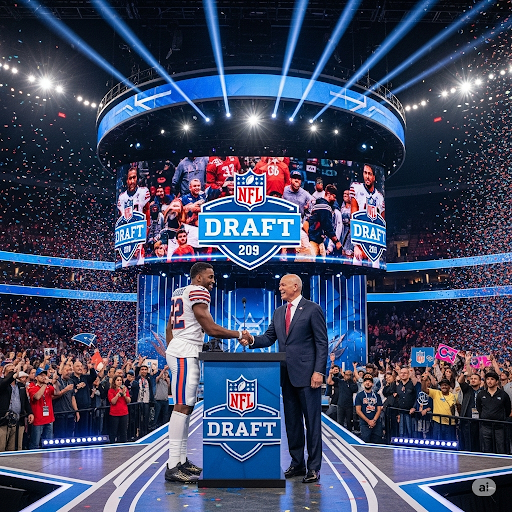
The fierce battle of value and bias occurring behind the glamorous stage
The Winner’s Curse: The Tragedy of the Most Optimistic
The NFL Draft resembles a high-stakes auction conducted under conditions of incomplete information. In such an environment, the ‘Winner’s Curse’ inevitably arises. The crux of this theory is that the final winner of the auction is likely the one who has overestimated the value of the item the most, i.e., the most irrationally optimistic.
The moment a team rejoices in acquiring the top prospect, they have already fallen under the ‘curse’ of having paid more than the value.

The moment you win the auction, the curse may have already begun.
What further solidifies this curse is the overconfidence of general managers and the ‘Jimmy Johnson Trade Value Chart’ that has normalized past irrational practices. This chart uses what teams have historically paid rather than the actual value of players, perpetuating irrationality.
The real fear of the Winner’s Curse lies in opportunity cost. By acquiring one promising quarterback, teams lose out on other starting players they could have selected with the multiple draft picks they sacrificed, potentially leading to a shallow depth chart and a long-term dark period.
Data Reveals the Hidden Value of the Draft
When emotions are set aside and data is examined, the market inefficiencies become clearer. The curve of a player’s actual performance (Approximate Value, AV) declines more gradually than expected as draft rankings decrease. In contrast, rookie salaries drop sharply according to their rankings.
This is where the opportunity for ‘salary arbitrage’ arises, meaning there exists a ‘sweet spot’ where high value can be created at low cost. This sweet spot lies in the ‘value zone’ from the late first round to the 3rd and 4th rounds.
Table 1: Analysis of Draft Pick Value vs. Performance ROI
| Draft Rank Range | Average ROI Index² | Key Features |
|---|---|---|
| 1-5 | 105 | Highest expectations and costs, lowest ROI |
| 6-10 | 132 | Still high costs, slight improvement in ROI |
| 11-20 | 166 | Value begins to improve relative to cost |
| 21-32 | 221 | Start of the ‘value zone’, high ROI |
| 33-64 (2nd Round) | 298 | One of the best ‘sweet spots’, very high ROI |
| 65-100 (3rd Round) | 381 | Highest ROI, best value zone |
The results are shocking. The ROI of the coveted top 5 draft picks (105) does not even reach one-third of that of the 3rd round (381). This is clear evidence that the market systematically overvalues top draft picks while undervaluing mid-round picks.
Strategies that Separate Winners from Losers
How teams leverage these market inefficiencies determines their fate.
Value Creators: The Power of Trading Down
- New England Patriots: Dominating the NFL for the past 20 years, the Patriots have consistently executed trade downs to sell high draft picks. In return, they secured multiple picks in the ‘value zone,’ continuously infusing young talent at low cost. This is akin to a portfolio theory of diversifying investments in several quality stocks instead of going all-in on one ‘blockbuster’ stock. From my long observation, even Patriots fans often expressed dissatisfaction on draft day about trading down, but by the end of the season, the correctness of those choices was often proven.
- Baltimore Ravens: Under the philosophy of “the right player at the right price,” they have consistently maintained a strong roster by accumulating mid-round picks.
Value Destroyers: The Trap of Trading Up
- Chicago Bears (2017): They spent three valuable picks to move up just one spot to acquire quarterback Mitchell Trubisky. This remains a classic case of the Winner’s Curse.
- Washington Commanders (2012): They paid a hefty price, including three future first-round picks, to acquire Robert Griffin III, leading to a long-term dark period for the team.
Table 2: Comparative Analysis of Draft Strategies (5-Year Period)
| Franchise Archetype | Total Drafted Players | ‘Successful’ Players¹ | Cumulative Wins-Losses |
|---|---|---|---|
| Trade Down Teams (e.g., Patriots) | 52 | 18 | 65-15 |
| Trade Up Teams (e.g., Rams²) | 38 | 11 | 43-37 |
The data is clear. The ‘boring’ strategy of scratching more lottery tickets yields more long-term victories than the ‘sexy’ strategy of chasing one star.
Value-Based Drafting (VBD) Execution Guide
So how can teams avoid the Winner’s Curse and create value? The Value-Based Drafting (VBD) model may hold the answer. The goal of VBD is to select not the ‘best player’ but the ‘best value for the salary.’
- Embrace probabilistic thinking. The notion of a ‘sure player’ is an illusion. Acknowledge that every pick is a probability game and focus on maximizing the expected value of the overall draft portfolio rather than individual player success.
- Actively sell high draft picks. Sell your top 10 picks at a premium to teams suffering from the Winner’s Curse. In return, secure multiple lottery tickets in the ‘value zone.’
- Develop an independent data model. Build a cold evaluation system that focuses solely on data predicting actual NFL success, eliminating ’noise’ from media hype or halo effects.
- Focus on key positions. The value of each position varies. Prioritize allocating draft assets to positions that have the greatest impact on victory and are the most expensive in the FA market (quarterbacks, offensive tackles, pass rushers, cornerbacks).
- Adopt a portfolio approach. The more players you draft, the higher the probability of hitting. Diversifying investments effectively offsets the risk when one or two promising players fail.
Conclusion
We have concluded that the NFL Draft is an inefficient market shaped by human cognitive biases. This inefficiency is unlikely to disappear as long as general managers remain overconfident and fans maintain high expectations. Here are three key points to remember:
- The Winner’s Curse is real: Top draft picks are often overvalued beyond their worth.
- True value lies in the middle: 2nd to 3rd round picks show the highest ROI relative to cost.
- Value-Based Drafting is the key to victory: Managing a draft pick portfolio based on data rather than emotions leads to long-term success.
If you were a general manager, would you sacrifice the future for a superstar prospect that garners enthusiastic support from fans, or would you endure criticism to invest in more possibilities? This upcoming draft season, why not pay attention not just to who is picked first, but to which teams quietly build value?