
In 2008, just as the heart of global finance was about to stop, two colossal towers stood. On one side, with 158 years of history, Lehman Brothers danced on the blade’s edge of leverage. On the other, Warren Buffett’s Berkshire Hathaway quietly waited for its moment atop a mountain of cash.
The outcome is as we all know. Lehman, without a single safety net, vanished into the dust of history, while for Buffett, who held the ultimate Margin of Safety, the crisis became a once-in-a-lifetime opportunity.
What separated the fates of these two was not mere financial standing. It was the difference in understanding the powerful psychological principle that draws the line between ruin and opportunity: ‘Margin of Safety’. This article aims to discuss how the margin of safety is not just an accounting term, but the most robust shield and the greatest opportunity-creating tool for all of us living in an age of uncertainty.
Part 1. How Has the Margin of Safety Evolved?
The margin of safety is a core mindset for thriving in an unpredictable world. And this concept has continuously evolved with the changes of the times.
💰 Benjamin Graham’s Legacy: Discounting ‘Value’
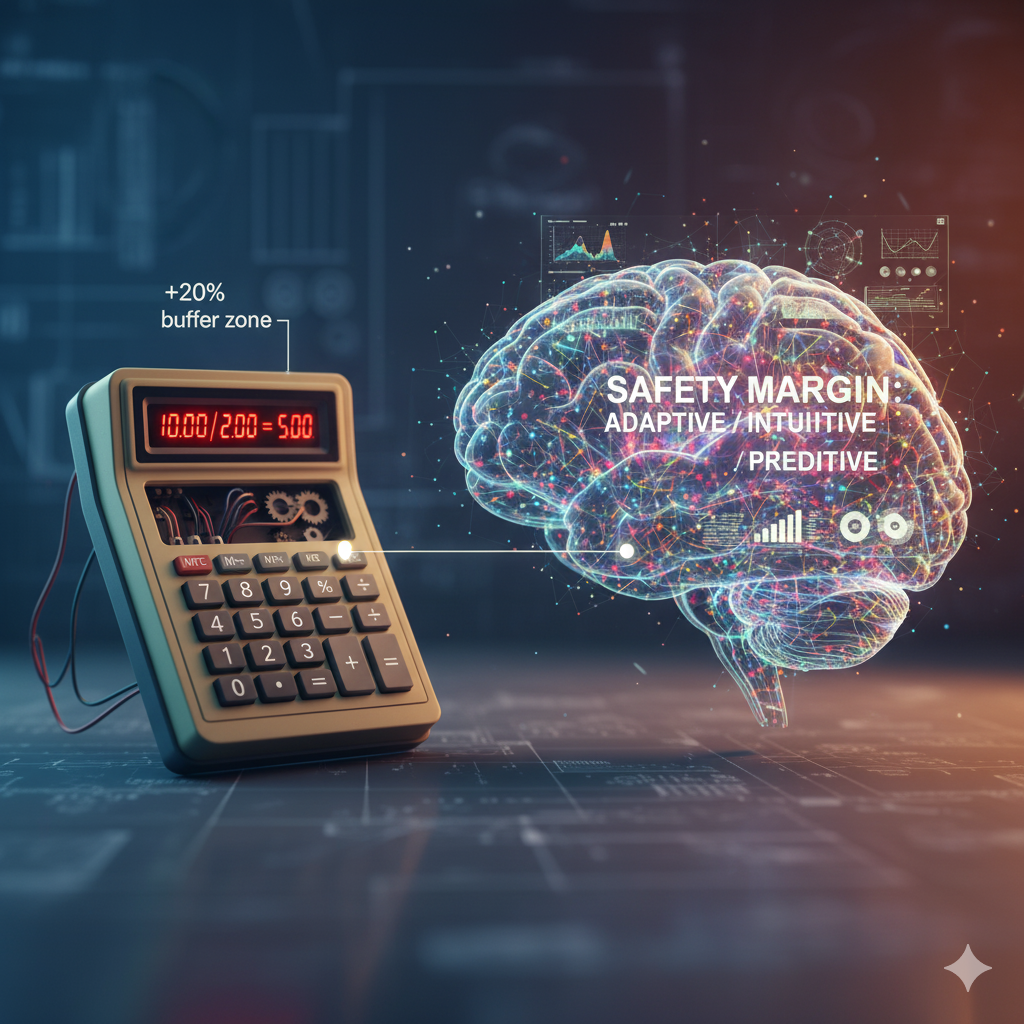
For Benjamin Graham, the ‘father of value investing’, the margin of safety was a clear mathematical equation: the gap between a company’s intrinsic value and its actual market price. He presented a clear defense against the risk of his analysis being wrong or the market behaving irrationally, using the analogy of “buying a dollar bill for fifty cents.” For him, the margin of safety was a strictly rational, ‘quantitative tool’.
🧠 Morgan Housel’s Insight: Leaving ‘Room for Error’
As time passed, Morgan Housel, author of “The Psychology of Money,” expanded this concept to encompass our entire lives. For him, the margin of safety is not just numbers on an Excel sheet, but the very attitude of life that leaves ‘room for error’. Financial success ultimately depends on the ability to ‘survive’, and to harness the magic of compounding, one must avoid being kicked out of the market at all costs. This is a ‘psychological strategy’ based on the humility that past successes might be luck and the realistic recognition that no one can predict the future.
| Category | Benjamin Graham (Analyst) | Morgan Housel (Psychologist) |
|---|---|---|
| Definition | Discount rate relative to intrinsic value | Room for error in life planning |
| Primary Goal | Avoiding losses in individual investments | Long-term survival for compounding effects |
| Core Principle | Rational calculation | Respect for and humility towards uncertainty |
| Scope of Application | Primarily stock selection | All financial and life decisions |
Part 2. Why Do We Destroy Our Own Safety Nets?
Despite knowing how crucial the margin of safety is, why do we struggle to establish safety nets? The answer lies deep within our brains, in ingrained psychological biases.
🌹 Rose-Tinted Glasses: The Trap of Overconfidence and Planning Fallacy
Humans are inherently optimistic. The overconfidence that ‘I can beat the market’ is evident even in the dismal returns of the ‘Mensa Investment Club’. This overconfidence leads to the ‘Planning Fallacy’, which systematically underestimates future time, costs, and risks. We always assume the best-case scenario, thereby leaving no ‘room for error’ from the outset.
⚡ The Asymmetry of Pain: Loss Aversion and the Paralysis Trap
The core of the Nobel Prize-winning theory of ‘Prospect Theory’ is ‘Loss Aversion’. The pain of losing $100 is more than twice as powerful as the joy of gaining $100. Because of this, investors irrationally hold onto losing stocks. They fall into the ‘paralysis trap’ of causing even greater losses by trying to avoid the pain of realizing a loss.
These psychological biases create a chain reaction. Overconfidence leads to risky investments, and with the Planning Fallacy, when the stock market shakes without any emergency savings, the Loss Aversion instinct prevents timely selling, completing a scenario that leads to ruin.
Part 3. History’s Verdict: The Margin of Safety Dictates Fate
History clearly shows the harsh consequences of lacking a margin of safety.
📉 The Catastrophe of Zero Margin: The 2008 Subprime Mortgage Crisis
The 2008 financial crisis is a textbook example of what happens when the entire system has a margin of safety of ‘zero’. The system, built on the fragile assumption that ‘US housing prices will never fall’, triggered a horrific chain collapse the moment that assumption crumbled.

👑 The Sage’s Counterattack: Warren Buffett’s 2008 Masterclass
While everyone was in a panic, Warren Buffett, armed with billions of dollars in cash (margin of safety), went on a shopping spree. He invested $5 billion in Goldman Sachs under unprecedented terms: preferred stock with a 10% annual dividend and warrants. His margin of safety became more than just a defensive measure; it transformed into a formidable offensive weapon amidst the crisis.
💪 Companies Shining Through Crisis: The Pandemic Stress Test
The COVID-19 pandemic was a stress test that proved which companies were truly strong. Companies with financial and strategic ‘cushion’, such as diverse business portfolios (Sony) and substantial cash reserves (Walmart), actually strengthened their market dominance during the crisis.
Part 4. How to Build Your Own Fortress
Now it’s time to apply grand theories to our lives. How can we create our own margin of safety?
🏦 The First Step to Wealth: Define ‘Enough’ and Automate Savings
True wealth comes not from income, but from savings. The first step to a personal margin of safety is to define for yourself “What is enough for me?” and automate savings regardless of income.
🛌 The ‘Sleep Well’ Portfolio: Asset Allocation Optimized for Survival
The primary goal of a margin of safety portfolio is not profit maximization, but ‘survival’. Through the principle of asset allocation, mixing various assets like stocks, bonds, and cash, we must prevent the worst mistake of panic-selling everything when the market fluctuates.
⏳ The Ultimate Margin: Trust in the Power of Time
The most powerful force in investing is ’time’. A long investment horizon is itself the ultimate margin of safety. It provides opportunities to recover from mistakes, mitigates the impact of short-term volatility, and offers a runway for the magic of compounding to work.
Conclusion: Beyond Survival to ‘Antifragile’
‘Antifragile’, as proposed by Nassim Taleb, refers to systems that become stronger from shocks and stressors. They don’t break like a wine glass (fragile), nor do they merely endure like steel (robust). Instead, they grow stronger from shocks, like an immune system.
Here, the margin of safety plays a crucial role. It is the minimum defense that prevents breaking from shocks (robust), and it is the bridge (antifragile) that allows us to leverage that chaos as an opportunity to become stronger. Just like Warren Buffett in 2008.
Predict less, prepare more.
Ultimately, the greatest wisdom lies not in the arrogance of trying to predict the future, but in the humility to be prepared for any future. The margin of safety is the physical and psychological embodiment of that humility. It is the shield that protects us from ruin and the key that unlocks doors to unforeseen opportunities. That is the most important wisdom we must learn from the psychology of money.
References
- The Psychology of Money | Morgan Housel
- Benjamin Graham’s Margin of Safety - Learning Spoonz
- Benjamin Graham, The Father of Value Investing - Korea Investors Education Institute
- Prospect Theory and Loss Aversion - Behavioral Economics
- Subprime Mortgage Crisis - Namu Wiki
- Collection of articles on Warren Buffett’s 2008 investment in Goldman Sachs
- Antifragile | Nassim Nicholas Taleb