
An epic history of love and marriage in ancient Korea, exploring the vast changes over time.
- The diverse ways of romance where personal feelings and strategies were important before Goryeo.
- The strict and ritualistic marriage system restructured by Confucian ideals during the Joseon dynasty.
- The impact and meaning of past marriage views on today’s society.
Imagine a scene in 8th century Silla, where a young warrior meets a woman at a festival, exchanging exciting glances. Now, leap forward to 18th century Joseon, where a noblewoman’s future is decided by a piece of paper with the name of a man she has never seen, while confined in her home. These two scenes succinctly illustrate how dramatically the most intimate institution of Korean marriage customs has transformed throughout history.
This article explores how the transition from the pre-Goryeo era to the Joseon dynasty was not merely a change of dynasties but a redesign of the most fundamental ways of relationships in our society. The state’s adoption of Confucianism transformed a world where women’s subjectivity, strategic courtship, and diverse family forms existed into one dominated by strict patriarchy and standardized rituals. Now, let us walk together through the traces of stories and customs that once made a nation’s heart beat, following the path of this monumental change.
Part 1: The Era of Passion and Strategy (Pre-Goryeo)
This section depicts an era where personal desires, political ambitions, and social customs intertwined to create a vibrant and dynamic path to marriage.
The Politics Behind Fateful Encounters: Kim Chun-chu and Moon-hee
The story begins with the fateful meeting of Kim Chun-chu, who would later become King Taejong Muyeol, and Moon-hee, the sister of Kim Yu-shin. One day, while enjoying a game similar to soccer called ‘Chukguk’, Kim Yu-shin accidentally stepped on Kim Chun-chu’s clothing string during a fierce tussle. This was the prologue to a meticulously planned scheme disguised as an accident. Kim Yu-shin led the flustered Kim Chun-chu to his home, offering to sew the clothing string back together.
Upon arriving home, Kim Yu-shin first asked his elder sister Bo-hee, but she refused, deeming it a trivial matter. At that moment, the stage of fate shifted to his second sister, Moon-hee. As the beautiful Moon-hee carefully sewed the clothing string, a special feeling blossomed between the two young individuals, leading to a secret relationship where Moon-hee became pregnant with Kim Chun-chu’s child.
Kim Chun-chu and Moon-hee’s fateful meeting was hidden behind Kim Yu-shin’s meticulous political calculations.
Upon discovering this, instead of expressing anger, Kim Yu-shin devised a political drama to turn the crisis into an opportunity. He proclaimed, “I will burn my sister who has tarnished the family honor,” and lit a bonfire in the yard. As the black smoke rose into the sky, it caught the attention of Queen Seondeok (then a princess) who was passing by Namsan. Upon hearing the details, the queen instinctively sensed Kim Chun-chu’s involvement and commanded, “It is your doing, so go and save her.” Receiving the royal command, Kim Chun-chu rode to rescue Moon-hee, ultimately officially recognizing their relationship and holding a wedding.
This story is not merely a scandal. It is a dramatic example of how love could serve as a tool for political ambition. For Kim Yu-shin, a descendant of the Gaya royal family striving to integrate into the core power of Silla, the union of his sister and the heir apparent Kim Chun-chu was the best strategy for the future of his family. Thus, behind actions that seemed like ‘free love’ often lay cold political calculations.
A Social Space for Encounters: Tappuri
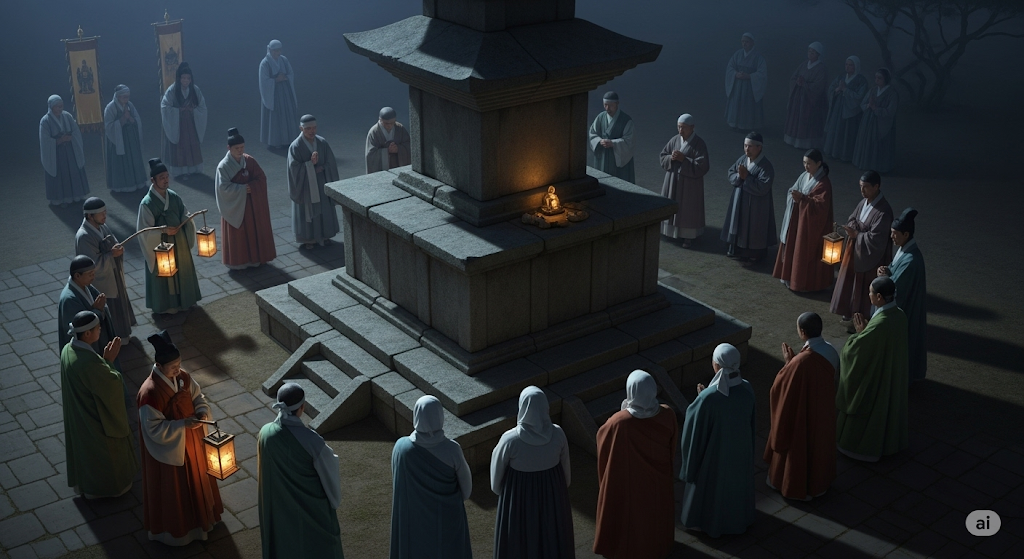
Even though the meeting of Kim Chun-chu and Moon-hee was a product of meticulous scheming, there was a social atmosphere that made such encounters possible. At that time, Silla society was much freer in terms of male-female interactions compared to Joseon. A representative example is the custom of ‘Tappuri’. This ritual at large temples like Heungnyunsa was an important social venue where young men and women could naturally mingle and form connections. The story of Kim Hyun and the Tiger Maiden in the ‘Samguk Yusa’ also begins here. This reflects the era’s characteristic where personal feelings and choices could be socially accepted.
Love Crossing Borders with a Song: Seo-dong and Princess Sunhwa
The story of Seo-dong, a commoner youth from Baekje, and Princess Sunhwa of Silla illustrates how love could transcend social classes and borders. According to the ‘Samguk Yusa’, Seo-dong, who lived by harvesting and selling reeds, heard rumors that Princess Sunhwa, the third daughter of King Jinpyeong of Silla, was a breathtaking beauty and devised a clever plan to marry her.
He infiltrated the capital of Silla, Saro, winning the favor of children by distributing reeds, and spread a song he had composed himself. The content was shocking.
Princess Sunhwa (善花公主主隱)
Secretly marries (他密只嫁良置古)
Seo-dong (薯童房乙)
Steals away at night (夜矣卯乙抱遣去如)
This short nursery rhyme spread uncontrollably through the children’s mouths, reaching the palace. As the rumors spiraled out of control, the king ultimately decided to exile his beloved daughter to a distant place.
On the way to exile, Seo-dong appeared before Princess Sunhwa, revealing that he was the protagonist of the song, and welcomed her as his wife. Based on the gold she brought, Seo-dong gained the people’s support and is said to have later become King Mu of Baekje. This tale demonstrates the belief in the power of song, or media, to shape public opinion and change reality.
Of course, the sarira inscription discovered in 2009 at the Iksan Mireuksaji pagoda records that King Mu’s queen was the daughter of Satak Jeokdeok, leaving the existence of Princess Sunhwa open to debate.
The House for the Son-in-Law: The Beginning of Living with the In-laws
The unique marriage custom of Goguryeo known as ‘Seoakje’ (壻屋制) is a key to understanding the family structure and gender relations of the time.
First, the two families verbally promise marriage. On the evening of the wedding day, the groom arrives at the bride’s house and kneels outside, pleading to be allowed to stay with the bride. Once permission is granted, the groom begins his newlywed life in a small annex, or ‘Seoak’ (the son-in-law’s house), which the bride’s parents had prepared behind the main house.
This cohabitation continues until they have children and they grow up. During this period, the groom provides labor as a member of the bride’s family. Only after a long time can he finally return to his own home with his wife and children. The phrase ‘going to the in-laws’ meaning ‘going to the father-in-law and mother-in-law’s house’ originates from this custom.
This cohabitation custom (male return to female’s home, 男歸女家婚) had a significant impact on women’s status. Since women maintained ties with their own kin and lived under the protection of their natal family even after marriage, they enjoyed a stable and strong position within the household. This is directly related to the social background where women in the Goryeo period could become heads of households, inherit property equally with sons, and preside over ancestral rites.
Part 2: The Era of Rules and Rituals (Joseon)
As Confucianism dominated society, love and marriage transformed from expressions of personal feelings into strict, patriarchal systems for maintaining social order.
Silence Beyond the Veil: The World of Gender Separation
The core principle defining male-female relationships in Joseon society was ‘Namnyeo Chilsabu Dongseok’ (男女七歲不同席). Originating from the Confucian classic ‘Yegi’, this phrase was enforced as a fundamental ‘Ritual’ to maintain social order.
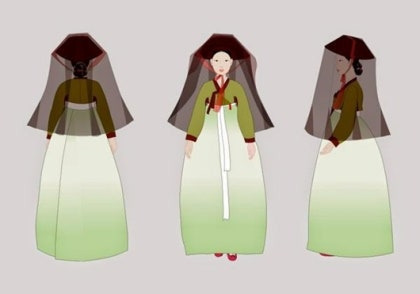
Joseon noblewomen covered their faces with veils when going out to block contact with outside men.
This principle permeated daily life. Noblewomen had to cover their faces with veils or headscarves when going out. Such strict gender separation fundamentally blocked the possibility of natural encounters that existed in earlier times. Love and marriage became separated, with the former redefined as a dangerous emotion that could disrupt society, and the latter as an important institution for maintaining family and social order.
Gender separation was a sophisticated political device aimed at severing the old customs of Goryeo and establishing a new order in Joseon from the family unit. This was the first step in depriving individuals of the right to choose their partners and fully delegating that authority to the heads of families who were to act according to the hierarchical order set by the state.
Marriages Bound by Documents and Destiny: Matchmaking and Saju Danja
Marriages in Joseon were initiated not by the meeting of the parties involved but by the busy steps of a matchmaker and the cold calculations of the elders from both families. In the first stage called ‘Uihon’ (議婚), the matchmaker meticulously examined the families’ lineage, customs, and wealth to find a suitable match.
Once negotiations began, the groom’s side sent a ‘Saju Danja’ (四柱單子) listing the groom’s birth date and time to the bride’s side. This was an important procedure to determine a favorable wedding date based on the fateful harmony of the two individuals, known as ‘Gungah’ (宮合). Subsequent exchanges of complex documents such as the ‘Nabchae-seo’, ‘Yeongiljang’, and ‘Nabpaeseo’ followed. These procedures, in accordance with the Confucian etiquette of ‘Yukrye’ (六禮), illustrate the process of marriage being completed without the bride and groom having seen each other even once.
Symbols of the Wedding Day: Geese and Haphwanju
The wedding ceremony in Joseon, known as ‘Daerye’ (大禮), was the official occasion where the groom and bride first met, and it was a theatrical representation of Confucian values.
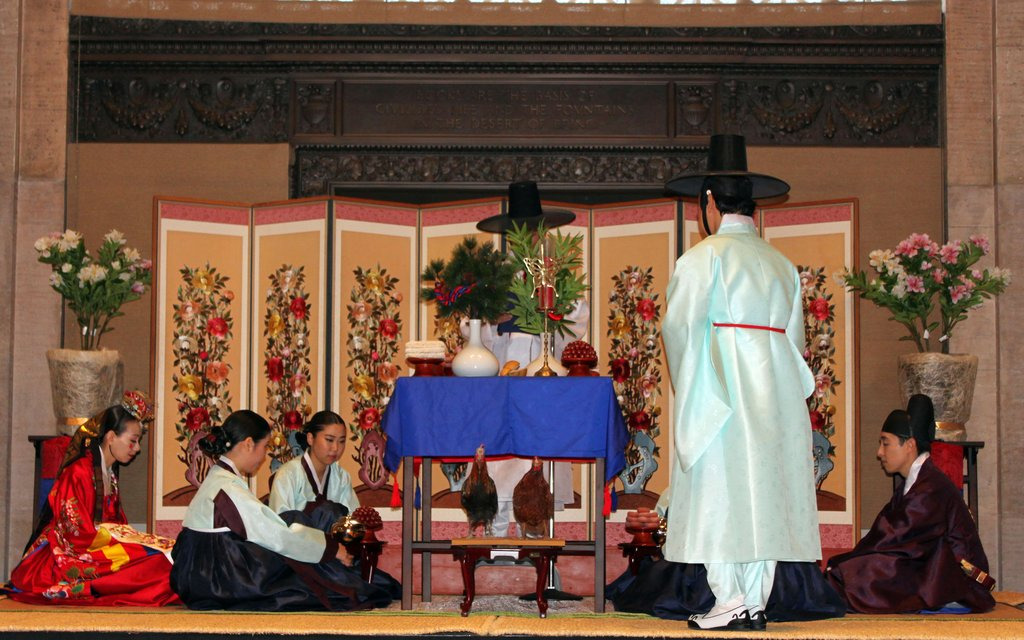
In the Jeonanrye ceremony of a traditional wedding, the groom presents a pair of wooden geese to his future mother-in-law, pledging for a hundred years of harmony.
The ceremony began with ‘Jeonanrye’ (奠雁禮). The groom arrived at the bride’s house and presented a pair of wooden geese to the future mother-in-law. Geese are known to mate for life, symbolizing a firm pledge for a hundred years of harmony.
The following ‘Gyobae-rye’ (交拜禮) was a ceremony where the groom and bride faced each other for the first time and performed deep bows to each other, while ‘Hapgeun-rye’ (合巹禮) involved pouring wine into two cups made from a single gourd, symbolizing their union. All these rituals were a process where the entire community witnessed their union and social obligations.
A New Life Beyond the Threshold: Living with In-laws
For the bride, the end of the wedding signified the beginning of new hardships. The moment she embarked on the journey called ‘Ugwi’ (于歸) towards her husband’s house, she was completely integrated into a new world, separated from her family.
The first ceremony the bride had to perform upon arriving at her in-laws was ‘Pye-baek’ (幣帛). By bowing deeply to her in-laws and presenting dates (for sons) and chestnuts (for daughters), she was reminded that her most important duty was to continue the family line.
The subsequent ‘Sijipsari’ (시집살이) was a harsh reality for the bride. The legal and social structures constraining her life were solid.
- ‘Chilgeojiak’ (七去之惡): Specified seven reasons for which a husband could unilaterally expel his wife (disobedience to in-laws, childlessness, infidelity, jealousy, bad character, gossip, and theft), granting immense power to the husband and in-laws.
- ‘Jaega Geumji Beop’ (再嫁禁止法): Legally prohibited widows from remarrying, forcing them to live in mourning for life and protect the family of the deceased husband.
In this oppressive structure, living with in-laws became a training ground for political obedience to state ideology.
Part 3: Love Beyond Norms
Strict systems could not control all human emotions. This section explores the other forms of love that persistently bloomed both inside and outside the official marriage system.
Love Overcoming Adversity: The King’s Unrequited Love and Forbidden Romance
A Bridge from the Past: King Gongmin and Princess Noguk
Just before the founding of Joseon, the love story between King Gongmin of Goryeo and Princess Noguk from the Yuan dynasty stands in stark contrast to the obligation-centered marital relationships of the Joseon era. Though it began as a political marriage, their relationship evolved into a true partnership based on deep emotional connection and political trust. Princess Noguk actively supported her husband’s anti-Yuan reform policies, becoming his strongest pillar.
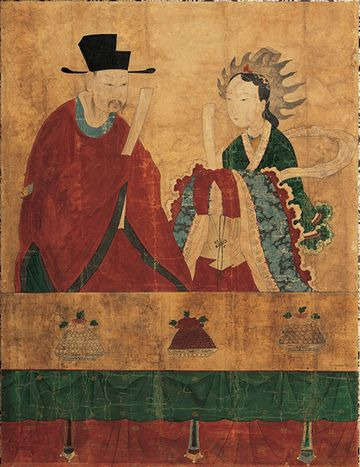
The love between King Gongmin and Princess Noguk became one of the causes of Goryeo’s downfall, yet remains a testament to passionate love.
When Princess Noguk passed away from complications during childbirth, King Gongmin, having lost the meaning of life, abandoned all state affairs and devoted himself solely to mourning his deceased wife. This serves as a poignant evidence of the last glimpse of an era where passionate love could exist even within marital relationships.
An Exception in Joseon: The Love Between the Yangban and Gisaeng
The strict gender separation in Joseon society paradoxically gave rise to the unique existence of ‘Gisaeng’ (妓生). Gisaeng were artists and intellectuals skilled in poetry, calligraphy, and painting, and were often the only women with whom yangban men could share intellectual and artistic exchanges that they could not with their wives.
The spiritual connection between Hwang Jini and Seo Gyeong-deok, as well as the tragic yet passionate love story between Gisaeng Hong-rang and poet Choi Gyeong-chang, reveal the duality of Joseon society. Marriage was an obligation for the family, while emotions like passion and romance were often sought outside the institution of marriage, in special relationships with Gisaeng.
Is there a similar duality present in modern society? The struggle between stable relationships and passionate love may reflect the shadows of the Joseon era.
Comparison: Pre-Goryeo Era vs. Joseon Era Wedding Customs
| Feature | Pre-Goryeo Era (Three Kingdoms/Goryeo) | Joseon Era |
|---|---|---|
| Courtship Method | ‘Free love’, strategic meetings, Tappuri, etc., in public spaces. Individual will and ambition are important. | ‘Matchmaking marriage’ through a matchmaker. Individual will is subordinate to family decisions. |
| Male-Female Interaction | Relatively free interactions possible in public spaces or events. | Strict separation based on ‘Namnyeo Chilsabu Dongseok’. Almost impossible for unmarried men and women to interact. |
| Marriage Procedure | Relatively simple procedures based on verbal promises. Goguryeo ‘Seoakje’, etc. | Highly formalized and documented procedures according to Confucian ‘Yukrye’, including Saju Danja, marriage letters, etc. |
| Post-Marriage Residence | ‘Living with in-laws’ (male return to female’s home) is common. Newlyweds live for a long time at the bride’s house. | ‘Living with the husband’s family’ (Chin-young system) is the principle. The bride moves into the groom’s house immediately after the wedding. |
| Status of Women | Relatively high. Rights as heads of households, equal inheritance rights, relatively free divorce and remarriage. | Significantly decreased. Subordinate to the husband’s family. Oppressed by ‘Chilgeojiak’, remarriage prohibition laws, etc. |
| Concept of Love | Integrated with marriage and political strategy. Passionate love within marriage is possible and praised. | Separated from marriage. Marriage is for duty and lineage continuation. Passionate love is pursued outside of marriage. |
| Purpose of Marriage | Alliances between families, securing labor, personal and political strategies, lineage continuation. | Maintenance of paternal lineage, solidification of social hierarchy, conducting ancestral rites. |
Conclusion
The Korean wedding customs of the pre-Goryeo and Joseon eras represent two distinct worlds shaped not merely by the passage of time but by differences in social governing ideologies. Through this article, we can reaffirm the following key points:
- Freedom and Control: While the pre-Goryeo society recognized relatively free encounters and women’s subjectivity, Joseon strictly controlled individual emotions to maintain Confucian order.
- Politics and Love: Love and marriage never remained solely in the realm of pure personal feelings. In Silla, they were tools of political ambition, while in Joseon, they served to reinforce state governance ideologies.
- Connections Between Past and Present: The family-centered mindset and Confucian concepts rooted in the Joseon era continue to cast deep shadows over contemporary Korean views on marriage and family relations.
Studying this history, I found an interesting similarity where modern marriage agencies or dating apps play the role of the past ‘matchmakers’, and social media serves the function of ‘Seo-dong’s song’. While the forms have changed, the human desire to win love and establish relationships remains the same.
What traces of the past do you find in today’s marriage and romance? Please share your thoughts in the comments!
References
- Anecdotes related to Kim Yu-shin Hankyung
- The marriage of Kim Chun-chu and Moon-hee Joongang Ilbo
- Queen Munmyeong Wikipedia
- Marriage customs of the Three Kingdoms Regional N Culture
- Customs of marriage and romance Our History Net
- Seo-dong and Princess Sunhwa Iksan City Hall
- The story of Seo-dong and Princess Sunhwa KBS WORLD
- Seoakje (壻屋制) Korean Folk Encyclopedia
- The history of living with in-laws Hankyoreh21
- Namnyeo Chilsabu Dongseok Our History Net
- Matchmaking marriage (仲媒婚) Korean Folk Encyclopedia
- Saju Danja (四柱單子) Korean Folk Encyclopedia
- Traditional wedding procedures Ministry of Education Official Blog
- Wedding (婚禮) Korean National Culture Encyclopedia
- Wedding stories YTN Science
- Living with in-laws Korean Folk Encyclopedia
- Chilgeojiak and Sambulgeo Gwangjang21
- Joseon society and women Our History Net
- The love story of King Gongmin and Princess Noguk Dangjin Times, Our Culture Newspaper
- Stories of Gisaeng in the Joseon era Dongbuk Asia News
- The love between Choi Gyeong-chang and Hong-rang Brunch