
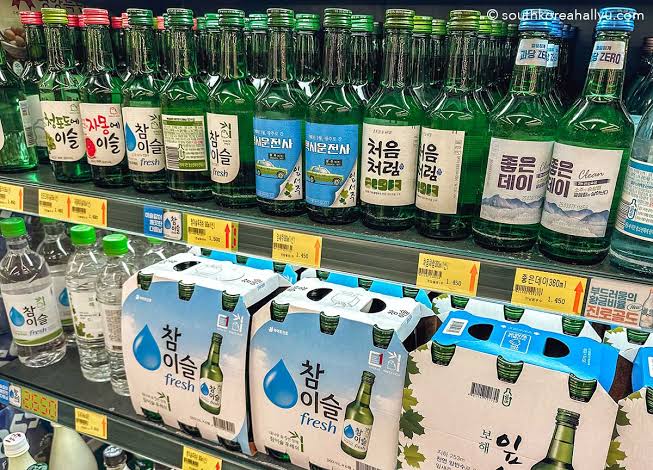
You push open the door of a convenience store and open the refrigerator. About twenty varieties of green bottles stand in a row. Only the label designs differ; the liquid inside is virtually identical. In a narrow section next to them, a slight layer of dust rests on two or three bottles of traditional liquor.
France competes in the global market with wine, Japan with sake, and Scotland with whisky. Korea once had a thousand-year tradition of cheongju, yakju, and distinctive regional soju. Yet today, what fills the glasses of Koreans is diluted soju (huisik-sik soju) that costs only a few hundred won to produce.
South Korea’s domestic liquor market is valued at 10.0575 trillion won. Even when combining liquor brewed by Intangible Cultural Heritage masters, regional specialty liquors produced by local farmers, and legally recognized traditional liquors, the total comes to just 147.5 billion won. That is less than 1.5% of the entire market. The remaining 80.1% by value is monopolized by just two categories: beer and diluted soju.
Converting this into 200 bottles paints an even clearer picture. Out of every 200 bottles of alcohol sold domestically, fewer than 3 are traditional liquor. Over 197 bottles are filled with beer, diluted soju, and other mainstream spirits.
It is easy to dismiss this as merely a matter of consumer preference. However, most people reading this are already consumers in this very market. The drinks consumed at company dinners, on holidays, and from hotel refrigerators during trips are predominantly the green bottles created by this system. Even if you do not have a particular affinity for traditional liquor, the reality remains that your choices were artificially narrowed from the start.
When trying to introduce Korean alcohol to a foreign friend, one quickly hits a wall. There are few bottles one can present with pride, comparable to sake or whisky. That void is not an accident; it is the direct outcome of the tax rate structure.
This restricted set of options is directly reflected in the scale of the industry. Although licensed traditional liquor producers are scattered across the country, the vast majority remain small, family-run operations. With low revenue, capital investment in equipment and the acquisition of distribution networks naturally take a back seat. The price disparity manufactured by the tax structure ultimately dictates the physical scale of the businesses themselves.
Common wisdom often points to consumer taste—the idea that Koreans simply prefer strong, cheap alcohol. But examining the tax architecture reveals that the order of cause and effect is reversed. Current tastes are not the cause; they are the result.
A Hierarchy of Spirits Dictated by Taxes
Distilled spirits carry a 72% liquor tax on their factory-release price. On top of this, education tax and value-added tax are added. For yakju, cheongju, and fruit wines, the rate is 30%. Within distilled spirits, mass-produced diluted soju, traditional distilled soju, and aged whisky all pay the exact same 72% rate.
The problem is not that the tax rate is identical. The problem is what that 72% is applied to. This method is called an ad valorem tax. It is a tax levied on the monetary value of the alcohol rather than its physical volume.
The production cost difference between a distilled spirit aged for 10 years and one aged for 1 year is enormous. Under an ad valorem tax, the higher the production cost, the higher the tax multiplies in exact proportion. Aging periods, premium ingredients, meticulous crafting processes—all of these factors inflate the tax burden.
The taxable base price of a single bottle of Chamisul (360 ml) was around 548 won, and the taxes levied on it exceeded its production cost. Nevertheless, the final retail price remained low. Because the initial cost of goods was engineered to be dirt cheap, multiplying it by 72% still yielded a very small absolute sum.
The exact same tax rate creates completely opposite effects. Cheap alcohol stays cheap even when taxed. High-quality alcohol is doubly penalized by tax for its excellence. Ultimately, makers of traditional distilled soju or premium yakju are trapped in a paradox where improving quality destroys their price competitiveness.
In recent years, as whisky highballs surged in popularity, retail shelf space for imported whisky actually expanded. One of the reasons domestic traditional distilled spirits could not occupy that space is this very tax structure. Imported whiskies enter the market backed by economies of scale achieved overseas to absorb the 72% tax, whereas domestic craft distilleries attempting to scale up face relatively higher unit production costs, putting them at an even greater disadvantage under the same percentage tax rate.
How the Illusion of Cheapness Became Entrenched
From the consumer’s perspective, this structural distortion is invisible. In supermarkets, green bottles remain the cheapest alcohol, while traditional distilled spirits remain expensive. Looking solely at price tags, it is easy to assume that spirits are inherently that way, rather than recognizing the role of taxation.
A significant portion of this price gap is not the result of raw production costs, but of tax design. Even with similar alcohol content and production scales, taxes mount proportionally with every extra won spent on ingredients and craftsmanship. The final price tag that consumers see is a figure loaded with these accumulated taxes.
This optical illusion solidifies over time. When cheap alcohol remains continuously cheap, that price becomes the baseline normal. Any slightly more expensive alternative appears abnormally overpriced. The price disparity engineered by the tax rate establishes itself in the consumer’s psyche as an absolute standard unrelated to actual quality.
Consequently, the next generation of consumers inherits the same perception. The basis for distinguishing what is expensive because of tax versus what is genuinely expensive to make becomes blurred beyond recognition.
1965: A Country Forbidden from Brewing with Rice
Tracing the origins of this framework leads not to tax policy first, but to food security. However, the suppression of homebrewing culture (gayangju) did not begin in 1965. During the Japanese colonial era, liquor tax ordinances required licenses and taxes even for alcohol brewed at home, delivering the first major blow to long-standing domestic and regional brewing traditions.
Following liberation, that framework went largely unrevised. Then, in 1965, the South Korean government enacted the Grain Management Act, outright banning the use of rice for brewing alcohol. The rationale was the dire food supply situation of a post-war nation.
Makgeolli, distilled soju, and all traditional liquors made from rice became illegal overnight. The empty void was filled by diluted soju. It was produced simply by distilling neutral spirits from cheap imported tapioca or sweet potatoes and diluting them with water. There was no need to source fine grains, nor any need to wait for aging.
During more than two decades of near-total market monopoly, rice-brewing recipes faded from public memory. Homebrewing culture and region-specific distillation techniques lost their continuity. Recipes and fermentation timings passed down orally from mother to daughter or master to apprentice were rarely documented. Over those twenty forbidden years, an entire generation of practitioners who possessed hands-on mastery vanished.
When regulations were finally lifted in 1990, consumers’ palates and wallets were already completely accustomed to diluted soju. Those who attempted revival faced two simultaneous hurdles: reconstructing lost brewing techniques and overcoming the rock-bottom price expectations cemented in the low-cost market.
The tax rate system was layered directly on top of this. The explanatory statement for the 1967 Liquor Tax Act revision contains the phrase: “Tax rate adjustments centered on heavy taxation of high-end liquors.” At that time, “high-end liquors” referred to virtually all alcohol except coarse takju and yakju. The explicit intent to penalize fine liquor with heavier taxation was written directly into the law.
That framework remained virtually untouched for over half a century. It was only in 2020 that takju and beer were transitioned from ad valorem taxation to a specific tax—a system taxing by physical volume. This was the turning point that allowed domestic beer to be taxed on equal footing with imported beer.
Distilled spirits, yakju, and cheongju, however, were left behind. The very categories that house Korea’s heritage liquors remain trapped in the obsolete ad valorem model.
Borders Inside a Borderless Nation
The United States, Japan, and France adopted specific taxation for distilled spirits long ago. This difference becomes even clearer when translated into the language of international trade.
Tariffs are levied on goods crossing national borders. Yet Korea’s liquor tax system produces a similar effect entirely within its own borders. Alcohol crafted with premium ingredients and time-intensive methods is taxed as heavily as luxury imports, despite being produced domestically. Meanwhile, mass-produced, cheap alcohol enjoys benefits akin to domestic trade protection.
It is not geographical borders that divide them, but production methods. Traditional liquor effectively faces a domestic tariff barrier within its own home market. Even before embarking on export routes, its price competitiveness is eroded right at the domestic distribution stage.
In international trade, anti-dumping duties exist to prevent cheap foreign imports from decimating domestic industries. Korea’s liquor tax system functions in exact reverse. It protects cheap, mass-produced domestic alcohol while imposing a punitive burden on domestic premium craft spirits. It is a perverse inversion of anti-dumping logic applied against our own domestic artisanal industry.
In 1994, Japan revised its liquor tax law, lowering the minimum annual brewing volume required for a beer manufacturing license from 2,000 kl to 60 kl. This reduced the barrier to entry by a factor of 33. Following this reform, regional craft breweries known as ji-biiru sprang up nationwide.
Even as overall national beer consumption declined, sales of small-scale craft beer nearly doubled. Distilled soju (honkaku shochu) also overtook diluted soju (korui shochu) in market share starting in 2003, propelled by marketing rooted in local agricultural heritage and tax structure overhauls. When regulations were dismantled, tradition reclaimed the market.
The United States reached the same outcome through a different mechanism. The federal government created separate, reduced tax tiers for small-scale craft distilleries. Craft distilleries like House Spirits Distillery, founded in 2004, grew within this framework. Thanks to reduced tax brackets, it was genuinely feasible to start small and gradually scale up production. This meant early-stage break-even points were determined by consumer response in the market, rather than tax penalties. In 2026, a bipartisan bill permanently lowered the craft distilling tax rate by $2.35 per proof gallon.
France chose an architecture pointing in the opposite direction. The AOC (Appellation d’Origine Contrôlée) system confers a market premium on wines that adhere to specific regions, grape varieties, and traditional methods. Craftsmanship and regionality are converted into brand value rather than tax burdens. This demonstrates how the entire trajectory of an industry hinges on the tax and regulatory framework governing its raw materials.
South Korea does offer a tax reduction system for traditional liquor. When officially recognized as traditional liquor, a 50% tax cut is granted. However, the production volume eligible for this relief was long capped at 500 kiloliters annually for fermented liquor and 250 kiloliters for distilled spirits. The moment a brewery grows even slightly beyond this threshold, it is pushed outside the relief zone.
Growth was structurally treated as an offense. In the 2024 tax revision bill, the limits were expanded to 700 kl and 350 kl, and further raised to 1,000 kl and 500 kl in early 2025 government measures, with tax reduction tiers subdivided.
The direction is correct. However, it remains an eleventh-hour widening of a framework preserved for over half a century.
Why Specific Tax Reform Always Stalls
This leaves the real question. Bills to convert distilled spirits to a specific tax system have been introduced in the National Assembly multiple times, including in 2023. Why do they consistently fail to pass and simply disappear?
The answer lies not in tax calculations, but in the premise underpinning those calculations. Every single specific tax conversion scenario proposed to date begins with one non-negotiable condition: that the tax burden on diluted soju must not increase.
Neither in scenarios proposed by the Korea Institute of Public Finance nor in bills introduced in the National Assembly was this premise ever compromised. When tax rates are reverse-calculated under this constraint, the inevitable outcome is a picture where taxes drop drastically only for whisky and premium distilled soju—with some scenarios showing tax cuts exceeding 72%.
If the factory-release price of diluted soju rises by even 100 won, the media immediately headlines it as a price hike on the “working class’s drink.” It is a staple commodity summoned alongside core inflation indices. For politicians, putting their name on a reform bill that directly clashes with this public narrative poses immense risk. In terms of votes, it is readily judged as carrying far more liability than reward.
Another force works to preserve this premise. The diluted soju market is shared by a handful of large corporate conglomerates. Conversely, the traditional liquor sector is fragmented across hundreds of small micro-breweries. It is not difficult to deduce which side can voice its interests more organizedly and forcefully in tax policy debates. Fragmented stakeholders lack the bargaining power required to push through legislation tailored to their benefit.
Reform has always stalled at this juncture. The political consensus that the price of everyday working-class alcohol must remain untouched has simultaneously kept traditional distilled spirits locked down in the process.
Consumer advocacy for traditional liquor also lacks clear collective momentum. Diluted soju is a price point felt by nearly the entire population, immediately organizing public sentiment as a cost-of-living issue. By contrast, the consumer base that would benefit from traditional liquor tax reform is comparatively niche and dispersed, making it difficult to generate equivalent political leverage. As a result, the only voice echoing loudly at the negotiating table is the demand to “protect prices.”
Ultimately, the detour chosen by the government was the “Standard Sales Ratio” system introduced in 2024. By deducting a significant portion of selling and administrative expenses from the taxable base of domestic liquor beforehand, it aimed to level the playing field with imported spirits. In effect, the tax rate system was left untouched while only the calculation formula was tweaked.
This did have the effect of slightly lowering the factory-release prices of domestic soju and whisky. However, the backbone of ad valorem taxation remains intact. The fundamental dynamic where higher production costs yield proportionally higher taxes remains identical before and after the introduction of the Standard Sales Ratio.
What sustains this half-century-old tax structure is not the text of the law. It is the unspoken political consensus that the price of the green bottle must never rise. What appeared to be a traditional liquor crisis was, in truth, the collateral damage of price defense surrounding diluted soju.
Between Won Soju and Baekgeolli
Examining what has played out in recent years shows that this problem is far from abstract.
Won Soju, registered as a regional specialty liquor, was permitted to be sold online because it met the regional specialty criteria by using 100% locally grown rice. Baekgeolli, released around the same period, could not be sold online despite using local rice from Yesan, South Chungcheong Province, simply because it was registered under a micro-brewery manufacturing license.
The difference was not determined by quality or authenticity. It was determined solely by which regulatory filing cabinet the paperwork landed in. Despite using local agricultural produce, an entire distribution channel was dictated by a single registration category.
To be recognized as a regional specialty liquor, a producer must satisfy regional agricultural raw material quotas. For a long time, this requirement mandated 100% local produce across the top three ingredients. Only in 2025 was it slightly relaxed to 95% or more.
This means micro-breweries were genuinely excluded from tax benefits simply because a single remaining 5% ingredient was sourced from another region. When an entire online sales avenue is cut off over a single ingredient, the only businesses capable of withstanding the financial blow are established, well-capitalized operations. For smaller breweries, arbitrary paperwork criteria have literally decided their survival.
The Blind Spot Consumers Never See
For several years, the media has buzzed with talk of a “traditional liquor renaissance.” Department store pop-ups, viral social media posts, and sleek, sophisticated branding have emerged. Yet the vast majority of local regional breweries remain completely outside this boom. A widening chasm divides the few high-profile brands entering upscale urban boutiques and the struggling majority burdened by tax penalties and distribution shortages.
When a small brewery exceeds the tax-relief volume threshold, its taxes spike. At that moment, its only choices are to halt expansion, downsize distribution, or shut its doors entirely. In a structure where the reward for scaling up is a tax penalty, choosing stagnation over growth is actually the rational economic decision.
As a result, the traditional liquor market is split into a tiny handful of breakout successes and a vast sea of stagnant micro-breweries. The media almost exclusively highlights the former. The 1.5% market share statistic is a far more accurate reflection of the entire reality, including the latter.
Questions Left by Half a Century of Inertia
The government has recently accelerated the pace of regulatory adjustments by permitting distilled spirit licenses for micro-breweries, easing tasting restrictions, and relaxing tax payment stamp requirements. The direction is not bad.
However, all these reforms merely polish the outer edges of a framework cast in 1967. The core architecture has never been altered. The ad valorem tax remains firmly in place, as does the sacred premise that working-class liquor prices must never be disturbed.
Let us return to the convenience store refrigerator. The landscape of green bottles standing in uniform rows is not the organic culmination of consumer preference. It is the composite artifact of 1965 food security measures, 1967 tax architecture, and a half-century-old political red line defending cheap everyday liquor that has never once been confronted directly.
Years from now, the people standing before that refrigerator may be our children. In all likelihood, the composition will not look very different. The green bottles will still line up twenty deep, and the traditional liquor shelf will remain just as narrow. Whether an assumption left unquestioned for half a century persists for the next fifty years may well depend on how many people finally understand the mechanism behind it.
The next time you open that refrigerator door, it is worth asking why those two or three dust-covered bottles in the corner are doomed to stay right where they are.
References
- National Tax Service, Liquor Tax Filing Status Statistics
- Ministry of Agriculture, Food and Rural Affairs & aT, 2025 Liquor Industry Information Survey
- Ministry of Economy and Finance, 2024 Tax Law Revision Bill
- Ministry of Agriculture, Food and Rural Affairs, Traditional Liquor Industry Revitalization Plan (Feb 2025)
- National Law Information Center, Reasons for Revision of the Liquor Tax Act and Enforcement Decree
- Lee Dae-hyung, Traditional Sool Column - Contemplating the Transition of Traditional Liquor to Specific Tax, thesool.com
- Namuwiki, Liquor Tax / Diluted Soju / Distilled Soju / Korean Traditional Liquor entries
- Korea Economic Daily Dictionary, Ad Valorem Tax vs Specific Tax
- Law Times, Liquor Tax Act Amendment Introduced to Impose Specific Tax Instead of Ad Valorem Tax (Oct 2023)
- Nongmin Ilbo, Government Considers Specific Tax Transition for Distilled Spirits (Oct 2023)
- Monthly JoongAng, Korean Beer and Japan's Ji-biiru Deregulation Analysis
- Economic Review & Viva100, Introduction of the Standard Sales Ratio System (2023–2024)
- Maeil Shinmun, Expansion of Distilled Spirits for Micro-Brewery Licenses (Feb 2025)
- Ohmynews, Traditional Liquor Is Popular, but Why Are Regional Breweries Suffering? (2022)
- Nongsaro, Guide to Starting a Korean Traditional Liquor Business