
A few months ago, I idly searched for a train ticket from Busan to Paris.
Naturally, there were none. However, the phrase “theoretically possible” kept appearing in the search results.
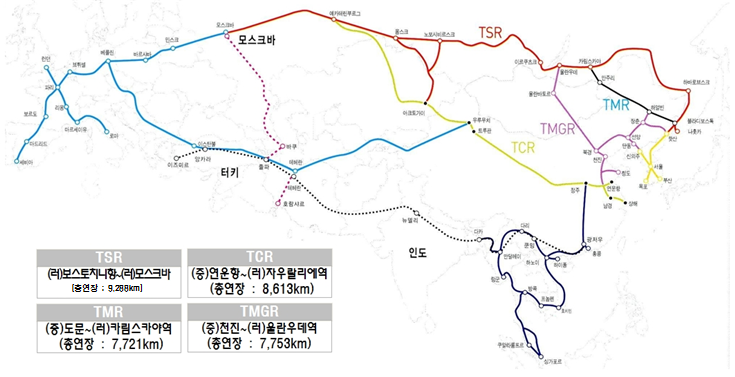
Trans-Siberian Railway, the Organization for Cooperation of Railways (OSJD), the groundbreaking ceremony for connecting inter-Korean railways. If you look only at the keywords, the atmosphere makes it seem like the route could open at any moment, yet it is surprisingly rare to find articles that explain in detail why it isn’t happening.
As I looked into it, I found that the problem wasn’t just one thing.
I thought it was just a political issue, but it turned out that wasn’t the case. The track gauges are different, the North Korean section is slower than a car, and even the premise of “passing through Russia” is currently being shaken. I broke down these three factors one by one.
The Tracks Don’t Even Match
It gets stuck at the most basic level. South and North Korea use standard gauge—a track width of 1,435mm. Russia, however, uses broad gauge: 1,520mm. An 85mm difference might sound insignificant, but it means the bogie (the wheel assembly of the train) is completely incompatible, so it cannot simply be ignored.
There are two known solutions.
One is to replace the entire bogie at the border, and the other is a technology called “gauge change,” where the width of the wheels automatically expands or contracts as the train crosses the border. Countries like Spain apply an automatic gauge-changing system even to 200 km/h high-speed trains to allow direct travel between standard-gauge high-speed lines and broad-gauge conventional lines, so the technology itself is already proven. There are reports that bogie exchange facilities have long been installed at Khasan Station and Tumangang Station on the North Korea-Russia border, though I could not confirm exactly when they started operating or at what scale.
In any case, the gauge issue is, objectively speaking, the easiest of the three. It is a technology already used by other countries every day, so there is nothing new to develop. The real problems start after that.
The North Korean Section is the True Gateway
North Korea’s railway network is quite dense in terms of length. As a country with a lot of mountainous terrain, it is known that railways handle over 85% of passenger and freight transport. However, about 97% of the lines are single-track. This means trains cannot run in both directions simultaneously and must take turns. Furthermore, because power supply is not stable, reports consistently state that even electrified sections suffer from significantly reduced actual operating speeds and efficiency.
It is quite well-known that at the 2018 Inter-Korean Summit, Chairman Kim Jong Un mentioned to then-President Moon Jae-in that the North Korean railway environment was poor. Some interpreted this as a subtle hint to pay attention to improvements. Indeed, in December of that year, the two Koreas held a groundbreaking ceremony for rail and road connections, having received an exemption from UN sanctions. They went through all the symbolic events, from signing the sleepers to the track-fastening ceremony. However, the South Korean government had already made it clear at the time that further detailed surveys and designs were needed after the ceremony, and that actual construction would depend on denuclearization negotiations and sanctions.
To digress for a moment—it has always bothered me that modernizing North Korean railways is not just a matter of laying a few kilometers of new rails. Many experts assess that the entire network—power grids, signaling systems, bridges, and tunnels—is so outdated that it needs to be completely redesigned. Whether it’s for unification or improving relations, this isn’t a problem that will end with a simple “Okay, now let’s just connect them.”
Rajin-Khasan, an Experiment That Once Stopped
There was a project that actually tested this framework: the Rajin-Khasan project. It was a trilateral cooperation project between South Korea, North Korea, and Russia to modernize the 54km railway connecting North Korea’s Rajin Port and Russia’s Khasan Station, as well as to improve the port itself. In 2007, South Korea reached an agreement with Russian Railways on renovation, and when it faltered following the May 24 measures, South Korean companies continued the project by taking an indirect approach, participating in Russian stakes.
It ran reasonably well until 2016. However, after North Korea’s sixth nuclear test, the situation changed completely. Due to a sanction clause stating that ships that have entered North Korean ports cannot enter ports in other countries, the method of importing coal via Rajin Port became subject to international sanctions. Consequently, the South Korean side withdrew, and only nominal cooperation remained between North Korea and Russia. There are rumors that Russia continues to signal its desire to resume the project, but North Korea is said to have shown no particular response.
What is interesting about the Rajin-Khasan case is that it didn’t stop because of a lack of technology or capital. It was a project where solutions to the gauge issue and infrastructure backwardness had already been found to some extent. In the end, what held it back was international politics.
A Wall Bigger Than the Bogies
Sanctions are still in effect today. As of 2026, inter-Korean relations are described even by the Ministry of Unification as being “completely blocked.” In public opinion polls, about half of the respondents expected no significant changes in inter-Korean relations this year, and a considerable number expected them to worsen. State-run research institutes generally agree that North Korea is highly likely to maintain its stance of “hostile two states.”
The South Korean government is not entirely unaware of this situation, as it continues to propose ideas like the Seoul-Beijing high-speed railway or linking tourism to Wonsan-Kalma. However, as long as sanctions against North Korea are not lifted, the feasibility is low, and since it is a scenario that requires North Korean cooperation, it is not something South Korea can decide on its own. While routes connecting the two Koreas, such as the Gyeongwon Line and the Donghae Line, continue to appear in government documents like the National Railway Network Construction Plan, this seems closer to keeping a spot open on paper to “move immediately if relations thaw” rather than an actual construction plan.
Is There a Way Without Russia?
Here, one more variable has been added. The original plan was for a trans-Korean railway that would pass through North Korea and meet the Trans-Siberian Railway. However, since the war in Ukraine, as Europe has imposed high-intensity sanctions on Russia, logistics passing through Russia have become a politically burdensome option. Statistics also show that Russia’s trade with Europe has shrunk significantly in recent years, shifting rapidly toward China.
An alternative that has emerged is the China-Europe Railway Express (TCR) route, which passes through China, Kazakhstan, and Central Asia to reach Europe. In fact, China-Europe freight trains have been running since 2011, with cargo volume exceeding 1.9 million TEUs as of 2023, and some cargo from South Korea is reportedly mixed in. However, this does not connect directly from South Korea by rail; it involves taking a ship from Busan Port to a Chinese or Russian port and then transferring to a train. It is a multimodal transport system mixing sea and rail, not a complete land connection.
In other words, the phrase “to Europe by land” currently splits into two paths. The original plan passing through North Korea is completely deadlocked politically, and the route bypassing through China is already functioning for freight, but the political weight of the Russian transit section is becoming increasingly heavy. It is difficult to say that either path is fully “open.”
So, Where Do We Stand?
Looking back, I see three layers of problems stacked in order. The gauge is a technology problem that has already been solved, and the North Korean infrastructure, while requiring time and money, is not impossible in principle. The real variable is the politics layered on top of it. Inter-Korean relations, sanctions against North Korea, and now the international situation surrounding Russia. All three must be resolved simultaneously, and the current situation is that none of the three shows any sign of being resolved.
When I searched for that ticket from Busan to Paris, the feeling I had was more like curiosity than regret. I want to say with confidence that it will happen someday, but based on the data currently available, there is no real basis for such a conclusion. Instead, it feels like I have a clearer picture of exactly what is being blocked right now.
References
- Inter-Korean-Eurasia Railway
- “Inter-Korean railway connection project, difficult to begin in earnest within 2 years”
- Peace Unification Webzine, Railway Connection and Community Growth
- 4,250km railway connecting China and Europe opened... A 'New Silk Road' created by war
- [Political Outlook 2026-Special Issue-No. 8] 2026 Russia Outlook: Ukraine War, Domestic Prospects, Foreign Policy