
The Beautiful and Confusing Paradox of You
Let’s start with a common story from our surroundings. There was an ace who was passionately dedicated to work, earning recognition from the entire team. Everyone praised his drive and achievements. But one day, he suddenly declared burnout and dropped everything. There’s another story of a friend who always played the role of a ‘human counselor,’ listening to others and providing warm empathy. However, this friend often found himself emotionally drained and struggling alone, without anyone to lean on.
In this way, our most shining strengths can sometimes become the shackles that push us into the deepest darkness. As the saying goes, “A person with unique but excellent traits also possesses unique but not excellent traits.” Human strengths and weaknesses are like two sides of a coin. This is not a flaw; rather, it may be the most important key to understanding the complex and mysterious nature of humanity. Through this article, we will explore why such contradictions arise and how we can embrace this duality to live as a more complete self.
What about you? What is your greatest strength that others praise? And is there a cost you are secretly paying to maintain that strength?

Chapter 1: Two Sides of a Coin: Portraits of Strengths and Shadows
In this chapter, we will vividly examine how strengths and their corresponding shadows (weaknesses) are interconnected through specific character types and examples. We will traverse literature, philosophy, and our daily lives to illuminate the duality of humanity in a multifaceted way.
1.1. Ambitious Achievers and Anxious Perfectionists
Many people cite ‘the desire for recognition’ as a driving force behind success. The desire to be acknowledged by others serves as a powerful motivation for growth and better performance. However, when this healthy desire spirals out of control into ‘recognition obsession,’ the story changes. We become trapped in the ‘prison of recognition.’ When the pressure to meet others’ expectations, or ‘perceived expectations,’ exceeds our own abilities (self-efficacy), we become overwhelmed by extreme stress.
Especially for those who are diligent and perfection-seeking, the ‘model student’ type, it is easy to fall into this trap. They suffer from the dual pressure of needing recognition not only for the results of their work but also for their identity as a ‘diligent person.’ As a result, failure is perceived not merely as a mistake but as a collapse of their very existence, which can lead to extreme choices in severe cases. Ultimately, the more we chase after others’ recognition, the more we experience the paradox of diminishing inner satisfaction. The moment we entrust our value to external standards, we become an unstable being swayed by evaluations we cannot control. The strength that meets others’ needs transforms into a shadow that causes us to lose ourselves.
1.2. Visionary Dreamers and Obsessive Idealists
F. Scott Fitzgerald’s novel The Great Gatsby dramatically illustrates the tragedy of this type. Gatsby’s ‘greatness’ stems from a pure and grand dream of reclaiming his beloved Daisy. He accumulates immense wealth solely to achieve this dream and throws lavish parties at his mansion every night. His passion and vision were undoubtedly his greatest strengths.

However, his dream was directed not at the real Daisy but at an idealized image that existed only in his memories. He forced Daisy to deny ever loving her husband, demanding that she conform to his fantasy. But reality brutally betrayed his expectations. Ultimately, his great dream, or his greatest strength, became his most fatal weakness. The fact that not a single person from the crowd enjoying his parties attended his funeral symbolically illustrates how hollow and unrealistic his dream was. When a beautiful dream transforms into rigid expectations that disregard reality, it ceases to inspire and begins to destroy. This is what we call the ‘Gatsby Trap.’
1.3. Radical Free Thinkers and Isolated Misfits
The ancient Greek philosopher Diogenes was a figure who completely rejected social conventions and expectations. He lived like a dog in a large jar, believing that a life faithful to his natural desires was true happiness. The famous anecdote of Alexander the Great visiting him and asking what he could do for him, to which Diogenes replied, “Please step aside; you are blocking my sunlight,” clearly shows how little he valued worldly wealth and power.
His strength was his complete mental freedom that was unbound by anyone, even in front of a great king, and his radical egalitarianism that viewed all humans as equals. However, the price he paid was severe social isolation. His philosophy was so unique and radical that it is said he was always alone. His great freedom was, at the same time, a solid wall that completely separated him from the world. The pursuit of perfect individual freedom often requires sacrificing meaningful social connections, illustrating the ‘Diogenes Dilemma.’ His strength (uncompromising freedom) and shadow (deep isolation) are not separate but merely different perspectives on the same phenomenon.
1.4. Empathetic Healers and Emotionally Drained Sponges
The ability to feel others’ emotions as if they were our own and to empathize deeply is an amazing talent that enriches human relationships. However, this talent also comes with a dark shadow. When overly exposed to external emotions, we can become overwhelmed, leading to a state of ‘emotional excess’ where others’ feelings become indistinguishable from our own. In such a state, we desperately need alone time to recharge our energy, sometimes even cutting off contact with those around us.
This can disappoint those around us, but for highly empathetic individuals, it is a necessary survival strategy to protect themselves. Absorbing others’ emotions like a sponge without any boundaries can lead to a complete depletion of one’s own feelings, leaving oneself uncared for. The resource of empathy used to heal others is not infinite. Without appropriate boundaries, the gift of helping others can become a weapon that harms oneself.
Table 1. The Two Faces of Our Strengths
| Strength (Light) | Shadow (Darkness) |
|---|---|
| Passionate and driven | Prone to burnout and obsession |
| Detail-oriented and meticulous | Perfectionistic and anxious |
| Highly empathetic and kind | Emotionally drained and lacking boundaries |
| Independent and free-thinking | Isolated and stubborn |
| Ambitious and visionary | Holds unrealistic expectations and easily disappointed |
Chapter 2: The Engine of This Paradox: Why Are We Made This Way?
So why do our strengths inevitably come with shadows? In this chapter, we will analyze the psychological mechanisms that drive us from within and the social environment surrounding us to uncover the fundamental causes.
2.1. The Blueprint of Mindset: Fixed Mindset vs. Growth Mindset
Stanford University psychologist Carol Dweck presents ‘mindset’ as a decisive force that can change our lives. Mindsets can be broadly categorized into ‘fixed mindset’ and ‘growth mindset.’
Those with a ‘fixed mindset’ firmly believe that abilities such as intelligence or talent are innate. Therefore, when faced with their shadows, or weaknesses and failures, they accept them as permanent evidence of ‘I lack talent.’ For them, failure is akin to a disaster, and effort is seen as a shameful act reserved for those without talent.
In contrast, those with a ‘growth mindset’ believe that abilities are not fixed but can be developed through effort and learning. For them, failure is a valuable piece of information for growth and an opportunity to learn something new. Ultimately, what defines us is not the shadow itself but the operating system of our minds that interprets that shadow, i.e., our mindset. A fixed mindset views the shadow as a flaw to be hidden, while a growth mindset sees the shadow as valuable material for growth.
2.2. The Expectation Equation: The Dangers of High Hopes
Our strengths often lead us to harbor high expectations for ourselves and others. However, ‘expectations’ can be a double-edged sword. Charlie Munger, Warren Buffett’s long-time business partner, asserted, “The first principle for a happy life is to lower expectations” because unrealistic expectations can torment us throughout our lives.
This is also explained by the expectation disconfirmation theory in psychology. This theory states that we feel dissatisfaction when our actual experiences fall short of our expectations and feel great satisfaction when our experiences exceed our expectations. In other words, our happiness depends not merely on ‘what we have (reality)’ but on the functional relationship between ‘what we have’ and ‘what we expect.’
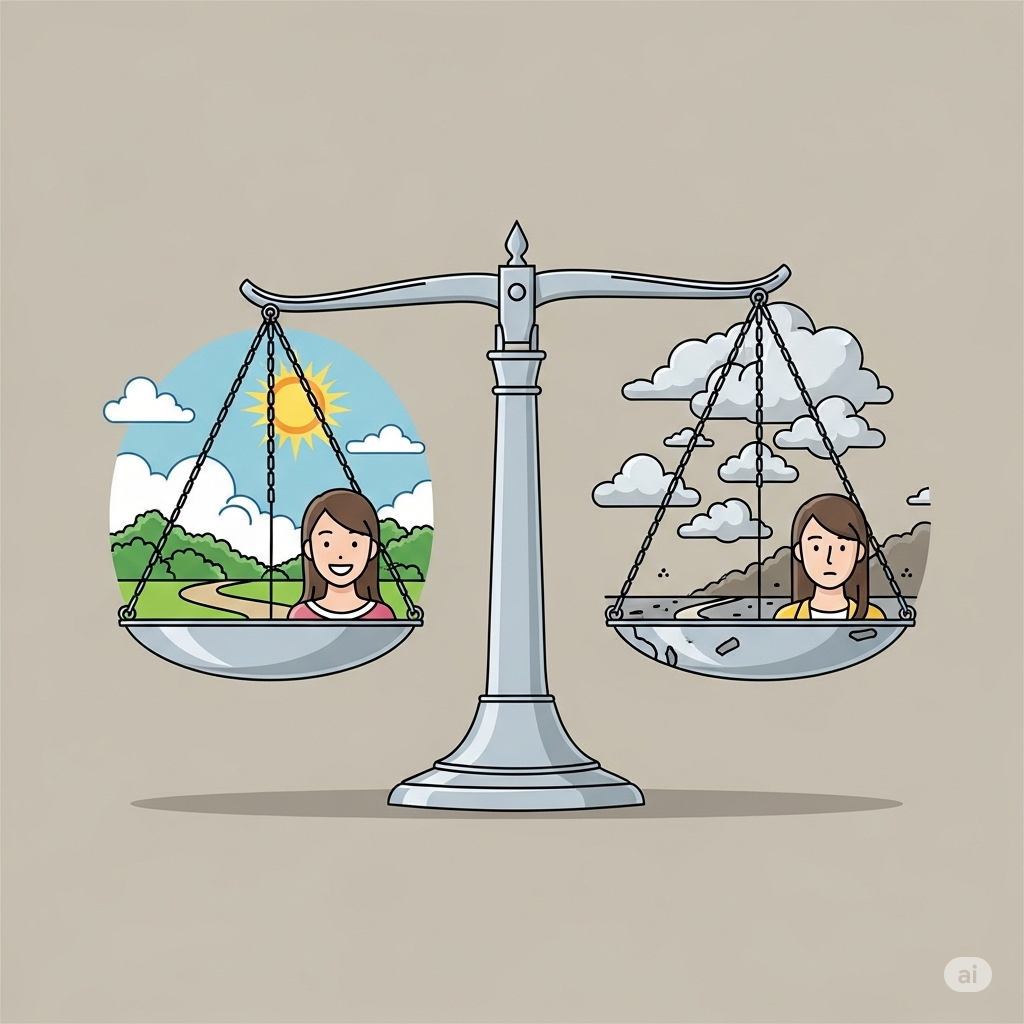
However, this does not mean we should abandon all expectations and live passively. Rather, high goals can open new perspectives and serve as powerful motivators for growth. The key here is where we place our ’expectations.’ We need to lower expectations regarding ‘results’ that we cannot control while maintaining high expectations for the ‘process’ (our efforts, attitudes, learning) that we can control. For instance, even if we set a high goal of completing a marathon, we should let go of the expectation that uncontrollable variables like the weather or our condition on race day must be perfect. This is the key to resolving the paradox of expectations.
2.3. Modern Society as a Grand Stage
Modern society, especially the rise of social media, dramatically amplifies the dynamics of our ‘strength-shadow’ relationship. Social media is inherently a space for ‘showing off life.’ We carefully edit and display only our brightest moments—our strengths—while thoroughly hiding the struggles that cast shadows. Psychologist Jonathan Haidt accurately pointed out that “people perform for each other rather than communicate.” By comparing the perfectly edited highlights of others to our mundane and ordinary lives, we suffer from constant discomfort and inferiority, a phenomenon often referred to as ‘caffeine depression.’
Moreover, societal pressures that enforce ‘age-appropriate roles,’ known as ‘ageism,’ also constrain us like an invisible stage. We face prejudices that make it difficult to challenge new careers in our thirties, and women, in particular, confront immense pressure from childbirth and career interruptions. These societal expectations compel us to perform certain ‘strengths’ (e.g., stable employees, devoted mothers) while suppressing the shadows (anxiety, worries, true desires) hidden behind the masks. Ultimately, the contradictions within us are amplified on the grand stage of society, spreading individual struggles into collective anxiety.
Chapter 3: Making Friends with the Shadow: A Practical Guide to Wholeness
So how should we deal with this unavoidable paradox? We propose concrete and practical methods to stop the futile war against the shadow, acknowledge its existence, and integrate it healthily to live as a more complete self.
3.1. From Results to Process: Living a Life Enjoying the Journey
In a results-oriented society, we can easily forget the value of the process. Evaluations are always based solely on results, and failure equates to frustration. However, by shifting our perspective to ‘process-oriented thinking,’ we can escape the pressure of results and experience the pure joy of growth. Instead of focusing on the ‘goal’ of achieving a perfect outcome, we concentrate on the ‘process’ of learning and trying something new.
This becomes a powerful antidote for those burdened by the shadow of perfectionism. When we set the standard for success not on ‘results’ but on ‘process,’ focusing on self-controllable questions like ‘What did I learn today?’ or ‘What new attempts did I make?’ allows us to embrace new challenges without fear of failure. A mindset focused on the process creates a psychological safe zone where the shadow of perfectionism loses its power.
3.2. The Art of Self-Compassion: Recalibrating the Inner Critic
Those tormented by the shadow of strengths often harbor a harsh inner critic. To reduce the voice of this critic, it is essential to change our evaluation criteria regarding ourselves. We should place greater significance on internal values such as stability and inclusiveness rather than flashy skills or appearances.
Additionally, it is crucial not to go all-in on a single strength or role but to diversify our identity. For example, instead of clinging solely to the identity of a ‘successful employee,’ having multiple identities like ’the artist in me,’ ’the socializer with friends,’ and ’the family member in me’ creates a psychological insurance that prevents a failure in one area from shaking our entire existence. This is akin to a ‘portfolio’ strategy in investing, where diversifying assets mitigates risk. Sometimes, honestly revealing our weaknesses to realistically lower others’ expectations can also be a wise strategy for self-protection.
3.3. My Toolbox for Balance
There are specific tools that can help manage the shadows of strengths and maintain mental balance in daily life. These are not emergency kits to be used when problems arise but maintenance tools that we practice consistently to build mental strength.
- Mindfulness Meditation: A training to fully focus on the ‘here and now.’ Even when anxious thoughts or uncomfortable emotions arise, we practice observing them from a distance, like clouds drifting in the sky. This helps us cultivate the strength to maintain calmness without being swept away by emotional waves.
- Gratitude Journaling: A simple habit of writing down three or four things we are grateful for from our day. This small practice shifts our focus from ‘what is still lacking’ to ‘what we already have.’ It helps silence the inner critic’s voice that shouts, “I’m not there yet,” and enhances our happiness by discovering the positive aspects of life.
- Setting Healthy Boundaries: An essential skill, especially for those with high empathy who easily merge with others’ emotions. It involves not fearing rejection, balancing work and life to protect our energy, and ensuring we have complete rest time. This is not selfish behavior but a wise choice to maintain healthy relationships for both ourselves and others in the long run.
Conclusion: The Irreplaceable Beauty of Wholeness
Through this article, we explored how our brightest strengths create shadows, the reasons behind this phenomenon, and how we can dance with these shadows to live fully. From Gatsby’s dreams to Diogenes’ freedom, and in our own daily lives, we confirmed that this paradox is not a flaw to be avoided but a core aspect of human existence.

Perhaps what we truly need is not an endless war against our weaknesses but an understanding that our strengths and weaknesses actually grow from the same root, and to fully accept that whole as ‘me.’ Your sensitivity may be another name for delicate insight, and your stubbornness may be another face of strong conviction. When we try to eliminate the shadow, we live as half of ourselves, but when we warmly embrace the shadow, we finally become whole. That paradoxical and sometimes imperfect aspect is your own irreplaceable beauty that no one else can imitate, and the greatness of the mysterious existence that is humanity.